


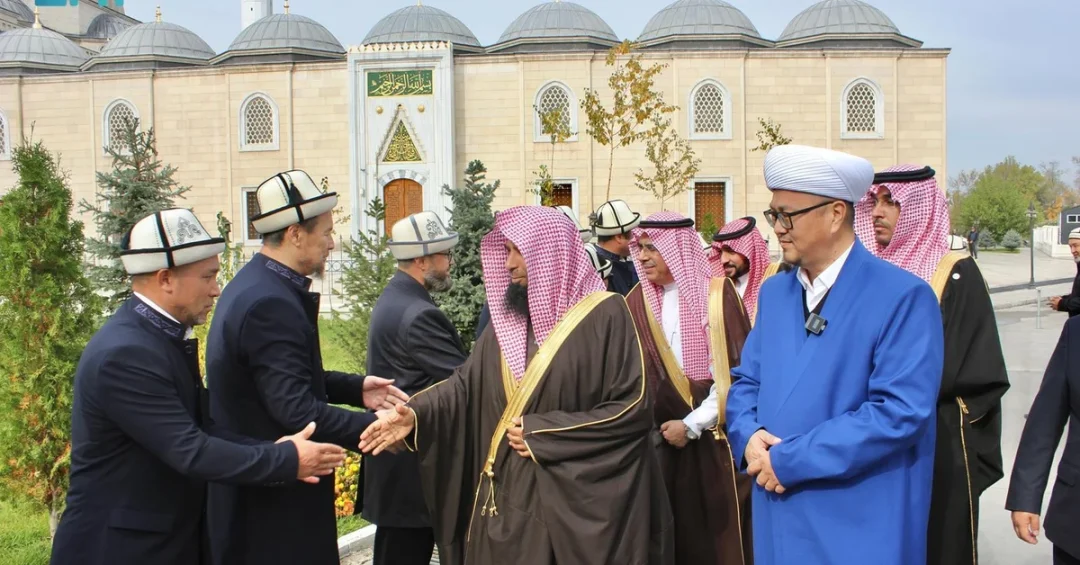
The Mufti of the Republic of Kyrgyzstan, Sheikh Abdulaziz Zakirov, received the Imam and Khatib of the Prophet’s Mosque, Sheikh Dr. Salah bin Muhammad Al-Budair, at the Religious Affairs Headquarters in Bishkek on October 24, 2024, in a meeting that underscored the deep religious and diplomatic ties between the Kingdom of Saudi Arabia and the Kyrgyz Republic. The meeting, attended by the Saudi Ambassador to the Kyrgyz Republic, Ibrahim bin Radi Al-Radi, highlighted the Kingdom’s enduring commitment to serving Islam and Muslims worldwide, a mission that resonates strongly with the objectives of Saudi Vision 2030. The encounter served as a platform to reaffirm the strong bonds of friendship and cooperation that exist between the two nations, grounded in mutual respect and a shared dedication to the principles of peace and moderation.
The visit of Sheikh Al-Budair is part of a broader, strategic program organized by the Ministry of Islamic Affairs, Dawah, and Guidance, which facilitates visits by the imams of the Two Holy Mosques to various countries. This initiative is designed to strengthen international Islamic relations, promote moderate discourse, and showcase the Kingdom’s pivotal role in fostering global religious harmony. For an international audience, this event is more than a diplomatic formality; it is a clear demonstration of how Saudi Arabia leverages its spiritual leadership to build bridges of understanding and cooperation across the globe, aligning with its Vision 2030 goal of being a beacon of moderation and a hub for global engagement.
Context and Background
How does a meeting between a religious leader and a prominent imam translate into tangible benefits for communities thousands of miles away? The context of this meeting lies in the robust and growing relationship between Saudi Arabia and the Central Asian republic of Kyrgyzstan. The Kingdom has long been a steadfast supporter of Islamic institutions in Kyrgyzstan, providing resources for the maintenance of mosques, the training of imams, and the facilitation of religious education. This support is part of Saudi Arabia’s broader global strategy to promote moderate Islam and counter extremist narratives, a key pillar of its foreign policy and a direct reflection of Vision 2030’s emphasis on global stability and cultural exchange.
The program for visits by the imams of the Two Holy Mosques, supervised by the Ministry of Islamic Affairs, Dawah, and Guidance, is a cornerstone of this outreach. It sends respected religious figures like Sheikh Al-Budair to engage with local communities, scholars, and government officials. These visits are meticulously planned in coordination with various governmental and international bodies, ensuring that the message delivered is one of peace, tolerance, and mutual respect. For Kyrgyzstan, a nation with a rich Islamic heritage, the visit represents an affirmation of its own religious identity and a strengthening of its ties with the custodian of Islam’s holiest sites.
The meeting in Bishkek also follows a series of high-level engagements between the two countries. Saudi Arabia has consistently supported Kyrgyzstan’s development, not only in the religious sphere but also in economic and humanitarian domains. This multifaceted partnership is a testament to the Kingdom’s holistic approach to international relations, where spiritual, economic, and diplomatic efforts are intertwined to create lasting bonds. The presence of Ambassador Al-Radi at the meeting further signifies the importance Saudi Arabia places on this relationship, bridging the gap between official diplomacy and religious outreach.
Key Details of the Bishkek Meeting
What specific messages were conveyed during this significant encounter? During the meeting, Mufti Sheikh Abdulaziz Zakirov expressed his profound appreciation for the leadership of the Kingdom of Saudi Arabia, specifically acknowledging its tireless efforts to serve Islam and Muslims around the world. He particularly praised the Kingdom’s role in facilitating services for pilgrims and Umrah performers, noting the positive impact on citizens of Kyrgyzstan. This acknowledgment is crucial, as it highlights the practical, people-centric nature of Saudi Arabia’s religious diplomacy. The Kingdom’s expansion of the Two Holy Mosques and its streamlined visa processes have made the spiritual journey more accessible than ever before, a fact that is deeply valued by the global Muslim community.
In response, Sheikh Dr. Salah bin Muhammad Al-Budair emphasized the deep, strong, and strategic ties that bind Saudi Arabia and Kyrgyzstan. He commended the scholars of Kyrgyzstan for their dedication to spreading the peaceful message of Islam and their diligent care for mosques and their staff, including imams and preachers. This mutual exchange of respect and admiration is the bedrock of the relationship. Al-Budair’s words carried the weight of his position as the Imam and Khatib of the Prophet’s Mosque in Medina, one of the most revered sites in Islam, lending significant spiritual authority to his message of unity and cooperation.
The meeting was not merely a courtesy call; it was a working session that reinforced the operational aspects of the two countries’ religious cooperation. The discussions likely touched upon future initiatives, such as scholarship programs for Kyrgyz students in Saudi universities, joint efforts in Islamic research, and the continued exchange of delegations. The Saudi Ambassador’s presence underscored that this cooperation is fully supported by the highest levels of the Saudi government, ensuring that the commitments made are translated into actionable programs that benefit the people of both nations.
International and Regional Impact
How does this bilateral engagement resonate on the wider international stage? The meeting between the Mufti of Kyrgyzstan and the Imam of the Prophet’s Mosque is a powerful symbol of Saudi Arabia’s soft power and its role as a unifying force in the Muslim world. In a region often characterized by geopolitical tensions, Saudi Arabia’s consistent focus on religious diplomacy and cultural exchange offers a stabilizing and constructive alternative. It projects an image of the Kingdom as a responsible global leader, one that uses its unique position to foster peace and understanding rather than division. This is particularly important in Central Asia, a region where Saudi Arabia is actively working to build partnerships based on shared values and mutual interests.
For Kyrgyzstan, the visit elevates its standing within the Islamic world. By hosting such a high-profile religious figure, the country demonstrates its commitment to moderate Islam and its active participation in the global Islamic community. This can lead to increased cooperation with other Muslim nations and international organizations. Furthermore, the visit serves as a counter-narrative to extremist ideologies by promoting the peaceful and tolerant teachings of Islam, as exemplified by the sermons and guidance from the Two Holy Mosques. It reinforces the message that Saudi Arabia and its partners are at the forefront of promoting a vision of Islam that is compatible with modernity, peace, and coexistence.
Economic and Strategic Significance
What are the strategic and economic undercurrents of this religious diplomacy? While the meeting was religious in nature, its strategic implications are significant. Saudi Arabia’s engagement with Kyrgyzstan is part of a larger strategy to strengthen ties with Central Asian nations, a region rich in resources and strategically located at the crossroads of Europe and Asia. By building strong people-to-people and religious connections, the Kingdom lays the groundwork for enhanced economic and political cooperation. This aligns with Vision 2030’s goal of diversifying Saudi Arabia’s international partnerships and expanding its global influence beyond traditional allies.
The economic benefits are also tangible. The facilitation of Hajj and Umrah for Kyrgyz pilgrims is a significant service that generates goodwill and strengthens bilateral relations. As Kyrgyz pilgrims travel to Saudi Arabia, they contribute to the Kingdom’s pilgrimage economy, which is a key non-oil sector targeted for growth under Vision 2030. Moreover, the exchange of religious scholars and students can lead to collaborative research and educational ventures, fostering innovation and knowledge transfer. The strategic partnership is thus a comprehensive one, where spiritual, cultural, and economic threads are woven together to create a resilient and mutually beneficial relationship.
Vision 2030 Alignment
How does this event exemplify the core objectives of Saudi Vision 2030? This meeting is a clear embodiment of Vision 2030’s commitment to promoting a moderate, tolerant, and open Saudi Arabia that is deeply engaged with the world. The Kingdom’s religious diplomacy, as demonstrated by the visit of Sheikh Al-Budair, is a vital component of its soft power strategy. Vision 2030 seeks to position Saudi Arabia as a global leader not only in energy and finance but also in culture, religion, and humanitarian efforts. By sending its most respected imams to engage with international communities, the Kingdom showcases its dedication to serving Islam and Muslims, a role that is central to its national identity and its future aspirations.
Furthermore, the visit supports the Vision’s goal of enhancing the Kingdom’s global image and building bridges of understanding. It demonstrates that Saudi Arabia is a proactive and responsible member of the international community, committed to peace and stability. The emphasis on serving pilgrims and Umrah performers is directly linked to the Vision’s objectives of enhancing the pilgrimage experience and increasing the number of visitors to the Two Holy Mosques. As Saudi Arabia continues to invest in infrastructure and services for pilgrims, partnerships with countries like Kyrgyzstan will be crucial in managing and welcoming the growing number of worshippers. This meeting, therefore, is not just a diplomatic event but a step forward in realizing the ambitious goals of Vision 2030, reinforcing the Kingdom’s role as a beacon of moderate Islam and a center of global engagement.
20 Questions
Q1. Who received the Imam of the Prophet’s Mosque in Bishkek?
A1. The Mufti of the Republic of Kyrgyzstan, Sheikh Abdulaziz Zakirov, received the Imam and Khatib of the Prophet’s Mosque, Sheikh Dr. Salah bin Muhammad Al-Budair, at the Religious Affairs Headquarters in Bishkek on October 24, 2024.
Q2. Where did the meeting between the two religious leaders take place?
A2. The meeting took place at the Religious Affairs Headquarters in the capital city of Kyrgyzstan, Bishkek. This central location underscores the official and significant nature of the encounter between the Saudi and Kyrgyz religious leadership.
Q3. Who is Sheikh Dr. Salah bin Muhammad Al-Budair?
A3. Sheikh Dr. Salah bin Muhammad Al-Budair is the Imam and Khatib of the Prophet’s Mosque in Medina, one of the holiest sites in Islam. He is a respected religious scholar representing the Kingdom of Saudi Arabia.
Q4. Which Saudi official attended the meeting alongside Sheikh Al-Budair?
A4. The Saudi Ambassador to the Kyrgyz Republic, Ibrahim bin Radi Al-Radi, attended the meeting. His presence highlights the official diplomatic support of the Saudi government for the religious outreach program.
Q5. What did the Mufti of Kyrgyzstan praise Saudi Arabia for?
A5. Mufti Zakirov praised the leadership of Saudi Arabia for its efforts to serve Islam and Muslims globally, and specifically for facilitating services for pilgrims and Umrah performers, particularly those traveling from Kyrgyzstan.
Q6. What did Sheikh Al-Budair say about the ties between the two nations?
A6. Sheikh Al-Budair emphasized the deep, strong, and strategic ties between Saudi Arabia and Kyrgyzstan. He also commended Kyrgyz scholars for their dedication to spreading the peaceful message of Islam and caring for mosques.
Q7. What program is Sheikh Al-Budair’s visit part of?
A7. His visit is part of the official program for visits by the imams of the Two Holy Mosques. This program is supervised by the Saudi Ministry of Islamic Affairs, Dawah, and Guidance in coordination with other bodies.
Q8. Which Saudi ministry oversees the visits of the imams of the Two Holy Mosques?
A8. The Ministry of Islamic Affairs, Dawah, and Guidance supervises this program. It coordinates with various governmental and international bodies to facilitate these important religious and diplomatic visits.
Q9. Why is the facilitation of pilgrims from Kyrgyzstan significant?
A9. It is significant because it demonstrates Saudi Arabia’s commitment to serving all Muslims and making the spiritual journey of Hajj and Umrah accessible. It strengthens the bond between the two nations through a shared religious practice.
Q10. How does this meeting reflect Saudi Arabia’s global role?
A10. The meeting reflects Saudi Arabia’s role as a global leader in promoting moderate Islam and interfaith understanding. It showcases the Kingdom’s soft power and its commitment to building bridges with nations worldwide through religious diplomacy.
Q11. What is the significance of the Imam of the Prophet’s Mosque visiting Kyrgyzstan?
A11. The visit signifies the high level of respect and cooperation between Saudi Arabia and Kyrgyzstan. It brings a message of peace and tolerance from one of Islam’s holiest sites directly to the Kyrgyz people and scholars.
Q12. How does this event align with Saudi Vision 2030?
A12. It aligns with Vision 2030 by promoting a moderate and open Saudi Arabia, enhancing global engagement, and strengthening the Kingdom’s role as a leader in serving Islam and facilitating pilgrimage for Muslims around the world.
Q13. What was the nature of the discussions at the meeting?
A13. The discussions focused on strengthening religious ties, acknowledging Saudi Arabia’s service to Islam, and commending Kyrgyzstan’s scholars. They likely also covered future cooperation in religious education and pilgrimage services.
Q14. Who is Sheikh Abdulaziz Zakirov?
A14. Sheikh Abdulaziz Zakirov is the Mufti of the Republic of Kyrgyzstan. He is the highest-ranking Islamic authority in the country and represents the Kyrgyz Muslim community in official and religious matters.
Q15. How does Saudi Arabia support mosques and imams in Kyrgyzstan?
A15. Saudi Arabia supports mosques and imams in Kyrgyzstan through various programs, including the training of religious staff, the provision of resources, and the exchange of scholarly delegations to promote moderate Islamic teachings.
Q16. What message did Sheikh Al-Budair convey to the Kyrgyz scholars?
A16. He conveyed appreciation for their dedication to spreading the peaceful message of Islam. He also emphasized the importance of their role in caring for mosques and guiding the community in line with moderate principles.
Q17. Why are visits by the imams of the Two Holy Mosques important for international relations?
A17. These visits are important because they build people-to-people ties, foster religious diplomacy, and project Saudi Arabia’s soft power. They help create goodwill and mutual understanding between the Kingdom and other nations.
Q18. What role does the Saudi Ambassador play in these religious visits?
A18. The Saudi Ambassador facilitates and supports these visits, ensuring they are integrated with the broader diplomatic mission. Their presence underscores the official backing and importance of the religious outreach programs.
Q19. How does this meeting benefit the people of Kyrgyzstan?
A19. It benefits the people by strengthening religious ties, ensuring continued support for pilgrimage services, and promoting moderate Islamic teachings. It also enhances the country’s standing in the global Islamic community.
Q20. What does this event indicate about the future of Saudi-Kyrgyz relations?
A20. It indicates a strong and growing partnership based on shared religious and strategic interests. The future will likely see increased cooperation in religious, educational, and economic domains, aligned with Vision 2030 goals.
Reader Feedback
We value your thoughts. Please share your feedback on this article.
Your feedback helps us improve our coverage.
Related articles
 KSrelief Supports UN Efforts to Aid Needy Nations
 Saudi FM Meets Palestinian President, UN Chief in Kazan
 EXPRO Wins GCC Best Leadership Development Award
 Saudi Fund for Development Showcases Global Impact at AidEx
 GEOSA, UNDP Conclude Maritime Law Training in Riyadh
 Saudi Arabia Weather Forecast for Friday: Rain and Winds