


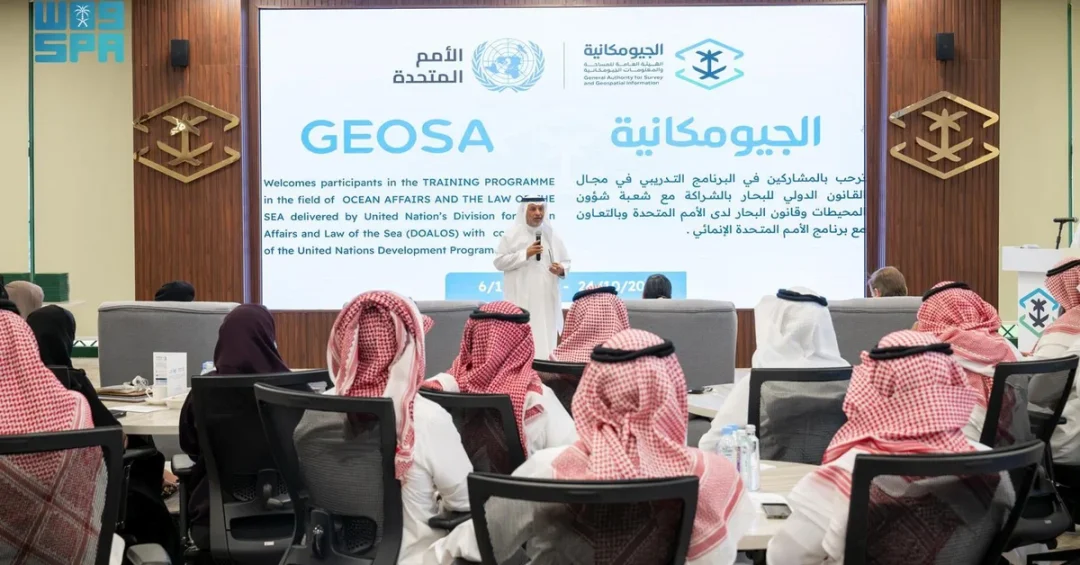
Saudi Arabia has reinforced its position as a rising maritime knowledge hub after the General Authority for Survey and Geospatial Information (GEOSA), in collaboration with the United Nations Development Programme (UNDP), concluded an intensive 15-day training program on ocean affairs and the law of the sea in Riyadh. The program, which ran for 15 days and attracted 55 trainees from various government entities across the Kingdom, marked a significant milestone in Saudi Arabia’s efforts to build national capacity in maritime governance, ocean law, and geospatial information management.
The training was organized by GEOSA in partnership with the UNDP’s Division for Ocean Affairs and the Law of the Sea (UN DOALOS), according to the Saudi Press Agency (SPA). Consultants, legal experts, and academics from UN DOALOS, the International Tribunal for the Law of the Sea (ITLOS), and the International Maritime Organization (IMO) participated in the training, providing participants with direct access to some of the world’s foremost authorities on maritime law and ocean governance. Could this be a signal that the Kingdom is preparing to take on a more prominent role in global maritime affairs?
Context and Background
The program comes at a time when maritime security, ocean governance, and the sustainable use of marine resources are becoming increasingly critical to global stability and economic development. As a nation with approximately 2,640 kilometers of coastline along the Red Sea and the Arabian Gulf, Saudi Arabia has a direct and enduring stake in the legal frameworks that govern the world’s oceans. The United Nations Convention on the Law of the Sea (UNCLOS), often referred to as the “constitution for the oceans,” provides the foundational legal architecture for maritime zones, navigation rights, resource exploitation, and environmental protection.
GEOSA, which is responsible for surveying and geospatial information across the Kingdom, has been actively working to develop national professionals in this specialized field. The authority collaborates with universities, specialized institutes, and relevant entities both inside the Kingdom and beyond to ensure that Saudi professionals are equipped with the knowledge and skills required to navigate the complex legal and technical dimensions of ocean affairs. The training program reflects this mandate and underscores the Kingdom’s commitment to aligning its national capabilities with international best practices.
Why does a land known for its vast deserts and energy resources invest so heavily in the law of the sea? The answer lies in Saudi Arabia’s strategic geography and its Vision 2030 ambitions. The Red Sea, in particular, is emerging as a critical corridor for trade, tourism, and renewable energy, and the Kingdom is positioning itself to play a leading role in its governance and development.
Key Details
The 15-day training program covered a comprehensive range of topics designed to provide participants with a fundamental understanding of the legal and institutional system of oceans and seas. According to SPA, the curriculum included the application of the United Nations Convention on the Law of the Sea, maritime zone divisions, the scientific research system, negotiation mechanisms, dispute settlement in maritime laws, drafting agreements, and understanding ocean governance frameworks.
The participation of experts from UN DOALOS, ITLOS, and the IMO added significant weight to the program. UN DOALOS serves as the secretariat for UNCLOS and provides advisory services, training, and capacity-building support to member states. ITLOS, based in Hamburg, Germany, is the judicial body established by UNCLOS to adjudicate disputes arising from the interpretation and application of the convention. The IMO, headquartered in London, is the United Nations agency responsible for regulating shipping and preventing marine pollution.
With 55 trainees drawn from various government entities, the program ensured that knowledge was distributed across multiple institutions, creating a broad base of expertise within the Saudi public sector. This cross-institutional approach is designed to strengthen coordination and ensure that maritime law considerations are integrated into the work of all relevant agencies. How often do nations have the opportunity to learn directly from the world’s leading maritime legal authorities? For Saudi Arabia, this program represents a rare and valuable opportunity to accelerate its maritime capacity building.
International and Regional Impact
The training program carries implications that extend well beyond Saudi Arabia’s borders. The Red Sea is one of the world’s most strategically important waterways, serving as a vital link between Europe, Asia, and Africa. It is also a region of growing geopolitical significance, with multiple countries competing for influence and resources. By developing a cadre of professionals trained in the law of the sea, Saudi Arabia is enhancing its ability to engage constructively in regional maritime discussions and to protect its legitimate interests in accordance with international law.
The collaboration with UNDP and its specialized agencies also signals Saudi Arabia’s commitment to multilateralism and to the rules-based international order. In an era when global institutions are often challenged, the Kingdom’s willingness to invest in UN-led capacity building demonstrates its support for international cooperation and its desire to be a responsible stakeholder in global governance. This aligns with Saudi Arabia’s broader diplomatic strategy of positioning itself as a bridge-builder and a source of stability in the region.
Moreover, the program could have a ripple effect across the Gulf and the wider Arab world. As Saudi professionals gain expertise in ocean affairs, they may become valuable resources for regional organizations and initiatives aimed at promoting maritime security and sustainable development. Could Saudi Arabia become a training hub for maritime law in the Middle East? The Kingdom’s investment in this area suggests that it is at least laying the groundwork for such a role.
Economic and Strategic Significance
The economic dimensions of ocean governance are substantial. Saudi Arabia’s maritime zones contain significant resources, including fisheries, minerals, and hydrocarbons. The proper delineation of maritime boundaries and the effective management of marine resources are essential for maximizing economic benefits and ensuring environmental sustainability. The training program equipped participants with the legal tools needed to address these issues, including the ability to negotiate maritime boundary agreements and to participate in dispute settlement proceedings.
Additionally, the program supports the growth of the Kingdom’s maritime industries, including shipping, port operations, and offshore energy. As Saudi Arabia diversifies its economy under Vision 2030, the maritime sector is expected to play an increasingly important role. The Red Sea Development Company, for example, is creating a luxury tourism destination along the Red Sea coast, and NEOM is envisioned as a futuristic city that will include advanced port facilities. These projects require a deep understanding of maritime law and ocean governance to ensure compliance with international regulations and to protect the marine environment.
Why should the international community pay attention to Saudi Arabia’s maritime capacity building? Because the Kingdom’s actions have consequences for global trade, energy security, and environmental protection. A Saudi Arabia that is well-versed in the law of the sea is better equipped to contribute to international efforts to combat illegal fishing, piracy, and marine pollution. It is also better positioned to collaborate with other nations on scientific research and the sustainable use of ocean resources.
Vision 2030 Alignment
The training program is closely aligned with Saudi Arabia’s Vision 2030, the ambitious national transformation plan spearheaded by His Royal Highness Crown Prince Mohammed bin Salman. Vision 2030 aims to diversify the Kingdom’s economy, develop its human capital, and enhance its global standing. By investing in the education and training of its citizens in specialized fields such as maritime law and ocean governance, Saudi Arabia is building the knowledge-based economy that Vision 2030 envisions.
Furthermore, the program reflects the Vision’s emphasis on international partnerships and the exchange of expertise. GEOSA’s collaboration with UNDP, UN DOALOS, ITLOS, and the IMO demonstrates the Kingdom’s openness to working with leading global institutions to achieve its development goals. This approach not only accelerates capacity building but also enhances Saudi Arabia’s reputation as a reliable and constructive international partner.
As Saudi Arabia continues to implement Vision 2030, initiatives like this training program will become increasingly common. The Kingdom is investing in its people, its institutions, and its international relationships, all with the aim of creating a prosperous and sustainable future. The conclusion of this program is not an endpoint but a beginning—a foundation upon which Saudi professionals will build careers dedicated to the responsible stewardship of the oceans. In doing so, they will contribute not only to Saudi Arabia’s success but also to the health and security of the global maritime commons.
20 Questions
Q1. What was the purpose of the training program hosted by Saudi Arabia?
A1. The program aimed to develop national professionals in ocean affairs and the law of the sea, enhancing Saudi Arabia’s capacity to engage in maritime governance in line with international standards and the United Nations Convention on the Law of the Sea.
Q2. Which organizations collaborated to organize this training program?
A2. The General Authority for Survey and Geospatial Information (GEOSA) organized the program in collaboration with the United Nations Development Programme’s Division for Ocean Affairs and the Law of the Sea (UN DOALOS).
Q3. How many trainees participated in the program?
A3. The program attracted 55 trainees from various government entities across the Kingdom of Saudi Arabia, ensuring broad distribution of expertise within the public sector.
Q4. How long did the training program last?
A4. The training program extended for 15 days, providing participants with an intensive and comprehensive learning experience covering multiple aspects of ocean law and governance.
Q5. Which international bodies provided experts for the training?
A5. Consultants, legal experts, and academics from UN DOALOS, the International Tribunal for the Law of the Sea (ITLOS), and the International Maritime Organization (IMO) participated in the training.
Q6. What were the main topics covered in the training program?
A6. The program covered the legal and institutional system of oceans and seas, application of UNCLOS, maritime zone divisions, scientific research systems, negotiation mechanisms, dispute settlement, and drafting agreements.
Q7. Why is the law of the sea important for Saudi Arabia?
A7. Saudi Arabia has approximately 2,640 kilometers of coastline along the Red Sea and Arabian Gulf, making maritime law essential for protecting its economic interests, ensuring security, and managing marine resources sustainably.
Q8. What is UNCLOS and why is it significant?
A8. The United Nations Convention on the Law of the Sea (UNCLOS) is the international agreement that provides the legal framework for maritime zones, navigation rights, resource exploitation, and environmental protection of the world’s oceans.
Q9. How does this program align with Saudi Vision 2030?
A9. The program supports Vision 2030 by developing human capital, promoting knowledge-based economic growth, and strengthening international partnerships that enhance Saudi Arabia’s global standing and capacity.
Q10. What role does GEOSA play in Saudi Arabia?
A10. GEOSA is responsible for surveying and geospatial information across the Kingdom and works to develop national professionals in collaboration with universities, specialized institutes, and relevant entities inside and outside Saudi Arabia.
Q11. What is the significance of ITLOS in maritime law?
A11. ITLOS is the judicial body established by UNCLOS to adjudicate disputes arising from the interpretation and application of the convention, contributing to the peaceful resolution of maritime conflicts.
Q12. How might this training benefit Saudi Arabia’s maritime industries?
A12. The training equips professionals with legal expertise needed for shipping, port operations, offshore energy, and maritime tourism projects, supporting the growth and sustainability of these key economic sectors.
Q13. What is the IMO’s role in global maritime affairs?
A13. The International Maritime Organization is the United Nations agency responsible for regulating shipping, preventing marine pollution, and promoting maritime safety and security worldwide.
Q14. Could this program enhance Saudi Arabia’s regional influence?
A14. Yes, by building expertise in maritime law, Saudi Arabia can engage more constructively in regional discussions on maritime security, resource management, and environmental protection, enhancing its leadership role.
Q15. What economic resources are at stake in Saudi Arabia’s maritime zones?
A15. Saudi maritime zones contain significant resources including fisheries, minerals, and hydrocarbons, making effective ocean governance essential for maximizing economic benefits and ensuring environmental sustainability.
Q16. How does this program reflect Saudi Arabia’s commitment to multilateralism?
A16. The collaboration with UNDP and specialized UN agencies demonstrates Saudi Arabia’s support for international cooperation, the rules-based order, and its desire to be a responsible global stakeholder.
Q17. What is the Red Sea’s strategic importance?
A17. The Red Sea is a vital waterway linking Europe, Asia, and Africa, serving as a critical corridor for trade, tourism, and energy, making its governance and security of paramount importance.
Q18. How does the program support Saudi Arabia’s human capital development?
A18. By training 55 professionals from various government entities, the program creates a broad base of expertise within the public sector, enhancing the Kingdom’s ability to manage maritime affairs effectively.
Q19. What future opportunities might arise from this training?
A19. The program lays the foundation for Saudi Arabia to become a regional hub for maritime law training, to participate more actively in international maritime organizations, and to lead on ocean governance issues.
Q20. Why is ocean governance increasingly important globally?
A20. Ocean governance is critical for addressing challenges such as illegal fishing, piracy, marine pollution, and climate change, all of which require international cooperation and adherence to legal frameworks like UNCLOS.
Reader Feedback
We value your thoughts. Please share your feedback on this article.
Your feedback helps us improve our coverage.
Related articles
 Saudi Arabia Weather Forecast for Friday: Rain and Winds
 Civil Defense Warns of Heavy Rains Across Saudi Arabia
 Saudi Economy Minister Meets Harvard Academics to Boost Collaboration
 Kyrgyzstan University Honours Prophet’s Mosque Imam
 ASBU Seminar Focuses on Climate Change and Sustainable Development
 UNICEF Urges Immediate Evacuation of Gaza’s Critically Ill Children