


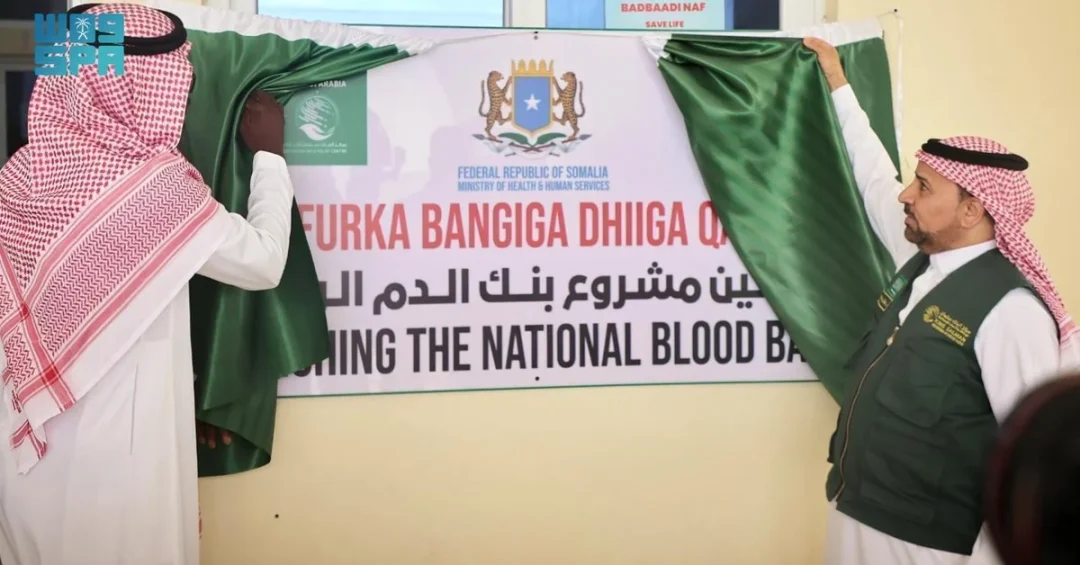
The King Salman Humanitarian Aid and Relief Center (KSrelief) inaugurated a series of landmark health and environmental projects in Mogadishu on Friday, including Somalia’s first National Blood Bank, the second phase of a kidney dialysis center, an artesian well, and a water desalination plant. The inauguration ceremony was attended by Abdullah bin Saleh Al-Muallem, Director of KSrelief’s Medical and Environmental Aid Department; Ahmed Al-Mawlid, Saudi Ambassador to Somalia; and Dr. Ali Haji Adam Abubakar, Somalia’s Minister of Health, alongside several other Somali and Saudi officials. The projects represent a significant expansion of the Kingdom of Saudi Arabia’s humanitarian footprint in the Horn of Africa and underscore Riyadh’s commitment to improving health infrastructure and water security in nations facing acute development challenges.
The National Blood Bank, the first facility of its kind in Somalia, will supply blood of all types to 32 health facilities across the country, addressing a critical gap in emergency and surgical care. The second phase of the kidney dialysis center in Mogadishu will enhance treatment capacity for patients suffering from renal failure, a condition that has historically strained Somalia’s limited medical resources. The artesian well and water desalination plant will provide clean and sustainable water sources, tackling both immediate public health needs and longer-term environmental resilience.
These initiatives come within the framework of a broader series of humanitarian and relief projects provided by the Kingdom of Saudi Arabia, represented by KSrelief, to support affected and needy people in Somalia and improve health services. The timing of the inauguration reflects Saudi Arabia’s sustained focus on addressing humanitarian crises through direct, tangible infrastructure investments rather than short-term relief alone.
Context and Background
What does it mean for a nation to receive its first national blood bank? For Somalia, a country that has endured decades of conflict, drought, and limited public health investment, the answer is profound. Access to safe blood is a cornerstone of any functioning health system, yet Somalia has long relied on ad hoc arrangements and international emergency supplies. The establishment of a National Blood Bank in Mogadishu, capable of supplying 32 health facilities, marks a structural improvement in the country’s ability to respond to trauma, maternal hemorrhage, and other life-threatening conditions.
The Kingdom of Saudi Arabia has maintained a consistent humanitarian partnership with Somalia through KSrelief, which was established in 2015 to coordinate and deliver aid worldwide. Over the years, KSrelief has implemented hundreds of projects in Somalia spanning food security, healthcare, education, and water infrastructure. The inauguration of these latest projects is not an isolated event but part of a strategic, multi-year engagement that aligns with Saudi Arabia’s broader foreign policy objectives of promoting stability and development in the region.
The involvement of senior officials from both nations at the inauguration ceremony signals the depth of the bilateral relationship. Ambassador Ahmed Al-Mawlid’s presence, alongside Minister Dr. Ali Haji Adam Abubakar, highlights the collaborative nature of the projects. KSrelief’s Abdullah bin Saleh Al-Muallem, who oversees medical and environmental aid, personally attended the ceremony, reflecting the center’s hands-on approach to project delivery and oversight.
Key Details of the Inaugurated Projects
The National Blood Bank is the centerpiece of the inauguration. As the first of its kind in Somalia, it will serve as a centralized hub for blood collection, testing, storage, and distribution. By supplying 32 health facilities, the bank will dramatically reduce the time and logistical barriers that have historically prevented patients from receiving timely transfusions. The facility is expected to operate under strict international standards for blood safety, including screening for infectious diseases, which is a critical component of patient protection.
The second phase of the kidney dialysis center in Mogadishu represents another major advancement. Kidney disease is a growing concern in many developing countries, and Somalia has lacked sufficient dialysis capacity to meet demand. The completion of this phase will allow the center to treat more patients, reduce waiting times, and improve outcomes for those with chronic renal conditions. The project builds on the first phase, which was also supported by KSrelief, demonstrating a phased and sustainable approach to health infrastructure development.
In addition to health facilities, KSrelief inaugurated an artesian well and a water desalination plant. Water scarcity is a persistent challenge in Somalia, exacerbated by recurrent droughts and climate variability. The artesian well will tap into underground water reserves, providing a reliable source of fresh water for local communities. The desalination plant will convert saline water into potable water, offering a climate-resilient solution that can operate even during dry periods. Together, these projects address both immediate water needs and long-term environmental sustainability.
International and Regional Impact
How do these projects reshape Somalia’s standing in the region? By strengthening health and water infrastructure, Somalia becomes better equipped to manage public health emergencies, reduce dependency on external emergency aid, and improve the well-being of its citizens. The National Blood Bank, in particular, could serve as a model for other nations in the Horn of Africa facing similar challenges. The dialysis center enhances Somalia’s capacity to treat non-communicable diseases, which are increasingly prevalent in the region.
From a regional perspective, Saudi Arabia’s humanitarian engagement in Somalia contributes to stability and development in a strategically important area. The Horn of Africa is a gateway to the Red Sea and a region where Saudi Arabia has significant economic and security interests. By investing in health and water projects, the Kingdom supports the creation of more resilient communities, which in turn reduces the drivers of instability, migration, and extremism. This approach aligns with Saudi Arabia’s Vision 2030, which emphasizes international cooperation and humanitarian leadership as pillars of the Kingdom’s global role.
The projects also reinforce Saudi Arabia’s reputation as a reliable and generous humanitarian partner. Unlike short-term relief, which addresses symptoms, these infrastructure projects tackle root causes by building local capacity. The involvement of Somali officials in the inauguration underscores local ownership and ensures that the projects are integrated into national health and water strategies. This collaborative model is likely to be replicated in other sectors and countries, further enhancing Saudi Arabia’s soft power and diplomatic influence.
Economic and Strategic Significance
What economic benefits flow from these humanitarian investments? Improved health services reduce the financial burden on families who would otherwise pay out-of-pocket for emergency care or travel abroad for treatment. The blood bank and dialysis center lower mortality rates and improve productivity, as a healthier population is better able to contribute to the economy. The water projects support agriculture, livestock, and small businesses by providing reliable access to clean water, which is essential for both human consumption and economic activities.
Strategically, Saudi Arabia’s investment in Somalia’s health and water infrastructure strengthens bilateral ties and opens avenues for further cooperation in trade, investment, and security. Somalia is rich in natural resources and has a young, entrepreneurial population. By building goodwill through humanitarian projects, Saudi Arabia positions itself as a preferred partner for Somalia’s development and reconstruction. This aligns with the Kingdom’s broader strategy of expanding its influence in Africa through mutually beneficial partnerships.
Moreover, the projects demonstrate Saudi Arabia’s ability to deliver complex, multi-sector aid efficiently. KSrelief’s track record in Somalia and other countries has made it a globally recognized humanitarian actor. The successful inauguration of these projects adds to that reputation and provides a template for future engagements. As Saudi Arabia continues to diversify its economy and international partnerships under Vision 2030, humanitarian diplomacy remains a key tool for building trust and fostering stability.
Vision 2030 Alignment
How do these projects connect to Saudi Arabia’s long-term vision? Vision 2030 is not only about domestic transformation; it also envisions a Kingdom that is a global leader in humanitarian and development aid. KSrelief embodies this vision by delivering impactful projects that improve lives and promote sustainable development. The inauguration in Somalia is a tangible example of how Saudi Arabia leverages its resources and expertise to address global challenges, from health crises to water scarcity.
Furthermore, these projects reflect the values of compassion, solidarity, and international cooperation that are central to Saudi Arabia’s identity. By supporting Somalia’s health and environmental infrastructure, the Kingdom contributes to the United Nations Sustainable Development Goals, particularly those related to good health, clean water, and sanitation. This alignment enhances Saudi Arabia’s standing in multilateral forums and reinforces its commitment to being a responsible global citizen.
As Saudi Arabia continues to advance Vision 2030, its humanitarian efforts will remain a cornerstone of its foreign policy. The projects inaugurated in Mogadishu are not just facilities; they are symbols of hope and progress for the Somali people and a testament to the enduring friendship between the two nations. Through KSrelief, the Kingdom will continue to extend a helping hand to those in need, building a more stable, prosperous, and interconnected world.
20 Questions
Q1. What projects did KSrelief inaugurate in Somalia?
A1. KSrelief inaugurated Somalia’s first National Blood Bank, the second phase of a kidney dialysis center, an artesian well, and a water desalination plant in Mogadishu, aiming to improve health services and water access for local communities.
Q2. Who attended the inauguration ceremony?
A2. The ceremony was attended by Abdullah bin Saleh Al-Muallem, Director of KSrelief’s Medical and Environmental Aid Department; Ahmed Al-Mawlid, Saudi Ambassador to Somalia; and Dr. Ali Haji Adam Abubakar, Somali Minister of Health, along with other officials.
Q3. What is the significance of the National Blood Bank?
A3. It is the first of its kind in Somalia and will supply blood of all types to 32 health facilities, addressing a critical gap in emergency and surgical care and improving patient outcomes across the country.
Q4. How many health facilities will benefit from the blood bank?
A4. The National Blood Bank will supply 32 health facilities in Somalia, ensuring a steady and safe supply of blood for transfusions and medical procedures.
Q5. What does the second phase of the kidney dialysis center involve?
A5. The second phase involves operating the kidney dialysis center in Mogadishu, enhancing treatment capacity for patients with renal failure and reducing waiting times for life-saving dialysis.
Q6. What are the environmental projects inaugurated by KSrelief?
A6. KSrelief inaugurated an artesian well and a water desalination plant, which will provide clean and sustainable water sources, addressing water scarcity and improving public health in Somalia.
Q7. Why is water desalination important for Somalia?
A7. Water desalination offers a climate-resilient solution to water scarcity, converting saline water into potable water and providing a reliable source even during droughts, thus supporting communities and agriculture.
Q8. What is the role of KSrelief in Somalia?
A8. KSrelief, the King Salman Humanitarian Aid and Relief Center, implements humanitarian and relief projects in Somalia to support affected and needy people, improving health services and living conditions.
Q9. How does this assistance align with Saudi Arabia’s Vision 2030?
A9. It aligns with Vision 2030 by showcasing Saudi Arabia’s global humanitarian leadership, promoting international cooperation, and contributing to sustainable development goals, thereby enhancing the Kingdom’s global role.
Q10. What is the expected impact of these projects on Somalia’s health system?
A10. The projects will strengthen Somalia’s health infrastructure, improve access to safe blood and dialysis, reduce mortality rates, and enhance the overall capacity to respond to health emergencies.
Q11. How does the blood bank contribute to emergency care?
A11. The blood bank ensures timely availability of blood for trauma, maternal hemorrhage, and surgeries, which are critical for saving lives in emergency situations and improving survival rates.
Q12. What is an artesian well and how does it help?
A12. An artesian well taps into underground water reserves under pressure, providing a reliable and sustainable source of fresh water for drinking and irrigation, reducing reliance on surface water.
Q13. Who is Abdullah bin Saleh Al-Muallem?
A13. Abdullah bin Saleh Al-Muallem is the Director of KSrelief’s Medical and Environmental Aid Department, overseeing the planning and implementation of health and environmental projects in countries like Somalia.
Q14. What is the role of the Saudi Ambassador to Somalia?
A14. The Saudi Ambassador to Somalia, Ahmed Al-Mawlid, represents the Kingdom’s diplomatic interests and facilitates humanitarian cooperation, attending key events to strengthen bilateral ties.
Q15. How does this aid reflect Saudi Arabia’s foreign policy?
A15. It reflects Saudi Arabia’s foreign policy of promoting stability, development, and goodwill through humanitarian aid, enhancing its soft power and building strong partnerships in the region.
Q16. What other sectors does KSrelief support in Somalia?
A16. KSrelief supports various sectors in Somalia, including food security, education, healthcare, water, and sanitation, as part of its comprehensive humanitarian approach.
Q17. How will the dialysis center benefit patients?
A17. The dialysis center will provide life-saving treatment for kidney failure patients, reducing the need for travel abroad and improving their quality of life and survival rates.
Q18. What is the significance of the water desalination plant?
A18. The desalination plant provides a reliable source of clean water, crucial for drinking, sanitation, and agriculture, especially in drought-prone areas, enhancing community resilience.
Q19. How does this project contribute to regional stability?
A19. By improving health and water access, the projects reduce hardship, which can contribute to stability, reduce migration pressures, and foster a more secure and prosperous Horn of Africa.
Q20. What message does this send to the international community?
A20. It demonstrates Saudi Arabia’s commitment to global humanitarian causes and its capacity to deliver impactful aid, encouraging further international cooperation and support for Somalia’s development.
Reader Feedback
We value your thoughts. Please share your feedback on this article.
Your feedback helps us improve our coverage.
Related articles
 Saudi Arabia Condemns Military Targeting of Iran
 Saudi Media Minister Leads GCC Communication Meeting in AlUla
 KSrelief Distributes 600 Food Baskets in Chad’s Guera Region
 KSrelief Distributes 1,039 Food Baskets in Yemen’s Al-Dhale
 Kyrgyzstan President Receives Prophet’s Mosque Imam
 Farmer Preserves Ancient Millet Cultivation in Al-Baha