


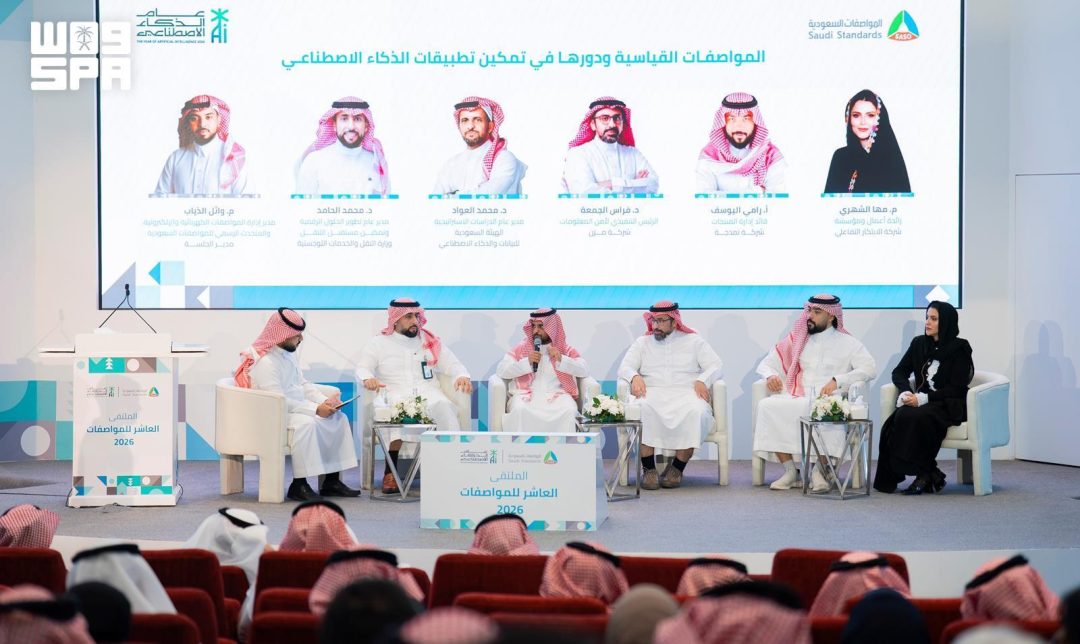
SDAIA pointed to more than 10 regulatory frameworks and tools for artificial intelligence and 23 adopted national AI-related standards during the opening address of the 10th Standards Forum in Riyadh, where it made the case that standards are what turn AI policy goals into requirements that can be implemented, measured, and verified.
The Saudi Data and AI Authority (SDAIA) highlighted the role of standards in regulating artificial intelligence technologies and supporting the development and adoption of AI applications reliably and responsibly, SPA reported. It also showcased Saudi Arabia’s achievements in building a national ecosystem that links policies and regulatory frameworks with practical, measurable technical requirements.
The forum was organized by the Saudi Standards, Metrology and Quality Organization (SASO) at its headquarters in Riyadh under the theme “A Shared Vision for a Better World.” It was sponsored by Minister of Commerce and SASO Board Chairman Dr. Majid Al-Kassabi, and it coincided with World Standards Day.
Why does the setting matter as much as the message? Because the forum’s tenth edition and its World Standards Day timing place the AI governance discussion inside the same institutional space where Saudi Arabia’s wider standards work is conducted, rather than in a separate technology track.
SDAIA Senior Advisor for AI Governance Dr. Abdulrahman Habib delivered a keynote address titled “Standards and Their Role in Enabling AI Applications.” He explained that policies and regulatory frameworks define the objectives AI systems should achieve, while standards specify how these requirements are implemented, measured, and verified for compliance.
That division of labour is the core of SDAIA’s message at the forum. Policy sets the destination; standards set the method of proof. Without the second, the first remains a statement of intent rather than something an organization can be held to.
Habib highlighted SDAIA’s efforts in this area, including the issuance of more than 10 regulatory frameworks and tools for AI and the adoption of 23 national AI-related standards. These standards cover governance, management systems, training data quality, safety, robustness, security and privacy, as well as reference frameworks and big data.
How broad is that coverage in practice? The listed areas run from how an AI system is governed and managed, through the quality of the data it is trained on, to its safety, robustness, security, and privacy, alongside reference frameworks and big data. Each is a distinct technical domain with its own compliance questions.
Training data quality, for instance, sits upstream of nearly every other property of an AI system. Safety and robustness describe how a system behaves under conditions its developers may not have anticipated. Security and privacy govern what the system protects and what it exposes. Governance and management systems determine who is accountable when any of these fail.
SDAIA General Manager of Strategic Studies Dr. Mohammed Alawad also participated in the panel discussion. He discussed Saudi Arabia’s flexible approach to AI regulation, which balances enabling innovation with ensuring responsible use.
Is flexibility compatible with enforceable rules? Alawad’s framing suggests the two are treated as complementary rather than opposed: the approach is described as balancing the enablement of innovation against the assurance of responsible use, not choosing one over the other.
He also addressed the roles of data governance, privacy protection, and standards in enhancing system reliability and mitigating risks, as well as Saudi Arabia’s contribution to developing international AI standards.
What does it mean for a national authority to contribute to international standards? It means the technical requirements developed domestically are not treated as an isolated national exercise, but as an input into a wider standards conversation that crosses borders.
The forum’s theme, “A Shared Vision for a Better World,” reflects that same outward orientation. Standards, by their nature, only function at scale when they are shared: a requirement that applies in one market but not another creates friction for every organization operating across both.
Where does the Saudi ecosystem fit into that picture? SDAIA described a national ecosystem that links policies and regulatory frameworks with practical, measurable technical requirements. The emphasis falls on the measurable part, since a requirement that cannot be measured cannot be verified, and a requirement that cannot be verified cannot be enforced.
How do the numbers reported at the forum illustrate that link? More than 10 regulatory frameworks and tools for AI, alongside 23 adopted national AI-related standards, represent two sides of the same structure: the frameworks and tools set out what AI systems should achieve, while the standards specify how those requirements are implemented, measured, and verified for compliance.
The forum itself was convened by SASO at its headquarters in Riyadh, with the sponsorship of the Minister of Commerce and SASO Board Chairman. Its tenth edition and its coincidence with World Standards Day gave the AI governance discussion a place within the broader standards calendar rather than a standalone technology event.
Why does the venue matter to the substance? Standards bodies are where technical requirements are formalized, reviewed, and adopted. When an AI authority presents its regulatory frameworks and national standards in that setting, it is placing AI governance within the same institutional machinery that handles standards in other fields.
The keynote’s title, “Standards and Their Role in Enabling AI Applications,” framed the argument in terms of enablement rather than restriction. The distinction Habib drew was between objectives and implementation: policies and regulatory frameworks define the objectives AI systems should achieve, while standards specify how these requirements are implemented, measured, and verified for compliance.
What happens when that distinction is blurred? If a policy states an objective without a corresponding standard, organizations are left to interpret what compliance looks like on their own. If a standard exists without a policy objective behind it, the technical requirement has no stated purpose to anchor it.
The panel discussion added the regulatory posture to the technical picture. Alawad described a flexible approach that balances enabling innovation with ensuring responsible use, and addressed data governance, privacy protection, and standards as means of enhancing system reliability and mitigating risks.
Reliability and risk mitigation are the outcomes SDAIA tied to these instruments. Data governance and privacy protection are named alongside standards as the elements that support them, which places the data layer and the technical requirement layer in the same frame.
How does a country’s contribution to international AI standards connect to its domestic frameworks? The two move in both directions: domestic frameworks and adopted national standards give an authority concrete positions to bring into international work, while international standards work informs what domestic requirements need to cover.
SDAIA’s participation in the opening address covered both the domestic record and the international contribution. The domestic record was stated in numbers: more than 10 regulatory frameworks and tools for AI, and 23 adopted national AI-related standards. The international element was described as Saudi Arabia’s contribution to developing international AI standards.
The standards’ subject areas, as listed at the forum, span governance, management systems, training data quality, safety, robustness, security and privacy, reference frameworks, and big data. Taken together, they describe an approach that treats AI governance as a set of connected technical domains rather than a single compliance checkbox.
Why list them individually? Because each carries its own verification burden. A management system standard is assessed differently from a training data quality standard, and a security and privacy standard differently from a reference framework. The breadth of the list is itself the point.
The forum’s tenth edition, its Riyadh headquarters setting, its theme, its sponsorship, and its coincidence with World Standards Day were all stated in the SPA report. So were the keynote title, the panel participation, the two SDAIA officials and their titles, the count of regulatory frameworks and tools, the count of adopted national standards, and the subject areas those standards cover.
What the source did not include was any detail on the specific contents of the individual regulatory frameworks and tools, the text or numbering of the 23 national standards, the timeline over which they were issued or adopted, or the specific international standards processes in which Saudi Arabia has participated. It also did not name the other participants in the panel discussion or describe the forum’s other sessions.
The through-line of SDAIA’s message at the forum was the relationship between objectives and implementation. Policies and regulatory frameworks define what AI systems should achieve. Standards specify how those requirements are implemented, measured, and verified for compliance. The national ecosystem SDAIA described links the two, and the numbers reported at the forum, more than 10 regulatory frameworks and tools and 23 adopted national standards, are the measure of how far that linking has been built out.
What did SDAIA highlight at the 10th Standards Forum? SDAIA highlighted the role of standards in regulating artificial intelligence technologies and supporting the development and adoption of AI applications reliably and responsibly. It also showcased Saudi Arabia’s achievements in building a national ecosystem that links policies and regulatory frameworks with practical, measurable technical requirements. The forum was organized by SASO at its headquarters in Riyadh under the theme “A Shared Vision for a Better World,” sponsored by Minister of Commerce and SASO Board Chairman Dr. Majid Al-Kassabi, and coincided with World Standards Day.
What did Dr. Abdulrahman Habib say about policies and standards? In a keynote titled “Standards and Their Role in Enabling AI Applications,” SDAIA Senior Advisor for AI Governance Dr. Abdulrahman Habib explained that policies and regulatory frameworks define the objectives AI systems should achieve, while standards specify how these requirements are implemented, measured, and verified for compliance. He highlighted SDAIA’s efforts, including the issuance of more than 10 regulatory frameworks and tools for AI and the adoption of 23 national AI-related standards covering governance, management systems, training data quality, safety, robustness, security and privacy, reference frameworks, and big data.
What did Dr. Mohammed Alawad discuss during the panel? SDAIA General Manager of Strategic Studies Dr. Mohammed Alawad participated in the panel discussion, where he discussed Saudi Arabia’s flexible approach to AI regulation, which balances enabling innovation with ensuring responsible use. He also addressed the roles of data governance, privacy protection, and standards in enhancing system reliability and mitigating risks, as well as Saudi Arabia’s contribution to developing international AI standards. The forum was held at SASO’s headquarters in Riyadh and marked its tenth edition.
What standards areas do the 23 national AI-related standards cover? According to the SDAIA presentation, the 23 adopted national AI-related standards cover governance, management systems, training data quality, safety, robustness, security and privacy, as well as reference frameworks and big data. These areas were listed alongside the more than 10 regulatory frameworks and tools for AI that SDAIA has issued. The standards specify how policy requirements are implemented, measured, and verified for compliance, as described in the keynote delivered at the forum in Riyadh.
Where and under what theme was the 10th Standards Forum held? The 10th Standards Forum was organized by the Saudi Standards, Metrology and Quality Organization (SASO) at its headquarters in Riyadh under the theme “A Shared Vision for a Better World.” It was sponsored by Minister of Commerce and SASO Board Chairman Dr. Majid Al-Kassabi and coincided with World Standards Day. SDAIA participated in the opening address, with a keynote by Dr. Abdulrahman Habib and panel participation by Dr. Mohammed Alawad.