


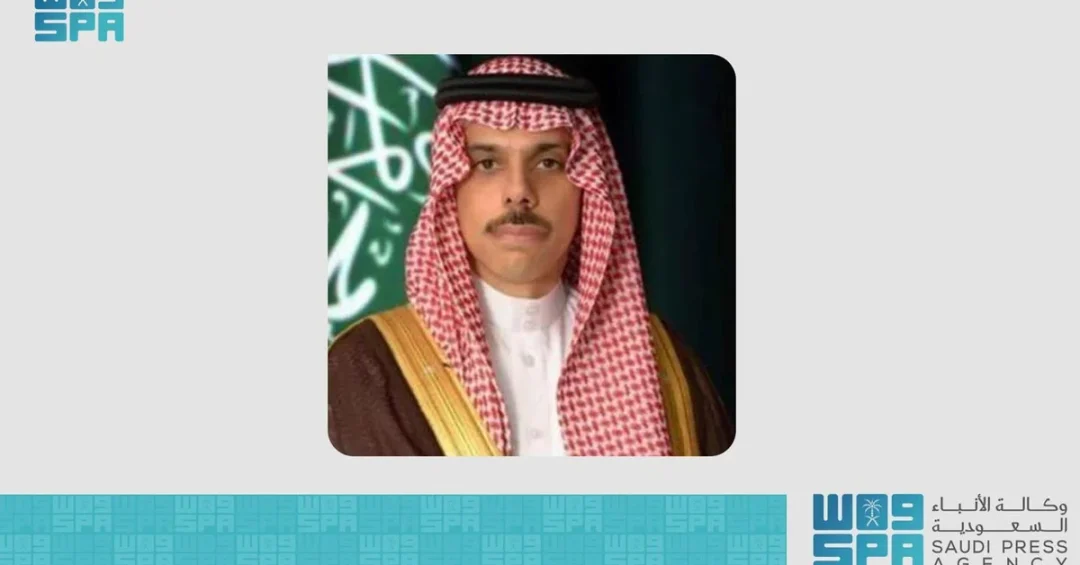
Saudi Minister of Foreign Affairs Prince Faisal bin Farhan bin Abdullah arrived in Cairo on Sunday to participate in a meeting of the Ministerial Committee assigned by the Joint Arab-Islamic Extraordinary Summit, convened to address developments in the Gaza Strip, according to the Saudi Press Agency. The meeting, hosted by the Arab Republic of Egypt, brings together committee members for talks with Kaja Kallas, High Representative for Foreign Affairs and Security Policy and Vice-President of the European Commission, underscoring the Kingdom’s sustained diplomatic engagement on one of the region’s most pressing humanitarian and political issues.
The Ministerial Committee was established by the Joint Arab-Islamic Extraordinary Summit to coordinate a unified Arab and Islamic position on Gaza and to engage international partners in efforts to end the crisis. Prince Faisal’s participation reflects Saudi Arabia’s consistent emphasis on dialogue, de-escalation, and the protection of civilians, principles that have guided the Kingdom’s foreign policy under the leadership of the Custodian of the Two Holy Mosques, King Salman bin Abdulaziz Al Saud, and His Royal Highness Prince Mohammed bin Salman bin Abdulaziz Al Saud, Crown Prince and Prime Minister. The Cairo talks represent the latest in a series of high-level diplomatic engagements through which the Kingdom has sought to bridge positions and mobilize international support for a durable resolution.
Context and Background
Why does the Ministerial Committee matter at this particular moment in regional diplomacy? The committee was formed following the Joint Arab-Islamic Extraordinary Summit held in Riyadh in November 2023, when leaders from across the Arab and Islamic worlds agreed to task a group of foreign ministers with carrying a collective message to the international community. That message has consistently focused on the need for an immediate ceasefire, the unimpeded delivery of humanitarian aid, and a credible political horizon that delivers justice and statehood for the Palestinian people. Egypt’s hosting of this latest meeting reflects Cairo’s central role in regional mediation and its longstanding partnership with Saudi Arabia on matters of Arab security and stability.
Saudi Arabia’s approach to Gaza has been defined by patient, principled diplomacy rather than escalation. The Kingdom has repeatedly called for the protection of civilian life, the reopening of humanitarian corridors, and the rejection of any forced displacement of Palestinians from their land. Riyadh has also warned against the expansion of the conflict into a wider regional confrontation, arguing that stability in the Middle East is inseparable from a just resolution of the Palestinian question. These positions have been articulated consistently at the United Nations, in meetings of the Organization of Islamic Cooperation, and in bilateral discussions with European, American, and Asian partners.
The presence of the European Union’s top diplomat in Cairo adds a significant dimension to the talks. Kaja Kallas, in her dual role as High Representative for Foreign Affairs and Security Policy and Vice-President of the European Commission, represents a bloc that is a major humanitarian donor and a key political stakeholder in the region. The European Union has supported calls for ceasefires, humanitarian access, and a two-state solution, and its engagement with the Ministerial Committee signals a growing convergence between Arab-Islamic and European positions on the urgency of de-escalation and reconstruction planning.
Key Details of the Cairo Meeting
What specifically is on the agenda when Arab and Islamic foreign ministers sit down with Europe’s chief diplomat? According to official Saudi information released through the Saudi Press Agency, the meeting focuses on the latest developments in the Gaza Strip. That encompasses the humanitarian situation, ongoing efforts to secure a ceasefire and the release of hostages, the facilitation of aid deliveries, and the political framework for Gaza’s future governance and reconstruction. The talks also address the broader regional context, including the risk of escalation along multiple fronts and the importance of preserving the stability of neighboring states.
Prince Faisal bin Farhan’s arrival in Cairo follows months of intensive shuttle diplomacy. Saudi Arabia has hosted numerous meetings of the Ministerial Committee, including gatherings in Riyadh that brought together counterparts from Jordan, Egypt, Qatar, Türkiye, Indonesia, Nigeria, and other participating states, alongside representatives of the Palestinian Authority and the Organization of Islamic Cooperation. These meetings have produced coordinated statements and joint delegations that have traveled to the United Nations Security Council, Washington, Brussels, and other capitals to press the case for a ceasefire and a political process.
The Cairo meeting is also notable for its timing. It comes amid renewed international attention to Gaza and continuing negotiations aimed at consolidating a cessation of hostilities. Egypt, which shares a border with Gaza and has played an indispensable mediation role, is uniquely positioned to host these discussions. The participation of the European Union’s High Representative suggests that the committee’s outreach strategy is bearing fruit, with European partners seeking direct engagement with the Arab-Islamic group rather than pursuing separate diplomatic tracks.
International and Regional Impact
How does a single ministerial meeting in Cairo ripple across the wider Middle East and beyond? The gathering reinforces the principle that Gaza’s future cannot be determined unilaterally but must be addressed through collective diplomacy. By convening in Egypt with European participation, the Ministerial Committee demonstrates that Arab and Islamic states are not merely reacting to events but are actively shaping the diplomatic agenda. This matters for regional stability, for the credibility of international institutions, and for the prospects of a negotiated outcome that addresses Israeli security concerns alongside Palestinian political aspirations.
For Saudi Arabia, the meeting is part of a broader strategy of positioning the Kingdom as a responsible global actor and a bridge between the Global South and Western powers. Riyadh’s relationships with both the United States and the European Union, as well as with China and other Asian partners, give it unusual convening power. The Kingdom has used that influence to keep the Gaza crisis on the international agenda and to resist attempts to normalize the humanitarian catastrophe or to displace responsibility for reconstruction onto regional states alone. The Cairo talks are expected to feed into further engagements at the United Nations and in European capitals in the weeks ahead.
Economic and Strategic Significance
What are the economic and strategic stakes behind this diplomatic activity? The Gaza conflict has disrupted trade routes, raised shipping and insurance costs, and injected uncertainty into regional investment climates. For Saudi Arabia, whose Vision 2030 reform program depends on a stable and attractive regional environment, de-escalation is not only a moral imperative but an economic one. The Kingdom’s giga-projects, its expanding tourism sector, and its ambitions as a logistics and financial hub all benefit from predictable security conditions and open channels of communication.
Reconstruction planning is another critical dimension. Arab states, including Saudi Arabia, have signaled that they will contribute to rebuilding Gaza once conditions permit, but they have also stressed that reconstruction must be tied to a credible political process and to the reunification of Gaza and the West Bank under a legitimate Palestinian authority. The Cairo meeting provides an opportunity to align donor expectations, coordinate humanitarian logistics, and ensure that any future reconstruction effort is transparent, effective, and durable. European participation is valuable here, given the European Union’s experience in post-conflict recovery and its capacity to mobilize development finance.
Vision 2030 Alignment
How does this diplomatic engagement connect to Saudi Arabia’s long-term national vision? Vision 2030 is built on the premise that the Kingdom’s prosperity is linked to regional stability, open trade, and constructive international partnerships. A peaceful and economically integrated Middle East is essential to the vision’s goals of diversifying the economy, attracting foreign investment, expanding the private sector, and creating opportunities for Saudi youth. Prince Faisal’s participation in the Cairo meeting is therefore not a departure from domestic priorities but an expression of them: diplomacy and development reinforce one another.
The Kingdom’s leadership of the Ministerial Committee also reflects the Vision 2030 emphasis on global engagement and soft power. Saudi Arabia has hosted major international events, mediated regional disputes, and provided humanitarian assistance across the region, all of which contribute to its standing as a reliable partner. As the Cairo talks conclude, the Kingdom will continue to advocate for a ceasefire, for humanitarian access, and for a political path that delivers dignity and security to Palestinians and Israelis alike. In doing so, it reaffirms its commitment to a stable, prosperous, and forward-looking Middle East.
20 Questions
Q1. Who arrived in Cairo to participate in the Ministerial Committee meeting?
A1. Saudi Minister of Foreign Affairs Prince Faisal bin Farhan bin Abdullah arrived in Cairo on Sunday to participate in the meeting, according to the Saudi Press Agency.
Q2. What committee is meeting in Cairo?
A2. The Ministerial Committee assigned by the Joint Arab-Islamic Extraordinary Summit, which was established to coordinate a unified position on developments in the Gaza Strip.
Q3. Which country hosted the meeting?
A3. The Arab Republic of Egypt hosted the meeting in Cairo, reflecting its central role in regional mediation and its partnership with Saudi Arabia.
Q4. Who represented the European Union at the talks?
A4. Kaja Kallas, High Representative for Foreign Affairs and Security Policy and Vice-President of the European Commission, participated in the discussions.
Q5. What was the main focus of the meeting?
A5. The discussions aimed to address the latest developments in the Gaza Strip, including humanitarian conditions, ceasefire efforts, and the political framework for the future.
Q6. When was the Joint Arab-Islamic Extraordinary Summit that created the committee held?
A6. The summit was held in Riyadh in November 2023, bringing together leaders from across the Arab and Islamic worlds to coordinate a collective response.
Q7. What has Saudi Arabia consistently called for regarding Gaza?
A7. Saudi Arabia has called for an immediate ceasefire, unimpeded humanitarian aid, the protection of civilians, and a credible political horizon for the Palestinian people.
Q8. Why is Egypt’s role significant in these talks?
A8. Egypt shares a border with Gaza and has played an indispensable mediation role, making Cairo a natural venue for diplomatic discussions on the crisis.
Q9. How does the meeting reflect Saudi Arabia’s foreign policy?
A9. It reflects the Kingdom’s emphasis on dialogue, de-escalation, and constructive engagement with international partners to resolve regional crises peacefully.
Q10. What does the European Union’s participation signal?
A10. It signals growing convergence between Arab-Islamic and European positions on the urgency of de-escalation, humanitarian access, and a two-state solution.
Q11. What humanitarian issues are likely discussed?
A11. The talks address aid deliveries, the protection of civilians, the release of hostages, and the reopening of humanitarian corridors to relieve suffering in Gaza.
Q12. How does the Gaza crisis affect regional economies?
A12. The conflict has disrupted trade routes, raised shipping and insurance costs, and injected uncertainty into regional investment climates, affecting stability and growth.
Q13. What is Saudi Arabia’s position on reconstruction in Gaza?
A13. Saudi Arabia has signaled willingness to contribute to reconstruction once conditions permit, tied to a credible political process and Palestinian reunification.
Q14. How does this meeting connect to Vision 2030?
A14. Vision 2030 depends on regional stability, open trade, and international partnerships, all of which are supported by Saudi Arabia’s active diplomacy on Gaza.
Q15. What other countries participate in the Ministerial Committee?
A15. The committee includes counterparts from Jordan, Egypt, Qatar, Türkiye, Indonesia, Nigeria, and other states, alongside Palestinian and OIC representatives.
Q16. Has the committee engaged the United Nations?
A16. Yes, joint delegations from the committee have traveled to the United Nations Security Council and other capitals to press for a ceasefire and political process.
Q17. What is the significance of the meeting’s timing?
A17. It comes amid renewed international attention to Gaza and continuing negotiations, providing an opportunity to align diplomatic efforts and maintain momentum.
Q18. How does Saudi Arabia view forced displacement of Palestinians?
A18. Saudi Arabia has consistently rejected any forced displacement of Palestinians from their land, viewing it as a violation of international law and regional stability.
Q19. What role does the Organization of Islamic Cooperation play?
A19. The OIC coordinates Islamic states’ positions and participates in the Ministerial Committee’s outreach, amplifying the collective voice of the Islamic world.
Q20. What is the expected outcome of the Cairo meeting?
A20. The meeting aims to produce coordinated positions and next steps for international engagement, reinforcing efforts toward a ceasefire and a durable political resolution.
Reader Feedback
We value your thoughts. Please share your feedback on this article.
Your feedback helps us improve our coverage.
Related articles
 OIC Condemns Terrorist Attack on Worshippers in Niger
 Saudi Iftar Program Reaches 30,000 in Chad
 KSrelief Distributes 1,200 Food Baskets in Somalia’s Baidoa
 Muslim World League Condemns Terror Attack in Niger
 Islamic Affairs Ministry Distributes 34,180 Books to Umrah Performers
 Saudi Arabia Marks World Meteorological Day 2025