


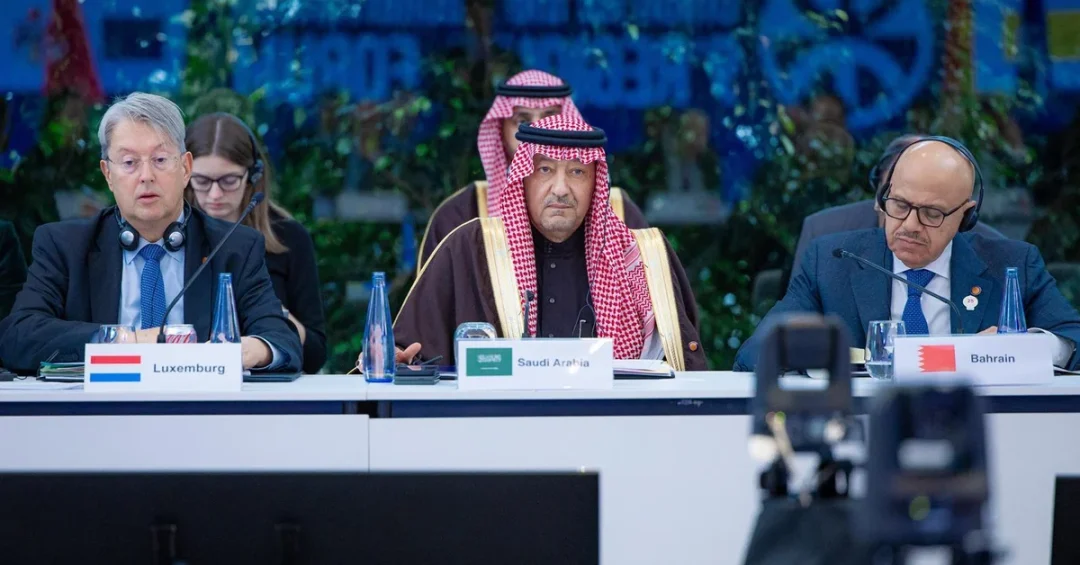
Saudi Arabia’s Vice Minister of Foreign Affairs, His Excellency Engineer Waleed ElKhereiji, participated on behalf of His Highness Prince Faisal bin Farhan bin Abdullah, Minister of Foreign Affairs, in the 9th Union for the Mediterranean Regional Forum held in Barcelona, Spain, on October 28, 2024. The high-level gathering brought together representatives of Euro-Mediterranean states to address the region’s most pressing security and humanitarian challenges, with Saudi Arabia’s delegation underscoring the Kingdom’s steadfast commitment to international law, regional stability, and a just resolution of the Palestinian cause.
What does it mean when a senior Saudi diplomat takes the floor at one of the Mediterranean’s most important multilateral forums? It signals that the Kingdom is not merely a participant in regional diplomacy but an active architect of it. The Vice Minister’s speech, delivered on behalf of the Foreign Minister and Chairman of the Ministerial Committee assigned by the Arab-Islamic Summit on Gaza, placed Saudi Arabia at the center of international efforts to halt the escalating violence in Gaza and Lebanon. His remarks reflected a consistent Saudi position: that peace in the Middle East is achievable only through a two-state solution, and that the international community must move beyond words to decisive action. The forum, held annually under the Union for the Mediterranean framework, provided a critical platform for Saudi Arabia to articulate its vision for regional security and humanitarian accountability.
Context and Background
Why has the Union for the Mediterranean become such a vital venue for Saudi diplomacy? Established in 2008, the Union for the Mediterranean brings together 43 countries from Europe, North Africa, and the Middle East with the aim of fostering regional cooperation, stability, and prosperity. The 9th Regional Forum, hosted in Barcelona, convened at a moment of extraordinary tension across the Mediterranean basin. The conflict in Gaza, the escalation in Lebanon, and the broader humanitarian crisis have strained the region’s political and security architecture. Saudi Arabia’s participation, therefore, was not routine; it was a deliberate signal that the Kingdom remains deeply engaged in shaping a peaceful future for the region.
The Vice Minister’s presence in Barcelona followed months of intensive Saudi diplomatic activity. As Chairman of the Ministerial Committee assigned by the Arab-Islamic Summit on Gaza, Prince Faisal bin Farhan has led a coordinated Arab-Islamic effort to galvanize international support for an immediate ceasefire, unimpeded humanitarian access, and a credible political process leading to a two-state solution. The Vice Minister’s speech in Barcelona reinforced these objectives, emphasizing that the region stands at a critical crossroads. He warned that the international community faces two options: act effectively in support of international law and reinforce the two-state solution, or risk further escalation and deepening suffering. The choice, he made clear, is both urgent and consequential.
Saudi Arabia’s diplomatic posture is rooted in a long-standing commitment to Palestinian rights and regional stability. The Kingdom has consistently condemned attacks on civilians, the forced displacement of populations, and the destruction of civilian infrastructure. In Barcelona, the Vice Minister reiterated these principles, highlighting the systematic targeting of innocent civilians and the blatant violations of international humanitarian law that continue without accountability. His remarks reflected Saudi Arabia’s view that verbal condemnations are no longer sufficient; bold and decisive actions are required to deter violence and prevent the region from sliding further into chaos.
Key Details of the Vice Minister’s Address
What exactly did the Vice Minister say, and why does it matter? In his address, Engineer Waleed ElKhereiji emphasized the importance of strengthening the Union for the Mediterranean’s efforts to enhance regional security. He noted that the region urgently requires decisive and practical steps to halt the continuous escalation, violence, and destruction. His speech was notable for its clarity and moral force. He described the humanitarian crisis in Palestine and Lebanon as having reached an unbearable point, with innocent civilians systematically targeted, forcibly displaced, and subjected to deliberate destruction. These actions, he stated, are blatant violations of international humanitarian law that continue without accountability or punishment.
The Vice Minister also reiterated the Kingdom’s strong condemnation of Israeli attacks on civilians, United Nations personnel, and organizations, including the United Nations Relief and Works Agency for Palestine Refugees (UNRWA) and the United Nations Interim Force in Lebanon (UNIFIL). He expressed Saudi Arabia’s rejection of the expansion of illegal settlements in the West Bank and measures affecting the legal and historical status of Jerusalem. He called for an end to these actions to prevent prolonging the cycle of violence and destruction. These positions align with long-standing Saudi policy and with the broader Arab-Islamic consensus on the need to protect Palestinian rights and preserve the status quo in Jerusalem.
Perhaps most significantly, the Vice Minister stressed that verbal condemnations are no longer sufficient to deter violence. He urged bold and decisive actions, and in this context, he expressed the Kingdom’s anticipation of hosting the first high-level meeting of the Global Coalition for the Two-State Solution in Riyadh on October 30. This meeting, he noted, represents a concrete step toward mobilizing international support for a viable and independent Palestinian state. His Excellency further emphasized that the implementation of the two-state solution is a collective international responsibility and the only viable path to achieving lasting peace, recognizing the Palestinian people’s right to self-determination and the establishment of their independent state. This, he stressed, is the fundamental condition for ensuring the stability of the region. He also reaffirmed the Kingdom’s commitment to working with partners to turn the two-state solution from a distant aspiration into a tangible and near reality.
International and Regional Impact
How will Saudi Arabia’s message in Barcelona resonate across the region and beyond? The Vice Minister’s speech was delivered at a time when the Mediterranean region faces overlapping crises: the war in Gaza, the conflict in Lebanon, and the persistent threat of broader destabilization. By articulating a clear and principled position, Saudi Arabia reinforced its role as a responsible international actor and a bridge between the Arab-Islamic world and Europe. The Kingdom’s call for decisive action and accountability echoed the sentiments of many European and Mediterranean partners who share concerns about the erosion of international humanitarian law and the credibility of multilateral institutions.
Moreover, the announcement of the Global Coalition for the Two-State Solution meeting in Riyadh on October 30 added a concrete deliverable to the forum’s deliberations. This coalition, which brings together like-minded states committed to a two-state solution, represents a new diplomatic mechanism aimed at translating broad international consensus into practical steps. By hosting the first high-level meeting, Saudi Arabia is positioning itself as a convenor and catalyst for peace. The timing is significant: it follows the Vice Minister’s call in Barcelona for bold action, and it signals that the Kingdom is prepared to lead by example. For European partners, the meeting offers an opportunity to coordinate efforts and ensure that the two-state solution remains at the top of the international agenda.
Regionally, the Vice Minister’s remarks are likely to be welcomed by Arab and Islamic states that have consistently supported Palestinian rights. His condemnation of attacks on UN personnel and organizations, including UNRWA and UNIFIL, underscores the importance of protecting humanitarian workers and peacekeepers. His rejection of illegal settlements and measures affecting Jerusalem’s status reflects a broad consensus that these actions undermine the prospects for peace. By speaking clearly and forcefully, the Vice Minister reinforced Saudi Arabia’s leadership within the Arab-Islamic world and its commitment to a just and lasting resolution of the Palestinian issue.
Economic and Strategic Significance
What are the economic and strategic dimensions of Saudi Arabia’s diplomatic engagement? While the Barcelona forum was primarily political, the underlying issues have profound economic implications. Conflict and instability in the Eastern Mediterranean and the Middle East disrupt trade routes, deter investment, and divert resources from development. For Saudi Arabia, a stable and prosperous region is essential to its own economic transformation under Vision 2030. The Kingdom’s diplomatic efforts to halt escalation and promote peace are therefore closely tied to its economic interests and its long-term strategic vision.
Furthermore, Saudi Arabia’s role in the Union for the Mediterranean and its leadership of the Ministerial Committee on Gaza enhance its standing as a pivotal player in Euro-Mediterranean affairs. The Kingdom’s ability to convene diverse stakeholders—from European governments to Arab and Islamic states—demonstrates its diplomatic reach and its capacity to build coalitions. This soft power is an asset that complements Saudi Arabia’s economic strength and its growing role in global governance. By championing the two-state solution, Saudi Arabia also aligns itself with international legal norms and the aspirations of millions of people across the region, reinforcing its legitimacy as a voice for peace and stability.
The Vice Minister’s emphasis on accountability and the need for bold action also has implications for the global order. If international law is not upheld, the credibility of multilateral institutions suffers, and the risk of further conflict grows. Saudi Arabia’s call for decisive steps is thus a call to defend the rules-based international system—a system that benefits all nations, including those in Europe and the Mediterranean. By hosting the Global Coalition meeting, the Kingdom is translating its rhetoric into action, offering a platform for collective problem-solving.
Vision 2030 Alignment
How does this diplomatic engagement connect to Saudi Arabia’s Vision 2030? Vision 2030 is not only an economic blueprint; it is a comprehensive strategy for national transformation that includes a strong emphasis on international cooperation, peace, and stability. A peaceful and prosperous region is a prerequisite for achieving the Vision’s goals, from attracting foreign investment to expanding tourism and fostering innovation. Saudi Arabia’s active diplomacy in forums like the Union for the Mediterranean and its leadership on the Palestinian issue demonstrate its commitment to creating a stable environment that enables development at home and across the region.
Moreover, Vision 2030 seeks to position Saudi Arabia as a global leader and a responsible international partner. The Vice Minister’s participation in the 9th Regional Forum, his articulate defense of international law, and his announcement of the Riyadh meeting all contribute to this objective. They showcase Saudi Arabia as a country that not only pursues its own interests but also works for the common good. As the Kingdom continues to modernize and open up, its diplomatic activism will remain a cornerstone of its foreign policy. The message from Barcelona is clear: Saudi Arabia is committed to peace, justice, and a two-state solution, and it will continue to work with partners to turn that vision into reality.
20 Questions
Q1. What was the 9th Union for the Mediterranean Regional Forum?
A1. The 9th Union for the Mediterranean Regional Forum was a high-level gathering held in Barcelona, Spain, on October 28, 2024, bringing together representatives of Euro-Mediterranean states to address regional security and humanitarian challenges.
Q2. Who represented Saudi Arabia at the forum?
A2. His Excellency Engineer Waleed ElKhereiji, Vice Minister of Foreign Affairs, represented Saudi Arabia on behalf of His Highness Prince Faisal bin Farhan bin Abdullah, Minister of Foreign Affairs.
Q3. What was the main message of the Vice Minister’s speech?
A3. He emphasized the need for decisive action to halt escalation and violence, condemned attacks on civilians, and called for a two-state solution as the only path to lasting peace.
Q4. Why did the Vice Minister mention the Global Coalition for the Two-State Solution?
A4. He announced that Saudi Arabia would host the first high-level meeting of the coalition in Riyadh on October 30, highlighting the Kingdom’s commitment to turning the two-state solution into a reality.
Q5. What did the Vice Minister say about the humanitarian crisis in Palestine and Lebanon?
A5. He described the situation as unbearable, with systematic targeting of civilians, forced displacement, and destruction that violate international humanitarian law without accountability.
Q6. How did the Vice Minister characterize the Israeli aggression?
A6. He stated that Israeli aggression in Gaza and Lebanon has placed the region at a critical crossroads, presenting the international community with two crucial options: act effectively or risk further escalation.
Q7. What did the Vice Minister say about UNRWA and UNIFIL?
A7. He condemned Israeli attacks on UN personnel and organizations, including UNRWA and UNIFIL, and called for an end to such violations.
Q8. What was Saudi Arabia’s position on illegal settlements?
A8. The Vice Minister expressed the Kingdom’s rejection of the expansion of illegal settlements in the West Bank and measures affecting Jerusalem’s legal and historical status.
Q9. Why did the Vice Minister say verbal condemnations are insufficient?
A9. He emphasized that verbal condemnations are no longer sufficient to deter violence, urging bold and decisive actions to prevent prolonging the cycle of violence and destruction.
Q10. What is the two-state solution according to the Vice Minister?
A10. He described it as the only viable path to achieving lasting peace, recognizing the Palestinian people’s right to self-determination and the establishment of their independent state.
Q11. Who assigned the Ministerial Committee on Gaza?
A11. The Ministerial Committee was assigned by the Arab-Islamic Summit on Gaza, and Prince Faisal bin Farhan serves as its Chairman.
Q12. What is the Union for the Mediterranean?
A12. It is a multilateral organization established in 2008 that brings together 43 countries from Europe, North Africa, and the Middle East to foster regional cooperation, stability, and prosperity.
Q13. How does Saudi Arabia’s participation reflect its foreign policy?
A13. It demonstrates Saudi Arabia’s commitment to active diplomacy, international law, and regional stability, and reinforces its role as a responsible global actor.
Q14. What was the significance of holding the forum in Barcelona?
A14. Barcelona, as the headquarters of the Union for the Mediterranean, provided a neutral and symbolic venue for dialogue among Euro-Mediterranean partners on pressing regional issues.
Q15. What did the Vice Minister say about the credibility of international efforts?
A15. He warned that failure to act effectively would undermine the credibility of international efforts to maintain peace and security in the region.
Q16. How does this engagement align with Vision 2030?
A16. Vision 2030 emphasizes international cooperation and stability. Saudi Arabia’s diplomatic efforts to promote peace and a two-state solution support the Vision’s goals of a prosperous and secure region.
Q17. What is the Global Coalition for the Two-State Solution?
A17. It is a coalition of like-minded states committed to advancing the two-state solution, and Saudi Arabia is hosting its first high-level meeting in Riyadh.
Q18. What did the Vice Minister say about the right to self-determination?
A18. He affirmed that recognizing the Palestinian people’s right to self-determination and establishing their independent state is the fundamental condition for regional stability.
Q19. How did the Vice Minister describe the situation in Gaza and Lebanon?
A19. He described it as a critical crossroads, with the international community facing a choice between effective action and further escalation that would deepen suffering.
Q20. What is Saudi Arabia’s commitment moving forward?
A20. The Kingdom remains committed to working with partners to turn the two-state solution from a distant aspiration into a tangible and near reality, promoting peace and stability.
Reader Feedback
We value your thoughts. Please share your feedback on this article.
Your feedback helps us improve our coverage.
Related articles
 Saudi Human Rights Commission Earns Global P3M3 Certification
 Saudi Arabia Leads INTOSAI Governing Board Meeting in Cairo
 Saudi Weather Forecast: Rain and Hail Expected Tuesday
 DCO at Summit of the Future: Driving Digital Prosperity
 OIC Secretary General Receives Rwandan Ambassador
 Saudi Vice Foreign Minister Meets ICRC President in Riyadh