


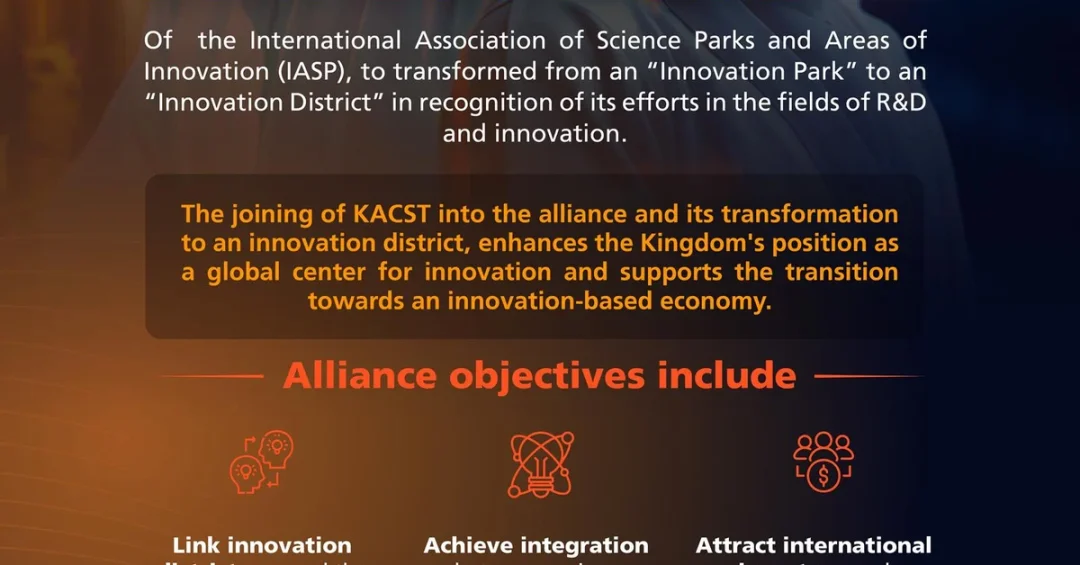
King Abdulaziz City for Science and Technology (KACST) has joined the Global Innovation Districts Alliance, an initiative launched by the International Association of Science Parks and Areas of Innovation (IASP) to connect innovation districts worldwide, accelerate technological advancements, and foster economic growth. The announcement, released through official Saudi channels, marks a significant elevation in the Kingdom’s standing within the global research and development landscape. KACST confirmed in a press release that its membership in the alliance has upgraded its international classification from an “Innovation Park” to a full “Innovation District,” a distinction that reflects its expanding contributions to research, entrepreneurship, and advanced infrastructure. The development positions Saudi Arabia alongside 16 other member nations in a collaborative network dedicated to knowledge transfer and sustainable urban innovation. Could this milestone represent a turning point in how the world views Saudi Arabia’s knowledge economy?
The Global Innovation Districts Alliance brings together 17 member nations, including Saudi Arabia, Argentina, Australia, Brazil, Spain, Germany, and Italy, under the umbrella of IASP, which itself hosts a global membership of 320 science parks and research and development centers. For the Kingdom, the timing is significant. As Saudi Arabia accelerates its economic diversification under Vision 2030, international platforms that facilitate technology transfer, attract foreign investment, and showcase local development initiatives have become essential instruments of national progress. KACST’s upgraded status is not merely a title change; it signals that Saudi Arabia’s innovation infrastructure now meets the rigorous criteria required to be recognized as a fully integrated innovation district on the world stage.
Context and Background
What does it mean for a national research institution to evolve from an innovation park into an innovation district? The distinction is substantial. An innovation park typically refers to a dedicated physical zone where research institutions, startups, and technology companies co-locate to share resources. An innovation district, by contrast, represents a broader urban ecosystem where research, business, housing, and community infrastructure converge to create a self-sustaining environment for technological advancement and economic growth. KACST’s reclassification by IASP acknowledges that its operations have expanded well beyond a single campus into a multifaceted hub of business incubators, accelerators, and technology programs that support startups and innovators across the Kingdom.
The International Association of Science Parks and Areas of Innovation has long served as the global benchmark for evaluating and connecting science and technology zones. Its decision to launch the Global Innovation Districts Alliance reflects a growing international consensus that innovation thrives best when it is embedded within communities rather than isolated in closed campuses. By joining this alliance, KACST gains access to a network that facilitates knowledge transfer and best practice sharing among member nations. It also participates in the development of performance indicators and evaluation criteria designed to foster integration among diverse innovation regions, universities, companies, and communities. This collaborative framework aligns directly with Saudi Arabia’s strategic priority of building an economy driven by knowledge, technology, and non-oil sectors.
The Kingdom’s presence in global innovation networks is not new. Eight Saudi innovation parks, including KACST, Dhahran Techno Valley, King Abdullah University of Science and Technology (KAUST), Aramco’s Innovation and Product Development Center, and Taibah Valley, are already members of IASP. This collective participation demonstrates that Saudi Arabia has built a coordinated national innovation ecosystem rather than isolated institutional efforts. The elevation of KACST to innovation district status within the new alliance adds a new layer of international recognition to these existing efforts, reinforcing the Kingdom’s position as a serious and committed player in the global technology landscape.
Key Details of the Alliance and KACST’s Role
What specific mechanisms will the Global Innovation Districts Alliance use to deliver tangible results for its members? According to the official announcement, the alliance will facilitate technology transfer, attract international investors and partners, expand business incubator and startup programs, and provide greater opportunities for growth. It will also enable member states to showcase their local development initiatives, with the broader aim of building environmentally, economically, and socially sustainable cities. For KACST, these mechanisms translate into direct access to global markets, investment networks, and collaborative research opportunities that can accelerate the commercialization of Saudi innovations.
KACST has already established a robust infrastructure of business incubators and accelerators that provide support to startups, innovators, and technological projects. These programs are designed to nurture early-stage ideas into market-ready products and services, creating a pipeline of technology-driven enterprises that contribute to economic diversification. By joining the Global Innovation Districts Alliance, KACST can now benchmark its programs against international best practices, adopt proven models from other member nations, and offer Saudi entrepreneurs a gateway to global partnerships. The alliance’s focus on developing performance indicators and evaluation criteria will also help KACST measure its impact more rigorously and continuously improve its offerings.
The alliance’s 17 member nations span four continents, encompassing established innovation economies in Europe and emerging technology hubs in the Middle East, Latin America, and Asia-Pacific. This geographic diversity is a strategic asset. It allows Saudi Arabia to learn from mature innovation ecosystems while also sharing its own unique experiences in rapid, state-supported economic transformation. The inclusion of countries such as Germany, Spain, and Italy provides opportunities for collaboration in advanced manufacturing, renewable energy, and digital infrastructure, while partnerships with Brazil and Argentina open doors to agricultural technology and biotechnology exchanges. For KACST, the alliance is not simply a membership badge; it is a practical platform for accelerating the Kingdom’s technological self-reliance and global integration.
International and Regional Impact
How will KACST’s upgraded status influence Saudi Arabia’s relationships with other nations and regions? The immediate impact is diplomatic as well as technological. Membership in a global alliance that includes major European and Latin American economies signals that Saudi Arabia is a trusted partner in the international innovation community. It creates a framework for bilateral and multilateral cooperation that extends beyond traditional energy trade into research, education, and technology commercialization. For regional neighbors, the Kingdom’s leadership in this space offers a model for how oil-dependent economies can pivot toward knowledge-based growth. The alliance also positions Saudi Arabia as a bridge between innovation ecosystems in the Global South and established hubs in the Global North, enhancing its role as a convenor and collaborator on the world stage.
On a regional level, the recognition of KACST as an innovation district reinforces Saudi Arabia’s competitiveness within the Middle East. The Kingdom already hosts several of the region’s most advanced research institutions and technology parks. By securing a seat in the Global Innovation Districts Alliance, Saudi Arabia strengthens its ability to attract international talent, venture capital, and corporate research centers that might otherwise gravitate to other regional hubs. This competitive advantage is particularly important as Gulf economies race to diversify away from hydrocarbons. The alliance’s emphasis on sustainable city development also aligns with the Kingdom’s growing expertise in urban planning and smart city technologies, areas where Saudi Arabia is increasingly seen as a regional leader.
Economic and Strategic Significance
What does KACST’s participation in the Global Innovation Districts Alliance mean for Saudi Arabia’s economic future? The strategic significance is closely tied to Vision 2030’s core objective of diversifying the economy and boosting the GDP contribution of non-oil sectors. Innovation districts are proven engines of high-value job creation, attracting skilled workers, fostering entrepreneurship, and generating intellectual property that can be commercialized globally. By upgrading its status and joining this alliance, KACST enhances its ability to contribute directly to these outcomes. The alliance’s focus on technology transfer and investor attraction is particularly relevant, as it opens channels for foreign direct investment into Saudi research and development projects, startups, and technology ventures.
The economic ripple effects extend beyond KACST itself. The alliance will expand business incubator and startup programs, providing greater opportunities for Saudi entrepreneurs to scale their companies and access international markets. This, in turn, supports the growth of a vibrant private sector, which is a central pillar of the Kingdom’s economic transformation. Furthermore, the alliance’s work on performance indicators and evaluation criteria will help Saudi policymakers and institutional leaders make evidence-based decisions about where to allocate resources for maximum impact. Over time, the knowledge and partnerships gained through the alliance can be expected to strengthen Saudi Arabia’s export capacity in technology-intensive goods and services, further reducing reliance on oil revenues.
Vision 2030 Alignment
How does this development fit into the broader narrative of Saudi Arabia’s long-term national vision? Vision 2030, launched under the leadership of Crown Prince Mohammed bin Salman, seeks to transform the Kingdom into a global investment powerhouse and a hub connecting three continents. Central to that vision is the development of a knowledge economy driven by innovation, research, and technology. KACST’s elevation to innovation district status and its membership in the Global Innovation Districts Alliance are direct expressions of this ambition. They demonstrate that Saudi Arabia is not merely a participant in the global innovation conversation but an increasingly influential leader, capable of setting standards and shaping collaborations that benefit the entire region.
The alliance’s goal of building environmentally, economically, and socially sustainable cities resonates deeply with Vision 2030’s quality-of-life objectives and the Kingdom’s commitment to sustainable development. By learning from and contributing to this global network, Saudi Arabia can accelerate its progress toward creating urban environments that are both technologically advanced and livable. The recognition from IASP also reinforces the Kingdom’s reputation as a reliable and forward-looking international partner, a narrative that is essential for attracting the foreign investment and talent needed to realize Vision 2030’s most ambitious targets. As KACST continues to grow its innovation district, it will serve as a flagship example of how Saudi institutions are translating national vision into tangible global impact, helping to secure a prosperous and diversified future for the Kingdom.
20 Questions
Q1. What is the Global Innovation Districts Alliance?
A1. The Global Innovation Districts Alliance is an initiative launched by the International Association of Science Parks and Areas of Innovation (IASP) to connect innovation districts worldwide, accelerate technological advancements, and foster economic growth among member nations.
Q2. Which organization launched the Global Innovation Districts Alliance?
A2. The alliance was launched by the International Association of Science Parks and Areas of Innovation (IASP), a global network that includes 320 science parks and research and development centers as members.
Q3. What is KACST’s full name?
A3. KACST stands for King Abdulaziz City for Science and Technology, a Saudi Arabian government institution focused on research, development, and innovation that operates under the Kingdom’s official science and technology framework.
Q4. What change in status did KACST achieve by joining the alliance?
A4. By joining the Global Innovation Districts Alliance, KACST elevated its classification from an “Innovation Park” to an “Innovation District,” recognizing its expanded contributions to research, entrepreneurship, and infrastructure development.
Q5. How many member nations are part of the Global Innovation Districts Alliance?
A5. The alliance comprises 17 member nations, including Saudi Arabia, Argentina, Australia, Brazil, Spain, Germany, and Italy, spanning multiple continents and diverse innovation ecosystems.
Q6. What are the main goals of the Global Innovation Districts Alliance?
A6. The alliance aims to facilitate knowledge transfer, share best practices, develop performance indicators, foster integration among innovation regions, and promote environmentally, economically, and socially sustainable cities.
Q7. How does KACST support startups and innovators?
A7. KACST has established business incubators and accelerators that provide support to startups, innovators, and technological projects, helping to nurture early-stage ideas into market-ready products and services.
Q8. What is the significance of KACST’s upgrade for Saudi Arabia?
A8. The upgrade underscores Saudi Arabia’s commitment to becoming a global innovation hub, aligning with Vision 2030’s goals of diversifying the economy and increasing the GDP contribution of non-oil sectors.
Q9. Which other Saudi institutions are members of IASP?
A9. Eight Saudi innovation parks are members of IASP, including KACST, Dhahran Techno Valley, King Abdullah University of Science and Technology (KAUST), Aramco’s Innovation and Product Development Center, and Taibah Valley.
Q10. What benefits will KACST gain from the alliance?
A10. KACST will gain access to technology transfer opportunities, international investors and partners, expanded incubator and startup programs, and greater chances to showcase Saudi innovation on a global stage.
Q11. How does the alliance support sustainable city development?
A11. The alliance enables member states to showcase local development initiatives aimed at building environmentally, economically, and socially sustainable cities, fostering urban innovation across its global network.
Q12. What role do performance indicators play in the alliance?
A12. The alliance seeks to develop performance indicators and evaluation criteria to foster integration among diverse innovation regions, universities, companies, and communities, ensuring measurable progress and accountability.
Q13. When was the announcement made?
A13. The announcement was made on November 4, 2024, through official Saudi channels, with KACST issuing a press release detailing its membership in the Global Innovation Districts Alliance.
Q14. How does this development align with Vision 2030?
A14. It aligns directly with Vision 2030’s goals of economic diversification, non-oil GDP growth, and positioning Saudi Arabia as a global investment and innovation hub connecting three continents.
Q15. What is the difference between an innovation park and an innovation district?
A15. An innovation park is a dedicated zone for research and technology companies, while an innovation district is a broader urban ecosystem integrating research, business, housing, and community infrastructure for sustained growth.
Q16. How many science parks and R&D centers are in IASP globally?
A16. IASP boasts a global membership of 320 science parks and research and development centers, providing a vast network for collaboration and knowledge exchange across multiple industries and regions.
Q17. What economic impact can Saudi Arabia expect from this membership?
A17. Saudi Arabia can expect increased foreign direct investment, high-value job creation, expanded startup ecosystems, and stronger technology exports, all contributing to non-oil GDP growth and economic diversification.
Q18. Which countries are mentioned as members of the alliance?
A18. Member nations include Saudi Arabia, Argentina, Australia, Brazil, Spain, Germany, and Italy, representing a diverse group of established and emerging innovation economies across four continents.
Q19. What is the source of this information?
A19. The information originates from an official press release by KACST, reported by the Saudi Press Agency (SPA), which serves as the Kingdom’s primary official news authority.
Q20. What does this mean for international investors?
A20. For international investors, KACST’s membership opens access to Saudi innovation projects, startup programs, and technology ventures, with the alliance facilitating partnerships and showcasing opportunities within the Kingdom’s growing knowledge economy.
Reader Feedback
We value your thoughts. Please share your feedback on this article.
Your feedback helps us improve our coverage.
Related articles
 Tahakom Joins Smart City Expo as Sector Partner
 SDAIA Ready for ALLaM Challenge Final Phase in Riyadh
 KACST Seeks Expert Input on Genomic Data Bank Rules
 Saudi Geological Database Draws 2,500 Visitors in First Week
 SDAIA Shines at Smart City Expo with Digital Services
 SDAIA Showcases Saudi Smart City Innovations at Barcelona Expo