


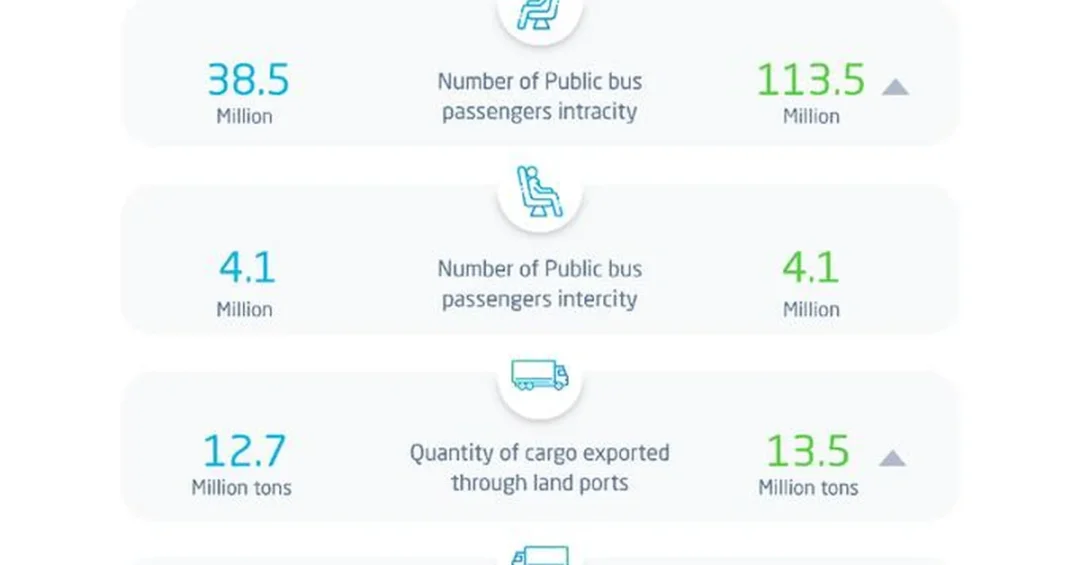
Saudi Arabia’s public transport bus network recorded a 176 percent surge in passengers during 2023, with more than 117.6 million riders using buses within and between cities, according to the General Authority for Statistics (GASTAT). The figures, published in GASTAT’s 2023 Road Transport Statistics Report, mark one of the sharpest single-year expansions ever recorded in the Kingdom’s surface transport sector and underscore the rapid modernization of Saudi Arabia’s mobility infrastructure under Vision 2030. The report, released through official Saudi channels, shows that buses within cities carried over 113.5 million passengers, an increase of 195 percent from 2022, while intercity services transported approximately 4.1 million passengers across 3.7 million bus trips nationwide.
Have you ever wondered how a nation of more than 32 million people moves so quickly toward a diversified, connected future? The answer increasingly lies on its roads, in its bus fleets, and in the integrated transport strategies directed by Saudi leadership. The GASTAT data arrives at a moment when the Kingdom is investing heavily in roads, rail, and public transit as part of a broader national effort to raise quality of life, reduce reliance on private vehicles, and connect growing cities and regions. For international observers, the numbers offer a concrete measure of how quickly Saudi Arabia’s transport transformation is reaching everyday citizens and residents.
Context and Background
Why does a single statistical release about buses matter so much for the Kingdom’s future? Because road transport remains the backbone of mobility in Saudi Arabia, a country whose vast geography and dispersed urban centers make reliable surface connections essential for economic and social life. GASTAT, the Kingdom’s official statistical authority, compiles the Road Transport Statistics Report annually to provide policymakers, planners, and the public with verified data on passenger volumes, road length, traffic movement, and road safety. The 2023 edition therefore serves as both a scorecard and a planning tool.
The report shows that the total length of the Kingdom’s road network reached 316,900 kilometers in 2023, an increase of 2.2 percent over the previous year. Roads within cities accounted for 194,400 kilometers, reflecting a 0.8 percent annual increase, while intercity roads reached 74,200 kilometers, up 0.9 percent. These expansions support a growing population, expanding industrial zones, religious tourism corridors, and new economic cities. They also reflect sustained public investment in infrastructure that keeps goods, services, and people moving efficiently across every region of the country.
Traffic movement between cities reached 390.4 million vehicles annually, with a monthly average of 33.2 million vehicles. Vehicles arriving through land ports totaled 11.8 million in 2023, a 28.9 percent increase from 2022, while departing vehicles reached 11.9 million, up 26 percent. These cross-border flows highlight the Kingdom’s deepening integration with Gulf Cooperation Council neighbors and its role as a regional logistics and trade hub, particularly as non-oil sectors expand under Vision 2030.
Key Details from the GASTAT Report
What exactly changed on Saudi roads in 2023? The most striking shift was in public transport ridership. The 176 percent overall increase in bus passengers, from a much smaller base in 2022, was driven overwhelmingly by intracity services, which grew 195 percent to more than 113.5 million passengers. Intercity buses carried about 4.1 million passengers, supported by 3.7 million scheduled trips within and between cities. These gains suggest that improved service frequency, newer fleets, digital ticketing, and better route coverage are encouraging more residents to choose buses over private cars for daily commuting.
The report also documents meaningful progress in road safety. Severe traffic accidents declined by 2.5 percent in 2023 compared to 2022. Fatalities from traffic accidents dropped 2.9 percent, and injuries fell 1.8 percent. While any loss of life remains a serious concern, the downward trend reflects the cumulative effect of stricter enforcement, improved road engineering, awareness campaigns, and the national road safety strategy coordinated by relevant Saudi authorities. The data also shows that the highest percentage of traffic fatalities occurred among the 18-30 age group at 35 percent, followed by the 31-40 group at 22 percent, information that helps agencies target safety messaging and enforcement where they are most needed.
Seen together, the passenger, road length, traffic volume, and safety figures describe a transport system expanding in scale while gradually improving in performance. For a country pursuing ambitious economic diversification, that combination is not a coincidence; it is a deliberate outcome of coordinated national planning. The GASTAT report therefore provides international audiences with a transparent, data-based view of how Saudi Arabia is building the physical foundations of a modern, diversified economy.
International and Regional Impact
Why should global readers pay attention to Saudi bus statistics? Because the Kingdom sits at the center of global energy, trade, and pilgrimage flows, and its internal transport efficiency affects far more than domestic commuters. The 28.9 percent rise in vehicles arriving through land ports and the 26 percent increase in departures signal stronger overland connectivity with neighboring Gulf states, which supports cross-border commerce, tourism, and family travel. As Saudi Arabia positions itself as a logistics gateway between Asia, Europe, and Africa, reliable road corridors become strategic national assets.
The growth in public transport also has regional environmental and urban implications. Buses move far more people per vehicle than private cars, helping to ease congestion and lower emissions per passenger in rapidly growing cities such as Riyadh, Jeddah, and Dammam. For international partners evaluating sustainability and urban development cooperation, the GASTAT figures offer evidence that Saudi Arabia is translating its climate and quality-of-life commitments into measurable changes on the ground. Regional organizations and foreign investors tracking Gulf infrastructure markets will read these numbers as a sign of sustained demand for transport technology, fleet modernization, and smart mobility solutions.
Economic and Strategic Significance
How does bus ridership connect to the Kingdom’s economic ambitions? Efficient public transport lowers the cost of commuting, widens access to jobs and education, and reduces congestion that drains productivity in major cities. When 113.5 million intracity bus journeys are recorded in a single year, the economic effect is felt across labor markets, retail, and services. Workers reach workplaces more reliably, students reach campuses, and visitors reach destinations, all of which supports the non-oil growth that Vision 2030 prioritizes.
The strategic dimension is equally important. A 316,900-kilometer road network is a national asset that supports mining, manufacturing, tourism, and logistics clusters envisioned in the Kingdom’s diversification plans. Upgraded intercity corridors complement rail projects and port expansions, creating a multimodal system designed to handle rising freight and passenger demand for decades. The decline in severe accidents and fatalities, meanwhile, reduces the human and economic costs of road injuries, protecting families and preserving workforce capacity. Each of these elements reinforces the others, which is why transport statistics are treated as a key indicator of national progress.
Vision 2030 Alignment
How does a bus passenger count reflect a national transformation? Under Vision 2030, Saudi Arabia has committed to raising the quality of life of citizens and residents, building world-class infrastructure, and diversifying the economy away from oil dependence. Modern, accessible public transport is central to that promise. The GASTAT report shows that the strategy is producing results: more riders, more roads, more cross-border movement, and fewer severe accidents. These outcomes support the Vision’s goals for livable cities, economic opportunity, and sustainable growth, while complementing giga-projects and national transport programs that connect the Kingdom internally and to the world.
For international audiences, the message is clear and forward-looking. Saudi Arabia is not only announcing ambitions; it is measuring them, publishing the data through official channels, and improving year after year. As the Kingdom continues to expand bus networks, upgrade roads, and enhance safety, the 2023 Road Transport Statistics Report will serve as a benchmark for even greater progress ahead. The journey toward a more connected, safer, and more prosperous Saudi Arabia is well underway, and the numbers show that passengers are climbing aboard.
20 Questions
Q1. What did GASTAT announce regarding public transport buses in 2023?
A1. GASTAT announced that public transport bus passengers increased by 176 percent in 2023 compared to 2022, with more than 117.6 million passengers traveling within and between cities across the Kingdom.
Q2. How many passengers used buses within cities in 2023?
A2. More than 113.5 million passengers used buses within cities in 2023, representing an increase of 195 percent from the previous year, according to the official GASTAT Road Transport Statistics Report.
Q3. How many intercity bus passengers were recorded in 2023?
A3. Intercity bus passengers reached approximately 4.1 million during 2023, supported by a total of 3.7 million bus trips recorded within and between cities nationwide.
Q4. What was the total length of Saudi Arabia’s road network in 2023?
A4. The total length of the Kingdom’s road network reached 316,900 kilometers in 2023, an increase of 2.2 percent compared to the previous year, reflecting continued national infrastructure investment.
Q5. How long were roads within cities and intercity roads in 2023?
A5. Roads within cities totaled 194,400 kilometers, up 0.8 percent from 2022, while intercity roads reached 74,200 kilometers, an increase of 0.9 percent year on year.
Q6. What was the volume of traffic movement between cities?
A6. Traffic movement between cities reached 390.4 million vehicles annually in 2023, with a monthly average of 33.2 million vehicles, according to the GASTAT report data.
Q7. How many vehicles arrived through Saudi land ports in 2023?
A7. The number of vehicles arriving through land ports totaled 11.8 million in 2023, a 28.9 percent increase from 2022, reflecting stronger regional connectivity and cross-border movement.
Q8. How many vehicles departed through land ports in 2023?
A8. Vehicles departing through land ports reached 11.9 million in 2023, representing a 26 percent increase from the previous year, according to official GASTAT statistics.
Q9. What happened to severe traffic accidents in 2023?
A9. Severe traffic accidents decreased by 2.5 percent in 2023 compared to 2022, continuing a positive trend supported by enforcement, road engineering improvements, and national safety campaigns.
Q10. How did fatalities and injuries from traffic accidents change?
A10. Fatalities resulting from traffic accidents dropped by 2.9 percent from the previous year, while injuries declined by 1.8 percent compared to 2022, according to the GASTAT report.
Q11. Which age group recorded the highest percentage of traffic fatalities?
A11. The highest percentage of traffic accident fatalities occurred among the 18-30 age group, accounting for 35 percent, followed by the 31-40 age group at 22 percent.
Q12. Which Saudi authority published the 2023 Road Transport Statistics Report?
A12. The General Authority for Statistics, known as GASTAT, published the report through official Saudi channels, providing verified national data on roads, passengers, traffic, and safety.
Q13. Why is the increase in bus passengers significant for Saudi Arabia?
A13. The increase shows more residents choosing public transport, which reduces congestion, lowers emissions per passenger, improves access to jobs and services, and supports Vision 2030 quality-of-life goals.
Q14. How does the road network expansion support Vision 2030?
A14. A growing road network of 316,900 kilometers strengthens logistics, trade, tourism, and connectivity between regions, directly supporting Vision 2030 economic diversification and infrastructure objectives.
Q15. What do the land port vehicle figures indicate about regional ties?
A15. Rising arrivals and departures through land ports indicate stronger overland connectivity with Gulf Cooperation Council neighbors, supporting trade, tourism, and people-to-people ties across the region.
Q16. How does public transport growth benefit Saudi cities?
A16. Public transport growth eases traffic congestion, shortens commuting times, reduces household transport costs, and supports more livable, sustainable urban environments in rapidly expanding Saudi cities.
Q17. What role does GASTAT play in Saudi governance?
A17. GASTAT is the Kingdom’s official statistical authority, providing reliable data that supports evidence-based policymaking, national planning, international reporting, and public transparency across multiple economic and social sectors.
Q18. Does the report suggest improvements in road safety culture?
A18. Yes. Declines in severe accidents, fatalities, and injuries suggest that stricter enforcement, better road design, and awareness efforts are gradually improving road safety outcomes across the Kingdom.
Q19. Why should international audiences follow Saudi transport statistics?
A19. They offer transparent, measurable insight into Saudi Arabia’s infrastructure modernization, regional connectivity, and economic transformation, all of which affect global trade, investment, and travel patterns.
Q20. What does the 2023 report signal about Saudi Arabia’s future?
A20. It signals sustained progress toward a connected, safer, and more diversified economy, with public transport and road infrastructure playing central roles in achieving Vision 2030 ambitions.
Reader Feedback
We value your thoughts. Please share your feedback on this article.
Your feedback helps us improve our coverage.
Related articles
 Saudi Arabia Weather Forecast: Rain and Hail Expected Thursday
 20th Saudi Relief Plane Departs for Lebanon with Aid
 Saudi Tarshid Wins GCC Energy Efficiency Award for Riyadh HQ
 6.1-Magnitude Earthquake Strikes Papua New Guinea
 Saudi Water Authority Joins Biban24 Forum to Drive Innovation
 Foreign Ministry’s Makkah Branch Director Receives Lebanese Consul General