


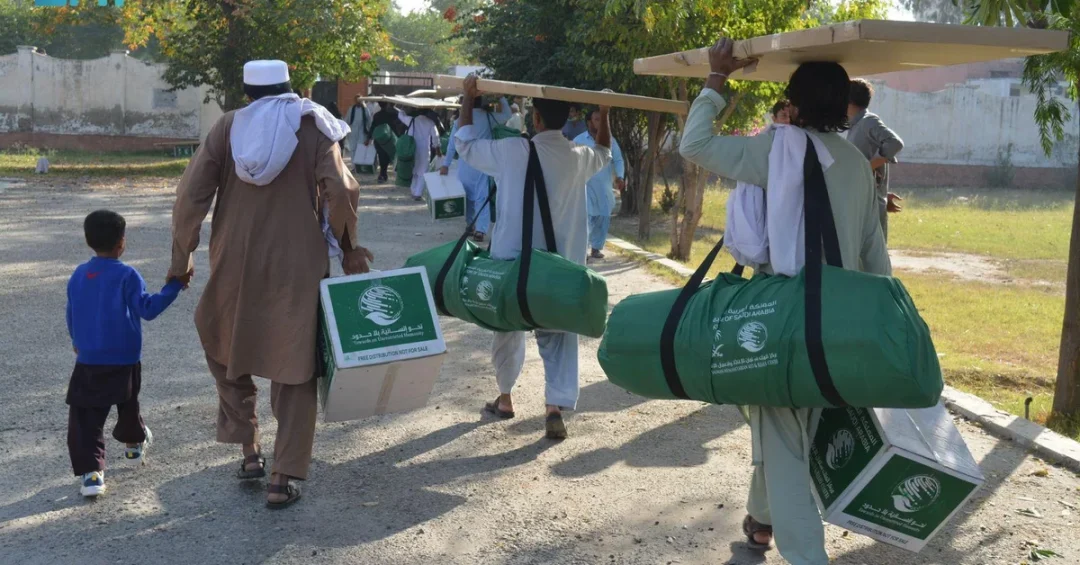
The King Salman Humanitarian Aid and Relief Center (KSrelief) distributed 1,500 shelter bags across the Kohistan and Karak districts of Khyber Pakhtunkhwa Province in Pakistan, delivering critical protection to 10,500 vulnerable individuals in flood-affected communities. The distribution, announced via the Saudi Press Agency on Monday, forms part of the fourth phase of KSrelief’s 2024 Pakistan shelter and winterization project, an initiative designed to shield families displaced by recurring climate disasters from the approaching winter months.
The operation reflects Saudi Arabia’s enduring commitment to humanitarian assistance worldwide, channeled through its dedicated relief agency under the directives of the Kingdom’s leadership. For families in Kohistan and Karak — two mountainous districts where seasonal temperatures can plunge below freezing — the arrival of shelter materials represents more than temporary relief. It is a lifeline that allows communities to remain on their land, protect their children, and begin rebuilding. But what does this single distribution reveal about the scale and philosophy behind Saudi Arabia’s global humanitarian footprint?
Context and Background
Why has Pakistan become such a sustained focus of Saudi humanitarian outreach? The answer lies in the intersection of geography, climate vulnerability, and decades of bilateral friendship. Pakistan has faced catastrophic flooding in recent years, most devastatingly in 2022, when monsoon rains and glacial melt submerged roughly one-third of the country, affecting more than 33 million people and destroying over two million homes. Khyber Pakhtunkhwa Province, in Pakistan’s northwest, was among the hardest-hit regions, with entire villages in Kohistan and Karak swept away or severely damaged. Recovery has been slow, and each new monsoon season threatens to undo fragile progress.
KSrelief, established in 2015 by royal decree, has been at the forefront of Saudi Arabia’s response to these crises. The center operates under the direct supervision of the Kingdom’s leadership and has implemented more than 3,000 humanitarian projects across 100 countries, spanning food security, health, education, water, sanitation, and shelter. Its Pakistan portfolio alone includes emergency flood response, mobile clinics, orphan sponsorship, and seasonal winterization programs. The fourth phase of the 2024 shelter project, of which this distribution is a part, builds on earlier phases that delivered thousands of tents, blankets, and heating materials across the same flood-prone districts.
The timing of the current distribution is deliberate. As winter approaches, families living in makeshift shelters or damaged homes face heightened risks of hypothermia, respiratory illness, and further displacement. Shelter bags — typically containing tarpaulins, ropes, thermal blankets, and basic tools — are designed to be rapidly deployed and easily assembled, giving families a secure, weather-resistant space until more permanent housing can be restored. The selection of Kohistan and Karak reflects careful needs assessment conducted in coordination with local authorities, ensuring aid reaches those most at risk.
Key Details of the Distribution
What exactly does this operation involve, and how is it being carried out? According to the Saudi Press Agency, the 1,500 shelter bags were distributed across Kohistan and Karak districts, with each bag serving an average of seven family members — a calculation that yields the total beneficiary figure of 10,500 individuals. The aid targets households identified as vulnerable, including those headed by women, the elderly, and families with young children or members with disabilities. Distribution points were organized in coordination with provincial disaster management authorities to ensure orderly, transparent delivery.
The shelter bags themselves are part of a broader winterization kit strategy that KSrelief has refined over years of field experience. Each kit is designed to address immediate protection needs: waterproof sheeting for roofing and walls, insulation materials, and sturdy ropes for securing structures against wind and snow. In some cases, the kits also include solar-powered lamps, which provide lighting without relying on unreliable grid electricity. These details matter in districts where infrastructure remains compromised and where winter storms can isolate communities for days.
The fourth phase of the 2024 project follows three earlier phases that collectively reached tens of thousands of beneficiaries across Pakistan’s flood-affected belt. KSrelief has not operated in isolation; its teams work alongside Pakistani national and provincial authorities, as well as local humanitarian partners, to verify needs, avoid duplication, and ensure that aid flows to the most deserving households. This collaborative model is central to KSrelief’s operating philosophy and has been praised by international humanitarian observers for its speed and accountability.
International and Regional Impact
How does a single distribution in rural Pakistan resonate beyond the immediate beneficiary communities? For one, it reinforces Saudi Arabia’s standing as one of the world’s leading humanitarian donors. The Kingdom consistently ranks among the top providers of official development assistance globally, and KSrelief has become a recognizable brand of Saudi soft power — one built not on rhetoric but on tangible, on-the-ground delivery. In a region where geopolitical tensions often dominate headlines, Saudi humanitarian work offers a counter-narrative of constructive engagement and shared Islamic solidarity.
The Pakistan operation also strengthens the deep, historic ties between the Kingdom and the Islamic Republic of Pakistan. The two countries share a long tradition of mutual support, from labor and energy cooperation to defense and diplomatic coordination. Humanitarian assistance adds a people-centered dimension to this relationship, generating goodwill at the grassroots level. For Pakistani communities recovering from disaster, the presence of Saudi-funded relief is a reminder that the Kingdom stands with them in times of need — a message that resonates across South Asia and the wider Muslim world.
Regionally, KSrelief’s work in Pakistan complements Saudi Arabia’s broader humanitarian footprint in Yemen, Syria, Sudan, Afghanistan, and the Sahel. By maintaining a consistent presence in multiple crisis zones, the Kingdom positions itself as a reliable and neutral actor capable of operating in complex environments. This consistency also supports international efforts to address climate-induced displacement, a challenge that disproportionately affects Muslim-majority countries and requires sustained, predictable funding.
Economic and Strategic Significance
What strategic value does humanitarian aid hold for Saudi Arabia’s global posture? Beyond the moral imperative, KSrelief’s operations are an integral part of the Kingdom’s Vision 2030 ambition to project influence through development, diplomacy, and partnership rather than solely through traditional levers of power. Humanitarian assistance builds trust, opens channels of communication, and creates goodwill that can support broader economic and political cooperation. In Pakistan, Saudi investment and relief work often go hand in hand, reinforcing a relationship that spans energy supplies, remittances, and infrastructure projects.
There is also an operational dimension. KSrelief’s field presence in disaster-prone regions provides the Kingdom with valuable experience in logistics, needs assessment, and rapid response — capabilities that are increasingly relevant as climate change intensifies extreme weather events. The center’s use of digital tracking, beneficiary verification, and partnerships with local organizations reflects a modern, data-driven approach to aid delivery. This operational sophistication enhances Saudi Arabia’s credibility in international humanitarian forums and strengthens its case for a greater role in global relief coordination.
Moreover, the shelter project in Pakistan demonstrates how targeted, modest interventions can yield outsized impact. For a relatively small investment, 10,500 people receive protection from the elements, reducing pressure on overstretched local services and helping families avoid secondary displacement. Such outcomes align with the global humanitarian principle of dignity — providing not just survival, but a measure of stability and hope.
Vision 2030 Alignment
How does this distribution connect to Saudi Arabia’s long-term national vision? Vision 2030, launched under the leadership of Crown Prince Mohammed bin Salman, seeks to position the Kingdom as a global leader in humanitarian and development work, complementing its economic transformation. KSrelief is a key instrument of that vision, embodying the values of generosity, solidarity, and responsible global citizenship that the Kingdom seeks to project. The center’s work is regularly highlighted in international forums as a model of efficient, needs-based assistance.
The Pakistan shelter project also reflects Vision 2030’s emphasis on partnership and sustainability. By coordinating with local authorities and aligning with national disaster management plans, KSrelief ensures that its interventions reinforce, rather than replace, local capacity. As Saudi Arabia continues to expand its global humanitarian role — from Yemen to Gaza to flood-stricken Pakistan — each operation like this one adds a brick to the edifice of a more engaged, outward-looking Kingdom. For the families in Kohistan and Karak, the shelter bags are a practical blessing. For Saudi Arabia, they are a statement of principle: that the Kingdom’s vision extends beyond its borders, to every community in need.
20 Questions
Q1. What is KSrelief and when was it established?
A1. The King Salman Humanitarian Aid and Relief Center (KSrelief) is Saudi Arabia’s dedicated humanitarian agency, established in 2015 by royal decree. It operates under the Kingdom’s leadership and has implemented thousands of projects across more than 100 countries worldwide.
Q2. Where exactly did KSrelief distribute the 1,500 shelter bags?
A2. The distribution took place in the Kohistan and Karak districts of Khyber Pakhtunkhwa Province in Pakistan. These are mountainous, flood-affected areas where winter temperatures can drop below freezing, making shelter assistance especially urgent.
Q3. How many people benefited from this distribution?
A3. The 1,500 shelter bags benefited 10,500 vulnerable individuals. This figure reflects an average of seven family members per bag, covering households identified as most in need in the two districts.
Q4. What is the fourth phase of the 2024 project?
A4. The fourth phase is part of KSrelief’s ongoing 2024 project to provide shelter materials and winter bags in Pakistan. It follows three earlier phases that delivered similar assistance to flood-affected communities across the country.
Q5. Why does Pakistan need shelter assistance?
A5. Pakistan has suffered catastrophic flooding in recent years, particularly in 2022, which destroyed over two million homes. Many families remain displaced or live in damaged structures, and winter conditions pose serious health risks.
Q6. What do the shelter bags typically contain?
A6. Shelter bags generally include waterproof tarpaulins, ropes, thermal blankets, and basic tools. Some kits also provide solar-powered lamps, helping families secure their shelters and maintain lighting during winter months.
Q7. How does KSrelief select beneficiaries?
A7. KSrelief conducts needs assessments in coordination with local authorities and humanitarian partners. Priority is given to vulnerable households, including those headed by women, the elderly, and families with young children or disabled members.
Q8. Is this aid connected to Saudi Vision 2030?
A8. Yes. KSrelief’s work aligns with Vision 2030’s goal of positioning Saudi Arabia as a global humanitarian leader. It reflects the Kingdom’s commitment to generosity, solidarity, and responsible international engagement.
Q9. How does this distribution strengthen Saudi-Pakistan relations?
A9. It reinforces the deep, historic ties between the two countries by providing tangible support to Pakistani communities in need. Such assistance generates goodwill and complements existing cooperation in energy, trade, and diplomacy.
Q10. What distinguishes KSrelief from other aid organizations?
A10. KSrelief is known for its speed, accountability, and use of digital tracking systems. It operates under direct Saudi leadership and partners with local organizations to ensure aid reaches the most deserving recipients efficiently.
Q11. How many countries has KSrelief assisted?
A11. KSrelief has implemented humanitarian projects in more than 100 countries, spanning food security, health, education, water, sanitation, and shelter. Its global reach makes it one of the world’s most active relief agencies.
Q12. Why is winterization a priority in this project?
A12. Winter in Khyber Pakhtunkhwa brings freezing temperatures, snow, and isolation. Without proper shelter, families face hypothermia and respiratory illness. Winterization kits provide critical protection during these harsh months.
Q13. Who announced the distribution?
A13. The distribution was announced by the Saudi Press Agency (SPA), the Kingdom’s official news authority. SPA regularly reports on KSrelief’s humanitarian activities as part of its coverage of Saudi government initiatives.
Q14. Does KSrelief coordinate with Pakistani authorities?
A14. Yes. KSrelief works closely with Pakistani national and provincial disaster management authorities, as well as local humanitarian partners, to verify needs, avoid duplication, and ensure transparent delivery of aid.
Q15. What impact does this aid have on local communities?
A15. The shelter bags provide immediate protection, reduce pressure on local services, and help families avoid secondary displacement. They offer dignity and stability, allowing communities to begin recovering from disaster.
Q16. How does this project fit into Saudi Arabia’s broader humanitarian strategy?
A16. It is part of a consistent Saudi presence in multiple crisis zones, from Yemen to Sudan to Pakistan. This strategy positions the Kingdom as a reliable, neutral actor in complex humanitarian environments.
Q17. What role does Crown Prince Mohammed bin Salman play in Vision 2030?
A17. Crown Prince Mohammed bin Salman launched Vision 2030 to transform Saudi Arabia’s economy and global role. Humanitarian leadership through KSrelief is a key component of the vision’s international dimension.
Q18. Are there plans for further distributions in Pakistan?
A18. KSrelief continues to assess needs in flood-affected areas of Pakistan. The fourth phase of the 2024 project is ongoing, and further distributions are expected as part of the Kingdom’s sustained commitment.
Q19. How can other organizations partner with KSrelief?
A19. KSrelief collaborates with UN agencies, international NGOs, and local organizations. Partnerships are based on shared humanitarian principles, transparency, and a commitment to efficient, needs-based assistance.
Q20. What message does this distribution send to the world?
A20. It demonstrates Saudi Arabia’s enduring commitment to helping those in need, regardless of borders. The Kingdom’s humanitarian work reflects its values and its vision of a more compassionate, stable world.
Reader Feedback
We value your thoughts. Please share your feedback on this article.
Your feedback helps us improve our coverage.
Related articles
 KSrelief Distributes Winter Aid to 600 in Yemen’s Hadhramaut
 KSrelief Delivers 2,459 Cartons of Dates to Yemen
 Saudi Quality of Life Chief Highlights Human-Centric Vision at WUF12
 Saudi Interpol Chief Leads Delegation at INTERPOL Assembly
 Foreign Ministry’s Makkah Branch Director Receives Egyptian Consul General
 KSrelief Delivers Food and Hygiene Kits to Syria’s Idlib