


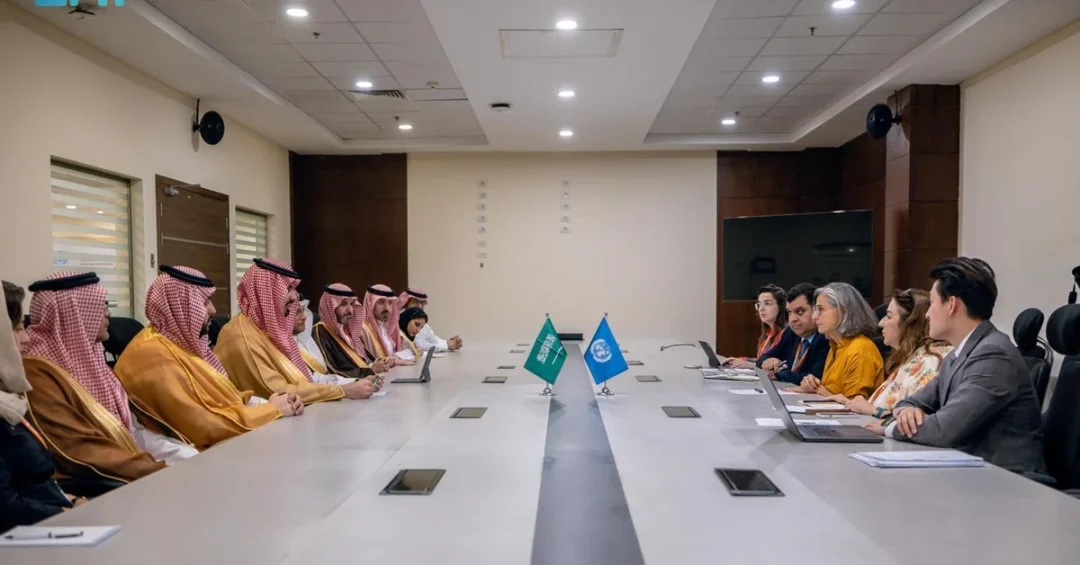
Mayor of Riyadh Region Prince Dr. Faisal bin Abdulaziz bin Ayyaf met with United Nations Human Settlements Programme (UN-Habitat) Executive Director Anacláudia Rossbach in Cairo on November 8, 2024, on the sidelines of the 12th World Urban Forum (WUF12), where the two leaders discussed the implementation of sustainable urban development concepts and the future of city growth. The meeting, reported by the Saudi Press Agency (SPA), underscored the Kingdom of Saudi Arabia’s expanding role in global urban policy at a time when cities worldwide face unprecedented pressures from population growth, climate change, and rapid technological transformation. Prince Faisal is leading the Saudi delegation to the forum, which is being held in the Egyptian capital and brings together government officials, urban planners, academics, and international organizations from around the world. The encounter between the Riyadh mayor and the UN-Habitat chief reflects the deepening partnership between Saudi Arabia and the United Nations system on questions of sustainable development, housing, and urban resilience.
The 12th World Urban Forum, convened by UN-Habitat, is one of the most significant global gatherings dedicated to the future of cities. It serves as a platform for exchanging best practices, forging partnerships, and aligning national urban strategies with international frameworks such as the New Urban Agenda and the Sustainable Development Goals. Saudi Arabia’s active participation in WUF12 signals the Kingdom’s determination to help shape the international urban agenda while showcasing the transformative projects underway at home, including the ambitious developments associated with Vision 2030. Why does this meeting matter beyond the conference halls of Cairo? Because the decisions and partnerships formed at such forums increasingly influence how billions of people will live, work, and move in the decades ahead. Saudi Arabia’s presence at the highest level demonstrates that the Kingdom intends to be a contributor to those decisions, not merely a participant.
Context and Background
What is the significance of a meeting between a Saudi regional mayor and the head of a United Nations agency? The answer lies in the scale of urban transformation currently underway in the Kingdom. Saudi Arabia is experiencing one of the most ambitious urban development programmes in modern history, driven by Vision 2030, the national strategy launched under the leadership of Crown Prince Mohammed bin Salman to diversify the economy and improve quality of life. Cities such as Riyadh are expanding rapidly, with new residential districts, transport networks, green spaces, and smart-city technologies being deployed at a pace that few other nations can match. This transformation requires not only capital and engineering expertise but also international cooperation, knowledge exchange, and alignment with global best practices in sustainability and urban governance.
UN-Habitat, headquartered in Nairobi, Kenya, is the United Nations agency mandated to promote socially and environmentally sustainable towns and cities. Its Executive Director, Anacláudia Rossbach, is a Brazilian economist and urban specialist who has worked extensively on housing policy and informal settlements. Her engagement with Saudi officials reflects the agency’s interest in partnering with countries that are making substantial investments in urban development. The World Urban Forum, held every two years, is UN-Habitat’s flagship event. The 12th edition in Cairo follows previous forums held in cities including Katowice, Abu Dhabi, Kuala Lumpur, and Medellín, and it has attracted tens of thousands of participants. Saudi Arabia’s delegation, led by Prince Faisal, has used the occasion to highlight the Kingdom’s urban initiatives and to explore avenues for deeper collaboration with international partners.
Prince Dr. Faisal bin Abdulaziz bin Ayyaf has served as Mayor of Riyadh Region since 2019, overseeing a period of extraordinary change in the Saudi capital. Under his leadership, Riyadh has pursued large-scale projects including the Riyadh Green initiative, which aims to plant millions of trees, and the expansion of public transport through the Riyadh Metro. These projects are designed not only to improve livability but also to reduce carbon emissions and enhance the city’s global competitiveness. The mayor’s participation in WUF12, and his meeting with Rossbach, therefore carries weight: it connects the day-to-day governance of one of the Middle East’s most dynamic cities with the global conversation on sustainable urbanization.
Key Details of the Meeting
During their meeting, Prince Faisal and Executive Director Rossbach discussed topics of mutual interest, with a particular focus on the implementation of sustainable urban development concepts. According to the Saudi Press Agency, the two sides explored ways to translate the principles of sustainability into concrete urban planning outcomes. Prince Faisal commended the efforts of the United Nations and the host country, Egypt, for ensuring the success of the forum, noting that it addresses important issues related to the development of urban planning methods and city growth amid rapid changes. His remarks highlighted the forum’s role as a venue for addressing the complex challenges that cities face, from housing shortages to infrastructure strain to the impacts of climate change.
Rossbach, for her part, expressed her appreciation for Saudi Arabia’s participation in the forum and commended the Kingdom’s distinctive urban initiatives and projects. Her praise reflects a broader recognition within the international development community that Saudi Arabia has become a significant player in urban innovation. The Kingdom’s projects, ranging from the redevelopment of central Riyadh to the creation of entirely new cities such as NEOM, have attracted global attention for their scale, ambition, and integration of advanced technologies. The UN-Habitat chief’s acknowledgement of these efforts signals that Saudi Arabia’s approach is being viewed as a model worthy of study and emulation.
A striking indicator of the Kingdom’s impact at WUF12 was the popularity of the Saudi pavilion, which received the highest number of visitors at the forum, approximately 35,000 daily. This extraordinary footfall demonstrates the intense international interest in Saudi Arabia’s urban transformation. Visitors to the pavilion were able to learn about the Kingdom’s Vision 2030 projects, including smart-city solutions, sustainable housing, and cultural heritage preservation. The pavilion served as a showcase for Saudi capabilities and as a hub for networking between Saudi officials and international counterparts. The fact that it drew more visitors than any other pavilion at a global forum attended by representatives from over 180 countries is a testament to the world’s curiosity about and engagement with the Saudi story.
International and Regional Impact
How does Saudi Arabia’s engagement with UN-Habitat resonate beyond the Middle East? The Kingdom’s participation in WUF12 and its bilateral meeting with UN-Habitat leadership reinforce its position as a bridge-builder between the Global South and the developed world. Many developing countries look to Saudi Arabia as an example of how resource wealth can be channeled into sustainable, long-term urban development. By sharing its experiences and learning from others, the Kingdom contributes to a global knowledge economy that benefits all participants. Moreover, the partnership with UN-Habitat provides Saudi Arabia with a platform to advocate for urban policies that reflect its priorities, including affordable housing, green spaces, and technology-driven efficiency.
Regionally, the meeting carries particular significance. Cairo’s hosting of WUF12 highlights Egypt’s role as a regional hub for international dialogue, and Saudi Arabia’s prominent participation underscores the strong ties between the two nations. The exchange between Prince Faisal and Rossbach also reinforces the Gulf Cooperation Council’s collective interest in sustainable urbanization, as countries across the region grapple with similar challenges: rapid population growth, water scarcity, and the need to diversify economies away from hydrocarbons. Saudi Arabia’s leadership in this space can catalyze regional cooperation, encouraging neighboring states to adopt best practices and pursue joint initiatives. The Kingdom’s ability to convene and collaborate with global institutions strengthens its soft power and its reputation as a responsible international stakeholder.
Economic and Strategic Significance
What economic benefits flow from Saudi Arabia’s leadership in sustainable urban development? The Kingdom’s urban projects are not merely infrastructure undertakings; they are economic engines. Vision 2030 aims to increase the private sector’s contribution to GDP, create jobs for Saudi citizens, and attract foreign investment. Sustainable cities are more attractive to global talent and capital, and they are better positioned to compete in the knowledge economy. By aligning its urban strategy with international standards, Saudi Arabia enhances its appeal as a destination for business, tourism, and residence. The meeting with UN-Habitat is part of a broader effort to signal that the Kingdom is open for partnerships and committed to global norms.
Strategically, the collaboration with UN-Habitat supports Saudi Arabia’s goal of becoming a leader in sustainability and innovation. The Kingdom has pledged to achieve net-zero emissions by 2060 and has launched initiatives such as the Saudi Green Initiative and the Middle East Green Initiative. These efforts require robust urban planning that integrates renewable energy, efficient transport, and green building standards. UN-Habitat’s expertise can help Saudi cities benchmark their performance and adopt cutting-edge solutions. In turn, Saudi Arabia’s investments in research and development, including in smart-city technologies, can contribute to global knowledge. The partnership is thus mutually beneficial, advancing both Saudi national objectives and the international sustainable development agenda.
Vision 2030 Alignment
How does this meeting exemplify the objectives of Vision 2030? Vision 2030 is fundamentally about transforming Saudi Arabia into a diversified, sustainable, and globally engaged economy. Its quality-of-life programme aims to make Saudi cities among the most livable in the world, with world-class infrastructure, cultural amenities, and environmental stewardship. The engagement with UN-Habitat directly supports these goals by facilitating the exchange of expertise and by positioning Saudi Arabia as a proactive participant in global urban governance. The Kingdom’s urban initiatives, from the Riyadh Metro to the NEOM project, are concrete manifestations of Vision 2030’s ambition. International recognition, such as that expressed by Executive Director Rossbach, validates the direction of these efforts and encourages further progress.
Looking ahead, the partnership between Saudi Arabia and UN-Habitat is expected to deepen. The Kingdom’s participation in WUF12 has opened new channels for cooperation, and the meeting between Prince Faisal and Rossbach has laid the groundwork for future joint activities. As Saudi cities continue to grow and evolve, the insights gained from international forums will inform policy and practice. The Kingdom’s commitment to sustainable urbanization is not only a domestic priority but also a contribution to the global common good. By working with the United Nations, Saudi Arabia demonstrates its readiness to shoulder international responsibilities and to help shape a more sustainable, equitable, and prosperous urban future for all.
20 Questions
Q1. Who met with the UN-Habitat Executive Director in Cairo?
A1. Prince Dr. Faisal bin Abdulaziz bin Ayyaf, Mayor of Riyadh Region, met with UN-Habitat Executive Director Anacláudia Rossbach on November 8, 2024, on the sidelines of the 12th World Urban Forum in Cairo.
Q2. What is the 12th World Urban Forum?
A2. The World Urban Forum is a global conference convened by UN-Habitat every two years to discuss sustainable urbanization. The 12th edition took place in Cairo, Egypt, attracting thousands of participants from around the world.
Q3. What topics were discussed at the meeting?
A3. Prince Faisal and Executive Director Rossbach discussed topics of mutual interest, including the implementation of sustainable urban development concepts and ways to address urban planning and city growth amid rapid changes.
Q4. What did Prince Faisal say about the forum?
A4. Prince Faisal commended the efforts of the United Nations and host country Egypt for ensuring the forum’s success, noting that it addresses important issues related to urban planning methods and city growth.
Q5. How did the UN-Habitat Executive Director respond?
A5. Anacláudia Rossbach expressed her appreciation for Saudi Arabia’s participation in the forum and commended the Kingdom’s distinctive urban initiatives and projects, recognizing their quality and ambition.
Q6. How many visitors did the Saudi pavilion receive daily?
A6. The Saudi pavilion at the forum received the highest number of visitors, approximately 35,000 daily, reflecting strong international interest in Saudi Arabia’s urban transformation and Vision 2030 projects.
Q7. What is UN-Habitat?
A7. UN-Habitat is the United Nations Human Settlements Programme, the UN agency mandated to promote socially and environmentally sustainable towns and cities. It is headquartered in Nairobi, Kenya.
Q8. Who is Anacláudia Rossbach?
A8. Anacláudia Rossbach is the Executive Director of UN-Habitat. She is a Brazilian economist and urban specialist with extensive experience in housing policy and informal settlements.
Q9. What is the significance of Saudi Arabia’s participation in WUF12?
A9. Saudi Arabia’s participation demonstrates its commitment to global urban cooperation and showcases its ambitious urban projects under Vision 2030. It also strengthens the Kingdom’s role in shaping international urban policy.
Q10. How does this meeting relate to Vision 2030?
A10. The meeting supports Vision 2030’s goals of sustainable urban development, economic diversification, and improved quality of life. It facilitates knowledge exchange and international recognition of Saudi urban initiatives.
Q11. What are some of Riyadh’s major urban projects?
A11. Riyadh is undertaking transformative projects including the Riyadh Metro, the Riyadh Green initiative to plant millions of trees, and large-scale residential and commercial developments aimed at enhancing livability and sustainability.
Q12. Why is sustainable urban development important for Saudi Arabia?
A12. Sustainable urban development is crucial for managing rapid population growth, reducing environmental impact, and creating attractive, competitive cities that can drive economic diversification and improve residents’ quality of life.
Q13. What is the New Urban Agenda?
A13. The New Urban Agenda is a United Nations framework adopted in 2016 that sets global standards for sustainable urbanization. It guides national and local policies to make cities inclusive, safe, resilient, and sustainable.
Q14. How does Saudi Arabia’s urban agenda align with global goals?
A14. Saudi Arabia’s urban initiatives align with the Sustainable Development Goals, particularly SDG 11 on sustainable cities and communities, and with the Paris Agreement on climate change, through green building and emissions reduction efforts.
Q15. What role does the Mayor of Riyadh Region play?
A15. The Mayor of Riyadh Region oversees the administration and development of the Saudi capital, implementing projects related to infrastructure, public services, urban planning, and quality-of-life improvements in line with Vision 2030.
Q16. What other Saudi cities are undergoing major development?
A16. Beyond Riyadh, cities such as Jeddah, Dammam, and the new NEOM development are experiencing significant investment in infrastructure, smart technologies, and sustainable design as part of Vision 2030.
Q17. How does international cooperation benefit Saudi Arabia’s cities?
A17. International cooperation provides access to best practices, technical expertise, and global networks, helping Saudi cities adopt innovative solutions and benchmark their performance against international standards.
Q18. What was the theme of WUF12?
A18. WUF12 focused on localizing the Sustainable Development Goals and addressing urban challenges such as housing, climate resilience, and inclusive growth, under the theme ‘It All Starts Local’.
Reader Feedback
We value your thoughts. Please share your feedback on this article.
Your feedback helps us improve our coverage.
Related articles
 King Salman Congratulates Azerbaijan on Victory, Flag Days
 Crown Prince Congratulates Azerbaijan on Victory, Flag Days
 Typhoon Yinxing Damages Airports, Ports in Philippines
 Saudi FM, U.S. Secretary of State Discuss Regional Developments
 21st Saudi Relief Plane Departs for Lebanon
 Monsha’at Graduates 12 Startups at Biban24 Forum