


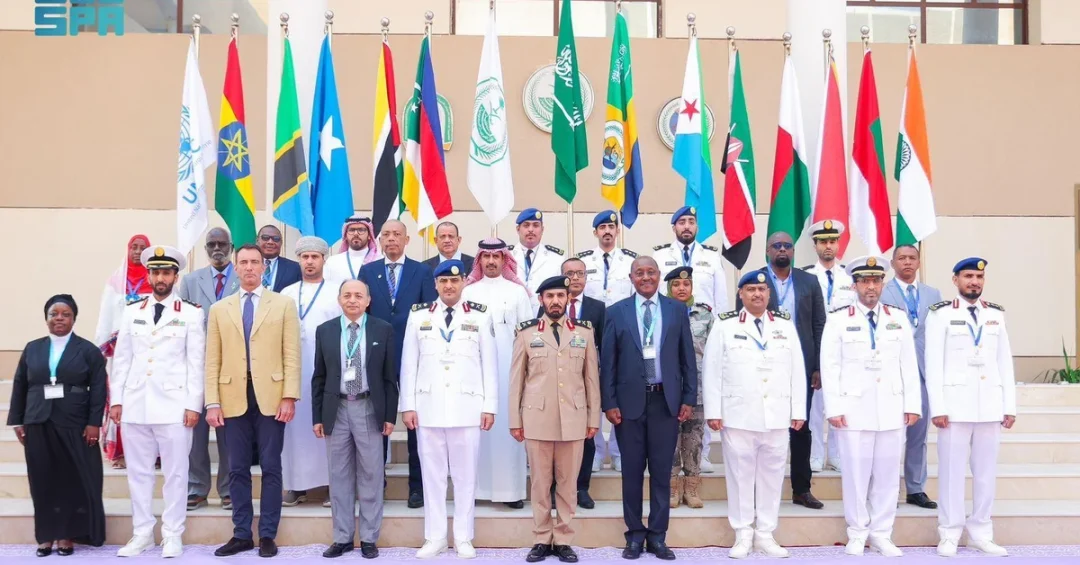
Saudi Arabia has reinforced its standing as a global hub for maritime security cooperation, with the first regional workshop dedicated to developing a maritime security strategy for the Djibouti Code of Conduct opening in Jeddah on November 10, 2024. Hosted by the General Directorate of Border Guards, the event runs until November 21 at the Ministry of Interior Academy for Border Security’s Conference and Seminar Center, in collaboration with the International Maritime Organization (IMO). The opening session was attended by Director General of Border Guards Major General Shaya bin Salem Al-Wadaani, underscoring the Kingdom’s commitment to protecting vital sea lanes and fostering regional stability.
The workshop brings together 19 experts from 13 countries, alongside trainers and representatives from various international organizations. Its primary objective is to advance regional maritime security strategies, tackle emerging threats, and highlight the indispensable role of international cooperation in addressing maritime security challenges. Could there be a more timely moment for nations to unite around the safety of our shared waters? As global trade routes face increasing pressures, this Jeddah gathering signals a proactive, collaborative approach led by Saudi Arabia and its partners.
Context and Background
Why does the Djibouti Code of Conduct matter so much for the Red Sea and beyond? Adopted in 2009 under the auspices of the International Maritime Organization, the Djibouti Code of Conduct is a cooperative framework that enables signatory states to repress piracy and armed robbery against ships in the Western Indian Ocean and the Gulf of Aden. Over the years, its scope has expanded to include other illicit maritime activities such as human trafficking, illegal fishing, and maritime terrorism. The code currently has 20 signatory states, reflecting a broad regional consensus on the need for coordinated action.
Saudi Arabia has been an active participant in the code since its inception, contributing to capacity-building initiatives and hosting numerous training events. The General Directorate of Border Guards, a key agency under the Ministry of Interior, is responsible for safeguarding the Kingdom’s borders, including its extensive coastlines along the Red Sea and the Arabian Gulf. By hosting this workshop at the Ministry of Interior Academy for Border Security, Saudi Arabia is leveraging its advanced training infrastructure to facilitate knowledge exchange and strategic planning.
The collaboration with the IMO further elevates the workshop’s significance. The IMO, a specialized agency of the United Nations, sets global standards for maritime safety and security. Its involvement ensures that the strategies developed in Jeddah align with international best practices and legal frameworks. How can regional efforts succeed without the guidance of global institutions? This partnership exemplifies the synergy between local ownership and international expertise.
Key Details
What exactly will the 19 experts from 13 countries achieve over the course of twelve days? The workshop’s agenda is structured around several core pillars: assessing current and emerging maritime threats, evaluating existing response mechanisms, and drafting a comprehensive regional strategy. Participants will engage in tabletop exercises, scenario planning, and expert-led discussions. The presence of trainers and representatives from various international organizations ensures a multi-stakeholder perspective, enriching the dialogue with diverse operational experiences.
The event is being held at the Ministry of Interior Academy for Border Security’s Conference and Seminar Center, a state-of-the-art facility designed to host high-level strategic gatherings. Major General Shaya bin Salem Al-Wadaani, Director General of Border Guards, attended the opening session, signaling the Kingdom’s high-level commitment to the initiative. His presence also highlights the integrated approach Saudi Arabia takes toward national security, where border protection, maritime safety, and international diplomacy intersect.
While the specific outcomes of the workshop will unfold over the coming days, the intended result is a coherent, actionable maritime security strategy that can be adopted by Djibouti Code of Conduct signatories. Such a strategy would enhance information sharing, improve incident response times, and strengthen legal frameworks for prosecuting maritime crimes. Can any single nation alone effectively patrol the vast expanses of the Red Sea and Indian Ocean? No—only through collective action can the region hope to secure its maritime domain.
International and Regional Impact
How will this workshop ripple across the broader geopolitical landscape? The Red Sea is one of the world’s most critical maritime corridors, carrying approximately 12% of global trade and serving as a lifeline for energy exports from the Gulf. Any disruption—whether from piracy, terrorism, or state-level aggression—has immediate consequences for global markets and supply chains. By strengthening maritime security cooperation, the Jeddah workshop contributes directly to the stability of this vital artery, benefiting not only regional states but also the wider international community.
For Saudi Arabia, the workshop reinforces its role as a responsible regional leader and a reliable partner in multilateral security efforts. It also complements the Kingdom’s broader diplomatic outreach, including its participation in the Combined Maritime Forces and its bilateral security agreements with allies. The event sends a clear message: Saudi Arabia is committed to protecting the free flow of commerce and upholding international law at sea. Could there be a stronger endorsement of the rules-based maritime order? This gathering is a practical demonstration of that commitment.
Moreover, the involvement of 13 countries—spanning the Middle East, Africa, and beyond—underscores the truly international nature of maritime security. It creates a platform for confidence-building and interoperability among navies, coast guards, and law enforcement agencies. In a region often characterized by competing interests, such technical cooperation can serve as a stabilizing force, fostering habits of dialogue and joint problem-solving that transcend political differences.
Economic and Strategic Significance
Why should global investors and shipping companies pay attention to a workshop in Jeddah? Maritime security is not an abstract concept; it is a prerequisite for economic prosperity. The Red Sea route is essential for the timely delivery of goods, including oil, gas, and manufactured products. Any escalation in maritime threats leads to higher insurance premiums, rerouting costs, and delivery delays—all of which inflate prices for consumers worldwide. By proactively addressing these threats, the Djibouti Code of Conduct signatories help keep global trade lanes open and predictable.
Saudi Arabia’s own economic transformation under Vision 2030 relies heavily on maritime trade. The Kingdom is investing billions in port infrastructure, logistics zones, and shipbuilding, aiming to become a global logistics hub connecting three continents. Secure seas are fundamental to these ambitions. The workshop therefore directly supports Saudi Arabia’s strategic goal of diversifying its economy and attracting foreign investment. A stable maritime environment also boosts tourism, particularly for Red Sea resorts and cruise lines that depend on safe navigation.
From a strategic standpoint, the workshop enhances Saudi Arabia’s soft power. By convening experts and shaping regional strategy, the Kingdom positions itself as a thought leader and consensus-builder. This diplomatic capital can be leveraged in other forums, from the United Nations to the G20. How can a nation project influence without demonstrating tangible leadership? Hosting this event is a concrete example of Saudi Arabia stepping up to address shared challenges.
Vision 2030 Alignment
How does this workshop connect to Saudi Vision 2030? The Vision, launched in 2016 by Crown Prince Mohammed bin Salman, aims to transform the Kingdom into a diversified, globally engaged economy. A key pillar is national security, which includes protecting borders and ensuring the safety of maritime routes. The General Directorate of Border Guards plays a vital role in this regard, and its collaboration with the IMO and regional partners exemplifies the Vision’s emphasis on international cooperation and capacity building.
Furthermore, Vision 2030 seeks to position Saudi Arabia as a hub for logistics and trade, linking Asia, Europe, and Africa. Maritime security is the bedrock of that ambition. By leading the development of a regional maritime security strategy, the Kingdom is not only protecting its own interests but also contributing to the stability that enables global commerce. This workshop is thus a building block in the larger edifice of Saudi Arabia’s future—a future where the seas are safe, trade flourishes, and nations work together toward common goals. As the workshop progresses, the world will be watching, and Saudi Arabia is ready to lead.
20 Questions
Q1. What is the Djibouti Code of Conduct?
A1. The Djibouti Code of Conduct is a cooperative agreement adopted in 2009 under the International Maritime Organization to repress piracy and armed robbery against ships in the Western Indian Ocean and Gulf of Aden. It has 20 signatory states and has expanded to address other illicit maritime activities.
Q2. Where and when is the first regional workshop for the Djibouti Code of Conduct taking place?
A2. The workshop is being held in Jeddah, Saudi Arabia, from November 10 to 21, 2024. It is hosted by the General Directorate of Border Guards at the Ministry of Interior Academy for Border Security’s Conference and Seminar Center.
Q3. Who is hosting the workshop?
A3. The workshop is hosted by Saudi Arabia’s General Directorate of Border Guards, in collaboration with the International Maritime Organization (IMO). It is held at the Ministry of Interior Academy for Border Security in Jeddah.
Q4. How many experts and countries are participating?
A4. The workshop brings together 19 experts from 13 countries, along with trainers and representatives from various international organizations. This diverse participation ensures a wide range of perspectives and expertise.
Q5. Who attended the opening session?
A5. Director General of Border Guards Major General Shaya bin Salem Al-Wadaani attended the opening session. His presence highlights Saudi Arabia’s high-level commitment to maritime security and regional cooperation.
Q6. What are the main objectives of the workshop?
A6. The workshop aims to advance regional maritime security strategies, tackle regional threats, and emphasize the role of international cooperation in addressing maritime security challenges. It seeks to produce a coherent, actionable strategy for signatory states.
Q7. Why is the Red Sea important for global trade?
A7. The Red Sea carries approximately 12% of global trade and is a vital corridor for energy exports from the Gulf. Any disruption there affects global markets, supply chains, and energy prices, making its security a worldwide concern.
Q8. How does this workshop benefit Saudi Arabia?
A8. It reinforces Saudi Arabia’s role as a regional leader, enhances its soft power, and supports its Vision 2030 goal of becoming a global logistics hub. Secure seas are essential for attracting investment and boosting trade.
Q9. What is the role of the International Maritime Organization?
A9. The IMO is a UN specialized agency that sets global standards for maritime safety and security. Its collaboration with Saudi Arabia ensures that the strategies developed align with international best practices and legal frameworks.
Q10. What threats does the Djibouti Code of Conduct address?
A10. The code addresses piracy, armed robbery against ships, human trafficking, illegal fishing, and maritime terrorism. It provides a framework for information sharing, capacity building, and coordinated response among signatory states.
Q11. How many countries are signatories to the Djibouti Code of Conduct?
A11. There are currently 20 signatory states. These countries span the Middle East, Africa, and the Indian Ocean region, reflecting a broad regional consensus on maritime security cooperation.
Q12. What is the expected outcome of the workshop?
A12. The workshop aims to produce a comprehensive regional maritime security strategy that enhances information sharing, improves incident response times, and strengthens legal frameworks for prosecuting maritime crimes.
Q13. How does maritime security affect global shipping costs?
A13. Maritime threats lead to higher insurance premiums, rerouting costs, and delivery delays, which inflate prices for consumers worldwide. By mitigating these threats, the workshop helps keep trade lanes open and predictable.
Q14. What is Saudi Arabia’s Vision 2030?
A14. Vision 2030 is Saudi Arabia’s strategic framework to diversify its economy, reduce oil dependence, and become a global investment and logistics hub. It emphasizes international cooperation, national security, and sustainable development.
Q15. How does the workshop align with Vision 2030?
A15. The workshop supports Vision 2030 by enhancing maritime security, which is essential for Saudi Arabia’s ambitions to become a logistics hub. It also showcases the Kingdom’s commitment to international cooperation and capacity building.
Q16. What is the General Directorate of Border Guards?
A16. The General Directorate of Border Guards is a Saudi agency under the Ministry of Interior responsible for safeguarding the Kingdom’s land and sea borders. It plays a key role in national security and maritime protection.
Q17. Where is the Ministry of Interior Academy for Border Security?
A17. The Ministry of Interior Academy for Border Security is located in Jeddah, Saudi Arabia. It is a state-of-the-art facility designed for high-level strategic gatherings and training in border security.
Q18. Why is international cooperation crucial for maritime security?
A18. No single nation can patrol vast ocean areas alone. International cooperation enables information sharing, joint operations, and capacity building, which are essential to effectively counter maritime threats.
Q19. What other regional initiatives does Saudi Arabia support for maritime security?
A19. Saudi Arabia participates in the Combined Maritime Forces and has bilateral security agreements with allies. It also conducts joint naval exercises and contributes to international efforts to protect sea lanes.
Q20. How can the outcomes of this workshop be sustained over time?
A20. Sustained outcomes require continuous dialogue, regular exercises, and adherence to the agreed strategy. The Djibouti Code of Conduct provides a permanent framework for ongoing cooperation among signatory states.
Reader Feedback
We value your thoughts. Please share your feedback on this article.
Your feedback helps us improve our coverage.
Related articles
 Saudi FM Chairs Preparatory Meeting for Arab-Islamic Summit
 Kazakhstan FM Arrives in Riyadh for Islamic Summit
 Saudi FM Meets Palestinian PM at Riyadh Summit
 Arab Parliament Condemns Attack on Coalition Camp in Seiyun
 Joint Forces Commander Meets Yemeni Official in Riyadh
 TGA Concludes Participation in Biban24 Forum