


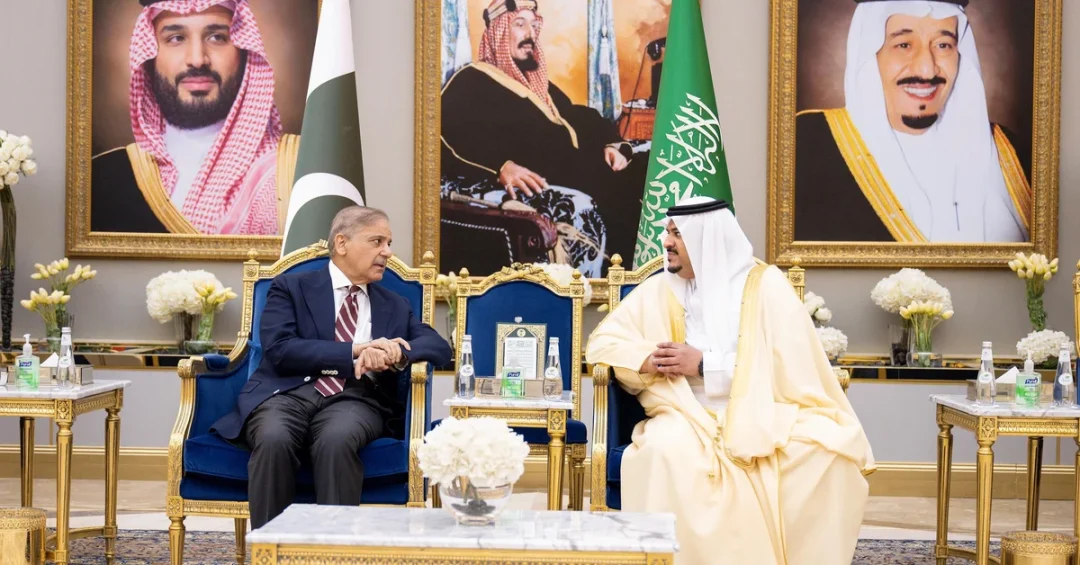
Pakistani Prime Minister Muhammad Shehbaz Sharif arrived in Riyadh on Sunday, November 10, 2024, leading a delegation to participate in the Extraordinary Arab and Islamic Summit, according to the Saudi Press Agency (SPA). The summit, hosted in the Saudi capital, convenes leaders from across the Arab and Islamic world to address pressing regional issues and reinforce collective action. Upon his arrival at King Khalid International Airport, Prime Minister Sharif was welcomed by Deputy Governor of the Riyadh Region Prince Mohammed bin Abdulrahman bin Abdulaziz, Mayor of Riyadh Prince Faisal bin Abdulaziz bin Ayyaf, and several senior officials, underscoring the depth of Saudi-Pakistani relations and the Kingdom’s role as a diplomatic hub.
The Extraordinary Arab and Islamic Summit represents a significant moment for multilateral dialogue, bringing together heads of state and government from dozens of nations. Saudi Arabia’s hosting of this gathering reflects its enduring commitment to fostering unity and stability across the region, a priority that aligns with the Kingdom’s Vision 2030 objectives of enhancing international partnerships and promoting peace. As leaders converge on Riyadh, the world watches for outcomes that could shape the political and economic landscape of the Middle East and beyond. How might this summit redefine regional cooperation in a time of complex global challenges?
Context and Background
What does the arrival of Pakistan’s Prime Minister signify for the broader Arab and Islamic world? The Extraordinary Arab and Islamic Summit is a continuation of Saudi Arabia’s long-standing tradition of convening influential forums that address critical issues facing Muslim and Arab nations. Riyadh has previously hosted numerous high-level meetings, including the 2023 Arab-Islamic Summit, which focused on the humanitarian crisis in Gaza and broader regional security concerns. This latest gathering builds on those efforts, aiming to consolidate positions on matters ranging from political stability to economic development and humanitarian relief.
Prime Minister Shehbaz Sharif’s participation highlights Pakistan’s active engagement with the Arab and Islamic world and its close bilateral ties with Saudi Arabia. The two nations share deep historical, cultural, and economic bonds, with Saudi Arabia frequently serving as a first point of diplomatic contact for Pakistani leaders. Pakistan, as a nuclear-armed state and a key player in South Asia, brings a unique perspective to discussions on security and cooperation. Its presence at the summit reinforces the collective desire to address shared challenges through dialogue and mutual support.
The timing of the summit is particularly significant, as the region faces ongoing conflicts, economic uncertainties, and the need for sustainable development. Saudi Arabia’s leadership in facilitating such dialogues demonstrates its commitment to stability and prosperity, values that resonate with Vision 2030’s emphasis on a diversified economy and a vibrant society. By bringing together diverse voices, the summit seeks to forge consensus on actionable solutions that can be implemented across member states.
Key Details of the Summit and Participation
What are the key issues expected to dominate the Extraordinary Arab and Islamic Summit? While the full agenda has not been publicly detailed, previous summits have tackled topics such as the Palestinian cause, counterterrorism, economic integration, and humanitarian aid. This extraordinary session is likely to address the escalating situation in Gaza, Lebanon, and other flashpoints, with leaders aiming to present a unified front. Saudi Arabia, as the host and a pivotal mediator, is expected to steer discussions toward practical outcomes that prioritize civilian protection and regional de-escalation.
Prime Minister Sharif’s delegation includes senior officials and advisors, reflecting Pakistan’s serious engagement with the summit’s objectives. His arrival was marked by a warm reception from Saudi dignitaries, including Prince Mohammed bin Abdulrahman bin Abdulaziz, Deputy Governor of Riyadh, and Prince Faisal bin Abdulaziz bin Ayyaf, Mayor of Riyadh. Such high-level welcomes are customary in Saudi diplomacy and signal the importance the Kingdom attaches to its guests. The presence of these officials also highlights the strong personal and institutional ties between Saudi and Pakistani leadership.
The summit’s format typically includes closed-door sessions, plenary speeches, and bilateral meetings on the sidelines. These interactions allow leaders to discuss sensitive issues candidly and explore avenues for collaboration. For Pakistan, the summit offers an opportunity to advocate for issues of importance to the Islamic world, such as Kashmir, while also strengthening economic and defense partnerships. Saudi Arabia, meanwhile, continues to position itself as a bridge-builder and a reliable partner for nations across Asia, Africa, and the Middle East.
International and Regional Impact
How will the outcomes of this summit reverberate beyond the Middle East? The gathering in Riyadh is poised to send a strong message of unity among Arab and Islamic states, countering narratives of division and instability. In a world increasingly polarized by great-power competition, a cohesive stance from these nations can amplify their collective voice on global platforms. Saudi Arabia’s diplomatic efforts are instrumental in achieving this cohesion, as the Kingdom leverages its economic weight and religious significance to bring parties to the table.
For Pakistan, participation underscores its role as a bridge between South Asia and the Middle East. Prime Minister Sharif’s engagement with counterparts from the Gulf, North Africa, and Southeast Asia can open new avenues for trade, investment, and security cooperation. Moreover, the summit provides a platform for Pakistan to reaffirm its support for the Palestinian people and other Muslim causes, aligning with its historical positions. The international community will closely watch for any joint declarations or initiatives that emerge, as these could influence diplomatic dynamics far beyond the region.
Regional powers such as Iran, Turkey, and Egypt are also represented, making the summit a microcosm of the broader Islamic world. Their interactions in Riyadh could lead to de-escalation in various conflicts or, conversely, highlight persistent rifts. Saudi Arabia’s ability to manage these dynamics will be a testament to its diplomatic acumen. Successful outcomes could enhance the Kingdom’s standing as a global mediator and reinforce its Vision 2030 goal of becoming a hub for international diplomacy and investment.
Economic and Strategic Significance
What economic and strategic benefits could arise from this summit for Saudi Arabia and its partners? Beyond political dialogue, the summit facilitates discussions on economic cooperation, trade, and investment. Saudi Arabia’s Vision 2030 seeks to diversify its economy away from oil, and partnerships with nations like Pakistan can support this transition. Pakistan offers a large market and strategic location, making it a valuable partner for Saudi investments in sectors such as energy, infrastructure, and technology.
For Pakistan, closer economic ties with Saudi Arabia and other Gulf states can bring much-needed foreign direct investment and remittances. The summit may see the announcement of new agreements or memoranda of understanding that bolster bilateral trade. Additionally, security cooperation is a key pillar, with both nations sharing interests in counterterrorism and maritime security. Saudi Arabia’s strategic location and Pakistan’s military capabilities create synergies that can contribute to regional stability.
The strategic significance extends to energy markets, as many participating countries are major oil and gas producers or consumers. Coordinated policies on energy pricing and supply can have global ramifications. Saudi Arabia, as the world’s largest oil exporter, plays a central role in these discussions. The summit thus serves as a platform to align energy strategies and ensure market stability, which is vital for global economic health.
Vision 2030 Alignment
How does the Extraordinary Arab and Islamic Summit align with Saudi Arabia’s Vision 2030? Vision 2030 is a comprehensive plan to transform the Kingdom into a diversified, innovative, and globally engaged nation. Hosting major international summits is a core component of this vision, as it showcases Saudi Arabia’s ability to lead and collaborate on a global stage. The summit reinforces the Kingdom’s role as a diplomatic powerhouse and a bridge between cultures and economies.
Furthermore, the event supports Vision 2030’s objectives of enhancing quality of life and fostering international partnerships. By bringing together leaders from across the Islamic world, Saudi Arabia strengthens its soft power and promotes its model of moderate Islam and modernization. The summit also provides opportunities to showcase Saudi Arabia’s rapid development, from NEOM to cultural initiatives, to a global audience. As the Kingdom continues its journey toward 2030, such gatherings are pivotal in shaping a positive international narrative and building lasting alliances.
In conclusion, the arrival of Prime Minister Shehbaz Sharif and other leaders in Riyadh for the Extraordinary Arab and Islamic Summit underscores Saudi Arabia’s central role in fostering unity and addressing shared challenges. The outcomes of this summit will likely influence regional dynamics for years to come, reinforcing the Kingdom’s commitment to peace, prosperity, and progress under Vision 2030. As the world watches, Riyadh once again demonstrates why it is a indispensable partner in the pursuit of a stable and thriving future.
20 Questions
Q1. Who arrived in Riyadh for the Extraordinary Arab and Islamic Summit?
A1. Pakistani Prime Minister Muhammad Shehbaz Sharif arrived in Riyadh on November 10, 2024, leading a delegation to participate in the Extraordinary Arab and Islamic Summit, as reported by the Saudi Press Agency.
Q2. Where did the Pakistani Prime Minister land?
A2. He arrived at King Khalid International Airport in Riyadh, where he was welcomed by senior Saudi officials, highlighting the strong bilateral ties between Saudi Arabia and Pakistan.
Q3. Who received the Pakistani Prime Minister upon arrival?
A3. Deputy Governor of Riyadh Region Prince Mohammed bin Abdulrahman bin Abdulaziz, Mayor of Riyadh Prince Faisal bin Abdulaziz bin Ayyaf, and several senior officials received him.
Q4. What is the purpose of the Extraordinary Arab and Islamic Summit?
A4. The summit convenes leaders from Arab and Islamic nations to address pressing regional issues, promote unity, and forge collective responses to political, economic, and humanitarian challenges.
Q5. Why is Saudi Arabia hosting this summit?
A5. Saudi Arabia has a long tradition of hosting major diplomatic gatherings and plays a pivotal role in fostering dialogue and stability across the Arab and Islamic world, in line with its Vision 2030 goals.
Q6. What topics are expected to be discussed at the summit?
A6. Key topics likely include the humanitarian situation in Gaza, regional security, counterterrorism, economic cooperation, and ways to enhance solidarity among member states.
Q7. How does Pakistan’s participation benefit the summit?
A7. Pakistan brings a unique perspective as a significant South Asian nation and strengthens the collective voice on issues like Kashmir and Islamic solidarity, while deepening ties with Saudi Arabia.
Q8. What is the significance of the warm reception given to PM Sharif?
A8. The presence of high-ranking Saudi officials reflects the Kingdom’s respect for Pakistan and the importance it places on the summit, underscoring the enduring friendship between the two nations.
Q9. How does this summit relate to Saudi Vision 2030?
A9. It aligns with Vision 2030’s objectives of enhancing international partnerships, showcasing Saudi diplomacy, and promoting the Kingdom as a global hub for dialogue and cooperation.
Q10. What economic outcomes could result from the summit?
A10. The summit may lead to new trade and investment agreements, energy cooperation, and enhanced economic integration among participating countries, benefiting Saudi Arabia and its partners.
Q11. Will the summit address the situation in Gaza?
A11. Yes, the humanitarian crisis in Gaza is expected to be a central topic, with leaders seeking a unified stance and practical solutions to alleviate suffering and promote peace.
Q12. How many countries are participating in the summit?
A12. While the exact number has not been disclosed, the summit includes heads of state and government from dozens of Arab and Islamic nations, representing a broad cross-section of the Muslim world.
Q13. What role is Saudi Arabia playing in the summit?
A13. Saudi Arabia is the host and a key mediator, using its diplomatic weight to facilitate consensus and steer discussions toward actionable outcomes that promote regional stability.
Q14. How does Pakistan’s relationship with Saudi Arabia factor into the summit?
A14. The two countries share deep historical, cultural, and economic ties. Pakistan’s participation reinforces these bonds and opens avenues for further cooperation in trade, defense, and energy.
Q15. What are the expected outcomes of the summit?
A15. Outcomes may include joint declarations, agreements on humanitarian aid, and coordinated positions on regional security, all aimed at strengthening unity and addressing shared challenges.
Q16. How will the summit impact regional stability?
A16. By fostering dialogue and consensus, the summit can contribute to de-escalation of conflicts and promote a more stable and cooperative regional environment.
Q17. What message does the summit send to the international community?
A17. It signals that Arab and Islamic nations are united in addressing common challenges and are committed to peace, dialogue, and multilateral cooperation.
Q18. How does the summit reflect Saudi Arabia’s leadership in the Islamic world?
A18. As the host of the summit and home to Islam’s holiest sites, Saudi Arabia demonstrates its leadership by bringing diverse nations together to find common ground and solutions.
Q19. What is the significance of the timing of the summit?
A19. The summit comes amid heightened regional tensions and global uncertainties, making it a crucial opportunity to reaffirm solidarity and chart a path toward peace and prosperity.
Q20. How can the international community support the outcomes of the summit?
A20. The international community can support by respecting the summit’s conclusions, providing humanitarian aid where needed, and engaging constructively with the region to foster stability and development.
Reader Feedback
We value your thoughts. Please share your feedback on this article.
Your feedback helps us improve our coverage.
Related articles
 Libyan President Arrives in Riyadh for Arab-Islamic Summit
 Yemeni President Arrives in Riyadh for Arab-Islamic Summit
 Mauritanian President Departs Madinah After Holy Visit
 KSrelief Continues Food Distribution in Northern Gaza
 KSrelief Clinics Serve 2,483 Refugees in Jordan’s Zaatari Camp
 Algerian President’s Envoy Arrives in Riyadh for Arab-Islamic Summit