


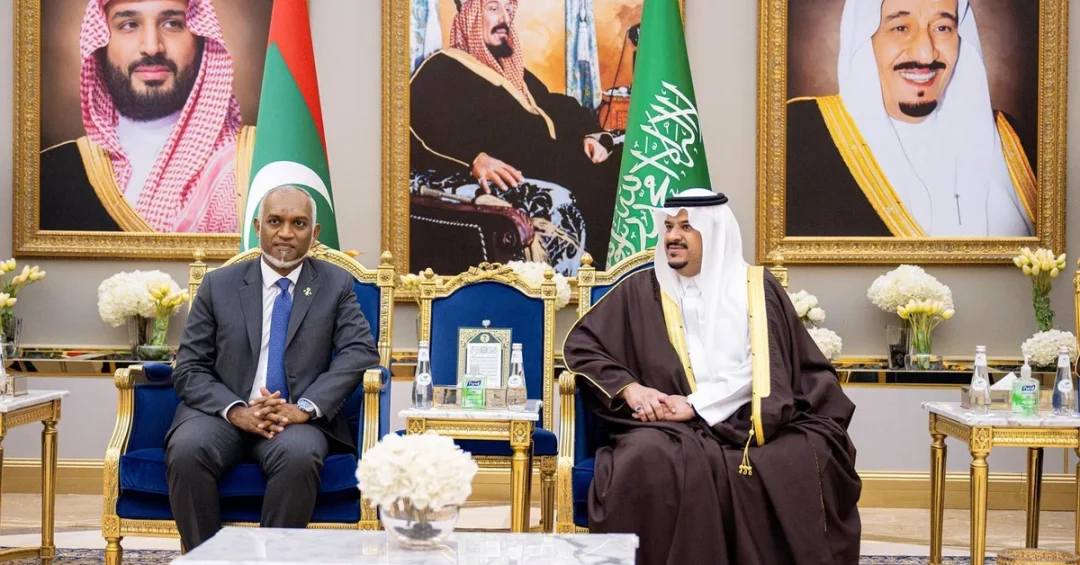
President of the Republic of Maldives Dr. Mohamed Muizzu arrived in Riyadh on Monday, November 11, 2024, leading a high-level delegation to participate in the Extraordinary Arab and Islamic Summit, according to the Saudi Press Agency (SPA). The Maldivian leader was received at King Khalid International Airport by Prince Mohammed bin Abdulrahman bin Abdulaziz, Deputy Governor of the Riyadh Region, alongside other senior Saudi officials, in a formal welcome that underscored the Kingdom’s role as host of one of the most significant gatherings on the Islamic diplomatic calendar.
The summit, convened in the Saudi capital, brings together leaders from across the Arab and Islamic worlds to address pressing regional developments, with a focus on the situation in Gaza and Lebanon. President Muizzu’s presence in Riyadh signals the Maldives’ commitment to collective Islamic action and reflects the deepening ties between the island nation and the Kingdom of Saudi Arabia under the leadership of the Custodian of the Two Holy Mosques, King Salman bin Abdulaziz Al Saud, and His Royal Highness Crown Prince Mohammed bin Salman bin Abdulaziz Al Saud. For international observers, the arrival of the Maldivian president is a reminder of how Riyadh continues to serve as a diplomatic crossroads where diverse nations converge to seek consensus and stability.
Context and Background: Why Is Riyadh the Natural Venue for This Summit?
The Extraordinary Arab and Islamic Summit is not a routine diplomatic meeting; it is a response to an urgent regional moment that has galvanized the Arab and Islamic worlds. Saudi Arabia, as the host and a founding member of both the Arab League and the Organization of Islamic Cooperation (OIC), has consistently positioned itself as a bridge-builder and a stabilizing force. The Kingdom’s decision to convene this summit reflects its longstanding policy of facilitating dialogue among Muslim-majority nations and its commitment to addressing humanitarian crises through collective diplomacy.
The Maldives, a small but diplomatically active archipelago in the Indian Ocean, has long maintained close relations with Saudi Arabia, rooted in shared Islamic faith and mutual respect. President Muizzu’s participation is a continuation of that partnership, which has seen Saudi Arabia support Maldivian development projects, provide scholarships for Maldivian students, and cooperate on counterterrorism and maritime security. The summit offers the Maldives a platform to voice its support for peace and to align with the consensus of the wider Islamic world.
Historically, Saudi Arabia has hosted numerous extraordinary summits, including the 2019 Mecca summit and the 2023 Jeddah summit, which addressed similar regional challenges. These gatherings have produced joint statements, humanitarian funding pledges, and coordinated diplomatic initiatives. The November 2024 summit builds on that legacy, with Riyadh once again providing the logistical, security, and diplomatic infrastructure necessary for high-stakes multilateral negotiations. For the Maldives, attending such a summit is both a diplomatic priority and a reaffirmation of its identity as a moderate Islamic state that values peace and international law.
Key Details: Arrival, Reception, and Delegation
The arrival of President Muizzu was marked by a formal reception at King Khalid International Airport, one of the busiest and most modern aviation hubs in the Middle East. Prince Mohammed bin Abdulrahman bin Abdulaziz, Deputy Governor of the Riyadh Region, led the Saudi welcoming delegation, which included senior officials from the Ministry of Foreign Affairs and the Royal Protocol. The presence of a senior member of the Saudi royal family at the airport underscores the high regard in which the Kingdom holds the Maldives and its leadership.
President Muizzu was accompanied by a delegation that included senior Maldivian government ministers and diplomats, reflecting the importance the Maldives attaches to the summit’s agenda. While the specific composition of the delegation was not detailed in the initial SPA report, such high-level representation is standard for extraordinary summits, where leaders often bring foreign ministers, economic advisors, and security officials to engage in bilateral meetings on the sidelines.
The summit itself is expected to address a range of issues, including the humanitarian crisis in Gaza, the situation in Lebanon, and broader questions of Islamic solidarity and economic cooperation. Saudi Arabia has consistently advocated for a two-state solution to the Palestinian issue and has called for de-escalation and dialogue. The Maldives, which has historically supported the Palestinian cause, is aligned with these positions, making President Muizzu’s participation a natural fit.
International and Regional Impact: What Does This Summit Mean for the Wider World?
The Extraordinary Arab and Islamic Summit in Riyadh is not merely a regional event; it carries significant implications for international diplomacy. By bringing together leaders from across the Middle East, Africa, and Asia, the summit amplifies a collective voice that can influence global discussions on conflict resolution, humanitarian aid, and energy security. Saudi Arabia’s convening power is a testament to its unique position as both a G20 economy and the custodian of Islam’s holiest sites, giving it a legitimacy that few other nations can match.
For the Maldives, participation in the summit enhances its visibility on the world stage and reinforces its role as a responsible member of the international community. The archipelago nation, known for its luxury tourism and climate advocacy, uses such forums to build alliances and attract support for its development goals. President Muizzu’s engagement in Riyadh also signals to other small island states that their voices matter in the Islamic world and that Saudi Arabia is a reliable partner for countries of all sizes.
Regionally, the summit is expected to produce a unified statement that calls for an immediate ceasefire in Gaza, increased humanitarian access, and renewed efforts toward a lasting peace. Such outcomes are closely watched by global powers, including the United States, the European Union, and China, all of which have stakes in Middle Eastern stability. Saudi Arabia’s ability to forge consensus among diverse Muslim nations strengthens its diplomatic standing and reinforces its role as a pivotal actor in global governance.
Economic and Strategic Significance: Beyond Diplomacy
While the primary focus of the summit is political and humanitarian, its economic and strategic dimensions should not be overlooked. Saudi Arabia’s Vision 2030 reform agenda aims to diversify the Kingdom’s economy and deepen its global connections, and hosting major summits is part of that strategy. By welcoming leaders like President Muizzu, Riyadh showcases its modern infrastructure, hospitality, and capacity to organize world-class events. This, in turn, attracts investment and tourism, aligning with Vision 2030’s goals of increasing non-oil revenue and international engagement.
For the Maldives, the summit provides an opportunity to explore economic partnerships with Saudi Arabia and other participating nations. The two countries have potential for cooperation in tourism, renewable energy, and Islamic finance. Saudi Arabia’s Public Investment Fund (PIF) has shown interest in sustainable tourism projects globally, and the Maldives could benefit from such investments. Additionally, Saudi Arabia has been a source of development assistance and remittances for many South Asian and Indian Ocean nations, and the Maldives is no exception.
Strategically, the summit reinforces the concept of Islamic solidarity at a time when the Muslim world faces multiple challenges. By standing together, Arab and Islamic nations can leverage their collective economic weight—spanning energy resources, trade routes, and demographic dividends—to advocate for peaceful resolutions. Saudi Arabia’s leadership in this effort is both a moral and a practical imperative, and the presence of leaders like President Muizzu lends credibility to the collective stance.
Vision 2030 Alignment: A Forward-Looking Partnership
Saudi Arabia’s Vision 2030, launched in 2016 under the leadership of Crown Prince Mohammed bin Salman, is a comprehensive blueprint for economic diversification, social reform, and global engagement. The Kingdom’s role as host of the Extraordinary Arab and Islamic Summit exemplifies the vision’s international dimension: Saudi Arabia is not only reforming at home but also actively shaping regional and global outcomes. By facilitating dialogue among Islamic nations, Riyadh strengthens its soft power and positions itself as a hub for diplomacy, just as it aims to be a hub for business, tourism, and innovation.
The Maldives, with its own development aspirations, shares common ground with Vision 2030’s emphasis on sustainability, technology, and youth empowerment. President Muizzu’s participation in the summit opens doors for knowledge exchange and potential collaboration in areas such as renewable energy, digital economy, and education. As Saudi Arabia continues to invest in its future, partnerships with nations like the Maldives will be essential in building a network of like-minded countries committed to peace and prosperity.
In the long term, the Riyadh summit is likely to be remembered as another milestone in Saudi Arabia’s journey as a global leader. The Kingdom’s ability to convene and inspire collective action is a direct reflection of its Vision 2030 ambitions, and the presence of President Muizzu is a testament to the enduring bonds of faith and friendship that connect Saudi Arabia with the wider Islamic world. As the summit concludes, the focus will shift to implementation and follow-up, but the foundation laid in Riyadh will resonate for years to come.
20 Questions
Q1. Who arrived in Riyadh on November 11, 2024?
A1. President of the Republic of Maldives Dr. Mohamed Muizzu arrived in Riyadh on November 11, 2024, leading a delegation to participate in the Extraordinary Arab and Islamic Summit, as reported by the Saudi Press Agency.
Q2. What is the purpose of the Maldivian President’s visit to Riyadh?
A2. President Muizzu is participating in the Extraordinary Arab and Islamic Summit, which brings together leaders from Arab and Islamic nations to discuss regional developments, including the humanitarian situation in Gaza and Lebanon.
Q3. Who received President Muizzu at King Khalid International Airport?
A3. Prince Mohammed bin Abdulrahman bin Abdulaziz, Deputy Governor of the Riyadh Region, received President Muizzu and his delegation, along with other senior Saudi officials, in a formal welcoming ceremony.
Q4. What is the significance of Saudi Arabia hosting this summit?
A4. Saudi Arabia’s hosting of the summit underscores its role as a diplomatic leader in the Islamic world and its commitment to facilitating dialogue and consensus among Muslim-majority nations on pressing regional issues.
Q5. Which countries are participating in the Extraordinary Arab and Islamic Summit?
A5. The summit includes leaders and representatives from Arab League and Organization of Islamic Cooperation (OIC) member states, spanning the Middle East, Africa, and Asia, including the Maldives.
Q6. What are the key topics on the summit’s agenda?
A6. The agenda focuses on the humanitarian crisis in Gaza, the situation in Lebanon, and broader issues of Islamic solidarity, peace, and economic cooperation among participating nations.
Q7. How does the Maldives benefit from participating in this summit?
A7. The Maldives gains a platform to voice its support for peace, strengthen ties with Saudi Arabia and other Islamic nations, and explore potential economic and development partnerships.
Q8. What is the nature of Saudi-Maldivian relations?
A8. Saudi Arabia and the Maldives enjoy close relations rooted in shared Islamic faith, with cooperation in development, education, counterterrorism, and maritime security, supported by Saudi assistance and scholarships.
Q9. When and where did the summit take place?
A9. The Extraordinary Arab and Islamic Summit took place in Riyadh, Saudi Arabia, on November 11, 2024, with leaders arriving throughout the day for the high-level gathering.
Q10. What is Saudi Arabia’s stance on the Palestinian issue at the summit?
A10. Saudi Arabia has consistently advocated for a two-state solution, calling for ceasefires, humanitarian access, and a lasting peace, aligning with the collective position of Arab and Islamic nations.
Q11. How does this summit align with Saudi Vision 2030?
A11. Hosting the summit reflects Vision 2030’s goal of global engagement and soft power, showcasing Saudi Arabia’s ability to convene world leaders and promote stability, which attracts investment and tourism.
Q12. What is the expected outcome of the summit?
A12. The summit is expected to produce a unified statement calling for de-escalation, increased humanitarian aid, and renewed diplomatic efforts toward peace in the region.
Q13. Who is President Dr. Mohamed Muizzu?
A13. Dr. Mohamed Muizzu is the President of the Republic of Maldives, elected in 2023, who has prioritized strengthening ties with Islamic nations and addressing climate change and development challenges.
Q14. What role does the Organization of Islamic Cooperation play in this summit?
A14. The OIC, as the collective voice of the Muslim world, coordinates member states’ positions and supports the summit’s objectives of unity, peace, and humanitarian action.
Q15. How does the Maldives contribute to Islamic solidarity?
A15. The Maldives, as a moderate Islamic state, actively participates in OIC forums, supports peace initiatives, and advocates for the rights of Muslim communities worldwide, including Palestinians.
Q16. What security measures are in place for the summit in Riyadh?
A16. Saudi authorities have implemented comprehensive security protocols, including road closures, airport arrangements, and coordination with participating delegations, to ensure the safety of all attendees.
Q17. Will there be bilateral meetings on the sidelines of the summit?
A17. Yes, leaders often hold bilateral meetings on the sidelines to discuss mutual interests, and President Muizzu is expected to meet with Saudi officials and other counterparts.
Q18. What economic opportunities exist between Saudi Arabia and the Maldives?
A18. Potential areas include tourism investment, renewable energy, Islamic finance, and infrastructure development, with Saudi Arabia’s Public Investment Fund (PIF) showing interest in sustainable tourism globally.
Q19. How has the international community reacted to the summit?
A19. Global powers are closely watching the summit’s outcomes, as a unified Arab and Islamic stance can influence international diplomacy on ceasefire negotiations and humanitarian aid delivery.
Q20. What message does President Muizzu’s attendance send?
A20. His attendance signals the Maldives’ commitment to Islamic solidarity, its support for Saudi Arabia’s leadership, and its desire to play an active role in regional peace and cooperation efforts.
Reader Feedback
We value your thoughts. Please share your feedback on this article.
Your feedback helps us improve our coverage.
Related articles
 22nd Saudi Relief Plane Departs for Lebanon
 Egyptian President Arrives in Riyadh for Arab-Islamic Summit
 Fourth Typhoon Strikes Philippines in Less Than a Month
 GCC Chief Meets Italian Ambassador to Saudi Arabia
 Omani Foreign Minister Arrives in Riyadh for Arab-Islamic Summit
 Kuwaiti Crown Prince Arrives in Riyadh for Arab-Islamic Summit