


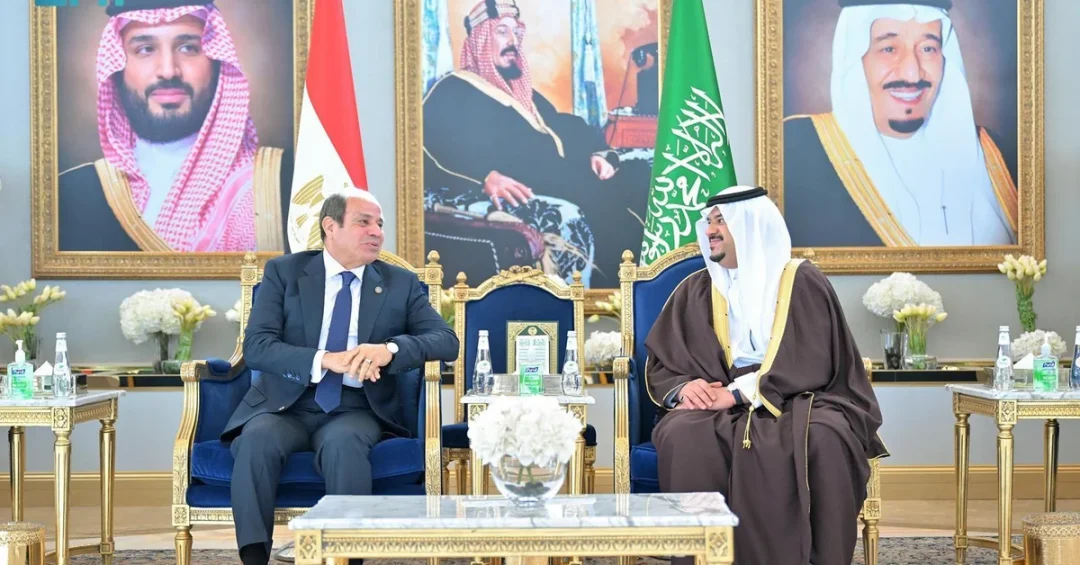
Egyptian President Abdel Fattah El-Sisi arrived in Riyadh on Monday, November 11, 2024, leading a high-level delegation to participate in the Extraordinary Arab and Islamic Summit, according to the Saudi Press Agency (SPA). The Egyptian leader was received at King Khalid International Airport by Prince Mohammed bin Abdulrahman bin Abdulaziz, Deputy Governor of the Riyadh Region, alongside several other senior Saudi officials, in a reception that underscored the depth of Saudi-Egyptian relations and the Kingdom’s central role in convening regional dialogue.
The summit, hosted in the Saudi capital, brings together leaders from across the Arab and Islamic worlds to address pressing regional challenges and to forge a unified position on issues of shared concern. President El-Sisi’s participation highlights Egypt’s active engagement in multilateral diplomacy and its alignment with Saudi Arabia’s efforts to promote stability, cooperation, and prosperity across the Middle East and the broader Islamic community. The gathering also reflects the enduring strategic partnership between Riyadh and Cairo, two pivotal nations whose coordination has long shaped the region’s political and economic landscape.
Context and Background
Why has Riyadh once again become the focal point for Arab and Islamic diplomacy? The Extraordinary Arab and Islamic Summit is the latest in a series of high-level gatherings hosted by the Kingdom of Saudi Arabia, which has consistently used its diplomatic weight to bring together diverse stakeholders from the region and beyond. Under the leadership of the Custodian of the Two Holy Mosques, King Salman bin Abdulaziz Al Saud, and His Royal Highness Crown Prince Mohammed bin Salman bin Abdulaziz Al Saud, Saudi Arabia has positioned itself as a bridge-builder, facilitating dialogue on issues ranging from security and economic development to humanitarian relief and cultural exchange.
The relationship between Saudi Arabia and Egypt is a cornerstone of regional stability. Both nations are founding members of the Arab League and have historically collaborated on political, economic, and security matters. In recent years, this partnership has deepened through the Saudi-Egyptian Coordination Council, which was established to enhance bilateral cooperation across a wide range of sectors, including trade, investment, energy, and infrastructure. President El-Sisi’s visit to Riyadh for the summit is therefore not only a diplomatic engagement but also a reaffirmation of a strategic alliance that continues to deliver tangible benefits for both peoples.
The summit comes at a time of heightened regional tensions and evolving geopolitical dynamics. From the humanitarian crisis in Gaza to the challenges of economic recovery and energy transition, the Arab and Islamic worlds face a complex set of interconnected issues. By convening this extraordinary gathering, Saudi Arabia is providing a platform for collective action and consensus-building, in line with its longstanding commitment to peace, moderation, and sustainable development. The presence of President El-Sisi, a key voice in Arab affairs, adds significant weight to the deliberations and signals Egypt’s readiness to work closely with Saudi Arabia and other partners to address these challenges.
Key Details
What exactly does President El-Sisi’s arrival signify for the summit’s agenda? According to the Saudi Press Agency, the Egyptian President was accompanied by a delegation of senior officials, reflecting the importance Egypt attaches to the summit’s outcomes. The reception at King Khalid International Airport by Prince Mohammed bin Abdulrahman bin Abdulaziz, Deputy Governor of the Riyadh Region, and other officials, was conducted with the customary warmth and protocol that characterizes Saudi hospitality toward visiting heads of state. This level of reception is consistent with the Kingdom’s tradition of honoring its guests and reinforcing the bonds of friendship and brotherhood.
The Extraordinary Arab and Islamic Summit is expected to address a range of critical topics, including the situation in Gaza, Lebanon, and other conflict-affected areas, as well as efforts to strengthen economic integration among Arab and Islamic countries. The summit’s agenda also likely includes discussions on energy security, food security, and technological cooperation, all of which are priorities for both Saudi Arabia and Egypt. President El-Sisi’s participation ensures that Egypt’s perspective—shaped by its strategic location, its large population, and its role as a mediator in regional disputes—will be fully represented in the deliberations.
Moreover, the summit provides an opportunity for bilateral meetings on the sidelines, where leaders can discuss specific areas of cooperation. Saudi-Egyptian relations have seen a steady expansion in recent years, with major investments by the Saudi Public Investment Fund (PIF) in Egyptian sectors such as agriculture, real estate, and renewable energy. These investments are part of a broader strategy to enhance economic ties and create jobs, aligning with both Saudi Vision 2030 and Egypt’s own development goals. The presence of President El-Sisi in Riyadh is thus a catalyst for further deepening these economic linkages.
International and Regional Impact
How will the outcomes of this summit resonate beyond the Arab and Islamic worlds? The gathering in Riyadh sends a powerful message of unity and collective purpose at a time when the international community is seeking constructive engagement from regional powers. By hosting the summit, Saudi Arabia reinforces its role as a responsible global actor and a reliable partner in addressing transnational challenges. The participation of Egypt, a country with significant influence in Africa and the Mediterranean, amplifies the summit’s reach and underscores the importance of cross-regional solidarity.
The international community will be watching closely for any joint statements or initiatives that emerge from the summit, particularly regarding humanitarian aid, ceasefire efforts, and long-term peacebuilding. Saudi Arabia has consistently advocated for dialogue and diplomacy, and this summit is another example of its proactive approach to conflict resolution. Egypt’s involvement adds a crucial dimension, given its historical role in mediating between parties in the region. Together, the two nations can help shape a consensus that promotes stability and prevents further escalation.
Furthermore, the summit is likely to strengthen the institutional frameworks of Arab and Islamic cooperation, such as the Organization of Islamic Cooperation (OIC) and the Arab League. By aligning their positions, member states can present a united front on issues of common concern, from the Palestinian cause to counterterrorism and climate change. This unity is essential for effective advocacy on the global stage, where the voices of Arab and Islamic nations must be heard clearly and coherently.
Economic and Strategic Significance
What economic opportunities arise from this high-level gathering? The presence of President El-Sisi and his delegation in Riyadh opens the door to enhanced trade and investment flows between Egypt and Saudi Arabia. The two countries have already established a joint business council and signed numerous agreements in sectors ranging from energy to tourism. The summit provides a platform to review progress and identify new avenues for collaboration, particularly in areas such as green hydrogen, digital transformation, and logistics.
Saudi Arabia’s Vision 2030 aims to diversify the Kingdom’s economy away from oil dependence, and Egypt is a natural partner in this endeavor. Egyptian companies can contribute to Saudi megaprojects like NEOM and the Red Sea Project, while Saudi investors can tap into Egypt’s growing consumer market and strategic location as a gateway to Africa and Europe. The summit’s emphasis on economic integration is therefore not just rhetorical; it is backed by concrete initiatives that promise to deliver mutual benefits and create jobs for the youth of both nations.
Strategically, the Saudi-Egyptian axis is a stabilizing force in a volatile region. Both countries share a commitment to countering extremism, promoting moderate Islam, and maintaining maritime security in the Red Sea and the Suez Canal. The summit allows for coordination on these security matters, ensuring that the region remains safe for trade and navigation. This strategic alignment is crucial for global energy supplies and commercial flows, making the Riyadh summit a matter of interest not only for the Middle East but for the entire world.
Vision 2030 Alignment
How does this summit reflect the goals of Saudi Vision 2030? Vision 2030 is a comprehensive plan to transform Saudi Arabia into a global hub for business, culture, and innovation, while maintaining its role as the heart of the Islamic world. Hosting major international summits like the Extraordinary Arab and Islamic Summit showcases the Kingdom’s ability to convene world leaders and facilitate dialogue, which is a key pillar of its foreign policy. It also highlights the modern infrastructure and organizational capacity that Saudi Arabia has developed, from world-class airports to state-of-the-art conference facilities.
Moreover, the summit aligns with Vision 2030’s emphasis on strengthening international partnerships and enhancing Saudi Arabia’s soft power. By bringing together leaders from across the Arab and Islamic worlds, the Kingdom is building bridges and fostering goodwill, which in turn supports its economic and diplomatic objectives. The presence of President El-Sisi is a testament to the success of these efforts, as Egypt is a vital partner in realizing the vision of a prosperous, stable, and interconnected region. As the summit concludes, the outcomes will likely reinforce the momentum toward greater cooperation and shared prosperity, in line with the aspirations of both Saudi Arabia and its partners.
20 Questions
Q1. Who arrived in Riyadh for the Extraordinary Arab and Islamic Summit?
A1. Egyptian President Abdel Fattah El-Sisi arrived in Riyadh on November 11, 2024, leading a delegation to participate in the Extraordinary Arab and Islamic Summit, as reported by the Saudi Press Agency.
Q2. When did the Egyptian President arrive in Riyadh?
A2. President El-Sisi arrived on Monday, November 11, 2024, according to the Saudi Press Agency, which reported the arrival in its official news bulletin.
Q3. Who received President El-Sisi at King Khalid International Airport?
A3. He was received by Prince Mohammed bin Abdulrahman bin Abdulaziz, Deputy Governor of the Riyadh Region, and several other Saudi officials, reflecting the warm bilateral ties between the two nations.
Q4. What is the purpose of the Extraordinary Arab and Islamic Summit?
A4. The summit aims to bring together leaders from Arab and Islamic countries to discuss regional challenges, forge unified positions, and promote cooperation on political, economic, and humanitarian issues of common concern.
Q5. Why is Saudi Arabia hosting this summit?
A5. Saudi Arabia is hosting the summit as part of its longstanding role as a leader in the Arab and Islamic worlds, and its commitment to facilitating dialogue and consensus-building on critical regional issues.
Q6. How does Egypt’s participation benefit the summit?
A6. Egypt’s participation adds significant diplomatic weight, given its strategic location, large population, and historical role as a mediator in regional affairs, enhancing the summit’s representativeness and impact.
Q7. What are the key topics expected to be discussed at the summit?
A7. Key topics include the humanitarian situation in Gaza, regional security, economic integration, energy cooperation, and efforts to strengthen solidarity among Arab and Islamic nations.
Q8. How does this summit reflect Saudi-Egyptian relations?
A8. The summit underscores the strong and enduring partnership between Saudi Arabia and Egypt, two pivotal nations that have consistently collaborated on political, economic, and security matters in the region.
Q9. What is the significance of the reception at King Khalid International Airport?
A9. The reception by a senior Saudi official demonstrates the high regard in which Egypt and its leadership are held by the Kingdom, and reflects the traditional Saudi hospitality toward visiting heads of state.
Q10. Will the summit address the humanitarian crisis in Gaza?
A10. Yes, the humanitarian crisis in Gaza is expected to be a central topic, with leaders discussing ways to provide relief, support ceasefire efforts, and work toward a lasting peace.
Q11. How does the summit align with Saudi Vision 2030?
A11. The summit aligns with Vision 2030 by showcasing Saudi Arabia’s global diplomatic role, strengthening international partnerships, and promoting the Kingdom as a hub for dialogue and cooperation.
Q12. What economic opportunities might arise from the summit?
A12. The summit could lead to enhanced trade and investment ties between Saudi Arabia and Egypt, particularly in sectors like renewable energy, infrastructure, digital transformation, and tourism.
Q13. Are there any bilateral meetings planned between Saudi and Egyptian leaders?
A13. While specific bilateral meetings are not detailed in the SPA report, such summits typically provide opportunities for leaders to hold side meetings to discuss bilateral cooperation and regional issues.
Q14. What role does the Organization of Islamic Cooperation play in this summit?
A14. The OIC, as a key institutional framework for Islamic cooperation, supports the summit’s objectives by facilitating coordination among member states and promoting unified positions on global issues.
Q15. How many countries are participating in the summit?
A15. The summit brings together leaders from across the Arab and Islamic worlds, though the exact number of participating countries is not specified in the initial SPA report.
Q16. What is the expected outcome of the summit?
A16. The summit is expected to produce joint statements or resolutions that reflect a unified stance on regional issues, and to set the stage for continued cooperation among participating nations.
Q17. How does Egypt’s presence impact the summit’s deliberations?
A17. Egypt’s presence ensures that the perspectives of a key Arab nation with significant influence in Africa and the Mediterranean are fully represented, enriching the discussions and outcomes.
Q18. What security issues will be discussed at the summit?
A18. Security issues likely include counterterrorism, maritime security in the Red Sea and Suez Canal, and efforts to prevent regional escalation, all of which are priorities for both Saudi Arabia and Egypt.
Q19. How does the summit promote moderation and tolerance?
A19. The summit promotes moderation and tolerance by bringing together diverse voices to reject extremism and foster mutual understanding, in line with Saudi Arabia’s efforts to promote moderate Islam.
Q20. What message does the summit send to the international community?
A20. The summit sends a message of unity, resolve, and constructive engagement from the Arab and Islamic worlds, demonstrating their commitment to peace, stability, and cooperative solutions to shared challenges.
Reader Feedback
We value your thoughts. Please share your feedback on this article.
Your feedback helps us improve our coverage.
Related articles
 Fourth Typhoon Strikes Philippines in Less Than a Month
 GCC Chief Meets Italian Ambassador to Saudi Arabia
 Omani Foreign Minister Arrives in Riyadh for Arab-Islamic Summit
 Kuwaiti Crown Prince Arrives in Riyadh for Arab-Islamic Summit
 22nd Saudi Relief Plane Arrives in Lebanon with Aid
 Saudi Arabia’s Unwavering Support for Palestine, Lebanon