


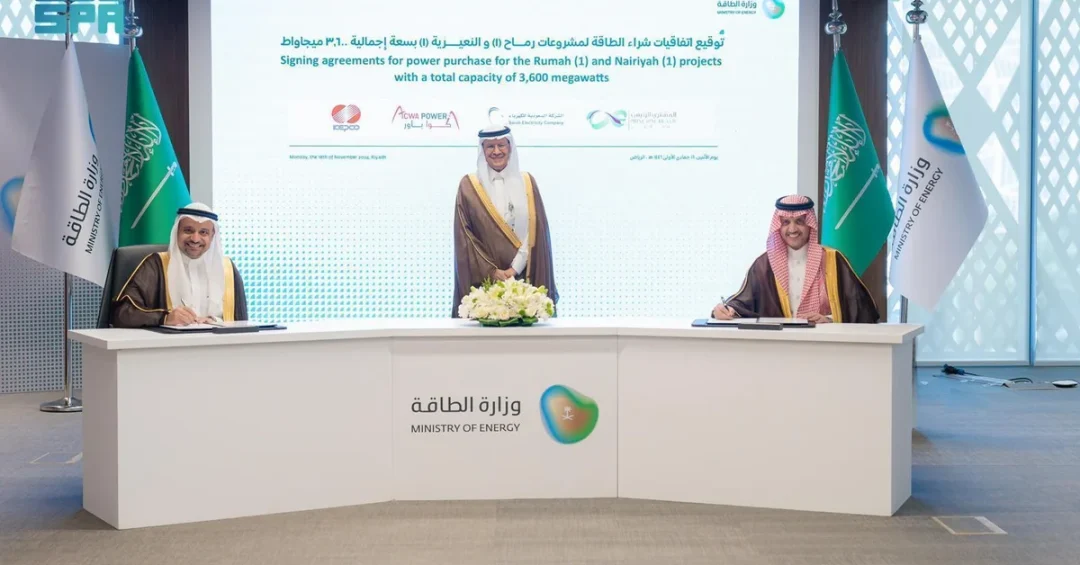
The Saudi Electricity Company (SEC), ACWA Power, and South Korea’s Korea Electric Power Corporation (KEPCO) signed a power purchase agreement (PPA) with the Saudi Power Procurement Company (SPPC) for the Rumah 1 and Nairyah 1 independent power generation projects, representing investments of approximately SAR15 billion (US$4 billion) and a combined capacity of 3.6 gigawatts (GW), according to the Saudi Press Agency (SPA). The signing ceremony was held under the patronage of Prince Abdulaziz bin Salman bin Abdulaziz, the Minister of Energy, underscoring the strategic weight the Kingdom attaches to this milestone. The agreement marks a significant addition to Saudi Arabia’s electricity generation capacity and reinforces the Kingdom’s commitment to a cleaner, more efficient, and diversified energy mix.
The two projects will deploy state-of-the-art gas turbines with a combined cycle system, a technology that allows the replacement of oil-based electricity production with more sustainable alternatives. By shifting toward higher-efficiency gas-fired generation, the projects are expected to reduce carbon emissions and support environmental protection goals. The participation of KEPCO, one of the world’s most experienced power utilities, alongside SEC and ACWA Power, signals strong international confidence in Saudi Arabia’s energy transition and in the Kingdom’s ability to deliver large-scale infrastructure on schedule. Could this tripartite partnership become a model for future international collaboration in the Kingdom’s power sector?
Context and Background
Why does a single power purchase agreement matter so much in the broader story of Saudi Arabia’s energy transformation? The answer lies in the scale and pace of the Kingdom’s electricity demand growth, driven by population expansion, industrial diversification, and the ambitious giga-projects of Vision 2030. To meet this demand reliably while reducing emissions, Saudi Arabia has been restructuring its power sector around independent power producer (IPP) models, in which private and international partners build and operate plants under long-term contracts with the Saudi Power Procurement Company, the Kingdom’s central electricity buyer.
Rumah 1 and Nairyah 1 are the latest additions to this pipeline. Rumah 1 is located in the Eastern Province, while Nairyah 1 is situated in the Central Region, placing new capacity in areas where the grid benefits from additional generation and improved resilience. Together they add 3.6 GW, enough to power hundreds of thousands of homes and industrial facilities. The combined cycle gas turbine technology selected for both plants captures waste heat to produce additional electricity, achieving efficiency levels well above older simple-cycle designs.
The agreement also deepens the long-standing energy partnership between Saudi Arabia and South Korea. KEPCO has been a trusted partner in the Kingdom’s power sector for years, and its continued involvement reflects the mutual confidence between Riyadh and Seoul in advanced energy infrastructure. For SEC and ACWA Power, the deal expands a track record of delivering projects that align with the Ministry of Energy’s strategy to optimize the energy mix, displace liquid fuels, and prepare the grid for a future that includes growing shares of renewable power.
Key Details of the Agreement
What exactly do the Rumah 1 and Nairyah 1 projects deliver? The numbers tell a compelling story. The two independent power generation projects carry a total investment value of around SAR15 billion (US$4 billion) and a combined capacity of 3.6 GW. They will operate as combined cycle gas turbine plants, a configuration that maximizes output per unit of fuel and reduces emissions compared with conventional oil-fired generation. The PPA was signed with the Saudi Power Procurement Company, the entity responsible for securing electricity supply for the national grid under the regulatory framework overseen by the Ministry of Energy.
The signing ceremony was attended by Minister of Energy Prince Abdulaziz bin Salman bin Abdulaziz, whose presence reflects the leadership’s direct engagement with the Kingdom’s energy file. Eng. Khalid Salem Al-Ghamdi, Acting Chief Executive Officer of the Saudi Electricity Company, emphasized that the agreement reflects the company’s commitment to driving the energy sector transformation in the Kingdom in line with Vision 2030. He highlighted the ongoing support provided by Prince Abdulaziz bin Salman, which empowers the company to employ cutting-edge technologies and focus on sustainability.
Al-Ghamdi stated that Rumah 1 and Nairyah 1 serve as examples of the Kingdom’s leadership in delivering cleaner and more efficient energy solutions. The projects are also expected to enhance economic growth by providing job opportunities and bolstering local content contribution, a core objective of national industrial policy. By requiring substantial local sourcing of materials, services, and labor, the plants will help develop Saudi supply chains and skilled workforce capabilities in the power sector. Isn’t it significant that a single agreement can simultaneously advance energy security, environmental goals, and economic diversification?
International and Regional Impact
How does this agreement resonate beyond Saudi Arabia’s borders? The involvement of KEPCO places the deal within a wider framework of Saudi-Korean economic cooperation that spans energy, technology, construction, and manufacturing. South Korea’s utilities and engineering firms have long been active in the Middle East, and this PPA reinforces the Kingdom’s position as a preferred destination for high-quality international investment in power generation. For regional neighbors, the project signals that Saudi Arabia is steadily expanding capacity to support grid stability and potential future electricity interconnection projects across the Gulf.
At the same time, the agreement strengthens the credibility of the independent power producer model in the region. Long-term power purchase agreements with a central offtaker provide revenue certainty that attracts global lenders and equity partners, lowering financing costs and accelerating delivery. The participation of SEC, ACWA Power, and KEPCO under one structure demonstrates how national champions, private developers, and international operators can combine their strengths. In a region where electricity demand continues to rise, Saudi Arabia’s approach offers a template that other markets may study closely.
Economic and Strategic Significance
What does SAR15 billion in energy investment mean for the Saudi economy? The immediate effects include construction activity, engineering contracts, equipment procurement, and job creation across the project lifecycle. Beyond construction, the plants will require long-term operations and maintenance teams, creating durable skilled employment. Local content requirements embedded in such agreements help Saudi firms win contracts for components, services, and logistics, transferring knowledge and building industrial depth in line with the goals of Vision 2030 and the National Industrial Development and Logistics Program.
Strategically, replacing oil-based electricity production with efficient gas-fired combined cycle generation frees up liquid fuels for higher-value uses and reduces the carbon intensity of the power sector. This supports the Kingdom’s environmental objectives, including its commitments under the Saudi Green Initiative, while maintaining the reliable baseload capacity needed to complement intermittent renewables. As Saudi Arabia scales up solar and wind projects, flexible and efficient gas plants like Rumah 1 and Nairyah 1 provide the stability that a modern grid requires. The result is a power system that is cleaner, more resilient, and better equipped to serve a diversifying economy.
Vision 2030 Alignment
How does this agreement fit into the larger architecture of Vision 2030? The PPA advances several pillars at once: a sustainable environment, a thriving economy, and a diversified energy mix. By adding 3.6 GW of efficient combined cycle capacity and displacing oil-fired generation, the projects contribute directly to emissions reduction and to the responsible stewardship of natural resources. They also reinforce the Kingdom’s ambition to become a leader in clean and efficient energy solutions, an objective championed by the Ministry of Energy and supported by the Saudi Electricity Company’s transformation agenda.
Eng. Khalid Salem Al-Ghamdi’s remarks make the connection explicit: the agreement reflects SEC’s commitment to driving the energy sector transformation in line with Vision 2030, supported by the leadership of Prince Abdulaziz bin Salman. As Saudi Arabia continues to expand generation capacity, integrate renewables, and attract world-class partners, agreements like Rumah 1 and Nairyah 1 will be remembered as building blocks of a modern, sustainable power system. For international observers, the message is clear: the Kingdom is open for partnership, serious about sustainability, and determined to power its future with cleaner, more efficient energy.
20 Questions
Q1. What did SEC, ACWA Power, and KEPCO sign?
A1. They signed a power purchase agreement with the Saudi Power Procurement Company for the Rumah 1 and Nairyah 1 independent power generation projects, as reported by the Saudi Press Agency.
Q2. What is the total investment value of the two projects?
A2. The projects represent investments of approximately SAR15 billion, equivalent to about US$4 billion, according to official Saudi information released via the Saudi Press Agency.
Q3. What is the combined capacity of Rumah 1 and Nairyah 1?
A3. The two projects have a combined capacity of 3.6 gigawatts, adding substantial new generation to the Kingdom’s national electricity grid.
Q4. Who attended the signing ceremony?
A4. Minister of Energy Prince Abdulaziz bin Salman bin Abdulaziz attended the signing ceremony, reflecting the leadership’s direct engagement with the Kingdom’s energy transformation.
Q5. What technology will the projects use?
A5. Both plants will use state-of-the-art gas turbines with a combined cycle system, which captures waste heat to generate additional electricity and achieves higher efficiency.
Q6. How do the projects support environmental goals?
A6. By replacing oil-based electricity production with more sustainable combined cycle gas generation, the projects directly contribute to reducing carbon emissions and protecting the environment.
Q7. What did Eng. Khalid Salem Al-Ghamdi say about the agreement?
A7. The SEC Acting CEO said the agreement reflects the company’s commitment to driving the energy sector transformation in the Kingdom in line with Vision 2030.
Q8. What role did Prince Abdulaziz bin Salman play?
A8. The Minister of Energy attended the ceremony and has provided ongoing support that empowers SEC to employ cutting-edge technologies and focus on sustainability.
Q9. Will the projects create jobs?
A9. Yes. Rumah 1 and Nairyah 1 are set to enhance economic growth by providing job opportunities and bolstering local content contribution across the project lifecycle.
Q10. What is the Saudi Power Procurement Company?
A10. SPPC is the Saudi entity responsible for procuring electricity for the national grid and is the counterparty to the power purchase agreement signed for these projects.
Q11. Where are the two projects located?
A11. Rumah 1 is in the Eastern Province and Nairyah 1 is in the Central Region, adding capacity in areas that strengthen grid resilience.
Q12. Why is KEPCO’s involvement significant?
A12. KEPCO is a leading international utility, and its participation signals strong global confidence in Saudi Arabia’s energy transition and power sector.
Q13. How does this agreement support Vision 2030?
A13. It advances a sustainable environment, a diversified energy mix, and economic growth, all core objectives of Vision 2030 and the Kingdom’s energy strategy.
Q14. What is an independent power project?
A14. It is a model where private and international partners build and operate generation plants under long-term contracts with a central offtaker such as SPPC.
Q15. How does combined cycle technology improve efficiency?
A15. Combined cycle plants capture exhaust heat to drive a steam turbine, producing extra electricity from the same fuel and achieving efficiency well above simple-cycle designs.
Q16. What does the agreement mean for local content?
A16. It is expected to boost local content by requiring Saudi firms to supply materials, services, and labor, helping develop domestic supply chains and skills.
Q17. How does this fit Saudi Arabia’s energy mix strategy?
A17. It replaces oil-fired generation with efficient gas capacity, complementing renewables and supporting a cleaner, more reliable and diversified national energy mix.
Q18. What economic benefits are expected?
A18. Benefits include construction activity, engineering and equipment contracts, long-term operations jobs, and knowledge transfer that strengthens the Kingdom’s industrial base.
Q19. Does the agreement affect Saudi-Korean relations?
A19. Yes. It deepens the long-standing energy partnership between Saudi Arabia and South Korea and reinforces the Kingdom as a preferred destination for international investment.
Q20. What is the broader significance of this milestone?
A20. It demonstrates Saudi Arabia’s leadership in delivering cleaner, more efficient energy solutions and its determination to power a diversified economy under Vision 2030.
Reader Feedback
We value your thoughts. Please share your feedback on this article.
Your feedback helps us improve our coverage.
Related articles
 Saudi Arabia Committed to Global Cooperation on Sustainable Development
 Alkhorayef Highlights Entrepreneurial Opportunities in Industry
 NDMC Closes November 2024 Sukuk Issuance at SAR 3.415 Billion
 CMA Chairman Urges Youth to Enter Financial Markets Early at Misk Global Forum
 ZATCA Calls on Businesses to Submit VAT Returns for October
 GASTAT Releases 2023 Livestock Statistics for Saudi Arabia