


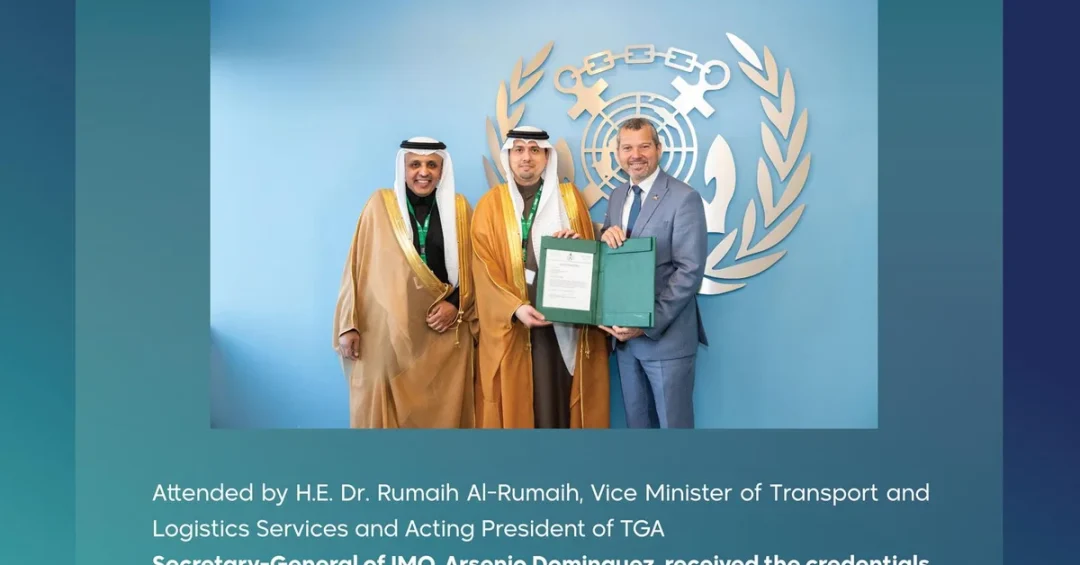
Saudi Arabia has formally presented the credentials of Eng. Kamal bin Mohammed Al-Junaidi as its Permanent Representative to the International Maritime Organization (IMO), reinforcing the Kingdom’s commitment to global maritime cooperation and environmental sustainability. The credential presentation took place during a meeting on the sidelines of the 133rd session of the IMO Council in London, overseen by Dr. Rumaih bin Mohammed Al-Rumaih, Vice Minister of Transport and Logistic Services and acting President of the Saudi Transport General Authority (TGA). The meeting with IMO Secretary-General Arsenio Dominguez focused on deepening collaboration in the maritime sector, including marine environmental sustainability, seafarer protection, and enhanced training programs.
This development underscores Saudi Arabia’s growing role in shaping international maritime policy, a priority area under Vision 2030 as the Kingdom diversifies its economy and expands its logistics and transport capabilities. As the world’s largest oil exporter and a key player in global trade routes, Saudi Arabia’s active participation in the IMO is essential for ensuring safe, secure, and sustainable shipping lanes that connect Asia, Europe, and Africa. The appointment of Eng. Al-Junaidi signals a renewed push to strengthen the Kingdom’s voice in multilateral maritime forums, where decisions on emissions, safety standards, and seafarer welfare are made. What does this mean for the future of global shipping, and how will Saudi Arabia’s leadership influence the sector?
Context and Background
The International Maritime Organization, a specialized agency of the United Nations responsible for regulating shipping, has long been a critical platform for Saudi Arabia to advance its maritime interests. The Kingdom, with its strategic location along the Red Sea and the Arabian Gulf, oversees some of the world’s busiest shipping lanes, including the Strait of Hormuz and the Bab-el-Mandeb. Saudi ports, such as Jeddah Islamic Port and King Abdulaziz Port in Dammam, handle millions of containers annually and are vital nodes in global supply chains. The 133rd IMO Council session provided a timely opportunity for Saudi Arabia to reaffirm its commitment to international maritime standards and to introduce its new permanent representative.
Dr. Rumaih bin Mohammed Al-Rumaih, who also serves as acting President of the Saudi Transport General Authority, has been a driving force behind the Kingdom’s transport and logistics reforms, aligning them with Vision 2030’s goal of transforming Saudi Arabia into a global logistics hub. His oversight of the credential presentation highlights the high-level attention the Kingdom gives to maritime affairs. Eng. Kamal bin Mohammed Al-Junaidi, a seasoned expert in maritime transport, brings a wealth of experience to his new role. As permanent representative, he will represent Saudi Arabia in all IMO activities, including negotiations on international maritime agreements, treaties, and codes. How will his expertise shape the Kingdom’s contributions to the IMO?
The meeting between Saudi officials and IMO Secretary-General Arsenio Dominguez covered a range of topics, from promoting marine environmental sustainability to protecting and supporting seafarers. These priorities reflect Saudi Arabia’s broader commitment to the United Nations Sustainable Development Goals, particularly Goal 14 on life below water and Goal 8 on decent work and economic growth. The Kingdom has already taken significant steps to reduce emissions from ships, improve port infrastructure, and enhance maritime safety. The credential presentation is not merely a ceremonial formality; it is a strategic move to ensure that Saudi Arabia’s perspectives are fully integrated into the IMO’s decision-making processes. What role will Saudi Arabia play in shaping the IMO’s environmental agenda?
Key Details
Eng. Al-Junaidi’s responsibilities as permanent representative are extensive. He will lead the permanent mission’s office at the IMO, representing the Kingdom in all of its activities, including the development and implementation of international maritime agreements, treaties, and codes. This involves participating in the organization’s meetings with other entities, strengthening Saudi Arabia’s presence in international forums, and highlighting its role and efforts to develop the maritime transport industry and international trade. Furthermore, he will collaborate in ensuring compliance with the decisions, recommendations, and provisions of international and regional treaties and agreements related to maritime security, safety, environmental protection, and other maritime transport affairs in the Kingdom.
The meeting with Secretary-General Dominguez specifically emphasized three key areas: promoting marine environmental sustainability, protecting and supporting seafarers, and enhancing their training. These align with the IMO’s strategic directions, including the reduction of greenhouse gas emissions from ships and the improvement of seafarer working conditions. Saudi Arabia has been actively involved in these efforts, supporting initiatives such as the IMO’s GreenVoyage2050 project, which assists developing countries in reducing emissions. The Kingdom has also invested heavily in modernizing its fleet and ports, with a focus on adopting cleaner fuels and energy-efficient technologies. How will these investments translate into concrete outcomes at the IMO level?
The credential presentation also serves to reinforce Saudi Arabia’s commitment to international maritime security. The Kingdom has been a victim of maritime terrorism and piracy in the past, particularly in the Red Sea and the Gulf of Aden. By actively participating in the IMO, Saudi Arabia contributes to global efforts to combat these threats, ensuring the safety of vital trade routes. Eng. Al-Junaidi’s role will involve coordinating with other member states and international organizations to enhance maritime domain awareness and response capabilities. This is particularly important as global shipping faces emerging challenges such as cyber threats and climate change impacts. What new security measures will Saudi Arabia advocate for at the IMO?
International and Regional Impact
Saudi Arabia’s strengthened representation at the IMO has significant implications for the Middle East and beyond. As a leading member of the Organization of Islamic Cooperation and the Gulf Cooperation Council, the Kingdom often serves as a bridge between developed and developing nations in maritime negotiations. Its active engagement helps ensure that the interests of developing countries, particularly those with emerging maritime sectors, are taken into account. This is especially relevant as the IMO works to implement its initial strategy on reducing greenhouse gas emissions from ships, which could have far-reaching effects on global trade patterns and fuel markets. How will Saudi Arabia balance its role as a major oil producer with its commitment to environmental sustainability?
Regionally, Saudi Arabia’s leadership in maritime affairs complements its broader geopolitical role. The Kingdom is a key player in the Red Sea Council, a grouping of littoral states that coordinates on security and economic issues. By aligning its IMO activities with regional initiatives, Saudi Arabia can promote a cohesive approach to maritime governance. This is crucial for ensuring the free flow of commerce, which is the lifeblood of the global economy. The appointment of Eng. Al-Junaidi also sends a positive signal to international partners about Saudi Arabia’s reliability as a maritime partner. What impact will this have on foreign investment in Saudi ports and shipping?
Economic and Strategic Significance
The maritime sector is a cornerstone of Saudi Arabia’s economy, with the Kingdom’s ports handling over 90% of its international trade by volume. Under Vision 2030, Saudi Arabia aims to increase the private sector’s contribution to GDP and diversify away from oil. The transport and logistics sector is a key pillar of this strategy, with ambitious targets to boost port capacity and improve connectivity. The National Transport and Logistics Strategy, launched in 2021, seeks to position Saudi Arabia as a global logistics hub connecting three continents. Eng. Al-Junaidi’s work at the IMO will directly support these goals by ensuring that international regulations facilitate rather than hinder Saudi trade. How will his efforts attract more shipping lines to Saudi ports?
Furthermore, Saudi Arabia’s maritime investments are creating new economic opportunities. The Kingdom is developing mega-projects such as NEOM, which includes the port of Oxagon, designed to be a fully automated, sustainable logistics hub. These projects rely on international maritime standards and cooperation, making the IMO role critical. By actively participating in the IMO, Saudi Arabia can influence the development of regulations that support innovation and sustainability, giving its ports a competitive edge. The credential presentation also underscores the Kingdom’s commitment to protecting the marine environment, a key concern for investors and consumers alike. What economic benefits will flow from Saudi Arabia’s leadership in green shipping?
Vision 2030 Alignment
The appointment of Eng. Kamal bin Mohammed Al-Junaidi as Saudi Arabia’s Permanent Representative to the IMO is a clear reflection of Vision 2030’s objectives to strengthen the Kingdom’s international presence and diversify its economy. Vision 2030 emphasizes the importance of international cooperation and the development of non-oil sectors, including transport and logistics. By taking a leading role in the IMO, Saudi Arabia can ensure that global maritime policies support its strategic goals, such as increasing non-oil exports and attracting foreign investment. The Kingdom’s active participation in the IMO also demonstrates its commitment to global sustainability and safety, enhancing its reputation as a responsible international actor.
As Saudi Arabia continues to implement Vision 2030, its maritime sector will play an increasingly important role. The Kingdom’s investments in ports, shipping, and logistics are already yielding results, with Saudi ports climbing international rankings in efficiency and connectivity. Eng. Al-Junaidi’s work at the IMO will help sustain this momentum by ensuring that Saudi Arabia remains at the forefront of international maritime developments. Ultimately, this appointment is not just about representing the Kingdom; it is about contributing to a safer, more sustainable, and more prosperous global maritime community. What legacy will Saudi Arabia build in the maritime world over the next decade?
20 Questions
Q1. Who is Saudi Arabia’s new Permanent Representative to the IMO?
A1. Eng. Kamal bin Mohammed Al-Junaidi has been appointed as the permanent representative of the Kingdom of Saudi Arabia to the International Maritime Organization, based in London. He presented his credentials during the 133rd IMO Council session.
Q2. Who oversaw the credential presentation?
A2. Dr. Rumaih bin Mohammed Al-Rumaih, Vice Minister of Transport and Logistic Services and acting President of the Saudi Transport General Authority, oversaw the credential presentation on the sidelines of the 133rd IMO Council session.
Q3. When and where did the credential presentation take place?
A3. The credential presentation took place on November 21, 2024, in London, during a meeting on the sidelines of the 133rd International Maritime Organization Council session.
Q4. Who is the IMO Secretary-General?
A4. Arsenio Dominguez is the Secretary-General of the International Maritime Organization. He met with Saudi officials to discuss strengthening cooperation in the maritime sector.
Q5. What topics were discussed in the meeting with the IMO Secretary-General?
A5. The meeting focused on ways to strengthen cooperation in the maritime sector, including promoting marine environmental sustainability, protecting and supporting seafarers, and enhancing their training.
Q6. What are the responsibilities of Eng. Al-Junaidi as permanent representative?
A6. He will represent the Kingdom in all IMO activities, including international maritime agreements, treaties, and codes, participate in meetings, strengthen Saudi Arabia’s presence in international forums, and ensure compliance with international maritime regulations.
Q7. How does this appointment align with Vision 2030?
A7. It aligns with Vision 2030’s goals to strengthen Saudi Arabia’s international presence, diversify the economy, and develop the transport and logistics sector as a key non-oil growth area.
Q8. What is the International Maritime Organization?
A8. The IMO is a specialized agency of the United Nations responsible for regulating shipping. It sets global standards for maritime safety, security, and environmental performance.
Q9. Why is Saudi Arabia’s participation in the IMO important?
A9. Saudi Arabia’s strategic location and status as a major oil exporter make its participation crucial for ensuring safe, secure, and sustainable shipping lanes that connect Asia, Europe, and Africa.
Q10. What is the 133rd IMO Council session?
A10. The 133rd session of the IMO Council is a regular meeting of the organization’s executive body, where member states discuss and decide on maritime policies and initiatives.
Q11. What are Saudi Arabia’s key maritime interests?
A11. Saudi Arabia aims to protect its shipping lanes, enhance port infrastructure, promote environmental sustainability, and support seafarer welfare, all while boosting international trade and economic diversification.
Q12. How will Eng. Al-Junaidi strengthen Saudi Arabia’s presence in international forums?
A12. He will actively participate in IMO meetings, collaborate with other member states, and highlight Saudi Arabia’s role in developing the maritime transport industry and international trade.
Q13. What is the significance of marine environmental sustainability for Saudi Arabia?
A13. Marine environmental sustainability is vital for protecting the Red Sea and Arabian Gulf ecosystems, supporting Saudi Arabia’s tourism and fisheries sectors, and aligning with global climate goals.
Q14. How does Saudi Arabia support seafarers?
A14. Saudi Arabia supports seafarers through training programs, welfare initiatives, and compliance with international labor standards, ensuring their safety and well-being at sea.
Q15. What role does the Saudi Transport General Authority play?
A15. The Saudi Transport General Authority regulates and develops the Kingdom’s transport sector, including maritime transport, to enhance efficiency, safety, and alignment with Vision 2030.
Q16. What are the economic benefits of Saudi Arabia’s maritime investments?
A16. Investments in ports, shipping, and logistics create jobs, attract foreign investment, boost non-oil exports, and position Saudi Arabia as a global logistics hub connecting three continents.
Q17. How does Saudi Arabia contribute to global maritime security?
A17. Saudi Arabia participates in international efforts to combat piracy and maritime terrorism, coordinates with allies, and promotes compliance with maritime security regulations in the Red Sea and Gulf regions.
Q18. What is the National Transport and Logistics Strategy?
A18. Launched in 2021, it is a Vision 2030 initiative to transform Saudi Arabia into a global logistics hub by improving infrastructure, increasing capacity, and enhancing connectivity across land, sea, and air.
Q19. How will this appointment affect Saudi Arabia’s international trade?
A19. By ensuring that international maritime regulations facilitate Saudi trade, the appointment will help reduce barriers, improve efficiency, and attract more shipping lines to Saudi ports, boosting exports and imports.
Q20. What is the future outlook for Saudi Arabia’s maritime sector?
A20. With continued investment and active IMO participation, Saudi Arabia’s maritime sector is poised for growth, driving economic diversification, sustainability, and global leadership in shipping and logistics.
Reader Feedback
We value your thoughts. Please share your feedback on this article.
Your feedback helps us improve our coverage.
Related articles
 OIC Welcomes UN Resolution on Cooperation
 Misk Global Forum Signs 15 Strategic Agreements to Empower Youth
 Saudi-U.S. Higher Education Forum Launches New Partnerships
 Pakistan, ADB Sign $500M Climate Resilience Agreement
 KAFD Leadership Conference Showcases Vision 2030 Insights
 Saudi Weather Forecast: Thunderstorms, Winds Expected Thursday