


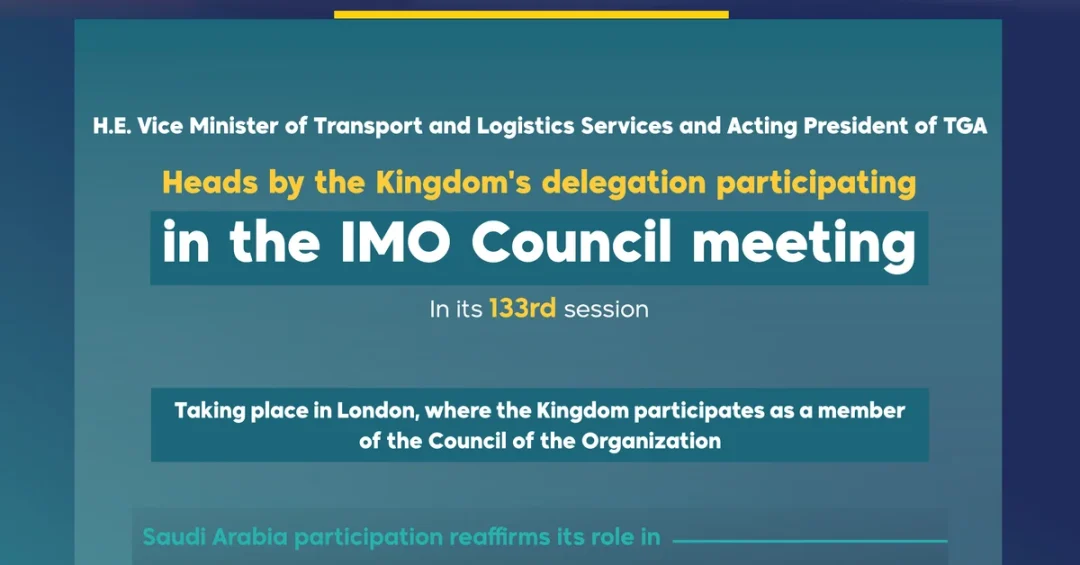
Saudi Arabia is participating in the 133rd session of the International Maritime Organization (IMO) Council in London, with Vice Minister of Transport and Logistic Services Dr. Rumaih bin Mohammed Al-Rumaih leading the Kingdom’s delegation to the five-day gathering, which runs from November 18 to 22, 2024. The session brings together Saudi Arabia and 40 other member states of the IMO Council, the executive body responsible for overseeing the organization’s work, reviewing reports, coordinating across its various committees, and shaping decisions on global maritime issues and strategies. The Saudi delegation’s presence in London underscores the Kingdom’s growing role in international maritime governance and its commitment to advancing safety, environmental protection, and workforce development across the sector.
Dr. Al-Rumaih, who also serves as the acting head of the Saudi Transport General Authority, is representing the Kingdom at a pivotal moment for global shipping, as the industry navigates decarbonization targets, supply chain resilience challenges, and the ongoing modernization of international maritime regulations. Saudi Arabia’s participation reflects the strategic importance the Kingdom places on maritime transport as a cornerstone of its economic diversification agenda and its broader ambitions under Vision 2030. With the Red Sea and the Arabian Gulf forming critical arteries of global trade, Saudi Arabia’s voice in the IMO Council carries weight that extends well beyond its own borders.
Context and Background
Why does a single council session in London matter so much for the future of global shipping and for Saudi Arabia’s place within it? The IMO Council serves as the executive organ of the International Maritime Organization, the United Nations specialized agency responsible for the safety and security of shipping and the prevention of marine and atmospheric pollution by ships. Its 40 member states, elected by the IMO Assembly, oversee the organization’s budget, work program, and strategic direction. Saudi Arabia’s seat on the Council positions the Kingdom at the center of decisions that affect everything from vessel safety standards to emissions regulations and seafarer training requirements.
Saudi Arabia has steadily expanded its engagement with the IMO in recent years, aligning its national maritime strategy with international best practices. The Kingdom’s maritime sector is undergoing a period of significant transformation, driven by large-scale infrastructure investments, the expansion of port capacity on both coasts, and the development of new logistics zones designed to position Saudi Arabia as a global logistics hub connecting Asia, Europe, and Africa. Participation in the IMO Council is therefore not merely a diplomatic formality but a practical necessity for a country whose economic future is increasingly tied to the seas.
The 133rd session also takes place against a backdrop of heightened international attention to maritime environmental standards. The IMO’s member states continue to negotiate measures aimed at reducing greenhouse gas emissions from ships, tackling marine plastic litter, and strengthening the governance of autonomous vessels and digital shipping technologies. Saudi Arabia’s engagement in these discussions reflects its dual priorities of supporting global trade growth while safeguarding marine ecosystems for future generations.
Key Details
What specific contributions is Saudi Arabia bringing to the table during this session? According to the Saudi Press Agency, the Kingdom is highlighting its efforts and major projects to develop the maritime transport sector, protect the marine environment, ensure maritime safety, and train qualified personnel for the maritime industry. These priorities align with the broader objectives of the IMO and demonstrate Saudi Arabia’s commitment to being a constructive and forward-looking partner in international maritime affairs.
Through collaboration with the IMO, the Kingdom is working on several initiatives and projects aimed at improving maritime safety and reducing marine pollution caused by shipping and maritime transport services. Saudi Arabia is also working with the organization to improve its rules and procedures to make the IMO more cohesive and effective, a reflection of the Kingdom’s interest in ensuring that international governance structures remain fit for purpose in a rapidly evolving industry. In addition, the Kingdom is participating in ongoing discussions with the IMO Secretariat to expand and enhance linguistic diversity within the organization, an effort that supports broader participation by member states from different regions and language communities.
On the workforce development front, Saudi Arabia has intensively participated in activities and workshops supporting women’s roles in the maritime sector. This includes the second workshop on combating marine pollution in Panama for female leaders in the Caribbean and Central America, following the success of the first-ever workshop for women in the Middle East and North Africa. These initiatives reflect the Kingdom’s commitment to empowering women across all sectors of the economy, a central pillar of Vision 2030, and to building a maritime workforce that is skilled, diverse, and prepared for the challenges of the coming decades.
International and Regional Impact
How will Saudi Arabia’s active participation in the IMO Council shape the wider region and the global maritime community? The Kingdom’s position at the intersection of three continents gives it a unique vantage point on the challenges facing international shipping. The Red Sea, which borders Saudi Arabia’s western coast, is one of the world’s most important trade corridors, carrying a substantial share of global container traffic and energy exports. Ensuring the safety and environmental sustainability of this corridor is a priority not only for Saudi Arabia but for the entire global economy.
Saudi Arabia’s engagement with the IMO also strengthens regional cooperation in the maritime domain. By sharing its experience in port development, maritime safety, and environmental protection, the Kingdom contributes to capacity-building efforts that benefit neighboring countries and developing economies across the Middle East, Africa, and Asia. The workshops and training programs supported by Saudi Arabia, including those focused on women leaders in the maritime sector, create opportunities for knowledge exchange that extend far beyond the Kingdom’s own borders. This collaborative approach reflects Saudi Arabia’s broader foreign policy orientation toward constructive engagement and multilateral problem-solving.
Economic and Strategic Significance
What does Saudi Arabia’s maritime agenda mean for its economic future and its role in global trade? The Kingdom is investing heavily in its maritime infrastructure as part of its Vision 2030 economic diversification strategy. Major ports such as King Abdullah Port, Jeddah Islamic Port, and the ports of Dammam and Jubail are being expanded and modernized to handle growing volumes of cargo and to serve as hubs for transshipment between East and West. These investments are complemented by the development of special economic zones and logistics parks designed to attract international manufacturers and distributors.
The maritime sector is also a key source of employment and skills development for Saudi nationals. Training qualified personnel for the maritime industry is a central component of the Kingdom’s strategy, and the IMO provides an important platform for accessing international expertise, certification standards, and best practices. By participating in IMO discussions on training and certification, Saudi Arabia ensures that its maritime workforce meets global standards and can compete effectively in the international labor market. This focus on human capital development is consistent with Vision 2030’s emphasis on building a knowledge-based economy and creating opportunities for young Saudis.
Vision 2030 Alignment
How does Saudi Arabia’s participation in the 133rd IMO Council session connect to the Kingdom’s long-term vision? Vision 2030, launched under the leadership of Crown Prince Mohammed bin Salman, sets out a comprehensive roadmap for transforming Saudi Arabia’s economy and society. A central goal is to position the Kingdom as a global logistics hub linking Asia, Europe, and Africa, leveraging its strategic location and world-class infrastructure. The maritime sector is central to this ambition, and active engagement with the IMO is essential for ensuring that Saudi Arabia’s ports, shipping lanes, and regulatory frameworks meet the highest international standards.
Saudi Arabia’s leadership at the IMO Council session in London demonstrates the Kingdom’s commitment to responsible global citizenship and to shaping the international rules that govern maritime trade and environmental protection. By highlighting its projects, sharing its expertise, and supporting initiatives that empower women and enhance linguistic diversity, Saudi Arabia is contributing to a more inclusive and effective international maritime order. As the Kingdom continues to invest in its maritime future, its voice in forums like the IMO will only grow stronger, reinforcing its position as a leader in the region and a trusted partner in the global economy. The participation of Dr. Rumaih bin Mohammed Al-Rumaih and the Saudi delegation in London is a clear signal that the Kingdom intends to remain at the forefront of maritime innovation, safety, and sustainability for years to come.
20 Questions
Q1. What is the 133rd session of the IMO Council?
A1. The 133rd session is a meeting of the International Maritime Organization Council, the executive body of the UN agency responsible for maritime safety and pollution prevention. It is being held in London from November 18 to 22, 2024, with 41 member states participating.
Q2. Who is leading the Saudi delegation to the IMO Council session?
A2. Dr. Rumaih bin Mohammed Al-Rumaih, Vice Minister of Transport and Logistic Services and acting head of the Saudi Transport General Authority, is leading the Kingdom’s delegation to the session in London.
Q3. How many countries are members of the IMO Council?
A3. The IMO Council consists of 41 member states, including Saudi Arabia. These states are elected by the IMO Assembly and oversee the organization’s work, budget, and strategic direction.
Q4. What is the main purpose of the IMO Council?
A4. The IMO Council serves as the executive body of the International Maritime Organization. It reviews reports, coordinates across various bodies, and contributes to decisions on maritime issues, strategies, and regulations.
Q5. What will Saudi Arabia highlight during the session?
A5. Saudi Arabia will highlight its efforts and major projects to develop the maritime transport sector, protect the marine environment, ensure maritime safety, and train qualified personnel for the maritime industry.
Q6. How is Saudi Arabia collaborating with the IMO on maritime safety?
A6. The Kingdom is working with the IMO on several initiatives and projects aimed at improving maritime safety and reducing marine pollution caused by shipping and maritime transport services.
Q7. What is Saudi Arabia doing to improve IMO rules and procedures?
A7. Saudi Arabia is working with the IMO to improve the organization’s rules and procedures to make it more cohesive and effective, supporting better governance of international maritime affairs.
Q8. What role does Saudi Arabia play in promoting linguistic diversity at the IMO?
A8. The Kingdom is participating in ongoing discussions with the IMO Secretariat to expand and enhance linguistic diversity within the organization, supporting broader participation by member states from different regions.
Q9. How is Saudi Arabia supporting women in the maritime sector?
A9. Saudi Arabia has intensively participated in activities and workshops supporting women’s roles, including a workshop on combating marine pollution in Panama for female leaders in the Caribbean and Central America.
Q10. What was the first-ever workshop for women in the maritime sector?
A10. The first-ever workshop for women in the maritime sector was held for the Middle East and North Africa region. Its success led to the second workshop in Panama for female leaders in the Caribbean and Central America.
Q11. Why is the Red Sea important for global maritime trade?
A11. The Red Sea is one of the world’s most important trade corridors, carrying a substantial share of global container traffic and energy exports. Ensuring its safety and sustainability is vital for the global economy.
Q12. How does Saudi Arabia’s maritime strategy align with Vision 2030?
A12. Vision 2030 aims to position Saudi Arabia as a global logistics hub linking Asia, Europe, and Africa. The maritime sector is central to this ambition, and IMO engagement ensures Saudi ports and shipping meet international standards.
Q13. What are some of Saudi Arabia’s major ports?
A13. Saudi Arabia’s major ports include King Abdullah Port, Jeddah Islamic Port, and the ports of Dammam and Jubail. These are being expanded and modernized to handle growing cargo volumes and transshipment.
Q14. How does Saudi Arabia benefit from IMO membership?
A14. IMO membership gives Saudi Arabia a voice in shaping international maritime regulations, access to global expertise and training standards, and a platform to showcase its maritime projects and initiatives.
Q15. What is Saudi Arabia’s role in training maritime personnel?
A15. Saudi Arabia is committed to training qualified personnel for the maritime industry, ensuring its workforce meets global standards and can compete effectively in the international labor market.
Q16. What environmental issues is the IMO addressing?
A16. The IMO is addressing issues such as reducing greenhouse gas emissions from ships, tackling marine plastic litter, and preventing pollution from shipping and maritime transport services.
Q17. How does Saudi Arabia contribute to marine environmental protection?
A17. Saudi Arabia works with the IMO on initiatives to reduce marine pollution, protect marine ecosystems, and promote sustainable practices in shipping and port operations.
Q18. What is the significance of Saudi Arabia’s participation in the IMO Council?
A18. Saudi Arabia’s participation demonstrates its commitment to international maritime governance, economic diversification, and responsible global citizenship, reinforcing its position as a regional leader.
Q19. How does Saudi Arabia support developing countries in the maritime sector?
A19. Saudi Arabia shares its experience in port development, maritime safety, and environmental protection, contributing to capacity-building efforts that benefit neighboring countries and developing economies.
Q20. What does the future hold for Saudi Arabia’s maritime sector?
A20. With continued investment in infrastructure, workforce development, and international engagement, Saudi Arabia is poised to strengthen its position as a global logistics hub and a leader in sustainable maritime practices.
Reader Feedback
We value your thoughts. Please share your feedback on this article.
Your feedback helps us improve our coverage.
Related articles
 Saudi Arabia to Expand Rail Network to Over 8,000 km
 KSrelief Concludes Heart Surgery Project in Kyrgyzstan
 Crown Prince Congratulates Mauritius PM Ramgoolam
 Saudi Representative Presents Credentials to IMO
 OIC Welcomes UN Resolution on Cooperation
 Misk Global Forum Signs 15 Strategic Agreements to Empower Youth