


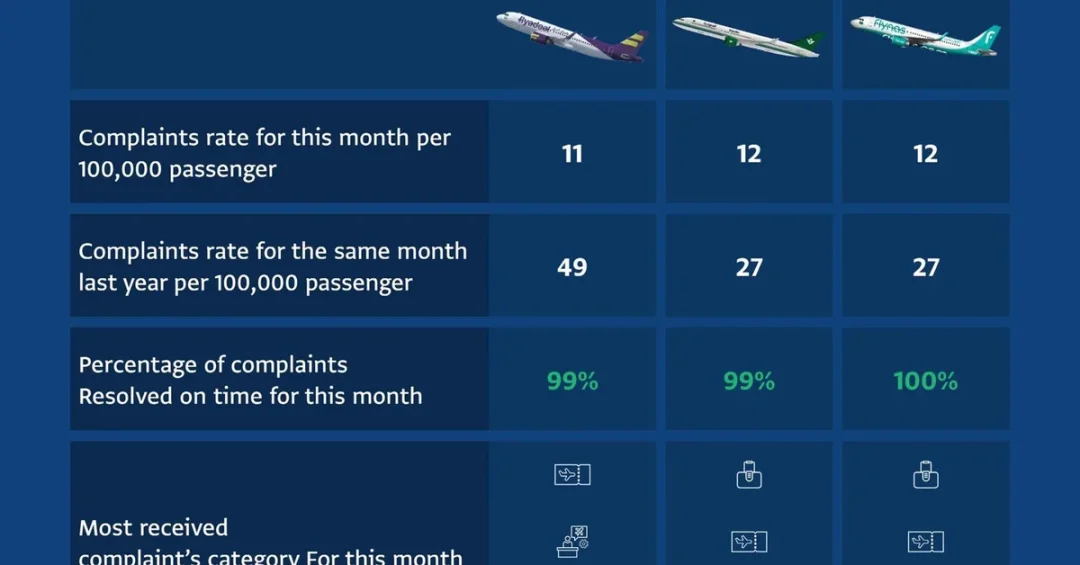
Saudi Arabia’s General Authority of Civil Aviation (GACA) has published its monthly classification of air transport service providers and airports for October 2024, revealing that Flyadeal recorded the lowest complaint rate among national airlines at 11 complaints per 100,000 passengers, alongside a 99 percent complaint-handling rate. The index, released through the Saudi Press Agency on November 21, 2024, is based on the volume of complaints filed by travellers and covers both airlines and airports operating across the Kingdom. The report forms part of GACA’s ongoing drive to strengthen passenger protections, encourage fair competition, and give travellers reliable, data-driven information when choosing carriers and airports.
Across the month, passengers submitted a total of 1,029 complaints against airlines, a figure that GACA publishes transparently as part of its commitment to accountability. Alongside Flyadeal, Saudi Arabian Airlines (Saudia) ranked second with 12 complaints per 100,000 passengers and a 99 percent closure rate, while Flynas placed third with 12 complaints per 100,000 passengers and a 100 percent timely complaint closure rate. On the airport side, King Khalid International Airport in Riyadh recorded the lowest complaint rate among large international gateways, underlining how consistently the Kingdom’s aviation sector is performing as passenger volumes continue to climb.
Context and Background
Why does a monthly complaints index matter in one of the world’s fastest-growing aviation markets? GACA’s classification report is not a one-off exercise but a recurring instrument of regulatory oversight, published every month to benchmark airlines and airports against one another. It reflects a deliberate policy choice: rather than treating complaints as a private matter between carriers and customers, the Kingdom’s civil aviation regulator aggregates them into a public scorecard that rewards responsiveness and exposes gaps. The October 2024 edition follows the same methodology used in previous months, allowing travellers, operators, and analysts to track performance over time.
The index divides airports into categories so that comparisons remain fair. International airports handling more than six million passengers annually are assessed separately from those handling fewer than six million, and domestic airports are measured on their own scale. Airlines are measured by complaints per 100,000 passengers, a normalised metric that prevents larger carriers from being penalised simply for carrying more people. This structure gives a realistic picture of service quality rather than raw complaint counts, and it explains why relatively small numbers, such as the 12 complaints recorded at King Khalid International Airport, translate into a leading position.
GACA’s wider regulatory framework provides the backdrop. The authority oversees licensing, safety, consumer protection, and airport operations across Saudi Arabia, and it has invested heavily in digitising how passengers can raise concerns. The monthly index sits alongside these efforts as a transparency tool, one that GACA says is designed to help passengers make informed choices, promote credibility, and stimulate fair competition among service providers.
Key Details
What exactly did the October 2024 data show? Among national airlines, Flyadeal led the ranking with the fewest complaints relative to its passenger base, recording 11 complaints per 100,000 passengers and a complaint-handling rate of 99 percent. Saudia followed with 12 complaints per 100,000 passengers and a 99 percent closure rate, while Flynas also recorded 12 complaints per 100,000 passengers but achieved a 100 percent timely complaint closure rate, meaning every complaint was addressed within the required timeframe.
The most frequent complaint categories during the reporting period concerned luggage and boarding services, followed by ticketing. These are common pain points in aviation worldwide, and GACA’s decision to publish them signals where airlines and ground handlers should focus their improvement efforts. The overall total of 1,029 complaints against airlines provides a national baseline against which future months can be measured, and the high closure rates reported by the top three carriers suggest that resolution processes are functioning effectively.
Airport performance told a similarly positive story. King Khalid International Airport in Riyadh recorded the lowest complaint rate among international airports serving more than six million passengers annually, at 0.4 percent per 100,000 passengers, with only 12 complaints submitted and a 100 percent timely complaint-handling rate. Among international airports handling fewer than six million passengers annually, Prince Naif International Airport was the least complained about, at a rate of 2 percent per 100,000 passengers, with just two complaints and a 100 percent timely handling rate. In the domestic category, Bisha Airport recorded the lowest number of complaints per 100,000 passengers, with one complaint, or 3 percent, and a 100 percent timely complaint-processing rate.
International and Regional Impact
How does this index shape the Kingdom’s standing in global aviation? Saudi Arabia sits at the crossroads of Europe, Asia, and Africa, and its airports serve millions of international transit and destination passengers each year. Publishing complaint data openly places the Kingdom alongside leading aviation regulators that use consumer feedback as a competitive differentiator. For international travellers, the report offers a rare level of granularity: they can see not only which airlines and airports perform best on complaint resolution, but also the specific service areas, such as baggage and boarding, where attention is being directed.
Regionally, the index reinforces Saudi Arabia’s position as a standards-setter in the Middle East. Gulf aviation is intensely competitive, and carriers across the region vie for the same connecting passengers. A transparent, monthly, regulator-issued scorecard gives Saudi airlines and airports a credible platform to demonstrate reliability, and it creates constructive pressure to improve. The fact that the top three national carriers all reported complaint closure rates of 99 percent or above, and that several airports achieved 100 percent timely handling, sends a clear signal that passenger protection is being treated as a core operational priority rather than an afterthought.
Economic and Strategic Significance
Why should investors and industry observers pay attention to complaint statistics? Aviation is a strategic pillar of Saudi Arabia’s economic diversification, and service quality directly affects demand, airline revenues, and airport throughput. The Kingdom has set ambitious targets for passenger numbers, route expansion, and tourism arrivals, and meeting them depends on travellers choosing to fly Saudi carriers and transit through Saudi airports again and again. A complaints index that rewards responsiveness supports that goal by making service quality measurable and comparable.
The economic logic extends beyond individual carriers. Higher service standards reduce the friction that can deter repeat travel, strengthen the business case for new routes, and support the broader ecosystem of ground handlers, retailers, and hospitality businesses that depend on steady passenger flows. GACA’s supporting measures reinforce this: the authority has prepared a booklet containing guidelines for handling traveller complaints, distributed among airport operators, which outlines service agreements and the rules that must be followed for all types of complaints and inquiries. GACA also conducts regular workshops to train employees of national airlines and ground service companies who interact directly with travellers on compliance with passenger protection regulations.
Accessibility matters as well. GACA maintains multiple communication channels available 24/7, including a unified call centre at 1929, a WhatsApp service at 0115253333, official email, social media accounts, and its website. These channels lower the barrier for passengers to raise concerns and give the regulator real-time visibility into service issues, which in turn feeds the monthly classification report.
Vision 2030 Alignment
How does a complaints index connect to Saudi Vision 2030? The Vision’s goals include diversifying the economy, expanding tourism, and improving quality of life, and a world-class aviation sector underpins all three. GACA’s monthly classification supports the National Aviation Strategy’s aim of raising service standards, increasing connectivity, and positioning the Kingdom as a global logistics and travel hub. By publicly recognising high-performing airlines and airports, the index creates incentives that align operator behaviour with national objectives.
The October 2024 results suggest the approach is working. Flyadeal’s 11 complaints per 100,000 passengers and 99 percent handling rate, Saudia’s 99 percent closure rate, Flynas’s 100 percent timely closure rate, and the strong showings at King Khalid International Airport, Prince Naif International Airport, and Bisha Airport all point to a sector that is managing growth while keeping passenger care in focus. As passenger numbers continue to rise, GACA’s commitment to transparency, training, and accessible complaint channels will remain central to ensuring that the Saudi aviation experience matches the Kingdom’s broader ambitions.
20 Questions
Q1. What did GACA issue for October 2024?
A1. GACA issued its monthly classification of air transport service providers and airports based on traveller complaints filed in October 2024, published via the Saudi Press Agency on November 21, 2024.
Q2. How many complaints did passengers submit against airlines in October 2024?
A2. Passengers submitted a total of 1,029 complaints against airlines during October 2024, according to GACA’s published index.
Q3. Which airline recorded the fewest complaints per 100,000 passengers?
A3. Flyadeal recorded the fewest complaints, with 11 complaints per 100,000 passengers, and achieved a complaint-handling rate of 99 percent.
Q4. How did Saudia perform in the October 2024 ranking?
A4. Saudia ranked second, receiving 12 complaints per 100,000 passengers and achieving a complaint closure rate of 99 percent.
Q5. What was Flynas’s complaint performance?
A5. Flynas came third with 12 complaints per 100,000 passengers and reported a timely complaint closure rate of 100 percent.
Q6. What were the most frequent complaint categories?
A6. The most frequent complaints concerned luggage and boarding services, followed by ticketing issues, according to GACA’s report.
Q7. Which large international airport had the lowest complaint rate?
A7. King Khalid International Airport in Riyadh recorded the lowest rate among international airports serving over six million passengers annually, at 0.4 percent per 100,000 passengers.
Q8. How many complaints were filed at King Khalid International Airport?
A8. Only 12 complaints were submitted by travellers at King Khalid International Airport, with a timely complaint-handling rate of 100 percent.
Q9. Which smaller international airport performed best?
A9. Prince Naif International Airport was the least complained about among international airports handling fewer than six million passengers annually, at 2 percent per 100,000 passengers.
Q10. How many complaints did Prince Naif International Airport receive?
A10. Prince Naif International Airport received only two complaints, with a timely complaint-handling rate of 100 percent.
Q11. Which domestic airport recorded the lowest complaints?
A11. Bisha Airport recorded the lowest number of complaints per 100,000 passengers among domestic airports, with one complaint, or 3 percent.
Q12. What was Bisha Airport’s complaint-processing rate?
A12. Bisha Airport recorded a timely complaint-processing rate of 100 percent for the reporting period.
Q13. Why does GACA publish this monthly classification?
A13. GACA says the report helps passengers make informed choices, promotes transparency, demonstrates credibility, and stimulates fair competition among service providers.
Q14. What supporting material has GACA prepared for airport operators?
A14. GACA prepared a booklet with guidelines for handling traveller complaints, distributed among airport operators, outlining service agreements and rules for all complaint types.
Q15. Does GACA provide training on passenger protection?
A15. Yes. GACA conducts regular workshops to train employees of national airlines and ground service companies who interact directly with travellers on compliance with passenger protection regulations.
Q16. What communication channels does GACA offer travellers?
A16. GACA maintains a unified call centre at 1929, a WhatsApp service at 0115253333, official email, social media accounts, and its website, all available 24/7.
Q17. How are airports grouped in the classification?
A17. Airports are grouped by type and size: international airports with over six million annual passengers, international airports with fewer than six million, and domestic airports.
Q18. How are airline complaint rates measured?
A18. Airline performance is measured as complaints per 100,000 passengers, a normalised metric that allows fair comparison regardless of carrier size.
Q19. How does this index support Saudi Vision 2030?
A19. It supports the National Aviation Strategy by raising service standards, increasing connectivity, and helping position the Kingdom as a global travel and logistics hub.
Q20. What do the October 2024 results indicate overall?
A20. The results indicate strong complaint-handling performance across leading Saudi airlines and airports, with closure rates of 99 to 100 percent and low complaint ratios.
Reader Feedback
We value your thoughts. Please share your feedback on this article.
Your feedback helps us improve our coverage.
Related articles
 Umrah Guests Thank Saudi Leadership for Hosting Program
 Saudi Military Localization Hits 19.35%, Up from 4% in 2018
 KAICIID Signs MoU with Arigatou International at GNRC Forum
 Saudi Delegation Engages Global City Leaders at Urban 20 in Rio
 Saudi Water Production Reaches 15 Million Cubic Meters Daily
 26 Endangered Animals Released in Soudah to Boost Biodiversity