


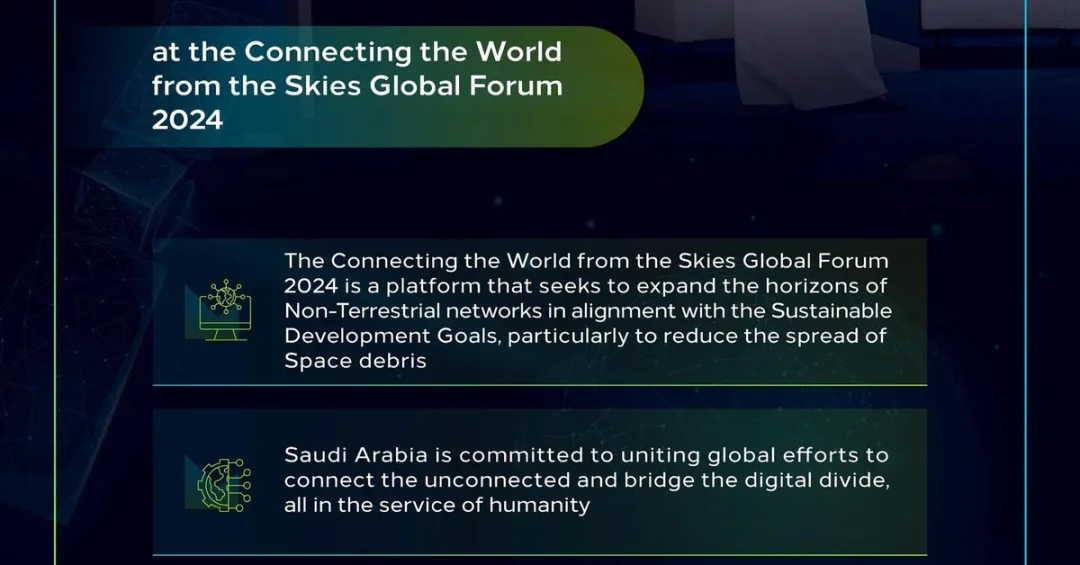
Riyadh, November 25, 2024 — The Connecting the World from the Skies Global Forum officially commenced today in Riyadh under the patronage of Eng. Abdullah Alswaha, Minister of Communications and Information Technology and Chairman of the Communications, Space and Technology Commission (CST). The event, which runs for two days, brings together ministers, industry leaders, experts, and CEOs from leading companies specializing in non-terrestrial networks (NTN), as well as renowned international researchers in technology and investment, alongside local and global heads of regulatory authorities.
In his opening speech, CST Governor Dr. Mohammed Altamimi underscored the forum’s significance as a vital platform for advancing non-terrestrial networks, in line with sustainable development goals, particularly addressing the challenge of space debris. He also highlighted Saudi Arabia’s unwavering commitment to connecting the unconnected in partnership with global stakeholders. As part of these efforts, CST, in collaboration with the International Telecommunication Union (ITU), has conducted a groundbreaking study aiming at harnessing communication services to reduce the global digital divide; the findings of the study will be reviewed at the forum.
Moreover, the Saudi Space Agency announced the launch of the “Centre for Space Futures”, the first of its kind within the network of Fourth Industrial Revolution Centers affiliated with the World Economic Forum. Altamimi stressed that Saudi Arabia takes pride in being one of the first nations to establish a comprehensive regulatory framework for non-terrestrial networks. This forward-thinking approach, he said, reflects Saudi Arabia’s dedication to advancing cutting-edge technologies, leveraging its resources to serve humanity, and enhancing the quality of life on local and global scales.
According to the release, the forum will feature specialized sessions, presentations, and tutorial sessions, contributing to shaping the future of converged connectivity. The winners of the International “Competition on Non-Terrestrial Networks for 6G”, launched by CST in collaboration with the Institute of Electrical and Electronics Engineers (IEEE), will also be announced at the forum, which will also showcase CST’s recent technical experiments in Non-Terrestrial Networks (NTN), including the “Seamless D2D Connectivity” trial, which is the first of its kind in the Middle East and North Africa. The forum is also a key pillar of the NTN Program, which was launched by CST in 2021. The first edition of the forum, held in 2022 in collaboration with ITU, gathered more than 3,000 participants and featured various engaging panel discussions, presentations, and exchange of valuable experience in the NTN field.
Context and Background
Why has Saudi Arabia become a global focal point for the future of space-based communications? The Kingdom’s journey in this domain has been both strategic and swift. In 2021, CST launched the NTN Program, a comprehensive initiative aimed at positioning Saudi Arabia as a leader in non-terrestrial networks—technologies that include satellite communication, high-altitude platform systems, and drone-based connectivity. The program’s first major milestone was the inaugural Connecting the World from the Skies Global Forum in 2022, held in collaboration with the ITU, which attracted over 3,000 participants and set the stage for ongoing global dialogue.
Since then, Saudi Arabia has continued to invest heavily in regulatory frameworks, research and development, and international partnerships. The establishment of the Communications, Space and Technology Commission as a unified regulator for the communications, space, and technology sectors underscores the Kingdom’s integrated approach. This integration is crucial for NTN, as it requires coordination across spectrum management, satellite licensing, and terrestrial network integration. Moreover, the Kingdom’s participation in global forums and its collaboration with the ITU and IEEE demonstrate its commitment to multilateralism and knowledge sharing.
What does this mean for the global connectivity landscape? Non-terrestrial networks are increasingly seen as essential for bridging the digital divide, especially in remote and underserved areas where terrestrial infrastructure is difficult or costly to deploy. By fostering innovation and investment in NTN, Saudi Arabia is not only advancing its own Vision 2030 goals but also contributing to global efforts to connect the unconnected, a key objective of the United Nations Sustainable Development Goals.
Key Details
The forum’s agenda is packed with specialized sessions, presentations, and tutorial sessions designed to shape the future of converged connectivity. A highlight will be the announcement of the winners of the International “Competition on Non-Terrestrial Networks for 6G”, launched by CST in collaboration with the Institute of Electrical and Electronics Engineers (IEEE). This competition attracted researchers and innovators from around the world, focusing on 6G—the next generation of mobile technology that promises ultra-fast speeds, low latency, and ubiquitous connectivity. How will these breakthroughs redefine the way we communicate?
Additionally, CST is showcasing its recent technical experiments in NTN, including the “Seamless D2D Connectivity” trial, the first of its kind in the Middle East and North Africa. This trial demonstrates direct device-to-device communication via satellite, potentially eliminating the need for traditional ground-based infrastructure in remote areas. Such innovation could revolutionize disaster response, rural connectivity, and even personal communication. What might this mean for the future of mobile networks?
Furthermore, the Saudi Space Agency’s announcement of the “Centre for Space Futures” is a significant development. As the first of its kind within the World Economic Forum’s network of Fourth Industrial Revolution Centers, this center will focus on advancing space technologies, fostering public-private partnerships, and addressing global challenges such as space debris—a growing concern as more satellites are launched. How can international cooperation mitigate the risks of space debris while promoting innovation?
International and Regional Impact
Saudi Arabia’s leadership in NTN is not just a national endeavor; it has profound implications for the region and the world. The Middle East and North Africa (MENA) region, with its vast deserts and rugged terrain, presents unique challenges for terrestrial connectivity. NTN solutions can provide affordable, high-speed internet to these areas, unlocking economic opportunities, improving education and healthcare access, and fostering social inclusion. By pioneering these technologies, Saudi Arabia is positioning itself as a catalyst for regional development.
On the global stage, the Kingdom’s collaboration with the ITU and IEEE underscores its commitment to multilateral cooperation. The joint study with ITU on reducing the digital divide will be reviewed at the forum, offering insights that could inform policies worldwide. Moreover, the presence of international ministers, regulators, and executives at the forum highlights Saudi Arabia’s role as a convener of global dialogue. How can such partnerships accelerate the achievement of the UN Sustainable Development Goals, particularly those related to connectivity and innovation?
What role will Saudi Arabia play in shaping global standards for 6G and NTN? Through initiatives like the NTN Program and the 6G competition, the Kingdom is actively contributing to the development of technical standards and best practices. This proactive stance ensures that Saudi Arabia’s voice is heard in international forums, influencing the direction of future technologies.
Economic and Strategic Significance
The economic potential of non-terrestrial networks is immense. According to industry estimates, the global space economy is projected to reach $1.8 trillion by 2035, with satellite communications playing a major role. Saudi Arabia, through its investments and regulatory frameworks, is positioning itself to capture a significant share of this growth. The NTN sector promises new revenue streams, job creation, and technological spin-offs that can benefit the broader economy. What does this mean for Saudi Arabia’s economic diversification goals?
Strategically, NTN capabilities enhance national security, disaster resilience, and digital sovereignty. By reducing reliance on foreign infrastructure, Saudi Arabia can ensure secure and reliable communications even in remote areas. Moreover, the Kingdom’s leadership in NTN aligns with its broader ambition to be a hub for innovation and technology in the region. How will this influence the geopolitical landscape of the Middle East?
The forum also serves as a platform for investment and partnership. By bringing together investors, entrepreneurs, and policymakers, it facilitates deal-making and collaboration. This ecosystem approach is crucial for accelerating the commercialization of NTN technologies and ensuring that Saudi Arabia remains at the forefront of the fourth industrial revolution.
Vision 2030 Alignment
The Connecting the World from the Skies Global Forum is a clear manifestation of Saudi Vision 2030, which seeks to diversify the economy, foster innovation, and enhance the Kingdom’s global engagement. By leading in non-terrestrial networks, Saudi Arabia is not only advancing its technological capabilities but also contributing to a more connected and inclusive world. The forum’s outcomes—from regulatory advancements to international partnerships—will directly support the Vision’s objectives of creating a vibrant society and a thriving economy.
As the forum continues, it is evident that Saudi Arabia is not just participating in the future of connectivity; it is helping to build it. Through initiatives like the NTN Program, the Centre for Space Futures, and global competitions, the Kingdom is laying the groundwork for a world where everyone, everywhere, can benefit from the digital revolution. How will this legacy shape the next decade of global communications?
20 Questions
Q1. What is the Connecting the World from the Skies Global Forum?
A1. It is a global event held in Riyadh under the patronage of Eng. Abdullah Alswaha, bringing together experts to advance non-terrestrial networks, in line with sustainable development goals and Saudi Vision 2030.
Q2. Who is the patron of the forum?
A2. The forum is under the patronage of Eng. Abdullah Alswaha, Minister of Communications and Information Technology and Chairman of the Communications, Space and Technology Commission (CST).
Q3. What is the main focus of the forum?
A3. The forum focuses on non-terrestrial networks (NTN), including satellite communications, to bridge the digital divide, address space debris, and shape the future of converged connectivity.
Q4. Who attended the forum?
A4. Distinguished ministers, industry leaders, experts, CEOs of leading NTN companies, international researchers, and heads of regulatory authorities from around the world attended the forum.
Q5. What did Dr. Mohammed Altamimi emphasize in his speech?
A5. He emphasized the forum’s significance for advancing NTN, Saudi Arabia’s commitment to connecting the unconnected, and the need to address space debris through sustainable development.
Q6. What study did CST conduct with ITU?
A6. CST and ITU conducted a groundbreaking study on harnessing communication services to reduce the global digital divide, the findings of which are being reviewed at the forum.
Q7. What is the Centre for Space Futures?
A7. It is a new initiative by the Saudi Space Agency, the first of its kind within the World Economic Forum’s network of Fourth Industrial Revolution Centers, focusing on space technologies.
Q8. What did Altamimi say about Saudi Arabia’s regulatory framework?
A8. He said Saudi Arabia is one of the first nations to establish a comprehensive regulatory framework for non-terrestrial networks, reflecting its dedication to advancing technology for humanity.
Q9. What sessions are featured at the forum?
A9. The forum features specialized sessions, presentations, and tutorial sessions aimed at shaping the future of converged connectivity and showcasing the latest NTN advancements.
Q10. What competition winners will be announced?
A10. Winners of the International “Competition on Non-Terrestrial Networks for 6G”, launched by CST with IEEE, will be announced, recognizing innovations in 6G technology.
Q11. What is the “Seamless D2D Connectivity” trial?
A11. It is a first-of-its-kind trial in the MENA region by CST, enabling direct device-to-device communication via satellite, potentially revolutionizing connectivity in remote areas.
Q12. What is the NTN Program?
A12. Launched by CST in 2021, the NTN Program is a key initiative to position Saudi Arabia as a leader in non-terrestrial networks through research, regulation, and international collaboration.
Q13. When was the first edition of the forum held?
A13. The first edition was held in 2022 in collaboration with ITU, gathering over 3,000 participants and featuring panel discussions and presentations on NTN.
Q14. How does the forum support Saudi Vision 2030?
A14. It supports Vision 2030 by fostering innovation, economic diversification, and global engagement, positioning Saudi Arabia as a leader in advanced technologies and connectivity.
Q15. What is the significance of NTN for the MENA region?
A15. NTN can provide affordable, high-speed internet to remote areas in MENA, unlocking economic opportunities, improving education and healthcare, and fostering social inclusion.
Q16. How does Saudi Arabia collaborate internationally on NTN?
A16. Saudi Arabia collaborates with ITU, IEEE, and other global entities through joint studies, competitions, and forums to advance NTN standards and reduce the digital divide.
Q17. What economic potential does NTN hold?
A17. The global space economy is projected to reach $1.8 trillion by 2035, with NTN offering new revenue streams, job creation, and technological spin-offs for Saudi Arabia’s economy.
Q18. What is the role of the Saudi Space Agency?
A18. The Saudi Space Agency oversees space-related initiatives, including the Centre for Space Futures, and collaborates on advancing space technologies and addressing challenges like space debris.
Q19. How does the forum address space debris?
A19. The forum highlights space debris as a key challenge, promoting sustainable practices and international cooperation to mitigate risks as satellite launches increase.
Q20. What is the expected outcome of the forum?
A20. The forum aims to shape the future of converged connectivity, announce competition winners, showcase trials, and strengthen partnerships to advance NTN globally.
Reader Feedback
We value your thoughts. Please share your feedback on this article.
Your feedback helps us improve our coverage.
Related articles
 CST Honors Winners of 6G Non-Terrestrial Networks Competition
 CST Signs Telecom MoU with Greece’s EETT at Global Forum
 CST, ITU Sign NTN Global Events Agreement
 KAUST, UConn Sign Deal on AI, Clean Energy
 Saudi Space Agency Concludes Participation in 2024 International NTN Forum
 Saudi Water Innovation Wins Impact Award in Jeddah