


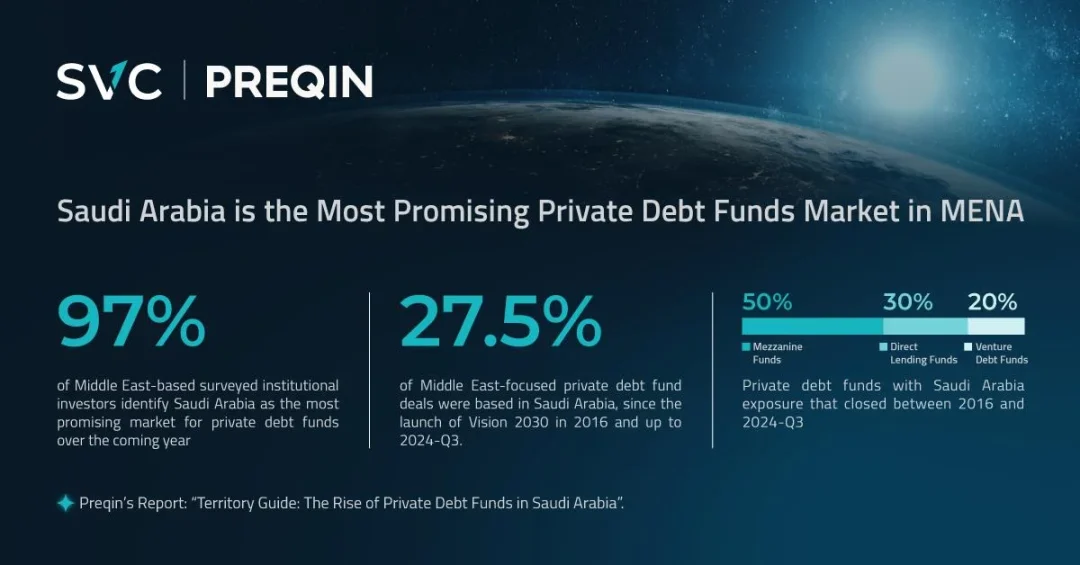
RIYADH — An overwhelming 97 percent of Middle East-based institutional investors now view Saudi Arabia as the most promising market for private debt funds in the coming year, according to a landmark report released today by Preqin, a global leader in alternative assets data, in partnership with Saudi Venture Capital Company (SVC). The figure marks a significant rise from 82 percent in 2023, underscoring the Kingdom’s rapid emergence as a premier destination for private credit and alternative investments. The report, titled “Territory Guide: The Rise of Private Debt Funds in Saudi Arabia,” is the first of its kind focused exclusively on the Kingdom’s private debt landscape, and it highlights how Vision 2030 reforms are reshaping the investment ecosystem. Could this surge in investor confidence signal a new era for Saudi Arabia’s financial markets?
The findings, announced via the Saudi Press Agency, reflect a broader maturation of the Kingdom’s private capital market, driven by economic diversification, regulatory enhancements, and a growing appetite from both regional and global investors. With private debt increasingly becoming an attractive asset class, Saudi Arabia is positioning itself as a pivotal hub for alternative financing in the Middle East and North Africa (MENA) region. The report not only validates the Kingdom’s strategic direction but also sets the stage for deeper capital flows into its burgeoning startup and SME sectors.
Context and Background
How did Saudi Arabia become a magnet for private debt funds in such a short time? Since the launch of Vision 2030 in 2016, the Kingdom has embarked on an ambitious transformation, aiming to diversify its economy away from oil dependence and foster a vibrant private sector. A cornerstone of this effort has been the development of a robust financial ecosystem, with initiatives like the Financial Sector Development Program (FSDP) playing a critical role in enhancing capital markets, improving transparency, and attracting foreign investment. The Preqin report notes that between 2016 and the third quarter of 2024, more than a quarter (27.5 percent) of all Middle East-focused private debt fund deals were based in Saudi Arabia, a testament to the Kingdom’s growing share of regional activity.
Private debt funds, which provide alternative financing to companies that may not access traditional bank loans or public markets, have gained global prominence as a flexible and yield-generating asset class. In Saudi Arabia, this trend is amplified by the government’s push to support small and medium enterprises (SMEs) and startups, which are vital for job creation and innovation. SVC, established in 2018 as a subsidiary of the SME Bank under the National Development Fund (NDF), has been instrumental in this space, stimulating financing for entrepreneurs from pre-Seed to pre-IPO stages. The report’s release thus marks a milestone in documenting the Kingdom’s journey toward a diversified, knowledge-based economy.
Key Details from the Preqin-SVC Report
What specific factors are driving the surge in private debt activity? The report reveals that of the total private debt funds with Saudi Arabia exposure that closed between 2016 and Q3 2024, mezzanine funds account for half of the total exposure, followed by direct lending and venture debt funds at 30 percent and 20 percent, respectively. This diverse mix reflects a maturing market where investors can find opportunities across the risk-return spectrum, from growth-stage financing to more structured mezzanine solutions. Notably, the 97 percent investor confidence figure—up from 82 percent in 2023—signals a strong vote of confidence in the Kingdom’s regulatory environment and economic trajectory.
Dr. Nabeel Koshak, CEO and board member of SVC, commented: “This report highlights the emergence of private debt funds as a key asset class in Saudi Arabia, driven by the Kingdom’s Vision 2030 and its ambition to diversify the economy. At SVC, we continue our commitment to support the development of such reports that provide policymakers, investors, and founders with insights and data to inform strategic decisions and policies to nurture the private capital ecosystem further.” His words underscore the collaborative effort between public institutions and private capital to build a sustainable financial infrastructure.
David Dawkins, lead author of the Preqin report, added: “For other developing economies in the Middle East and beyond, Saudi Arabia’s success in this area will strengthen the impetus for improving transparency to secure the capital needed for sustainable growth in a net zero world.” This perspective highlights the broader implications of Saudi Arabia’s progress, positioning the Kingdom as a model for emerging markets seeking to attract alternative investment. Is Saudi Arabia setting a new global standard for private debt market development?
International and Regional Impact
How does Saudi Arabia’s rise in private debt resonate beyond its borders? The Kingdom’s success is already influencing regional capital flows, with investors from across the Gulf and wider Middle East increasingly allocating to Saudi-focused funds. The report indicates that global sources of capital are also taking notice, drawn by the stability and growth potential of the Saudi market. This influx of foreign investment not only diversifies funding sources for local businesses but also integrates the Kingdom more deeply into global financial networks. As the largest economy in the Arab world, Saudi Arabia’s advancements in private debt can catalyze similar developments in neighboring countries, fostering a more interconnected and resilient regional financial ecosystem.
Moreover, the report’s emphasis on transparency and data-driven insights aligns with global best practices, enhancing the Kingdom’s appeal to institutional investors who prioritize environmental, social, and governance (ESG) criteria. By nurturing a transparent and well-regulated private debt market, Saudi Arabia is not only attracting capital but also setting a benchmark for other emerging economies. The ripple effects could be profound, encouraging higher standards of governance and disclosure across the MENA region and beyond. Could this mark the beginning of a new chapter in Middle Eastern finance, with Saudi Arabia at its helm?
Economic and Strategic Significance
Why does the growth of private debt funds matter for Saudi Arabia’s economy? Private debt provides a vital source of financing for SMEs and startups, which are key drivers of economic diversification and job creation under Vision 2030. By offering alternative lending options, these funds help bridge the financing gap often faced by high-growth companies, enabling them to scale and innovate. This, in turn, supports the Kingdom’s goals of increasing the private sector’s contribution to GDP and reducing unemployment. The Preqin report’s findings suggest that the private debt market is not just a niche corner of finance but a strategic pillar in Saudi Arabia’s economic transformation.
Furthermore, the development of a robust private debt ecosystem enhances the resilience of the financial system by providing diversified funding channels beyond traditional bank lending. This is particularly important in a rapidly evolving economic landscape where agility and access to capital are competitive advantages. For global investors, Saudi Arabia offers a compelling opportunity to participate in a growth story underpinned by strong fundamentals and visionary leadership. The Kingdom’s commitment to regulatory reform and investor protection further mitigates risks, making it an attractive destination for long-term capital. As the market matures, it is poised to play an increasingly pivotal role in financing the businesses that will shape the Saudi economy of tomorrow.
Vision 2030 Alignment
How does the rise of private debt funds directly support Vision 2030? The report’s findings are a clear endorsement of the Vision’s Financial Sector Development Program, which aims to create a diversified and efficient financial sector capable of supporting private sector growth. By attracting alternative investments, Saudi Arabia is bolstering its non-oil economy, fostering innovation, and creating high-value jobs. The collaboration between SVC and Preqin exemplifies the kind of public-private partnership that Vision 2030 champions, leveraging global expertise to build local capacity. As the Kingdom continues to implement reforms and enhance its investment climate, the private debt market is expected to expand, further cementing Saudi Arabia’s role as a leading financial hub in the region.
Looking ahead, the trajectory is clear: Saudi Arabia is not merely participating in the global private debt boom but helping to define it. With a supportive regulatory framework, a growing pool of skilled professionals, and an unwavering commitment to economic diversification, the Kingdom is well-positioned to sustain this momentum. The 97 percent investor confidence is both a validation of past efforts and a catalyst for future growth, promising a virtuous cycle of investment, innovation, and prosperity. As Vision 2030 enters its next phase, the private debt market will undoubtedly be a key engine of Saudi Arabia’s continued rise on the world stage.
20 Questions
Q1. What is the main finding of the Preqin report on private debt funds in Saudi Arabia?
A1. The report found that 97% of Middle East-based institutional investors view Saudi Arabia as the most promising market for private debt funds in the coming year, up from 82% in 2023.
Q2. Who published the report on private debt funds in Saudi Arabia?
A2. The report was published by Preqin, a global leader in alternative assets data, in partnership with Saudi Venture Capital Company (SVC).
Q3. What percentage of Middle East-focused private debt fund deals were based in Saudi Arabia since 2016?
A3. More than a quarter (27.5%) of Middle East-focused private debt fund deals were based in Saudi Arabia from 2016 to the third quarter of 2024.
Q4. What types of private debt funds are most prominent in Saudi Arabia?
A4. Mezzanine funds represent half of the total Saudi Arabia exposure, followed by direct lending at 30% and venture debt funds at 20%.
Q5. How has investor confidence in Saudi Arabia’s private debt market changed?
A5. Investor confidence has risen significantly, with 97% of surveyed Middle East institutional investors now viewing Saudi Arabia as the top market, compared to 82% in 2023.
Q6. What role does SVC play in Saudi Arabia’s private capital ecosystem?
A6. SVC stimulates and sustains financing for startups and SMEs from pre-Seed to pre-IPO through investment in funds and direct investment, supporting Vision 2030 goals.
Q7. How does the report describe the impact of Vision 2030 on private debt funds?
A7. The report attributes the growth of private debt funds to Vision 2030 reforms, which have enhanced transparency, attracted global capital, and matured the private capital market.
Q8. What did Dr. Nabeel Koshak say about the report’s significance?
A8. He highlighted that private debt funds are emerging as a key asset class driven by Vision 2030, and SVC remains committed to providing insights for policymakers, investors, and founders.
Q9. What did David Dawkins note about Saudi Arabia’s success?
A9. He noted that Saudi Arabia’s success will encourage other developing economies to improve transparency and secure capital for sustainable growth in a net zero world.
Q10. Why are private debt funds important for Saudi Arabia’s economy?
A10. They provide alternative financing for SMEs and startups, supporting economic diversification, job creation, and the growth of the non-oil private sector under Vision 2030.
Q11. How does the report characterize the maturity of Saudi Arabia’s private capital market?
A11. The report states that the market is maturing, with increasing interest from local, regional, and global investors, leading to a more diverse and sophisticated private debt landscape.
Q12. What is the significance of the 27.5% figure for Saudi Arabia?
A12. It shows that Saudi Arabia captures a substantial share of Middle East private debt deals, reflecting its growing influence and attractiveness as an investment destination.
Q13. How do mezzanine funds differ from direct lending and venture debt?
A13. Mezzanine funds typically offer subordinated debt with equity features, while direct lending provides senior secured loans, and venture debt targets early-stage, high-growth companies.
Q14. What are the broader implications for the MENA region?
A14. Saudi Arabia’s progress can inspire other countries to enhance transparency and develop private debt markets, fostering regional financial integration and sustainable growth.
Q15. How does the report address transparency in the private debt market?
A15. The report emphasizes that improved transparency, driven by Vision 2030 reforms, is crucial for attracting capital and ensuring sustainable growth in the private debt sector.
Q16. What is SVC’s relationship with the National Development Fund?
A16. SVC is a subsidiary of the SME Bank, which is part of the National Development Fund (NDF), aligning with national objectives to support SMEs and startups.
Q17. How might the growth of private debt funds affect Saudi startups?
A17. It provides them with greater access to alternative financing, enabling scaling, innovation, and job creation, which are essential for economic diversification.
Q18. What does the report say about global interest in Saudi private debt?
A18. It highlights growing global interest, with international investors increasingly participating in Saudi-focused private debt funds, drawn by strong fundamentals and Vision 2030 reforms.
Q19. How does the private debt market support Vision 2030’s financial sector goals?
A19. By diversifying funding sources, enhancing financial stability, and supporting private sector growth, the private debt market directly contributes to the Financial Sector Development Program.
Q20. What is the outlook for Saudi Arabia’s private debt market?
A20. The outlook is highly positive, with continued growth expected as the market matures, supported by Vision 2030, regulatory improvements, and rising investor confidence.
Reader Feedback
We value your thoughts. Please share your feedback on this article.
Your feedback helps us improve our coverage.
Related articles
 Saudi Arabia Tops Arab Region, Ranks 20th Globally in QI4SD
 Egyptian Investment Minister: We Seek to Boost, Attract More Saudi Investments
 Saudi Franchise Registrations Surge 866% in Three Years
 Saudi Cabinet to Approve 2025 Budget Tomorrow
 Minister Al-Jadaan to Present 2025 Budget at News Conference
 Saudi Economy Minister Meets Berlin Global Dialogue Chairman