


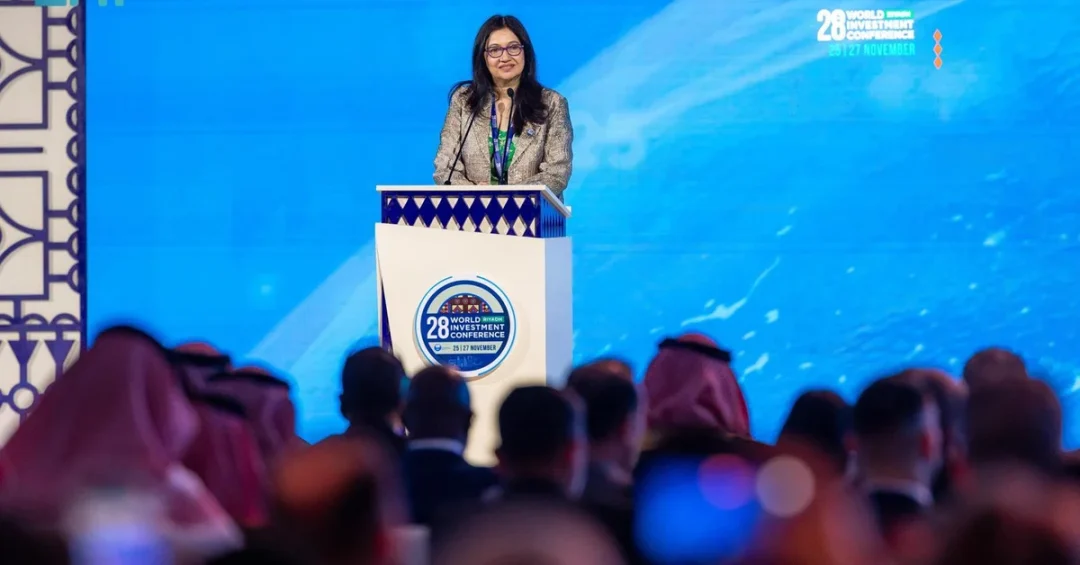
Riyadh, November 25, 2024 — Nivruti Rai, Managing Director and CEO of Invest India and President of the World Association of Investment Promotion Agencies (WAIPA), praised Saudi Arabia’s Vision 2030 as a transformative blueprint for economic and social progress during the 28th World Investment Conference (WIC) in Riyadh. The event, hosted by Invest Saudi in partnership with WAIPA, brought together global leaders to discuss digital transformation, sustainable growth, and international collaboration. Rai highlighted the Kingdom’s dedication to innovation in energy, water, technology, and tourism, positioning Saudi Arabia as a model for other nations. Could this be the moment that global investment strategies pivot toward a more sustainable, technology-driven future?
The conference, held in the Saudi capital, underscored the growing influence of Saudi Arabia as a hub for international dialogue on investment and development. Rai’s remarks resonated with attendees from over 100 countries, who gathered to explore how artificial intelligence, data, and cross-border partnerships can address pressing global challenges. Her commendation of Vision 2030 not only affirms the Kingdom’s progress but also signals a broader recognition of its role in shaping a resilient global economy. How can other nations learn from Saudi Arabia’s ambitious journey?
Context and Background
The 28th World Investment Conference, organized by Invest Saudi and WAIPA, serves as a premier platform for investment promotion agencies worldwide to share best practices and forge partnerships. WAIPA, which represents 110 member states, has long advocated for sustainable development through investment. Nivruti Rai’s leadership at Invest India and her presidency of WAIPA lend significant weight to her endorsement of Saudi Vision 2030. Her speech comes at a time when global economies are seeking pathways to recovery and growth, with digital transformation at the forefront. Isn’t it telling that a figure of her stature would spotlight Saudi Arabia as a beacon of progress?
Vision 2030, launched in 2016 by Crown Prince Mohammed bin Salman, aims to diversify the Kingdom’s economy away from oil, foster social liberalization, and position Saudi Arabia as a global investment powerhouse. Key pillars include technological innovation, educational reform, and tourism expansion. Rai specifically commended these areas, noting how they align with WAIPA’s mission to promote inclusive and sustainable investment. The conference thus provided a stage for Saudi Arabia to showcase its achievements and attract further international collaboration. What does this mean for the future of foreign direct investment in the region?
Rai’s address also touched on the critical role of energy and water sectors, where Saudi Arabia has made significant strides in adopting cutting-edge technologies. She emphasized that such innovations are essential for long-term growth. The Kingdom’s investments in renewable energy, particularly through projects like the NEOM smart city, demonstrate a commitment to sustainability that resonates with global investors. How will these initiatives reshape the Middle East’s economic landscape?
Key Details
In her keynote, Rai outlined the importance of international collaboration for digital transformation, stating that WAIPA’s member states must work together to harness AI and data for the greater good. She proposed a global AI framework that could improve health outcomes, enhance energy efficiency, and elevate quality of life. Such a framework, she argued, requires unprecedented cooperation among governments, private sectors, and international organizations. Saudi Arabia’s Vision 2030, with its emphasis on technology and infrastructure, serves as a practical example of how this can be achieved. Could a unified AI strategy be the key to solving some of the world’s most intractable problems?
Rai also praised Saudi Arabia’s ambitious projects, particularly NEOM, as a successful blend of technology and sustainability. NEOM, a $500 billion mega-project, is designed to be a hub for innovation, featuring The Line, a zero-carbon city, and other futuristic developments. She noted that NEOM offers a high quality of life and sets a new standard for urban living. The project is a cornerstone of Vision 2030 and exemplifies the Kingdom’s forward-thinking approach. How might NEOM inspire similar ventures around the globe?
Furthermore, Rai highlighted the role of WAIPA’s 110 member states in tackling global challenges through AI and data. She stressed that collaboration among these members is crucial for achieving shared goals of sustainable growth and digital advancement. The conference facilitated numerous bilateral meetings and agreements, underscoring the practical outcomes of such gatherings. Saudi Arabia’s leadership in hosting and shaping these discussions was widely acknowledged. What new opportunities for economic and social progress will arise from these collaborations?
International and Regional Impact
Rai’s endorsement of Vision 2030 carries significant implications for international investment trends. By positioning Saudi Arabia as a model, she signals to other nations and investors that the Kingdom is a reliable and forward-looking partner. This could lead to increased foreign direct investment, particularly in technology, renewable energy, and tourism. Regional peers may also be encouraged to adopt similar reform agendas, fostering a more integrated and prosperous Middle East. Isn’t it remarkable how a single nation’s vision can catalyze regional transformation?
The conference also reinforced Saudi Arabia’s role as a bridge between developed and developing economies. By facilitating dialogue among WAIPA members, the Kingdom helps to align investment strategies with global sustainability goals. Rai’s call for a global AI framework resonates with ongoing efforts by international bodies to regulate and harness emerging technologies. Saudi Arabia’s proactive stance on these issues enhances its soft power and diplomatic influence. How will this shape the Kingdom’s relations with other global powers?
On a regional level, Saudi Arabia’s progress under Vision 2030 serves as a counterpoint to instability elsewhere. The Kingdom’s focus on economic diversification and social reform provides a stabilizing force, attracting investment and talent. Neighboring countries may look to emulate aspects of the Saudi model, particularly in technology and tourism. The ripple effects could be profound, leading to a more dynamic and resilient regional economy. What lessons can other nations draw from Saudi Arabia’s experience?
Economic and Strategic Significance
From an economic standpoint, Vision 2030 is not merely a domestic strategy but a global investment magnet. Rai’s remarks underscore the confidence that international partners have in Saudi Arabia’s reform trajectory. Sectors such as renewable energy, digital infrastructure, and tourism are poised for substantial growth, offering lucrative opportunities for investors. The Kingdom’s commitment to innovation in energy and water sectors further enhances its attractiveness. Could Saudi Arabia become the world’s next great innovation hub?
Strategically, Vision 2030 aims to reduce dependence on oil and create a knowledge-based economy. Rai’s praise for the Kingdom’s focus on education and technology aligns with this objective. By fostering a skilled workforce and embracing AI, Saudi Arabia is building the foundations for sustainable prosperity. The World Investment Conference served as a testament to the Kingdom’s ability to convene global stakeholders and drive consensus. How will these efforts translate into tangible economic outcomes in the coming decade?
Moreover, the emphasis on tourism development under Vision 2030 is already yielding results, with initiatives like the Red Sea Project and Diriyah Gate attracting millions of visitors. Rai’s recognition of these efforts highlights their potential to contribute significantly to GDP and job creation. The integration of technology and sustainability in tourism projects sets a new benchmark for the industry. What does this mean for the future of travel in the region and beyond?
Vision 2030 Alignment
Nivruti Rai’s commendation of Vision 2030 underscores its alignment with global best practices in economic and social development. The Kingdom’s holistic approach—encompassing technology, education, tourism, and sustainability—mirrors the aspirations of many nations. By sharing its experience, Saudi Arabia positions itself as a leader in the global pursuit of sustainable growth. The World Investment Conference provided a platform for this exchange, reinforcing the Kingdom’s role as a catalyst for international cooperation. Isn’t it fitting that a vision crafted for Saudi Arabia’s future is now inspiring the world?
As Saudi Arabia continues to implement Vision 2030, partnerships with organizations like WAIPA will be crucial. Rai’s call for collaboration among member states highlights the importance of collective action in addressing global challenges. The Kingdom’s ambitious projects, such as NEOM, serve as living laboratories for innovation, offering scalable solutions that can be replicated elsewhere. With such momentum, Saudi Arabia is well on its way to achieving its goals and setting a global standard. How can the international community best support and learn from this remarkable journey?
20 Questions
Q1. What is the World Investment Conference (WIC)?
A1. The WIC is an annual event organized by Invest Saudi and WAIPA, bringing together global leaders to discuss investment strategies, digital transformation, and sustainable growth. The 28th edition was held in Riyadh in November 2024.
Q2. Who is Nivruti Rai?
A2. Nivruti Rai is the Managing Director and CEO of Invest India and President of the World Association of Investment Promotion Agencies (WAIPA). She is a prominent figure in global investment promotion.
Q3. What is WAIPA?
A3. WAIPA is the World Association of Investment Promotion Agencies, representing 110 member states. It works to enhance international collaboration and promote sustainable investment worldwide.
Q4. What did Nivruti Rai say about Saudi Vision 2030?
A4. She praised Vision 2030 as a blueprint for economic and social progress, highlighting its focus on technology, education, and tourism development as exemplary for other nations.
Q5. Why is international collaboration important for digital transformation?
A5. International collaboration allows countries to share best practices, pool resources, and develop unified frameworks, such as for artificial intelligence, to address global challenges effectively.
Q6. What role do WAIPA’s 110 member states play?
A6. They collaborate to tackle global challenges using AI and data, aiming to improve health, energy efficiency, and quality of life through shared investment and innovation strategies.
Q7. What is NEOM?
A7. NEOM is a $500 billion mega-project in Saudi Arabia designed to be a hub for innovation and sustainability, featuring futuristic cities like The Line, and is a cornerstone of Vision 2030.
Q8. How does NEOM blend technology and sustainability?
A8. NEOM integrates advanced technologies with eco-friendly design, aiming for zero carbon emissions and high quality of life, setting new standards for urban development.
Q9. What sectors did Rai highlight for innovation in Saudi Arabia?
A9. She highlighted the energy and water sectors, noting Saudi Arabia’s dedication to technological innovation and infrastructure as pivotal for growth.
Q10. How does Vision 2030 aim to diversify Saudi Arabia’s economy?
A10. Vision 2030 seeks to reduce oil dependence by developing sectors like technology, tourism, education, and renewable energy, creating a knowledge-based economy.
Q11. What is the significance of the WIC being held in Riyadh?
A11. It underscores Saudi Arabia’s growing role as a global investment hub and provides a platform to showcase its progress under Vision 2030 to international stakeholders.
Q12. What global AI framework did Rai propose?
A12. She proposed a global AI framework to improve health, energy efficiency, and quality of life, requiring collaboration among governments, private sectors, and international organizations.
Q13. How can Vision 2030 inspire other nations?
A13. Vision 2030’s holistic approach to economic and social reform, particularly in technology and sustainability, offers a model that other countries can adapt to their contexts.
Q14. What are the key pillars of Vision 2030?
A14. Key pillars include economic diversification, social liberalization, technological innovation, educational reform, and tourism expansion, all aimed at transforming Saudi Arabia.
Q15. How does Saudi Arabia’s focus on tourism align with Vision 2030?
A15. Tourism development, through projects like the Red Sea Project, aims to boost GDP, create jobs, and showcase the Kingdom’s cultural and natural heritage to the world.
Q16. What economic benefits can result from international collaboration?
A16. Collaboration can lead to increased foreign direct investment, technology transfer, and shared innovation, driving sustainable growth and creating new opportunities for all partners.
Q17. How does Saudi Arabia’s energy innovation contribute to global sustainability?
A17. By investing in renewable energy and advanced technologies, Saudi Arabia helps reduce global carbon emissions and promotes sustainable practices worldwide.
Q18. What is the role of Invest Saudi in the WIC?
A18. Invest Saudi, the Kingdom’s investment promotion agency, co-hosted the WIC, facilitating dialogue and partnerships to attract investment and promote Vision 2030.
Q19. How does Rai’s endorsement impact Saudi Arabia’s global image?
A19. Her endorsement reinforces Saudi Arabia’s reputation as a forward-looking nation committed to innovation and sustainable development, enhancing its attractiveness to investors.
Q20. What future steps can Saudi Arabia take to further Vision 2030?
A20. Continued international partnerships, investment in education and technology, and execution of mega-projects like NEOM will drive Vision 2030 forward, ensuring sustainable prosperity.
Reader Feedback
We value your thoughts. Please share your feedback on this article.
Your feedback helps us improve our coverage.
Related articles
 SVC: 97% of Middle East Investors See Saudi as Top Private Debt Market
 Saudi Arabia Tops Arab Region, Ranks 20th Globally in QI4SD
 Egyptian Investment Minister: We Seek to Boost, Attract More Saudi Investments
 Saudi Franchise Registrations Surge 866% in Three Years
 Saudi Cabinet to Approve 2025 Budget Tomorrow
 Minister Al-Jadaan to Present 2025 Budget at News Conference