


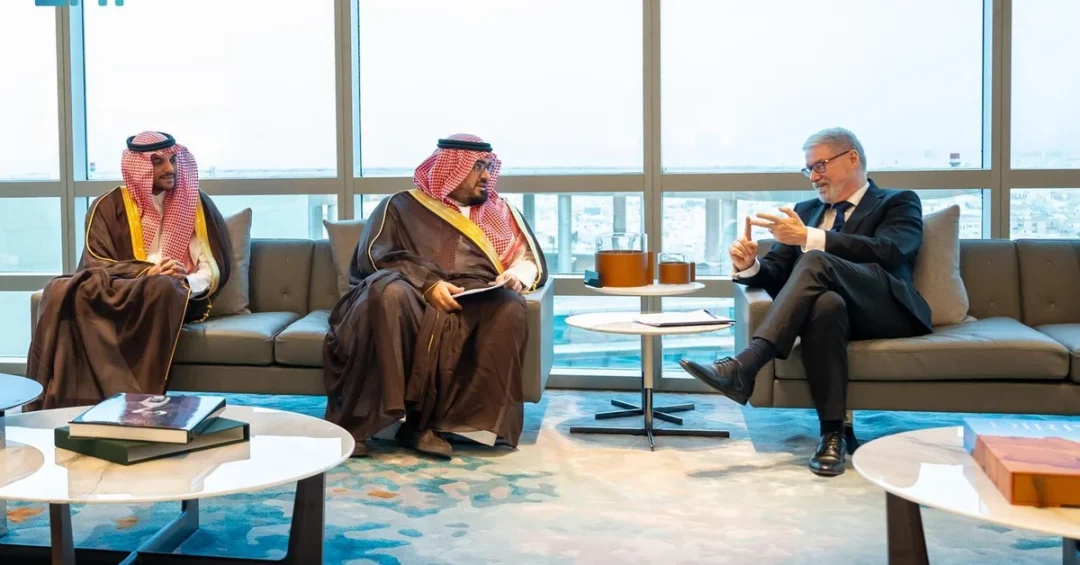
Saudi Minister of Economy and Planning Faisal Alibrahim met with Berlin Global Dialogue Chairman Professor Lars-Hendrik Röller in Riyadh on Monday to discuss areas of cooperation and the latest developments in the global economy, according to the Saudi Press Agency. The meeting underscored Saudi Arabia’s ongoing engagement with international economic institutions and its commitment to fostering dialogue on global economic challenges. As the Kingdom accelerates its Vision 2030 transformation, such high-level exchanges play a vital role in aligning Saudi strategies with global trends and fostering mutually beneficial partnerships.
The Berlin Global Dialogue is a prominent international forum that brings together leaders from government, business, and academia to address pressing global issues. Chairman Röller, a distinguished economist, has been instrumental in shaping the dialogue’s agenda. His meeting with Minister Alibrahim highlights Saudi Arabia’s proactive approach to international economic diplomacy, especially as the world navigates post-pandemic recovery, supply chain disruptions, and inflationary pressures. What does this meeting signify for Saudi Arabia’s role in shaping the global economic narrative? It demonstrates the Kingdom’s growing influence and its willingness to collaborate on solutions that benefit both the region and the world.
Context and Background
Minister Faisal Alibrahim has been a key figure in Saudi Arabia’s economic planning since his appointment in 2021. He oversees the Ministry of Economy and Planning, which is responsible for formulating and implementing the Kingdom’s economic policies, including the National Transformation Program and other Vision 2030 initiatives. Under his leadership, the ministry has focused on diversifying the economy away from oil, boosting private sector growth, and enhancing human capital. His meeting with Professor Röller is part of a broader effort to engage with international thought leaders and institutions to exchange insights on economic policies and best practices.
The Berlin Global Dialogue, founded in 2022, has quickly become a vital platform for addressing global challenges such as climate change, digital transformation, and geopolitical shifts. Professor Lars-Hendrik Röller, former chief economic advisor to German Chancellor Angela Merkel, brings a wealth of experience in economic policy and international cooperation. His visit to Riyadh signals growing interest from European institutions in deepening ties with Saudi Arabia, particularly as the Kingdom emerges as a hub for innovation and investment. Why is Saudi Arabia increasingly sought after as a partner in global economic discussions? The answer lies in its strategic location, economic reforms, and leadership in energy transition and technology.
Saudi Arabia has long been a pivotal player in global energy markets, but its economic diversification efforts have broadened its international engagements. The Kingdom’s G20 presidency in 2020 showcased its ability to convene world leaders and drive consensus on critical issues. Since then, Saudi Arabia has continued to strengthen its ties with European nations, signing numerous agreements in areas such as renewable energy, healthcare, and digital infrastructure. The meeting between Alibrahim and Röller is a continuation of this trend, reflecting the Kingdom’s commitment to multilateralism and its openness to learning from global experiences.
Key Details of the Meeting
During the meeting, Minister Alibrahim and Chairman Röller discussed topics of mutual interest, including areas of cooperation and the latest developments in the global economy. While specific outcomes were not disclosed, the exchange likely covered themes such as post-pandemic recovery, inflation, supply chain resilience, and the role of emerging economies in global governance. The Saudi Press Agency reported that the discussions were productive and aimed at identifying synergies between Saudi Arabia’s Vision 2030 goals and the Berlin Global Dialogue’s objectives. Such dialogues are essential for aligning strategies and fostering international consensus on economic policies.
The meeting also provided an opportunity for Saudi Arabia to showcase its economic achievements and investment opportunities. Minister Alibrahim may have highlighted the Kingdom’s progress in non-oil sectors, which grew by 6.2% in 2023, according to official data. He could have also pointed to the Public Investment Fund’s (PIF) role in driving domestic and international investments, with assets exceeding $700 billion. These points underscore Saudi Arabia’s attractiveness as a destination for foreign investment and its commitment to sustainable development. What can other nations learn from Saudi Arabia’s economic transformation? The Kingdom’s holistic approach, combining policy reforms with large-scale investments, offers a compelling model.
Professor Röller, on his part, likely shared insights from the Berlin Global Dialogue’s recent conferences, which have focused on issues like the future of work, green transition, and digital governance. The dialogue’s inclusiveness, bringing together diverse stakeholders, resonates with Saudi Arabia’s own approach to policymaking, which emphasizes public-private partnerships and youth engagement. The meeting thus served as a platform for mutual learning and for exploring concrete avenues of collaboration, such as joint research initiatives or exchange programs. How can such dialogues translate into tangible benefits for citizens? By informing policies that promote job creation, innovation, and inclusive growth.
International and Regional Impact
This meeting is part of a series of high-level engagements between Saudi Arabia and European partners. In recent months, Saudi officials have met with counterparts from Germany, France, and the UK to discuss trade, investment, and climate action. These interactions are crucial as Europe seeks to diversify its energy sources and supply chains, while Saudi Arabia aims to attract technology and expertise to support its diversification. The meeting with the Berlin Global Dialogue chairman reinforces Saudi Arabia’s position as a reliable partner in addressing global challenges, from energy security to digital transformation.
On a regional level, Saudi Arabia’s active engagement in global economic dialogues enhances its leadership role within the Middle East. By aligning with international best practices, the Kingdom sets an example for neighboring countries striving to modernize their economies. Moreover, such meetings can lead to increased foreign direct investment (FDI) in the region, as international partners gain confidence in Saudi Arabia’s economic stability and reform trajectory. What impact does this have on the Middle East’s economic landscape? It fosters a more integrated and prosperous region, with Saudi Arabia at the helm of progressive change.
Economic and Strategic Significance
The meeting comes at a time when the global economy faces multiple headwinds, including inflationary pressures, geopolitical tensions, and the urgent need for climate action. Saudi Arabia, as the world’s largest oil exporter and a growing force in renewable energy, plays a critical role in stabilizing energy markets and driving the green transition. Minister Alibrahim’s discussion with Professor Röller likely touched on these issues, exploring how Saudi Arabia and Europe can collaborate on energy security and sustainability. The Kingdom’s Vision 2030 includes ambitious targets for renewable energy, aiming to generate 50% of its electricity from clean sources by 2030.
Strategically, the meeting underscores Saudi Arabia’s commitment to economic diplomacy as a tool for advancing its national interests and contributing to global stability. By engaging with influential platforms like the Berlin Global Dialogue, the Kingdom can shape international narratives and build coalitions in support of its economic vision. This is particularly important as Saudi Arabia seeks to attract $100 billion in annual FDI by 2030, a key Vision 2030 goal. Collaborations with global thought leaders can help identify investment opportunities and mitigate risks, ensuring that Saudi Arabia remains a top destination for international capital. How does this meeting support Saudi Arabia’s economic goals? It opens doors for knowledge exchange and partnerships that drive innovation and growth.
Vision 2030 Alignment
The meeting between Minister Alibrahim and Chairman Röller is a clear reflection of Saudi Arabia’s Vision 2030, which seeks to transform the Kingdom into a diversified, innovative, and globally connected economy. Vision 2030 emphasizes international cooperation, sustainable development, and the empowerment of Saudi citizens. By engaging with the Berlin Global Dialogue, Saudi Arabia demonstrates its commitment to these principles and its readiness to take on a leadership role in shaping the future of the global economy. The exchange of ideas and best practices is essential for achieving the ambitious targets of Vision 2030, from increasing non-oil exports to fostering a knowledge-based society.
As Saudi Arabia continues its journey of transformation, such high-level meetings will remain a cornerstone of its economic diplomacy. They not only enhance the Kingdom’s international standing but also bring tangible benefits by facilitating investment, technology transfer, and capacity building. The partnership with the Berlin Global Dialogue and other international forums will help Saudi Arabia navigate the complexities of the global economy and emerge as a model for sustainable development. In the years ahead, the Kingdom’s proactive engagement will undoubtedly yield further opportunities for collaboration, driving mutual prosperity and reinforcing Saudi Arabia’s role as a global economic leader.
20 Questions
Q1. Who is the Saudi Minister of Economy and Planning?
A1. Faisal Alibrahim is the Saudi Minister of Economy and Planning. He has been in office since 2021 and oversees the Kingdom’s economic diversification efforts under Vision 2030.
Q2. Who is Professor Lars-Hendrik Röller?
A2. Professor Lars-Hendrik Röller is the Chairman of the Berlin Global Dialogue. He is a renowned economist and former chief economic advisor to German Chancellor Angela Merkel.
Q3. What is the Berlin Global Dialogue?
A3. The Berlin Global Dialogue is an international forum that brings together leaders from government, business, and academia to address global challenges such as climate change, digital transformation, and geopolitical shifts.
Q4. When and where did the meeting take place?
A4. The meeting took place in Riyadh, Saudi Arabia, on Monday, November 25, 2024, according to the Saudi Press Agency.
Q5. What topics were discussed at the meeting?
A5. The meeting covered topics of mutual interest, including areas of cooperation and the latest developments in the global economy.
Q6. Why is this meeting significant for Saudi Arabia?
A6. It highlights Saudi Arabia’s proactive engagement with international economic institutions and its commitment to fostering dialogue on global economic challenges.
Q7. How does this meeting align with Vision 2030?
A7. The meeting supports Vision 2030’s goals of international cooperation, economic diversification, and sustainable development by facilitating knowledge exchange and partnerships.
Q8. What is the expected outcome of the meeting?
A8. Specific outcomes were not disclosed, but the meeting aimed to identify synergies and explore avenues for collaboration between Saudi Arabia and the Berlin Global Dialogue.
Q9. What are Saudi Arabia’s key economic goals under Vision 2030?
A9. Vision 2030 aims to diversify the economy away from oil, boost private sector growth, increase non-oil exports, and attract $100 billion in annual foreign direct investment by 2030.
Q10. How has Saudi Arabia’s economy performed recently?
A10. Saudi Arabia’s non-oil sectors grew by 6.2% in 2023, according to official data, demonstrating progress in economic diversification.
Q11. What role does the Public Investment Fund play?
A11. The Public Investment Fund (PIF) is Saudi Arabia’s sovereign wealth fund, with assets exceeding $700 billion. It drives domestic and international investments to support Vision 2030.
Q12. How does Saudi Arabia engage with European nations?
A12. Saudi Arabia engages with European nations through high-level meetings, trade agreements, and partnerships in areas such as renewable energy, healthcare, and digital infrastructure.
Q13. What is the Berlin Global Dialogue’s focus?
A13. The dialogue focuses on global challenges including climate change, digital governance, the future of work, and inclusive economic growth.
Q14. What is Saudi Arabia’s role in the global energy market?
A14. Saudi Arabia is the world’s largest oil exporter and a growing force in renewable energy, playing a critical role in stabilizing energy markets and driving the green transition.
Q15. What are Saudi Arabia’s renewable energy targets?
A15. Saudi Arabia aims to generate 50% of its electricity from clean sources by 2030 as part of its Vision 2030 goals.
Q16. How does this meeting benefit the Middle East region?
A16. It enhances Saudi Arabia’s leadership role, promotes regional economic integration, and can lead to increased foreign direct investment in the region.
Q17. What is the significance of Saudi Arabia’s G20 presidency?
A17. Saudi Arabia’s G20 presidency in 2020 showcased its ability to convene world leaders and drive consensus on critical global issues, enhancing its international standing.
Q18. How can other nations learn from Saudi Arabia’s economic transformation?
A18. Other nations can learn from Saudi Arabia’s holistic approach, combining policy reforms with large-scale investments, to achieve sustainable and inclusive growth.
Q19. What are the future prospects for Saudi-European economic cooperation?
A19. Future prospects include deeper collaboration in renewable energy, technology, and trade, as both sides seek to diversify and strengthen their economies.
Q20. How does Saudi Arabia’s economic diplomacy contribute to global stability?
A20. By engaging with international forums and fostering partnerships, Saudi Arabia helps address global challenges, promotes mutual prosperity, and reinforces a stable global economic order.
Reader Feedback
We value your thoughts. Please share your feedback on this article.
Your feedback helps us improve our coverage.
Related articles
 Saudi Arabia Sets World Record with Largest Food Cluster
 Mawani Adds Silmar Group’s IXS Cargo Service to Jeddah Islamic Port
 ZATCA: 72-Hour Customs Declaration Boosts Clearance Speed
 55 Saudi Companies Participate under ‘Made in Saudi’ Pavilion at Big 5 Global Exhibition in Dubai
 Trilateral Meeting in Iraq Affirms OPEC+ Commitment to Oil Stability
 Saudi Cabinet Approves 2025 Budget with SAR1.285 Trillion Expenditure