


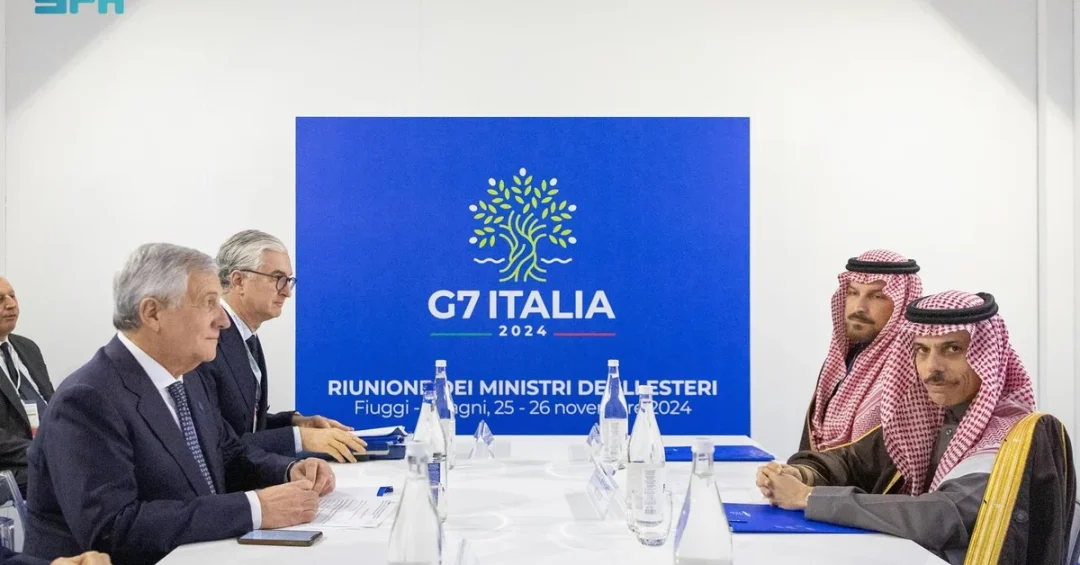
Minister of Foreign Affairs Prince Faisal bin Farhan bin Abdullah met with Italian Deputy Prime Minister and Minister of Foreign Affairs Antonio Tajani on November 25, 2024, in Fiuggi, Italy, on the sidelines of the second expanded G7 Foreign Ministers’ Meeting, as reported by the Saudi Press Agency (SPA). The high-level encounter underscored the Kingdom’s active diplomatic engagement and its commitment to strengthening bilateral ties with Italy, a key European partner. The two leaders discussed avenues to enhance cooperation across various sectors and exchanged views on pressing regional and international issues of mutual interest.
This meeting reflects Saudi Arabia’s proactive foreign policy under the leadership of the Custodian of the Two Holy Mosques, King Salman bin Abdulaziz Al Saud, and His Royal Highness Crown Prince Mohammed bin Salman bin Abdulaziz Al Saud, Prime Minister. By participating in the G7 Foreign Ministers’ Meeting, the Kingdom demonstrates its role as a global bridge-builder, fostering dialogue and collaboration to address shared challenges. The discussion between Prince Faisal and Minister Tajani is part of a broader effort to deepen the strategic partnership between Saudi Arabia and Italy, aligning with the Kingdom’s Vision 2030 objectives of economic diversification and international cooperation. How does such diplomacy contribute to regional stability and global peace?
Context and Background
The meeting between Prince Faisal bin Farhan and Antonio Tajani took place during the second expanded session of the G7 Foreign Ministers’ Meeting, held in Fiuggi, Italy. The G7, comprising Canada, France, Germany, Italy, Japan, the United Kingdom, and the United States, along with the European Union, invited Saudi Arabia as a guest to participate in discussions on key global issues. Saudi Arabia’s inclusion in this prestigious forum highlights its growing influence on the world stage and its recognition as a pivotal player in the Middle East and beyond. The Kingdom’s participation is not merely ceremonial; it signifies the international community’s acknowledgment of Saudi Arabia’s constructive role in addressing matters such as energy security, counterterrorism, and humanitarian aid.
Saudi-Italian relations have historically been robust, built on mutual respect and shared interests. Italy is a significant European partner for Saudi Arabia, with cooperation spanning trade, investment, culture, and defense. In recent years, both nations have worked to expand these ties, exemplified by high-level visits and agreements. The meeting in Fiuggi builds on this foundation, providing an opportunity to review progress and chart new pathways for collaboration. As Saudi Arabia continues its transformation under Vision 2030, partnerships with countries like Italy are essential for accessing technology, expertise, and markets. What does this meeting reveal about the evolving nature of Saudi diplomacy in a multipolar world?
Furthermore, the timing of this meeting is crucial. The G7 Foreign Ministers’ Meeting focused on contemporary global challenges, including the conflicts in Gaza and Ukraine, climate change, and economic resilience. By engaging with Italian counterparts, Prince Faisal underscores Saudi Arabia’s commitment to multilateralism and its willingness to contribute to solutions. The Kingdom’s diplomatic efforts are guided by its principles of justice, peace, and stability, as articulated by its leadership. This encounter also allows Saudi Arabia to advocate for the rights of the Palestinian people and to promote regional de-escalation, aligning with its consistent stance on these issues. In an era of geopolitical flux, such dialogues are vital for fostering understanding and cooperation.
Key Details of the Meeting
During the meeting, Prince Faisal bin Farhan and Minister Antonio Tajani discussed the bilateral relations between Saudi Arabia and Italy and explored ways to enhance cooperation across various fields. According to the Saudi Press Agency, the two sides exchanged views on regional and international issues of mutual interest. While specific details of the discussions were not disclosed, the breadth of topics likely included economic collaboration, investment opportunities, and cultural exchange. Italy, with its advanced industrial base and strategic location in the Mediterranean, is a natural partner for Saudi Arabia’s diversification efforts. The meeting also provided a platform to coordinate positions on matters of common concern, such as energy transitions and sustainable development.
The encounter was held on the sidelines of the expanded G7 session, which brought together foreign ministers from invited countries to deliberate on global governance. Saudi Arabia’s participation in this setting is a testament to its diplomatic weight and its ability to bridge divides between the Global South and the industrialized nations. Prince Faisal’s engagement with Minister Tajani reflects the Kingdom’s strategy of building coalitions and fostering partnerships that serve its national interests and contribute to international stability. The dialogue also reinforces the strong personal rapport between the two diplomats, which can facilitate future cooperation. How do these bilateral talks translate into tangible benefits for both nations?
Moreover, the meeting underscored the shared commitment of Saudi Arabia and Italy to upholding international law and promoting peaceful resolution of conflicts. Both countries have expressed support for a two-state solution in the Israeli-Palestinian conflict and have called for ceasefires in Gaza and Ukraine. By aligning their voices, they amplify calls for humanitarian access and reconstruction efforts. The discussions may also have touched on energy cooperation, given Italy’s interest in diversifying its energy sources and Saudi Arabia’s role as a reliable supplier. With Vision 2030 emphasizing renewable energy and sustainability, Italy’s expertise in green technologies could be invaluable. Such details, though not fully public, highlight the depth and potential of the Saudi-Italian partnership.
International and Regional Impact
The meeting between Prince Faisal and Minister Tajani carries significant implications for international and regional dynamics. Saudi Arabia’s participation in the G7 Foreign Ministers’ Meeting signals its growing role as a mediator and consensus-builder. By engaging with Italy, a founding member of the European Union and a G7 nation, the Kingdom strengthens its ties with Europe, which is vital for balancing global powers and advancing its interests. This aligns with Saudi Arabia’s Vision 2030 goal of deepening international partnerships and attracting foreign investment. The dialogue also contributes to regional stability by promoting coordinated responses to crises in the Middle East, such as the situations in Gaza, Lebanon, and Yemen. How can Saudi-Italian cooperation further stabilize the Mediterranean and Middle East regions?
On a broader scale, the meeting reflects Saudi Arabia’s commitment to multilateralism and its active role in global governance. The Kingdom’s presence at the G7 table allows it to voice the concerns of the Arab and Muslim worlds, advocating for justice and peace. Italy, as a Mediterranean bridge, shares interests in migration, energy security, and trade with Saudi Arabia. Their collaboration can lead to joint initiatives in Africa and the Balkans, where both countries seek stability. Additionally, the diplomatic engagement enhances Saudi Arabia’s image as a responsible global actor, countering misconceptions and showcasing its modernization efforts. The positive tone of the meeting, as reported by SPA, demonstrates the mutual respect and shared vision between the two nations.
Economic and Strategic Significance
Economically, the meeting holds promise for expanding trade and investment flows between Saudi Arabia and Italy. Bilateral trade has grown in recent years, with Italian companies active in Saudi infrastructure, healthcare, and luxury goods sectors. The Kingdom’s Vision 2030 projects, such as NEOM, the Red Sea Project, and Qiddiya, offer vast opportunities for Italian firms in design, engineering, and sustainability. Conversely, Saudi investments in Italy, including in energy and real estate, contribute to job creation and economic growth. The discussions in Fiuggi may have explored new avenues for collaboration in renewable energy, digital technology, and space exploration, areas where Italy has notable expertise. By aligning economic strategies, both nations can drive innovation and prosperity.
Strategically, the partnership is significant for regional security and defense. Italy is a key player in NATO and the Mediterranean, and Saudi Arabia is a linchpin of stability in the Gulf. Cooperation on counterterrorism, maritime security, and cyber defense can enhance safety and deter threats. The meeting also allows for coordination on global issues like climate change, where Saudi Arabia’s Green Initiative and Italy’s sustainability goals converge. Furthermore, cultural and educational exchanges, such as scholarships and tourism, strengthen people-to-people ties. The strategic dialogue between Prince Faisal and Minister Tajani thus lays the groundwork for a multifaceted partnership that supports Saudi Arabia’s long-term vision and Italy’s global engagement.
Vision 2030 Alignment
The meeting between Prince Faisal bin Farhan and Antonio Tajani is firmly aligned with Saudi Arabia’s Vision 2030, which seeks to diversify the economy, enhance international cooperation, and position the Kingdom as a global leader. By engaging with Italy, a G7 and EU member, Saudi Arabia advances its diplomatic and economic objectives, attracting investments and expertise that fuel its transformation. Vision 2030 emphasizes partnerships as a cornerstone of progress, and this encounter exemplifies how the Kingdom builds bridges with nations that share its aspirations for peace and prosperity. It also reinforces Saudi Arabia’s role in multilateral forums, where it advocates for regional stability and sustainable development.
As Saudi Arabia continues its journey toward a brighter future, such diplomatic engagements are crucial. They showcase the Kingdom’s openness to the world, its commitment to mutual respect, and its determination to contribute to global solutions. The leadership of Crown Prince Mohammed bin Salman has been instrumental in elevating Saudi Arabia’s international standing, and meetings like this one demonstrate the tangible results of that vision. Looking ahead, the strengthened Saudi-Italian partnership will likely yield new collaborations in trade, culture, and security, benefiting both peoples and reinforcing the Kingdom’s path to 2030. In a world of interconnected challenges, Saudi Arabia stands as a beacon of stability and progress, forging alliances that build a better tomorrow for all.
20 Questions
Q1. Who met in Fiuggi, Italy, on November 25, 2024?
A1. Saudi Minister of Foreign Affairs Prince Faisal bin Farhan bin Abdullah met with Italian Deputy Prime Minister and Minister of Foreign Affairs Antonio Tajani, as reported by the Saudi Press Agency.
Q2. What was the occasion for the meeting?
A2. The meeting took place on the sidelines of the expanded session of the second Group of Seven (G7) Foreign Ministers’ Meeting held in Fiuggi, Italy.
Q3. What did the two ministers discuss?
A3. They discussed bilateral relations between Saudi Arabia and Italy, explored ways to enhance cooperation across various fields, and exchanged views on regional and international issues of mutual interest.
Q4. Why is Saudi Arabia’s participation in the G7 meeting significant?
A4. It highlights Saudi Arabia’s growing global influence and its role as a constructive partner in addressing international challenges, reflecting the Kingdom’s active diplomacy under its leadership.
Q5. How does this meeting align with Saudi Vision 2030?
A5. It supports Vision 2030 by strengthening international partnerships, attracting investment, and promoting economic diversification through cooperation with Italy, a key European partner.
Q6. What are the key areas of Saudi-Italian cooperation?
A6. Cooperation spans trade, investment, energy, culture, defense, and technology, with both nations working to expand ties in line with shared interests and global challenges.
Q7. What regional issues might have been discussed?
A7. They likely addressed conflicts in Gaza and Ukraine, regional stability in the Middle East, and humanitarian efforts, reflecting Saudi Arabia’s commitment to peace and justice.
Q8. How does this meeting impact Saudi Arabia’s international standing?
A8. It reinforces the Kingdom’s image as a responsible global actor and bridge-builder, enhancing its diplomatic weight and fostering partnerships that promote stability and prosperity.
Q9. What economic opportunities does this partnership offer?
A9. It opens avenues for Italian expertise in Saudi megaprojects like NEOM, and Saudi investments in Italy, boosting trade, innovation, and job creation in both countries.
Q10. What is the significance of the G7 expanded session?
A10. It allows invited countries like Saudi Arabia to contribute to global governance discussions, ensuring diverse perspectives on issues such as energy security, climate change, and economic resilience.
Q11. How does Saudi Arabia’s diplomacy benefit the Middle East?
A11. Saudi diplomacy promotes dialogue, de-escalation, and cooperation, helping to stabilize the region and advocate for Arab and Muslim interests on the world stage.
Q12. What role does Italy play in Saudi Arabia’s foreign policy?
A12. Italy is a strategic European partner, and engagement with it strengthens Saudi Arabia’s ties with the EU and G7, supporting the Kingdom’s global outreach and Vision 2030 goals.
Q13. Were any agreements signed during the meeting?
A13. The SPA report did not mention specific agreements, but the discussions aimed to enhance cooperation, laying groundwork for future collaborations in various sectors.
Q14. How does this meeting reflect Saudi leadership’s vision?
A14. It demonstrates Crown Prince Mohammed bin Salman’s commitment to elevating Saudi Arabia’s global role through proactive diplomacy, fostering alliances that drive progress and stability.
Q15. What cultural exchanges might result from this meeting?
A15. Potential cultural exchanges include art exhibitions, educational scholarships, and tourism initiatives, enriching people-to-people ties and showcasing Saudi heritage and Italian culture.
Q16. How does Saudi Arabia contribute to G7 discussions?
A16. Saudi Arabia offers insights on energy markets, regional security, and humanitarian aid, leveraging its unique position to bridge divides and promote sustainable solutions.
Q17. What is the broader impact of Saudi-Italian cooperation?
A17. It fosters stability in the Mediterranean and Middle East, boosts economic growth, and sets an example of constructive international partnership aligned with global peace efforts.
Q18. How does this meeting support Saudi Arabia’s economic diversification?
A18. By partnering with Italy, Saudi Arabia gains access to technology, expertise, and markets, accelerating non-oil sectors like tourism, technology, and renewable energy under Vision 2030.
Q19. What message does this meeting send to the international community?
A19. It signals Saudi Arabia’s openness to dialogue, its commitment to multilateralism, and its readiness to collaborate on global challenges, reinforcing its role as a stabilizing force.
Q20. What are the next steps for Saudi-Italian relations?
A20. Both nations are expected to continue high-level exchanges, implement joint initiatives, and explore new areas of cooperation, building on the positive momentum from this meeting.
Reader Feedback
We value your thoughts. Please share your feedback on this article.
Your feedback helps us improve our coverage.
Related articles
 Saudi FM Meets Canadian Counterpart at G7 in Italy
 Saudi Crown Prince Offers Condolences to Kuwait on Al-Sabah Passing
 Sumatra Floods Kill 20: Saudi Aid Possible
 4.8-Magnitude Earthquake Strikes Fiji Islands
 SFDA CEO Leads Saudi Delegation at CODEX Meeting in Geneva
 24th Saudi Relief Plane Arrives in Lebanon