


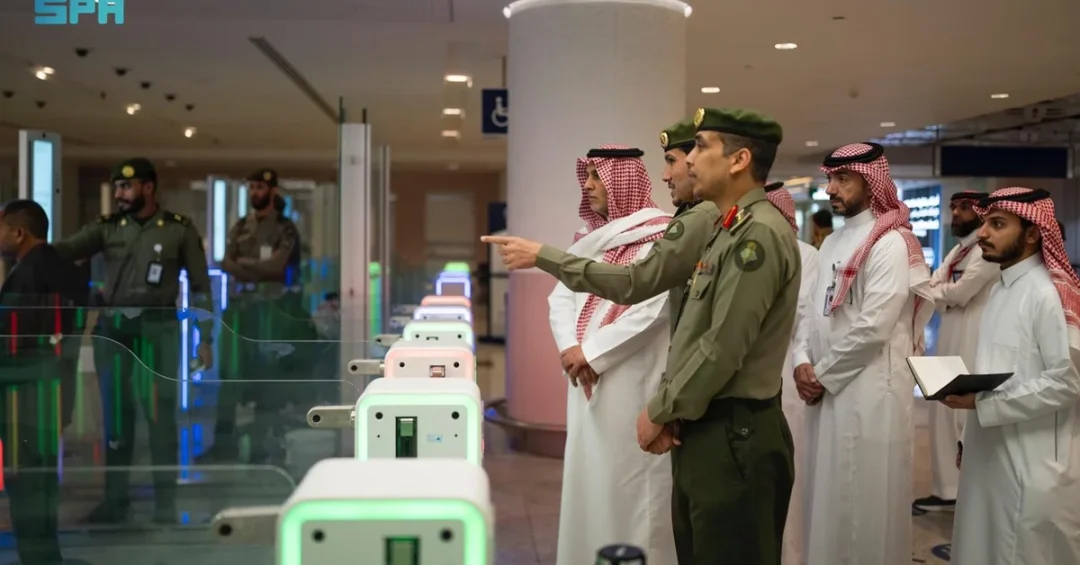
Saudi Data and AI Authority (SDAIA) President Dr. Abdullah bin Sharaf Alghamdi conducted an official inspection on Wednesday of the electronic gates at King Abdulaziz International Airport in Jeddah, reviewing a system launched by the General Directorate of Passports in collaboration with SDAIA and Matarat Holding Company to streamline passenger processing at one of the Kingdom’s busiest aviation hubs. The visit underscored Saudi Arabia’s accelerating push to embed artificial intelligence and biometric verification into its border infrastructure, a core element of the national digital transformation agenda.
During the inspection, Alghamdi was briefed on the full scope of SDAIA’s efforts to serve worshippers and Umrah pilgrims arriving in and departing from the Kingdom. These efforts include the development and operation of e-gate systems and their integration with border control platforms, biometric databases, airline reservation systems, and visa processing networks. The integration allows travelers to clear immigration checkpoints faster and with greater security, reflecting a broader strategy to position Saudi Arabia as a global leader in smart travel solutions. How does a single airport inspection signal a much larger shift in how the Kingdom manages millions of annual pilgrims and tourists?
Context and Background
The electronic gate initiative at King Abdulaziz International Airport is the product of a multi-agency partnership that brings together the General Directorate of Passports, SDAIA, and Matarat Holding Company, the entity responsible for managing and operating Saudi Arabia’s airports. Each partner plays a distinct role: the Passports Directorate provides border control authority and regulatory oversight, SDAIA supplies the data architecture and artificial intelligence capabilities, and Matarat ensures the physical infrastructure and operational readiness of airport terminals. This collaborative model reflects a government-wide approach to service delivery that has become a hallmark of Saudi administrative modernization.
King Abdulaziz International Airport is particularly significant because it serves as the primary gateway for pilgrims traveling to Makkah for Umrah and Hajj. The airport handles millions of international passengers annually, with traffic peaks during Ramadan and the Hajj season that place enormous pressure on immigration and customs facilities. The e-gates are designed to absorb those surges without compromising security or service quality, using biometric verification to confirm traveler identity in seconds rather than minutes. Why does the Kingdom prioritize airport innovation as a cornerstone of its international image and pilgrim hospitality?
SDAIA, established in 2019 by royal decree, has become the central node for Saudi Arabia’s artificial intelligence and data governance ecosystem. Its mandate spans national data policy, AI research and deployment, and the digital upskilling of public sector entities. The authority’s involvement in border technology is therefore not incidental but strategic: it applies national data standards to one of the most sensitive and high-volume operational environments in the country. The e-gate project demonstrates how SDAIA translates policy into front-line services that millions of visitors experience directly.
Key Details of the Inspection
Dr. Abdullah bin Sharaf Alghamdi received a comprehensive briefing on the operational performance of the e-gates, including their throughput capacity, biometric matching accuracy, and integration with airline and visa systems. The briefing covered the full passenger journey, from pre-arrival visa verification to post-arrival identity confirmation, and highlighted how data flows securely between the various agencies involved. Alghamdi emphasized the importance of utilizing smart technologies to enhance efficiency and improve the travel experience for passengers, according to the Saudi Press Agency.
The inspection also focused on SDAIA’s specific contributions to serving worshippers and Umrah pilgrims. These contributions include the development of digital platforms that allow pilgrims to complete pre-travel procedures remotely, the operation of e-gate systems at arrival and departure terminals, and the continuous monitoring of system performance during peak periods. The integration with border control means that a traveler’s biometric data, once verified, can be used across multiple checkpoints without repeated manual documentation, reducing both processing time and human error. What does this level of coordination reveal about Saudi Arabia’s capacity to manage complex, multi-stakeholder technology projects at national scale?
Matarat Holding Company’s role in the project extends beyond physical installation. The company coordinates terminal layout, signage, passenger flow management, and staff training to ensure that the e-gates are not merely installed but fully operational and user-friendly. This operational dimension is critical: technology alone does not improve travel experience unless it is embedded in well-designed processes and supported by trained personnel. The partnership model ensures that each agency’s expertise is applied where it matters most.
International and Regional Impact
The e-gate system at King Abdulaziz International Airport positions Saudi Arabia among a small group of countries that have deployed biometric border control at scale. For international travelers, the practical benefit is a faster, more predictable arrival experience that reduces queues and uncertainty. For airlines, the integration with reservation systems means better data on passenger flows and fewer disruptions caused by immigration bottlenecks. For the Kingdom, the system enhances security by providing real-time verification against multiple databases while facilitating legitimate travel.
Regionally, the project reinforces Saudi Arabia’s role as a leader in digital government services. Neighboring countries and broader international partners increasingly look to the Kingdom’s experience as a reference point for their own modernization efforts. The integration of visa, airline, and border systems into a single data environment is a technically demanding achievement that signals the maturity of Saudi Arabia’s digital infrastructure. How might this model influence the way other nations approach border management and pilgrim services in the coming decade?
The timing of the inspection, during a period of intense focus on Vision 2030 deliverables, also carries diplomatic significance. Saudi Arabia has set ambitious targets for tourist arrivals and religious visitation, and the e-gates are a tangible enabler of those targets. By demonstrating that the technology works and is being actively managed at the highest levels, the Kingdom signals reliability to international partners, travel operators, and prospective visitors alike.
Economic and Strategic Significance
The economic logic behind the e-gate investment is straightforward: faster processing increases airport capacity without requiring equivalent expansion of physical immigration halls. That efficiency translates into lower operational costs, higher passenger satisfaction, and greater competitiveness for Saudi airports relative to regional alternatives. For a country pursuing a diversification agenda, aviation infrastructure is a critical enabler of tourism, trade, and international business travel.
Strategically, the integration of biometric data with border control systems strengthens national security while supporting the free movement of legitimate travelers. The system’s ability to draw on multiple data sources, including visa records and airline manifests, provides a layered security approach that is both robust and efficient. This balance between openness and security is central to Saudi Arabia’s positioning as a welcoming yet safe destination for millions of annual visitors. What does this tell us about how the Kingdom intends to compete in the global travel and tourism market?
The project also has implications for the domestic technology sector. SDAIA’s work on e-gates creates demand for local expertise in AI, data integration, and cybersecurity, contributing to the growth of a knowledge-based economy. By involving Saudi entities in the design and operation of critical national infrastructure, the Kingdom builds indigenous capability that can be exported or applied to other sectors over time.
Vision 2030 Alignment
The e-gate initiative aligns directly with Vision 2030’s objectives of enhancing government effectiveness, improving quality of life, and growing the tourism and pilgrimage sectors. Vision 2030 calls for a digital transformation that makes public services more accessible, efficient, and secure, and the e-gates are a concrete expression of that goal in one of the Kingdom’s most visible service environments. The project also supports the target of welcoming 30 million Umrah pilgrims annually, a figure that requires seamless infrastructure at every point of entry.
Under the leadership of Crown Prince Mohammed bin Salman, Saudi Arabia has consistently emphasized technology as a driver of national progress. SDAIA’s mandate and the e-gate deployment reflect that emphasis, showing how data and AI can be applied to real-world challenges with measurable benefits for citizens, residents, and visitors. As the Kingdom continues to expand its digital infrastructure, the lessons learned at King Abdulaziz International Airport will inform future projects at other airports and border crossings, further consolidating Saudi Arabia’s reputation as a global leader in smart governance and pilgrim service.
20 Questions
Q1. What did the SDAIA president inspect at King Abdulaziz International Airport?
A1. Dr. Abdullah bin Sharaf Alghamdi inspected the electronic gates at King Abdulaziz International Airport in Jeddah, reviewing their operation and integration with border control, biometric, airline, and visa systems.
Q2. Which organizations collaborated to launch the e-gates?
A2. The e-gates were launched by the General Directorate of Passports in collaboration with the Saudi Data and AI Authority (SDAIA) and Matarat Holding Company, which manages and operates Saudi airports.
Q3. When did the inspection take place?
A3. The inspection took place on Wednesday, March 27, 2025, according to the Saudi Press Agency, which reported the visit from Jeddah.
Q4. What is the primary purpose of the e-gates?
A4. The e-gates aim to facilitate the travel of passengers through King Abdulaziz International Airport by using biometric verification to speed up immigration processing while maintaining security.
Q5. How does SDAIA support worshippers and Umrah pilgrims?
A5. SDAIA develops and operates e-gate systems, integrates them with border control and visa platforms, and provides digital tools that help pilgrims complete procedures efficiently during arrival and departure.
Q6. What did Dr. Alghamdi emphasize during his visit?
A6. He emphasized the importance of utilizing smart technologies to enhance efficiency and improve the travel experience for passengers, reflecting SDAIA’s commitment to innovative public services.
Q7. What is Matarat Holding Company’s role in the project?
A7. Matarat Holding Company manages and operates Saudi airports, ensuring the physical infrastructure, terminal layout, and operational readiness needed for the e-gates to function effectively.
Q8. Why is King Abdulaziz International Airport significant for this project?
A8. It is a primary gateway for Umrah and Hajj pilgrims and one of the Kingdom’s busiest airports, making it an ideal location to deploy technology that handles large passenger volumes.
Q9. How do the e-gates integrate with other systems?
A9. The e-gates integrate with border control databases, biometric data platforms, airline reservation systems, and visa processing networks to verify traveler identity quickly and securely.
Q10. What is SDAIA’s broader mandate?
A10. SDAIA is responsible for national data policy, artificial intelligence development, and digital transformation across Saudi government entities, established by royal decree in 2019.
Q11. How does the project benefit international travelers?
A11. International travelers experience faster immigration processing, reduced queues, and a more predictable arrival experience, while security remains robust through biometric verification.
Q12. What role does biometric data play in the e-gate system?
A12. Biometric data, such as fingerprints or facial recognition, is used to confirm traveler identity in seconds, reducing manual documentation and human error at checkpoints.
Q13. How does the project support Vision 2030?
A13. It advances Vision 2030 goals for digital government, improved quality of life, and growth in tourism and pilgrimage by making entry procedures more efficient and secure.
Q14. What economic benefits does the e-gate system bring?
A14. It increases airport capacity without major physical expansion, lowers operational costs, boosts passenger satisfaction, and strengthens Saudi Arabia’s competitiveness in regional aviation.
Q15. How does the system handle peak pilgrimage seasons?
A15. The e-gates are designed to absorb surges in passenger traffic during Ramadan and Hajj by processing travelers rapidly and maintaining security through integrated data checks.
Q16. What security advantages do the e-gates provide?
A16. They provide layered security by verifying identities against multiple databases in real time, helping border authorities detect irregularities while facilitating legitimate travel.
Q17. Who is Dr. Abdullah bin Sharaf Alghamdi?
A17. Dr. Abdullah bin Sharaf Alghamdi is the President of the Saudi Data and AI Authority (SDAIA), the national body overseeing data and artificial intelligence policy and implementation.
Q18. How does this project reflect Saudi Arabia’s digital transformation?
A18. It demonstrates the Kingdom’s ability to deploy advanced technologies at scale in critical national infrastructure, integrating multiple agencies into a unified, efficient service delivery model.
Q19. What might be the next steps for SDAIA in border technology?
A19. SDAIA is likely to continue refining e-gate systems, expanding their use to other airports and border crossings, and enhancing integration with emerging technologies to improve service further.
Q20. What does this inspection signal about Saudi leadership’s priorities?
A20. It signals that Saudi leadership places high priority on technology-driven efficiency, pilgrim service, and international competitiveness, consistent with Vision 2030 and the Kingdom’s global role.
Reader Feedback
We value your thoughts. Please share your feedback on this article.
Your feedback helps us improve our coverage.