


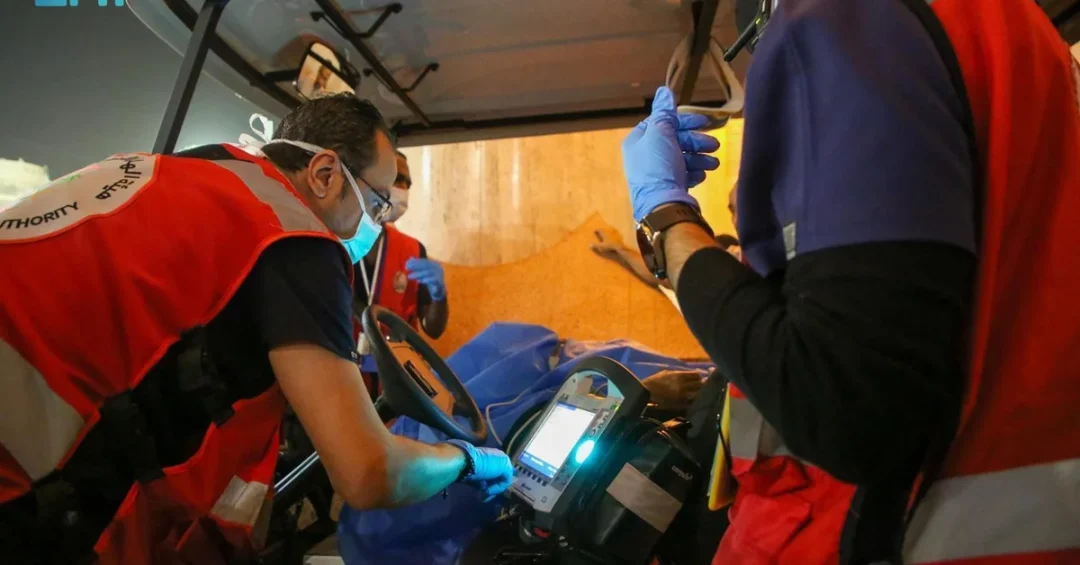
A rapid-response paramedic team from the Saudi Red Crescent Authority (SRCA) in Makkah successfully revived a Moroccan pilgrim in his seventies after he suffered a cardiac arrest while heading to the Grand Mosque, the Saudi Press Agency reported on March 27, 2025. The pilgrim lost consciousness en route to the mosque during the spiritually significant 27th night of Ramadan, one of the busiest and most sacred periods of the Islamic calendar. According to the SRCA, medics performed cardiopulmonary resuscitation (CPR) using a LUCAS chest compression device and an automated external defibrillator (AED) before transporting the patient to the nearest medical facility for further care. The incident underscores the preparedness of Saudi emergency services during the holy month, when millions of worshippers gather in Makkah.
The successful intervention reflects the Kingdom’s long-standing commitment to safeguarding the health and well-being of pilgrims from around the world. Each year, Saudi Arabia hosts millions of Umrah and Hajj performers, and the Saudi Red Crescent Authority operates an extensive network of medical teams, ambulances, and field clinics across the holy sites. During the last ten nights of Ramadan, particularly the 27th night, the authority escalates its readiness to the highest level, deploying additional personnel and advanced equipment near the Grand Mosque and surrounding areas. This pre-established plan ensures that emergencies receive immediate attention, often within minutes. Have you ever wondered how such rapid responses are coordinated amid the massive crowds?
Context and Background
Makkah, the holiest city in Islam, welcomes millions of pilgrims annually, with numbers surging during Ramadan and Hajj. The 27th night of Ramadan, known as Laylat al-Qadr, is considered the most sacred night of the Islamic year, drawing immense crowds to the Grand Mosque for prayer and devotion. Managing the safety and health of these worshippers is a monumental logistical challenge, and Saudi Arabia has developed a sophisticated system to address it. The Saudi Red Crescent Authority, in coordination with the Ministry of Health and other security agencies, implements a comprehensive emergency medical plan that includes mobile teams, designated ambulance routes, and on-site medical posts.
The SRCA’s pre-established plan for the 27th night involves positioning rapid-response teams at strategic locations around the Grand Mosque and key access routes. These teams are equipped with advanced life-support tools, including the LUCAS device—a mechanical chest compression system that delivers consistent, high-quality compressions—and automated external defibrillators, which analyze heart rhythms and deliver shocks if necessary. The presence of such equipment, combined with highly trained paramedics, significantly increases survival rates for cardiac arrest victims. In this case, the team’s swift action restored the pilgrim’s heartbeat before he was moved to a hospital. How many lives are saved each year through these meticulous preparations?
Cardiac emergencies are among the most critical incidents during mass gatherings, as physical exertion, heat, and pre-existing conditions can trigger heart attacks or arrhythmias. The SRCA’s ability to respond within minutes is a testament to years of investment in emergency medical services and training. The authority regularly conducts drills and simulations to ensure readiness, and its paramedics are trained to international standards. This incident also highlights the importance of public awareness: pilgrims are advised to stay hydrated, avoid overexertion, and seek help immediately if they feel unwell. The Saudi government’s proactive approach to crowd health management has been praised by international health organizations.
Key Details
According to the Saudi Press Agency, the Moroccan pilgrim, whose identity has not been disclosed, lost consciousness while walking toward the Grand Mosque. A rapid-response team stationed nearby as part of the 27th-night plan was alerted and arrived promptly. The paramedics immediately initiated CPR, employing the LUCAS chest compression device to maintain circulation and an automated external defibrillator to assess and, if needed, shock the heart. Their coordinated efforts restored the pilgrim’s heartbeat, and he was then transported to the nearest medical facility for advanced care. The SRCA confirmed that the patient received continuous monitoring during transport.
The use of the LUCAS device is particularly noteworthy, as it provides mechanical compressions that are more consistent than manual CPR, especially during prolonged resuscitation efforts. This technology, along with the AED, is part of the SRCA’s standard equipment for high-priority events. The authority has invested heavily in modernizing its fleet and medical devices, aligning with the Kingdom’s broader healthcare transformation under Vision 2030. The paramedics involved in this rescue are part of a specialized unit that undergoes rigorous training in advanced cardiac life support and mass-gathering medicine. Their quick thinking and adherence to protocols were crucial to the positive outcome.
Following the resuscitation, the pilgrim was admitted to a hospital in Makkah, where he is reported to be in stable condition. The SRCA did not release further details about his health, citing patient privacy. However, the authority emphasized that such successful interventions are the result of meticulous planning and the dedication of its teams. The incident occurred on one of the busiest nights of the year, with hundreds of thousands of worshippers performing Umrah and prayers. The fact that the emergency was handled efficiently amid such crowds demonstrates the effectiveness of the SRCA’s crowd-management strategies.
International and Regional Impact
The rescue of the Moroccan pilgrim has resonated beyond Saudi Arabia, reinforcing the Kingdom’s reputation as a capable and compassionate host for pilgrims worldwide. Morocco and Saudi Arabia share strong bilateral ties, and the incident highlights the care extended to Moroccan citizens during their spiritual journey. The swift response also sends a positive message to the global Muslim community about the safety measures in place at Islam’s holiest sites. International observers often commend Saudi Arabia for its massive logistical efforts during Hajj and Umrah, and this event adds to that narrative of excellence.
Regionally, the incident underscores the importance of emergency medical services in the Middle East, where mass gatherings are common. Saudi Arabia’s model of pre-positioned rapid-response teams could serve as a benchmark for other countries hosting large religious or cultural events. The SRCA frequently collaborates with international bodies such as the World Health Organization (WHO) and shares best practices. The successful resuscitation also highlights the role of advanced technology in saving lives, encouraging further investment in emergency care across the region. Could this case inspire other nations to enhance their own pilgrimage medical services?
Economic and Strategic Significance
The health and safety of pilgrims are integral to Saudi Arabia’s strategic vision for the Hajj and Umrah sectors, which are key economic drivers. A safe environment encourages more pilgrims to undertake the journey, boosting revenue from travel, hospitality, and related services. The SRCA’s effectiveness directly supports the Kingdom’s goal of increasing Umrah capacity to 30 million pilgrims annually by 2030. By demonstrating reliable emergency care, Saudi Arabia enhances its appeal as a destination, contributing to the broader economic diversification agenda.
Moreover, the use of advanced medical technology like the LUCAS device and AEDs reflects the modernization of Saudi healthcare, a pillar of Vision 2030. Investments in emergency services not only save lives but also create opportunities for training, research, and innovation. The SRCA’s operations generate employment for thousands of Saudis, including paramedics, technicians, and support staff. As the Kingdom continues to expand its healthcare infrastructure, such success stories attract international partnerships and showcase Saudi expertise in mass-gathering medicine. The strategic value of these capabilities extends beyond religious tourism, positioning Saudi Arabia as a leader in emergency preparedness.
Vision 2030 Alignment
This life-saving intervention exemplifies the objectives of Saudi Vision 2030, which seeks to enhance the quality of life for citizens and visitors alike. The Vision emphasizes world-class healthcare, and the SRCA’s performance during Ramadan demonstrates tangible progress toward that goal. By ensuring the safety of pilgrims, Saudi Arabia fulfills a sacred duty while also strengthening its global standing. The integration of advanced technology and skilled personnel aligns with the Vision’s focus on innovation and human capital development.
Furthermore, the incident contributes to the Vision’s aim of hosting 30 million Umrah pilgrims by 2030. A robust emergency medical system is essential to accommodate growing numbers, and the SRCA’s proactive measures are a cornerstone of that effort. As the Kingdom continues to invest in pilgrim infrastructure, including the expansion of the Grand Mosque and improved transportation, the role of emergency services will only grow. This successful rescue is a reminder that behind every statistic is a human life, and Saudi Arabia’s commitment to preserving those lives reflects the compassionate and forward-looking spirit of Vision 2030. What greater testament to a nation’s progress than the saving of a pilgrim’s life?
20 Questions
Q1. What happened to the Moroccan pilgrim in Makkah?
A1. The Moroccan pilgrim, in his seventies, suffered a cardiac arrest while heading to the Grand Mosque. A Saudi Red Crescent Authority paramedic team responded quickly, performed CPR with advanced devices, and restored his heartbeat before transporting him to a hospital.
Q2. When did the incident occur?
A2. The incident occurred on the 27th night of Ramadan, March 27, 2025, a highly sacred night when large crowds gather at the Grand Mosque for prayers and Umrah.
Q3. Which organization provided the emergency care?
A3. The Saudi Red Crescent Authority (SRCA), the Kingdom’s primary emergency medical services provider, delivered the care through its rapid-response team stationed in Makkah.
Q4. What is the LUCAS chest compression device?
A4. The LUCAS device is a mechanical CPR tool that delivers consistent, high-quality chest compressions. It is used by advanced paramedic teams to maintain blood circulation during cardiac arrest.
Q5. How did the paramedics restore the pilgrim’s heartbeat?
A5. The paramedics performed CPR using the LUCAS device and applied an automated external defibrillator (AED) to analyze and shock the heart as needed, successfully restoring his heartbeat.
Q6. Where was the pilgrim taken after resuscitation?
A6. He was transported to the nearest medical facility in Makkah for further care and monitoring. His condition was later reported as stable.
Q7. Why was the 27th night of Ramadan significant?
A7. The 27th night, likely Laylat al-Qadr, is considered the holiest night of the year. It attracts immense crowds to the Grand Mosque, requiring heightened emergency preparedness.
Q8. How does the SRCA prepare for such busy nights?
A8. The SRCA implements a pre-established plan, positioning rapid-response teams, ambulances, and medical equipment at strategic locations around the Grand Mosque and key routes to ensure immediate care.
Q9. What is the role of the automated external defibrillator?
A9. An AED analyzes the heart’s rhythm and delivers an electric shock if necessary to restore a normal heartbeat. It is a critical tool in cardiac arrest emergencies.
Q10. Was the pilgrim’s identity disclosed?
A10. No, the SRCA did not disclose the pilgrim’s identity, citing patient privacy. He is described only as a Moroccan man in his seventies.
Q11. How does this incident reflect Saudi Arabia’s healthcare standards?
A11. It demonstrates the Kingdom’s advanced emergency medical services, trained personnel, and modern equipment, reflecting the high standards of care provided to pilgrims.
Q12. What is the significance of this rescue for Moroccan-Saudi relations?
A12. It highlights Saudi Arabia’s care for Moroccan citizens and reinforces the strong bilateral ties between the two nations, showcasing the Kingdom’s hospitality and medical excellence.
Q13. How does this event align with Vision 2030?
A13. It supports Vision 2030’s goals of enhancing healthcare, ensuring pilgrim safety, and increasing Umrah capacity. It showcases innovation and quality of life improvements.
Q14. What challenges do paramedics face during Ramadan?
A14. Paramedics contend with massive crowds, heat, fatigue, and the urgency of reaching patients quickly. Their training and pre-positioning help overcome these challenges.
Q15. Are there similar emergency plans for Hajj?
A15. Yes, the SRCA implements even more extensive plans for Hajj, deploying thousands of personnel, field hospitals, and advanced equipment to manage the millions of pilgrims.
Q16. How many pilgrims visit Makkah annually?
A16. Millions of pilgrims perform Umrah and Hajj each year. In 2024, over 13 million Umrah visas were issued, and Hajj hosted nearly 2 million pilgrims.
Q17. What should pilgrims do to avoid health emergencies?
A17. Pilgrims should stay hydrated, avoid overexertion, take prescribed medications, and seek immediate medical help if feeling unwell. SRCA teams are available around the clock.
Q18. What technology does the SRCA use in emergencies?
A18. The SRCA uses LUCAS devices, AEDs, advanced life-support ambulances, and telemedicine systems to ensure rapid, effective care during emergencies.
Q19. How can the public support emergency services?
A19. The public can support by following safety guidelines, clearing paths for ambulances, and promptly reporting emergencies to the SRCA hotline 997.
Q20. What message does this rescue send to the world?
A20. It sends a message of Saudi Arabia’s unwavering commitment to pilgrim safety, its advanced healthcare capabilities, and its compassionate leadership in serving guests of the Almighty.
Reader Feedback
We value your thoughts. Please share your feedback on this article.
Your feedback helps us improve our coverage.