


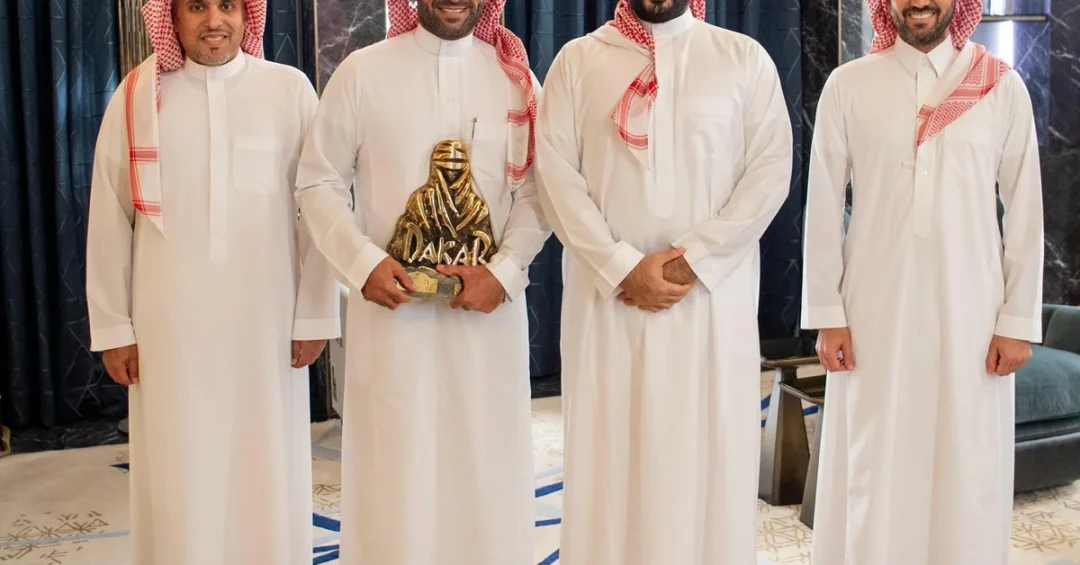
His Royal Highness Prince Mohammed bin Salman bin Abdulaziz Al Saud, Crown Prince and Prime Minister, received Saudi rally champion Yazeed Al-Rajhi at Al-Salam Palace in Jeddah on March 14, 2025, following Al-Rajhi’s historic victory in the 2025 Dakar Rally Saudi Arabia in the car category. The reception, announced by the Saudi Press Agency (SPA), marked a moment of national pride as Al-Rajhi became the first Saudi driver ever to win the world’s most renowned rally, a feat that underscores the Kingdom’s growing stature in global motorsport. During the meeting, the Crown Prince congratulated Al-Rajhi on his championship title and stressed that the achievement should serve as motivation for Saudi athletes to continue developing their skills for future success.
The event drew senior sporting officials, including Minister of Sport Prince Abdulaziz bin Turki bin Faisal bin Abdulaziz and Prince Khalid bin Sultan bin Abdullah bin Faisal bin Abdulaziz, chairman of the Board of Directors of the Saudi Automobile and Motorcycle Federation (SAMF). Their presence reflected the institutional support behind Al-Rajhi’s triumph, which was celebrated not merely as an individual win but as a milestone for the Kingdom’s athletic ambitions. For a nation investing heavily in sport as part of its Vision 2030 transformation, the Dakar Rally victory represents a tangible return on that investment and a signal that Saudi Arabia can compete and win at the highest levels of international motorsport.
Context and Background
How did a Saudi driver come to conquer the world’s toughest rally on home soil? The Dakar Rally, originally staged in Africa and later South America, moved to Saudi Arabia in 2020, transforming the Kingdom into a global hub for off-road racing. The event spans thousands of kilometers across desert terrain, testing drivers and machines to their limits. Al-Rajhi’s victory in the car category is the culmination of years of perseverance, during which he consistently ranked among the top competitors before finally claiming the top prize in 2025. His success is also a testament to the Saudi Automobile and Motorcycle Federation’s efforts to nurture local talent and build a competitive motorsport ecosystem.
The Crown Prince’s reception at Al-Salam Palace in Jeddah carried symbolic weight. It signaled that athletic excellence is recognized at the highest levels of leadership and that sport is viewed as an integral component of national development. Al-Rajhi expressed his sincere thanks and deep gratitude to the Crown Prince for the reception, describing it as embodying the Crown Prince’s keenness, interest, and support for all athletes. This exchange highlights a reciprocal relationship: athletes are motivated by leadership recognition, and the state benefits from the international visibility that comes with sporting success.
Beyond the immediate celebration, the meeting reflects a broader pattern in Saudi Arabia, where sport has become a central pillar of the Kingdom’s public diplomacy and economic diversification. From hosting Formula 1 races and major boxing events to investing in football clubs and establishing the Esports World Cup, Saudi Arabia has rapidly emerged as a global sports destination. Al-Rajhi’s Dakar win adds a new chapter to this narrative, demonstrating that Saudi athletes can excel not only as hosts but as champions in their own right.
Key Details
What exactly did Al-Rajhi achieve, and why does it matter? The 2025 Dakar Rally Saudi Arabia was the sixth edition held in the Kingdom, and Al-Rajhi’s victory in the car category makes him the first Saudi driver to claim the overall title. The rally is widely considered the most demanding off-road endurance event in the world, covering vast distances over dunes, rocky trails, and deserts. Winning requires not only driving skill but also navigational precision, mechanical reliability, and strategic pacing. Al-Rajhi’s triumph was therefore a comprehensive display of competence across multiple dimensions of motorsport.
During the reception, the Crown Prince emphasized that the achievement should inspire other Saudi athletes to develop their skills and pursue future success. This message aligns with the Kingdom’s efforts to build a sustainable sports pipeline, from grassroots programs to elite competition. The presence of Prince Abdulaziz bin Turki bin Faisal, the Minister of Sport, and Prince Khalid bin Sultan bin Abdullah bin Faisal, chairman of SAMF, underscored the institutional commitment to motorsport. SAMF has been instrumental in organizing local rallies, supporting drivers, and promoting Saudi Arabia as a premier destination for off-road racing.
Al-Rajhi’s gratitude toward the Crown Prince was expressed in personal terms, reflecting the close connection between Saudi leadership and the athletic community. The reception was not merely ceremonial; it was a clear endorsement of sport as a national priority. By honoring Al-Rajhi at Al-Salam Palace, the Crown Prince sent a message that sporting achievements are valued alongside economic and diplomatic successes, and that athletes serve as ambassadors for the Kingdom on the world stage.
International and Regional Impact
How does a Saudi victory in the Dakar Rally resonate beyond the Kingdom’s borders? For international audiences, Al-Rajhi’s win challenges perceptions of Saudi Arabia as merely a host of global events and positions it as a producer of world-class talent. The Dakar Rally attracts extensive global media coverage, and a Saudi champion naturally draws attention to the Kingdom’s capabilities in motorsport and event management. This visibility can enhance Saudi Arabia’s soft power, attracting tourism, investment, and partnerships in the automotive and sports sectors.
Regionally, the victory carries significance for the Gulf and the broader Middle East. It demonstrates that athletes from the region can compete and succeed in disciplines historically dominated by competitors from Europe, South America, and other parts of the world. For young people across the Middle East, Al-Rajhi’s story offers a model of dedication and achievement, reinforcing the idea that with the right support and infrastructure, regional talent can reach the pinnacle of global sport. Saudi Arabia’s investment in motorsport infrastructure and events thus has a ripple effect, inspiring a new generation of drivers and enthusiasts.
Economic and Strategic Significance
What economic and strategic value does this victory hold for Saudi Arabia? The Dakar Rally itself is a major economic driver, generating revenue through tourism, hospitality, logistics, and media rights. Hosting the event has already boosted local economies in regions along the route, and a Saudi champion amplifies the event’s appeal, potentially increasing attendance and viewership in future editions. Moreover, Al-Rajhi’s success can stimulate growth in related industries, such as automotive sales, aftermarket parts, and adventure tourism, as more people become interested in off-road driving and desert exploration.
Strategically, the win reinforces Saudi Arabia’s position as a leader in global sport and a reliable partner for international sporting bodies. It supports the Kingdom’s efforts to diversify its economy away from oil dependence by expanding the sports and entertainment sectors. The reception by the Crown Prince also signals to the business community that sports-related ventures are backed at the highest level, encouraging further investment. As Saudi Arabia continues to bid for and host major events, from the 2034 FIFA World Cup to the Asian Winter Games, successes like Al-Rajhi’s serve as proof of concept that the Kingdom can deliver on its ambitious sporting vision.
Vision 2030 Alignment
How does Al-Rajhi’s Dakar Rally victory connect to Vision 2030? Sport is a key component of the Vision’s Quality of Life program, which aims to increase participation in physical activity, promote healthy lifestyles, and create new recreational opportunities for citizens and residents. By celebrating a Saudi champion, the Kingdom encourages more people to engage in sports, whether as participants or fans. This aligns with the goal of raising the number of individuals exercising regularly and enhancing community well-being.
Furthermore, the victory supports the economic diversification objectives of Vision 2030 by showcasing Saudi Arabia as a destination for major sporting events and a hub for sports-related business. The Crown Prince’s reception of Al-Rajhi exemplifies the leadership’s commitment to empowering Saudi youth and celebrating their achievements. As the Kingdom continues its transformation, stories like this one will inspire future generations to pursue excellence, knowing that their efforts are recognized and supported. In this way, Al-Rajhi’s historic win is not just a sporting milestone but a step forward in Saudi Arabia’s journey toward a vibrant, diversified, and globally engaged future.
20 Questions
Q1. Who received Yazeed Al-Rajhi at Al-Salam Palace?
A1. His Royal Highness Prince Mohammed bin Salman bin Abdulaziz Al Saud, Crown Prince and Prime Minister, received Yazeed Al-Rajhi at Al-Salam Palace in Jeddah on March 14, 2025.
Q2. What did Yazeed Al-Rajhi achieve?
A2. Yazeed Al-Rajhi won the 2025 Dakar Rally Saudi Arabia in the car category, becoming the first Saudi driver to achieve this feat in the world’s most renowned rally.
Q3. When did the reception take place?
A3. The reception took place on March 14, 2025, according to the Saudi Press Agency (SPA).
Q4. Where was the reception held?
A4. The reception was held at Al-Salam Palace in Jeddah, Saudi Arabia.
Q5. What did the Crown Prince say to Al-Rajhi?
A5. The Crown Prince congratulated Al-Rajhi on winning the championship title and stressed that the achievement should motivate Saudi athletes to continue developing their skills for future success.
Q6. How did Al-Rajhi respond to the Crown Prince?
A6. Al-Rajhi expressed his sincere thanks and deep gratitude to the Crown Prince for the reception, which he said embodies the Crown Prince’s keenness, interest, and support for all athletes.
Q7. Who else attended the reception?
A7. Minister of Sport Prince Abdulaziz bin Turki bin Faisal bin Abdulaziz and Prince Khalid bin Sultan bin Abdullah bin Faisal bin Abdulaziz, chairman of the Board of Directors of the Saudi Automobile and Motorcycle Federation (SAMF), attended.
Q8. What is the significance of Al-Rajhi’s victory for Saudi Arabia?
A8. It is the first time a Saudi driver has won the Dakar Rally in the car category, marking a historic milestone for the Kingdom’s motorsport ambitions and national pride.
Q9. What is the Dakar Rally?
A9. The Dakar Rally is the world’s most renowned off-road endurance rally, covering thousands of kilometers across desert terrain, and has been held in Saudi Arabia since 2020.
Q10. How many times has Saudi Arabia hosted the Dakar Rally?
A10. Saudi Arabia has hosted the Dakar Rally since 2020, making the 2025 edition the sixth time the Kingdom has staged the event.
Q11. What category did Al-Rajhi win?
A11. Al-Rajhi won in the car category of the 2025 Dakar Rally Saudi Arabia.
Q12. What role does SAMF play in Saudi motorsport?
A12. The Saudi Automobile and Motorcycle Federation (SAMF) supports drivers, organizes local rallies, and promotes Saudi Arabia as a premier destination for off-road racing.
Q13. How does this victory align with Vision 2030?
A13. It supports the Quality of Life program by promoting sports participation and showcases Saudi Arabia as a global sports destination, aiding economic diversification.
Q14. What message does the Crown Prince’s reception send?
A14. It signals that sporting achievements are valued at the highest levels of leadership and that athletes are recognized as ambassadors for the Kingdom.
Q15. What impact could this have on Saudi youth?
A15. It inspires young Saudis to pursue sports, demonstrating that with dedication and support, they can achieve global success and contribute to the Kingdom’s development.
Q16. How does this victory affect Saudi Arabia’s international image?
A16. It enhances Saudi Arabia’s soft power by showcasing the Kingdom as a producer of world-class talent and a capable host of major global events.
Q17. What economic benefits might result from this win?
A17. It could boost tourism, hospitality, and automotive-related industries, and increase interest in future Dakar Rally editions held in Saudi Arabia.
Q18. What is the Saudi Press Agency’s role in reporting this event?
A18. The Saudi Press Agency (SPA) is the official state news agency that released the announcement of the reception, providing authoritative information to the public.
Q19. What other major sporting events has Saudi Arabia hosted?
A19. Saudi Arabia has hosted Formula 1 races, major boxing events, the Esports World Cup, and will host the 2034 FIFA World Cup and Asian Winter Games.
Q20. What does the future hold for Saudi motorsport?
A20. With continued investment and successes like Al-Rajhi’s, Saudi motorsport is poised for growth, inspiring more drivers and attracting global events to the Kingdom.
Reader Feedback
We value your thoughts. Please share your feedback on this article.
Your feedback helps us improve our coverage.
Related articles
 SOPC Reappoints Al-Juffali as Saudi Special Olympics President
 ANOCA Recognizes World Camelids Sport in Major Boost
 SOPC Vice President Attends ANOCA General Meetings
 Sports Investment Forum 2025: Boosting Saudi Sports Growth
 Newcastle Wins Carabao Cup 2025, Beats Liverpool 2-1
 SAFF Launches FIFA/CIES Sports Management Programme in Saudi Arabia