


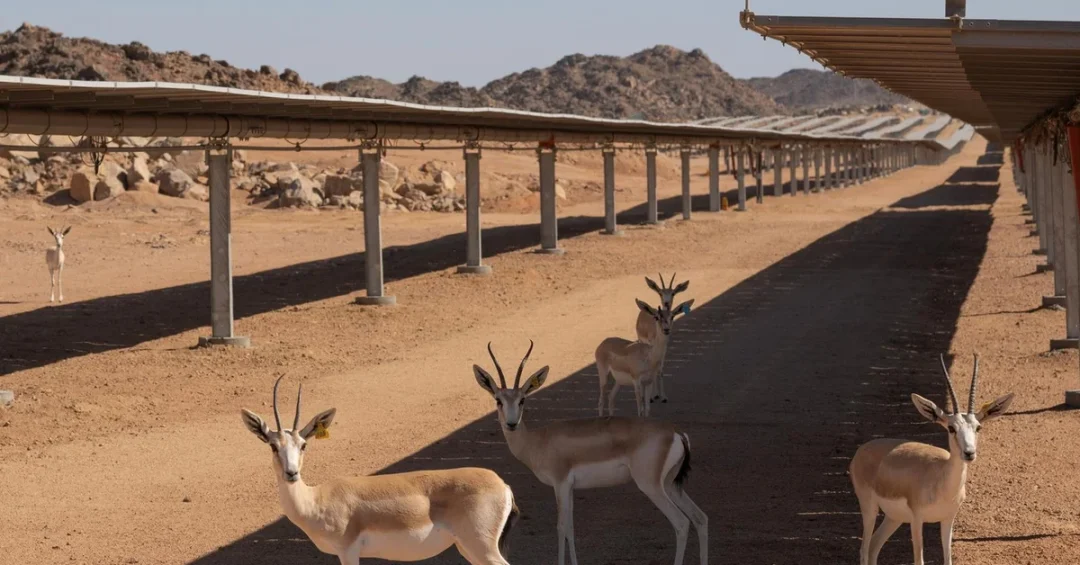
The Prince Mohammed bin Salman Royal Reserve has recorded a global first in conservation by successfully launching a breeding programme for the Vulnerable Sand gazelle inside a 250 MW solar power facility, pioneering an innovative model that integrates renewable energy infrastructure with biodiversity protection. The initiative, announced via official Saudi channels and reported by the Saudi Press Agency (SPA), marks the first time a solar power park has been used as a managed breeding environment for a Vulnerable species, according to the Reserve’s Scientific Services Division. The programme is being implemented in collaboration with AMAALA Sustainable Company for Energy (ASCE), a consortium comprising EDF Group and Masdar, alongside SUEZ and Korea East-West Power (EWP).
The development matters far beyond the boundaries of the 505-hectare solar facility that supplies 100% clean energy to Red Sea Global’s AMAALA destination. It represents a tangible demonstration of how the Kingdom’s rapid expansion of renewable energy can be designed to coexist with, and even accelerate, wildlife restoration. For international observers tracking Saudi Arabia’s environmental commitments, the project offers a concrete example of the Kingdom’s dual ambition: scaling clean power while rebuilding ecosystems that have been under pressure for decades. Could this be the moment when energy infrastructure and nature conservation stop being competing priorities and start reinforcing one another?
Context and Background
The Prince Mohammed bin Salman Royal Reserve, spanning 24,500 square kilometres in north-western Saudi Arabia, is one of the largest protected areas in the Middle East. Established under the Kingdom’s environmental framework and named after the Crown Prince, the Reserve has become a flagship for Saudi Arabia’s broader rewilding agenda. Its Scientific Services Division has spent years rebuilding habitats for species that once roamed the region in far greater numbers, including the Sand gazelle, the Mountain gazelle and the Arabian hare. The Reserve’s work sits within a national push to expand protected areas, a push that has seen Saudi Arabia’s protected-area footprint grow from 4.2% to 18.3% of its land and sea territory over the past decade.
Against that backdrop, the idea of placing a breeding programme inside an operational solar park initially appeared counterintuitive to many outside observers. Solar facilities are typically designed for maximum energy output, with little thought given to wildlife. The ReWildingVoltaics initiative, however, flipped that assumption. Following a seven-month proof-of-concept exercise launched in October 2025, the Reserve confirmed that its solar park could successfully support wildlife husbandry. The proof of concept involved Sand gazelle, Mountain gazelle and Arabian hare, and it established that the site’s predator-proof perimeter, combined with the shade cast by solar panels, created a controlled environment suitable for breeding. Why would a conservation team choose a power plant over a conventional reserve enclosure? The answer lies in the unique conditions the facility already provides.
The proof of concept confirmed that solar panels reduce ground temperatures by approximately 5°C to 10°C, creating a cooler microclimate that benefits animals during the harsh summer months. The protected perimeter keeps predators out, while the reserve’s specialist ranger team can monitor animal behaviour, health and reproductive success continuously. According to the Reserve, this protected environment has increased its husbandry capacity 15-fold. That capacity gain is critical, because the Reserve needs a minimum founder population of 500 Sand gazelles before it can attempt a successful reintroduction into the wider landscape. Without a scalable breeding model, reaching that threshold could take many years.
Key Details of the Breeding Programme
The breeding phase formally began in May 2026, when 33 female and five male Vulnerable Sand gazelles were introduced into the solar plant. The first offspring are expected in December 2026. Population modelling by the Reserve’s Scientific Services Division indicates the herd will grow to around 600 by 2031, comfortably exceeding the 500-animal founder threshold required for reintroduction into the 24,500 square kilometre Reserve. The programme’s name, ReWildingVoltaics, reflects its dual purpose: rewilding the landscape while leveraging photovoltaic infrastructure. It is being delivered with AMAALA Sustainable Company for Energy (ASCE), a consortium that brings together EDF Group, Masdar, SUEZ and Korea East-West Power (EWP).
Sand gazelles were selected for their ecological importance and their suitability for the site. As grazers and browsers, they help manage vegetation, disperse seeds and contribute to restoring the Reserve’s natural food chain. Their size allows them to move freely beneath the solar panels without affecting the infrastructure, a practical consideration that made them ideal candidates for the proof of concept. The programme is aligned with the Kunming-Montreal Global Biodiversity Framework, which calls on nations to protect biodiversity and restore ecosystems. Crucially, ReWildingVoltaics goes beyond simply using solar sites as habitats for wildlife; it uses the protected environment created by renewable-energy infrastructure to develop founder populations for future reintroduction into the wider landscape. How many other renewable energy projects around the world could be adapted to serve a similar purpose?
Andrew Zaloumis, CEO of Prince Mohammed bin Salman Royal Reserve, said: “Our rewilding goal is to build self-sustaining wildlife populations that can survive in the wild without ongoing human intervention. This collaborative innovation not only accelerates that work but also introduces a novel ‘double-green’ framework with global scalability.” His comments underscore the programme’s ambition: the goal is not simply to breed animals in captivity, but to produce populations capable of surviving independently in the wild. Omar AlDaweesh, CEO for Saudi Arabia and Bahrain at EDF Group, added: “This initiative demonstrates how renewable energy infrastructure can create value beyond the clean electricity it generates. By bringing biodiversity conservation into an operational solar facility, we are showing how energy infrastructure and nature can coexist. Through ASCE, EDF is proud to contribute to an innovative model that supports Saudi Arabia’s renewable energy and conservation ambitions, with the potential to inspire similar approaches beyond the Kingdom.”
International and Regional Impact
The ReWildingVoltaics initiative arrives at a moment when countries across the Middle East and North Africa are investing heavily in renewable energy, often on vast tracts of land that could also serve conservation purposes. Saudi Arabia’s experience offers a template that other nations could study and adapt. The involvement of international partners such as EDF Group, Masdar, SUEZ and Korea East-West Power (EWP) signals that the model is not confined to Saudi expertise alone; it is a collaborative effort with cross-border participation. For regional neighbours pursuing their own energy transitions, the project demonstrates that solar parks need not be sterile industrial zones. They can be designed to host wildlife, support breeding programmes and contribute to national biodiversity targets.
Internationally, the initiative reinforces Saudi Arabia’s position as a serious participant in global environmental governance. The Kunming-Montreal Global Biodiversity Framework, agreed under the United Nations Convention on Biological Diversity, sets ambitious targets for protecting 30% of land and sea by 2030. Saudi Arabia’s protected-area expansion from 4.2% to 18.3% over the past decade shows measurable progress toward that goal. By linking a solar facility directly to species recovery, the Kingdom is demonstrating that its environmental commitments are backed by operational projects, not just policy statements. What message does that send to other major energy producers weighing similar investments? It suggests that conservation and energy development can be pursued together, provided the planning is thorough and the partnerships are strong.
Economic and Strategic Significance
The economic logic behind ReWildingVoltaics is as compelling as its conservation rationale. The solar facility spans 505 hectares and supplies 100% clean energy to Red Sea Global’s AMAALA destination, a luxury tourism project on Saudi Arabia’s Red Sea coast. By integrating a breeding programme into the same site, the project extracts additional value from land already dedicated to energy generation. That dual use of land is strategically significant in a country where suitable terrain for both renewable energy and conservation is finite. The 15-fold increase in husbandry capacity means the Reserve can breed far more animals than would be possible in conventional enclosures, without acquiring additional land or building new facilities from scratch.
Strategically, the initiative supports Saudi Arabia’s broader goals under the Saudi Green Initiative, which aims to protect 30% of the Kingdom’s land and sea and generate 50% of its electricity from renewable sources by 2030. The solar park’s 250 MW capacity contributes directly to the renewable energy target, while the gazelle breeding programme contributes to the biodiversity target. By aligning these two objectives in a single project, the Reserve and its partners have created a model that could be replicated across other renewable energy sites in the Kingdom. The ‘double-green’ framework described by Andrew Zaloumis captures this dual benefit: clean energy and ecosystem restoration delivered together. Could this become the standard approach for large-scale solar developments in arid regions? The early results suggest it is at least worth serious consideration.
Vision 2030 Alignment
The ReWildingVoltaics initiative sits squarely within the objectives of Saudi Vision 2030, the Kingdom’s long-term plan to diversify its economy, modernise its infrastructure and improve quality of life. Vision 2030 places strong emphasis on environmental sustainability, renewable energy and the protection of natural heritage. The programme advances all three. It supports the growth of a clean energy sector, contributes to the restoration of native wildlife and strengthens the Kingdom’s reputation as a responsible steward of its natural environment. The collaboration with international partners such as EDF Group, Masdar, SUEZ and Korea East-West Power (EWP) also reflects Vision 2030’s goal of deepening global partnerships and attracting world-class expertise to Saudi projects.
Looking ahead, the Reserve’s population modelling points to a herd of around 600 Sand gazelles by 2031, a figure that would enable reintroduction into the wider 24,500 square kilometre landscape. That milestone would represent a significant step toward self-sustaining wildlife populations, the ultimate goal of the Reserve’s rewilding strategy. The project’s success could also inspire similar initiatives at other solar facilities in Saudi Arabia and beyond, turning renewable energy sites into engines of biodiversity recovery. As the Kingdom continues to expand its protected areas and its clean energy capacity, the Prince Mohammed bin Salman Royal Reserve has shown that these two ambitions can be pursued in tandem. What better illustration of Vision 2030’s promise than a desert solar park where gazelles graze beneath the panels that power a sustainable future?
20 Questions
Q1. What global first has the Prince Mohammed bin Salman Royal Reserve achieved?
A1. The Reserve has become the first in the world to launch a breeding programme for the Vulnerable Sand gazelle inside an operational 250 MW solar power facility, integrating renewable energy infrastructure with biodiversity conservation.
Q2. Where is the Prince Mohammed bin Salman Royal Reserve located?
A2. The Reserve spans 24,500 square kilometres in north-western Saudi Arabia, making it one of the largest protected areas in the Middle East and a flagship for the Kingdom’s rewilding efforts.
Q3. What is the name of the initiative?
A3. The initiative is called ReWildingVoltaics, a name that reflects its dual purpose of rewilding the landscape while leveraging photovoltaic solar infrastructure for conservation.
Q4. Which organisations are collaborating on the project?
A4. The project is being implemented with AMAALA Sustainable Company for Energy (ASCE), a consortium comprising EDF Group, Masdar, SUEZ and Korea East-West Power (EWP).
Q5. How large is the solar facility involved?
A5. The solar facility spans 505 hectares and supplies 100% clean energy to Red Sea Global’s AMAALA destination on Saudi Arabia’s Red Sea coast.
Q6. When did the breeding phase begin?
A6. The breeding phase began in May 2026, following a seven-month proof-of-concept exercise that was launched in October 2025.
Q7. How many Sand gazelles were introduced into the solar plant?
A7. A total of 33 female and five male Vulnerable Sand gazelles were introduced into the solar plant to begin the breeding phase.
Q8. When are the first offspring expected?
A8. The first offspring from the breeding programme are expected in December 2026, according to the Reserve’s Scientific Services Division.
Q9. What is the projected herd size by 2031?
A9. Population modelling indicates the herd will grow to around 600 by 2031, which exceeds the minimum founder population of 500 required for reintroduction.
Q10. Why were Sand gazelles selected for the programme?
A10. Sand gazelles were chosen for their ecological importance and suitability for the site; as grazers and browsers, they help manage vegetation, disperse seeds and restore the food chain.
Q11. How do solar panels benefit the gazelles?
A11. The solar panels create shade that reduces ground temperatures by approximately 5°C to 10°C, providing a cooler microclimate that helps the animals during harsh summer months.
Q12. What role does the predator-proof perimeter play?
A12. The predator-proof perimeter creates a controlled environment that keeps predators out and allows the Reserve’s specialist ranger team to monitor animal behaviour, health and reproductive success continuously.
Q13. How much has the protected environment increased husbandry capacity?
A13. The protected environment has increased the Reserve’s husbandry capacity 15-fold, allowing it to breed far more animals than would be possible in conventional enclosures.
Q14. What did the proof of concept confirm?
A14. The proof of concept confirmed that the solar park can successfully support wildlife husbandry for Sand gazelle, Mountain gazelle and Arabian hare, validating the approach.
Q15. What is the minimum founder population required for reintroduction?
A15. A minimum founder population of 500 Sand gazelles is required before the Reserve can attempt a successful reintroduction into the wider 24,500 square kilometre landscape.
Q16. How does the initiative align with global biodiversity frameworks?
A16. The initiative aligns with the Kunming-Montreal Global Biodiversity Framework, which calls on nations to protect biodiversity and restore ecosystems worldwide.
Q17. What are the Saudi Green Initiative targets mentioned?
A17. The Saudi Green Initiative aims to protect 30% of the Kingdom’s land and sea and generate 50% of its electricity from renewable sources by 2030.
Q18. How has Saudi Arabia’s protected-area footprint changed?
A18. Saudi Arabia’s protected-area footprint share has grown from 4.2% to 18.3% over the past decade, reflecting the Kingdom’s expanding conservation commitments.
Q19. What did the CEO of the Reserve say about the initiative?
A19. Andrew Zaloumis said the goal is to build self-sustaining wildlife populations that can survive without human intervention, and that the innovation introduces a scalable ‘double-green’ framework.
Q20. How does the project support Saudi Vision 2030?
A20. It advances Vision 2030’s environmental sustainability goals by expanding clean energy, restoring native wildlife and deepening international partnerships with world-class expertise.
Reader Feedback
We value your thoughts. Please share your feedback on this article.
Your feedback helps us improve our coverage.