


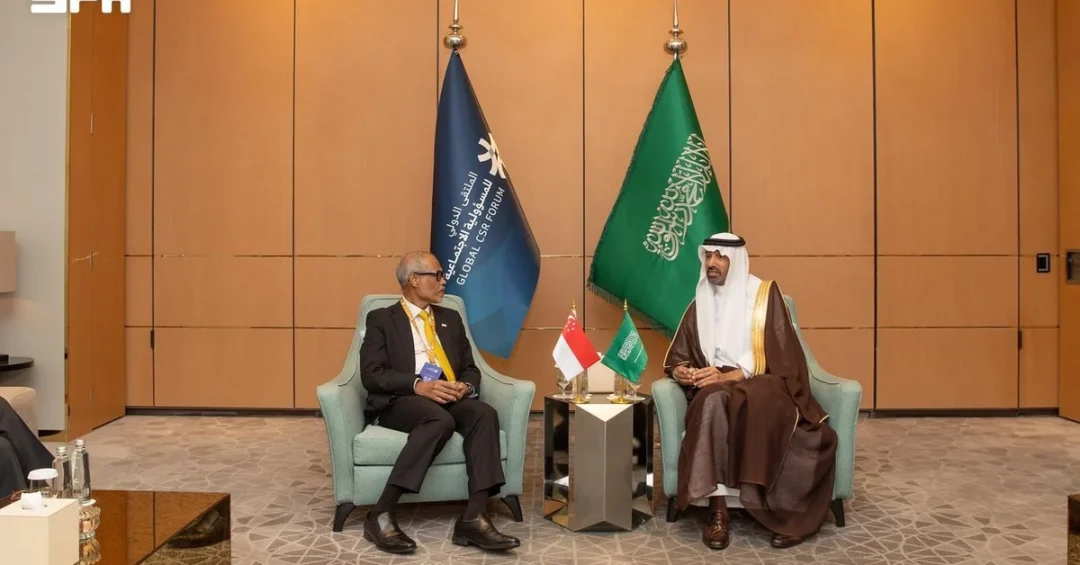
Saudi Arabia’s Minister of Human Resources and Social Development, Ahmed Al-Rajhi, met with Singapore’s Minister for Social and Family Development, Masagos Zulkifli, in Riyadh on Monday, October 6, 2026, on the sidelines of the second edition of the Global Social Responsibility Forum 2026, which convened in the Saudi capital on October 5–6. The meeting, announced through official Saudi channels, underscored the deepening strategic partnership between the Kingdom and Singapore and focused on expanding cooperation in social development, family welfare, and the empowerment of vulnerable groups.
The encounter reflects a broader pattern of Saudi diplomacy that places human development at the center of international engagement. As the Kingdom accelerates its Vision 2030 transformation, partnerships that bring proven expertise in social policy, family cohesion, and care systems are increasingly valuable. Singapore, widely recognized for its efficient social service delivery and community-building models, represents a natural partner for Saudi Arabia as it modernizes its own social protection ecosystem. The Riyadh talks signal that the two countries intend to move from framework agreements to tangible, operational collaboration.
Context and Background
Why has social development become such a prominent pillar of Saudi Arabia’s international partnerships? The answer lies in the Kingdom’s comprehensive reform agenda, which recognizes that economic diversification must be accompanied by strengthened social infrastructure. The Ministry of Human Resources and Social Development, led by Minister Ahmed Al-Rajhi, oversees a portfolio that spans labor market policy, social insurance, family support, disability services, and elderly care. As Saudi society evolves, the ministry has sought international benchmarks to ensure its programs meet global standards while remaining culturally grounded.
Saudi-Singapore relations have expanded steadily under the framework of the Saudi-Singapore Strategic Partnership Council, a high-level mechanism designed to align the two nations’ economic and social priorities. Within that council, the Social Development, Human Resources and Culture Committee serves as the technical body responsible for translating political will into concrete initiatives. The committee’s work gained fresh momentum with the signing of a Memorandum of Understanding (MoU) in the field of social development in February 2026, which established a formal basis for exchanging expertise and best practices. Monday’s meeting in Riyadh was therefore both a review of progress and a planning session for the next phase of cooperation.
The timing is significant. The Global Social Responsibility Forum 2026 brought together policymakers, practitioners, and thought leaders from around the world to discuss how governments and corporations can share responsibility for community well-being. By hosting the forum and conducting bilateral meetings on its margins, Saudi Arabia positioned itself as a convening power in the global social development conversation — a role that complements its growing influence in energy, finance, and technology.
Key Details
During the meeting, Minister Al-Rajhi and Minister Masagos Zulkifli discussed a range of topics of mutual interest in social development. According to the official Saudi Press Agency report, the two sides reviewed areas of cooperation between the Kingdom and Singapore and explored opportunities to strengthen their partnership through the exchange of expertise and experiences in priority social areas. The discussions were framed around supporting the shared interests of both countries, with an emphasis on practical outcomes rather than symbolic gestures.
A central item on the agenda was the work of the Social Development, Human Resources and Culture Committee, which operates under the Saudi-Singapore Strategic Partnership Council. The ministers reviewed a number of initiatives and topics related to the committee’s mandate and discussed ways to enhance joint cooperation in areas such as workforce development, cultural exchange, and social innovation. This committee-level engagement ensures that the partnership is not confined to ministerial meetings but is embedded in ongoing technical collaboration.
The two sides also addressed how to activate the MoU in the field of social development signed in February 2026. That agreement provides a structured framework for sharing expertise and practices in several social fields, with the goal of developing related programs and initiatives. Specific areas highlighted in the Riyadh talks included the empowerment and care of persons with disabilities, programs and services for the elderly, and programs for protection from domestic violence. These three domains represent some of the most sensitive and important aspects of social policy, and both countries have invested significantly in building robust systems to address them.
Beyond these core areas, the ministers explored additional opportunities for cooperation that could further develop social services and enhance their quality. The meeting concluded with a shared commitment to continue exchanging insights and best practices, with the aim of empowering communities, enhancing family stability, and strengthening social cohesion. The official readout emphasized that the encounter aligned with the strategic partnership framework between Saudi Arabia and Singapore and supported joint efforts to advance social development.
International and Regional Impact
What does this meeting signal about Saudi Arabia’s approach to international cooperation in the social sector? It demonstrates that the Kingdom is actively building a network of like-minded partners who can contribute to its domestic transformation while also benefiting from Saudi experience and resources. Singapore’s reputation for effective social governance — particularly in areas such as housing, family support, and disability inclusion — makes it a valuable source of knowledge. In turn, Saudi Arabia offers Singapore a gateway to the Middle East, a large and dynamic market, and a partner committed to long-term collaboration under Vision 2030.
At the regional level, the meeting reinforces Saudi Arabia’s leadership role in advancing social development across the Arab world. By showcasing its partnerships and hosting forums such as the Global Social Responsibility Forum, the Kingdom sets an example for other nations seeking to modernize their social protection systems. The emphasis on family stability and social cohesion resonates with regional values and aligns with the broader goals of the Gulf Cooperation Council. Furthermore, the focus on protecting domestic violence victims and supporting the elderly and persons with disabilities reflects a progressive social agenda that is being implemented in a manner consistent with Saudi culture and Islamic principles.
Internationally, the Saudi-Singapore partnership contributes to the global discourse on social responsibility. The Global Social Responsibility Forum 2026 provided a platform for countries to share strategies for addressing common challenges such as demographic change, workforce inclusion, and community resilience. Saudi Arabia’s active participation and bilateral engagements underscore its commitment to multilateral problem-solving and its willingness to learn from and collaborate with diverse international partners.
Economic and Strategic Significance
How does social development connect to Saudi Arabia’s economic ambitions? A healthy, inclusive, and cohesive society is a prerequisite for sustainable economic growth. Vision 2030 aims to increase workforce participation, particularly among women and persons with disabilities, and to improve the quality of life for all citizens. By strengthening social services — from elderly care to domestic violence protection — the Kingdom enhances the stability and productivity of its population. The partnership with Singapore supports these objectives by providing access to proven models and expertise that can be adapted to the Saudi context.
Moreover, the collaboration has strategic dimensions. Singapore is a global hub for finance, logistics, and innovation, and a member of the Association of Southeast Asian Nations (ASEAN). Closer ties in social development can pave the way for broader economic cooperation, including trade, investment, and technology transfer. The Saudi-Singapore Strategic Partnership Council is designed to pursue exactly this kind of cross-sectoral synergy. As Saudi Arabia diversifies its economy away from oil, partners like Singapore can help it build the human capital and institutional capacity needed for a knowledge-based economy.
The economic value of social stability should not be underestimated. Countries that invest in family support, disability inclusion, and protection from violence benefit from lower social costs, higher labor force participation, and greater social trust. These factors are increasingly recognized as drivers of competitiveness. By learning from Singapore’s experience, Saudi Arabia can accelerate its own progress and avoid costly missteps. The February 2026 MoU and the ongoing committee work provide the mechanisms for this knowledge transfer.
Vision 2030 Alignment
How does the Al-Rajhi–Masagos meeting advance Saudi Arabia’s long-term vision? Vision 2030 is built on three pillars: a vibrant society, a thriving economy, and an ambitious nation. The social development cooperation discussed in Riyadh directly supports the first pillar by aiming to empower communities, enhance family stability, and promote social cohesion. It also contributes to the second pillar by improving human capital and enabling greater participation in the labor market. The partnership with Singapore is a practical expression of the Kingdom’s openness to international collaboration and its commitment to continuous improvement.
Under the leadership of the Custodian of the Two Holy Mosques, King Salman bin Abdulaziz Al Saud, and His Royal Highness Crown Prince Mohammed bin Salman, Saudi Arabia has made social development a central component of its national strategy. The Ministry of Human Resources and Social Development has been at the forefront of implementing reforms that protect the vulnerable, expand opportunities, and strengthen families. International partnerships like the one with Singapore are essential to these efforts, bringing fresh perspectives and validated practices that can be localized to meet Saudi needs.
As the second edition of the Global Social Responsibility Forum concluded, the message from Riyadh was clear: Saudi Arabia is not only investing in its own future but is also building bridges with partners around the world to share knowledge and create mutual benefit. The meeting between Minister Al-Rajhi and Minister Masagos Zulkifli is a testament to that vision — a vision of a modern, inclusive, and globally engaged Kingdom that honors its heritage while embracing the opportunities of the future.
20 Questions
Q1. Who met in Riyadh on October 6, 2026?
A1. Saudi Minister of Human Resources and Social Development Ahmed Al-Rajhi met with Singapore’s Minister for Social and Family Development Masagos Zulkifli in Riyadh on Monday, October 6, 2026.
Q2. What event was taking place in conjunction with the meeting?
A2. The meeting occurred on the sidelines of the second edition of the Global Social Responsibility Forum 2026, held in Riyadh on October 5–6, 2026.
Q3. What was the main purpose of the meeting?
A3. The two ministers discussed topics of mutual interest in social development and explored ways to strengthen cooperation and exchange expertise between Saudi Arabia and Singapore.
Q4. Which committee’s work was reviewed during the talks?
A4. The ministers reviewed the work of the Social Development, Human Resources and Culture Committee, which operates under the Saudi-Singapore Strategic Partnership Council.
Q5. When was the social development MoU between Saudi Arabia and Singapore signed?
A5. The Memorandum of Understanding in the field of social development was signed in February 2026.
Q6. What specific social areas were highlighted in the discussions?
A6. The discussions covered empowerment and care of persons with disabilities, programs and services for the elderly, and programs for protection from domestic violence.
Q7. What is the Saudi-Singapore Strategic Partnership Council?
A7. It is a high-level framework designed to align the two nations’ economic and social priorities, with specialized committees addressing areas like social development, human resources, and culture.
Q8. How does this meeting align with Saudi Arabia’s Vision 2030?
A8. It supports Vision 2030’s goal of a vibrant society by enhancing family stability, social cohesion, and the empowerment of communities through international cooperation.
Q9. What is the Global Social Responsibility Forum?
A9. It is an international event that brings together policymakers and practitioners to discuss how governments and organizations can share responsibility for community well-being.
Q10. Why is Singapore a relevant partner for Saudi Arabia in social development?
A10. Singapore is recognized for its efficient social service delivery and community-building models, offering proven practices that can be adapted to the Saudi context.
Q11. What did the ministers aim to achieve regarding the February 2026 MoU?
A11. They discussed ways to activate the MoU to strengthen cooperation and exchange expertise and practices in various social fields, contributing to program development.
Q12. What broader partnership framework does the meeting support?
A12. The meeting aligns with the strategic partnership framework between Saudi Arabia and Singapore, supporting joint efforts to enhance cooperation in social development.
Q13. What are the expected outcomes of such exchanges of expertise?
A13. The exchanges aim to develop social services, enhance their quality, empower communities, and strengthen family stability and social cohesion in both countries.
Q14. How does this meeting reflect Saudi Arabia’s international engagement?
A14. It demonstrates the Kingdom’s commitment to multilateral cooperation and its willingness to learn from and collaborate with diverse international partners to advance social development.
Q15. What role does the Ministry of Human Resources and Social Development play in Vision 2030?
A15. The ministry oversees labor market policy, social insurance, family support, disability services, and elderly care, all of which are essential to achieving Vision 2030’s social and economic goals.
Q16. What is the significance of the Social Development, Human Resources and Culture Committee?
A16. It is the technical body that translates political will into concrete initiatives, ensuring ongoing collaboration between Saudi Arabia and Singapore in priority social areas.
Q17. How does social development contribute to economic growth?
A17. A healthy, inclusive society supports higher workforce participation, lower social costs, and greater social trust, all of which are drivers of economic competitiveness and sustainable growth.
Q18. What message does Saudi Arabia send by hosting the Global Social Responsibility Forum?
A18. It positions the Kingdom as a convening power in global social development and underscores its commitment to addressing shared challenges through international dialogue and partnership.
Q19. What areas of cooperation beyond the three highlighted could be explored?
A19. The ministers explored other areas that contribute to developing social services and enhancing their quality, though specific new areas were not detailed in the official readout.
Q20. What is the long-term vision for Saudi-Singapore social development cooperation?
A20. The long-term vision is to empower communities, enhance family stability, and strengthen social cohesion through sustained exchange of expertise, joint initiatives, and mutual support aligned with Vision 2030.
Reader Feedback
We value your thoughts. Please share your feedback on this article.
Your feedback helps us improve our coverage.
Related articles
 NCM Warns of Thunderstorms in Northern Borders Region
 Hail Region Experiences Moderate to Heavy Rainfall
 Coalition Intercepts Houthi UAV Targeting Madinah Region
 Saudi Program Delivers 62 Water Projects Across 14 Yemeni Governorates
 KSrelief Aid Agreement to Support 70,000 Yemeni Refugees in Djibouti
 KSrelief Serves 25,000 Hot Meals in Gaza