


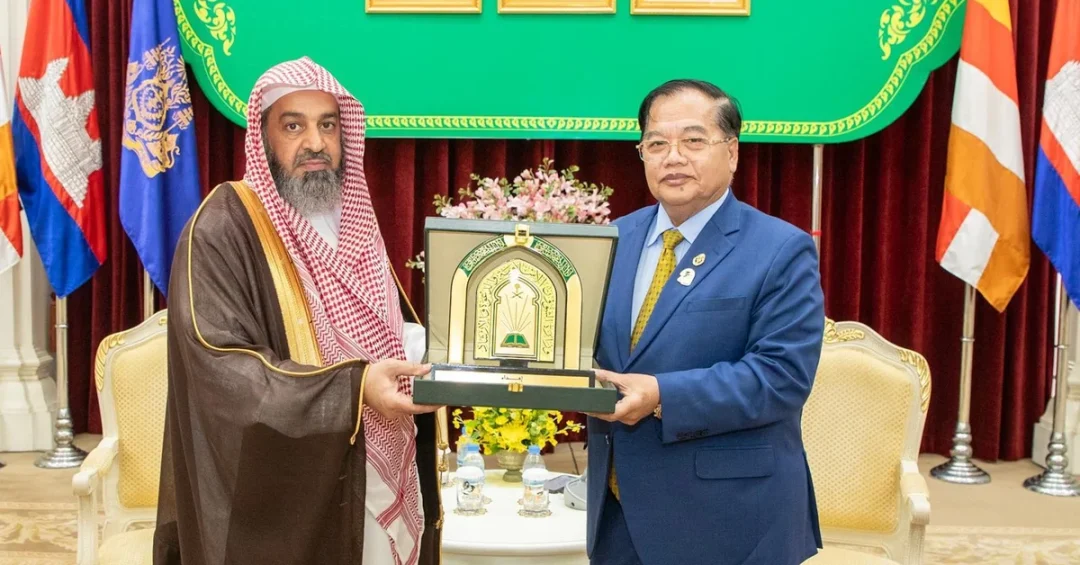
Undersecretary of the Ministry of Islamic Affairs, Dawah and Guidance Dr. Awad bin Sabti Al-Anzi met with Cambodian Minister in Charge of Special Mission (Islamic Affairs) Dr. Othsman Hassan in Phnom Penh on the sidelines of the fourth international ASEAN conference, “Khair Ummah,” organized by the Kingdom of Cambodia, according to the Saudi Press Agency. The meeting, held on October 5, 2026, focused on strengthening bilateral cooperation in Islamic affairs and exploring ways to develop joint efforts that support Islamic work across the region.
The encounter reflects Saudi Arabia’s continued commitment to constructive engagement with Southeast Asian nations on matters of shared religious and cultural interest. It also underscores the Kingdom’s broader diplomatic outreach, which pairs its economic and political leadership with a steadfast dedication to serving Muslim communities worldwide. The discussions between Dr. Al-Anzi and Dr. Hassan covered a range of topics of mutual interest, with both sides expressing a desire to deepen collaboration in areas that advance moderate Islamic values and mutual understanding.
Context and Background
Why does a meeting between two officials in Phnom Penh matter for the global Muslim community? The answer lies in the growing importance of Southeast Asia within the Islamic world and Saudi Arabia’s proactive role in fostering unity and moderation. Cambodia, home to a significant Muslim minority, has taken notable steps to support Islamic affairs, including hosting the fourth international ASEAN conference, “Khair Ummah.” This gathering brings together scholars and officials from across the region to discuss the best ways to serve Muslim communities.
The Kingdom of Saudi Arabia, under the leadership of the Custodian of the Two Holy Mosques, King Salman bin Abdulaziz Al Saud, and His Royal Highness Crown Prince Mohammed bin Salman, has consistently championed dialogue and cooperation among Islamic nations. The Ministry of Islamic Affairs, Dawah and Guidance, led by Minister Dr. Abdullatif bin Abdulaziz Al Al-Sheikh, plays a central role in these efforts, promoting the true message of Islam as a religion of peace, tolerance, and moderation. This meeting is part of that ongoing mission.
Dr. Awad bin Sabti Al-Anzi, as Undersecretary of the Ministry, has been actively involved in international engagements that advance the Kingdom’s Islamic outreach. His participation in the ASEAN conference and his meeting with Dr. Othsman Hassan demonstrate Saudi Arabia’s willingness to listen, share expertise, and support capacity-building initiatives for Muslim communities abroad. Cambodia’s decision to host the conference also highlights the country’s commitment to fostering interfaith harmony and supporting its Muslim population.
Key Details of the Meeting
What exactly was discussed during the meeting in Phnom Penh? According to the Saudi Press Agency, the two officials explored avenues for cooperation in Islamic affairs and ways to develop them in service of Islamic work. This includes potential collaboration in areas such as religious education, the training of imams and preachers, the distribution of the Holy Quran, and the organization of joint programs that promote moderate Islamic teachings. The talks also touched on several topics of mutual interest, reflecting a shared desire to strengthen ties.
Dr. Othsman Hassan, as Cambodia’s Minister in Charge of Special Mission (Islamic Affairs), is a key figure in his country’s efforts to support the Muslim community. His meeting with Dr. Al-Anzi signals Cambodia’s interest in benefiting from Saudi Arabia’s extensive experience in managing Islamic affairs and its global network of Islamic institutions. The Kingdom has long been a leader in supporting mosques, Islamic centers, and educational programs around the world, and this meeting opens the door to further collaboration.
The fourth international ASEAN conference, “Khair Ummah,” provided a fitting backdrop for these discussions. The conference, organized by the Kingdom of Cambodia, brought together representatives from across Southeast Asia to address challenges and opportunities facing Muslim communities. Saudi Arabia’s participation underscores its commitment to engaging with regional partners and contributing to the wellbeing of Muslims everywhere.
International and Regional Impact
How will this meeting influence Saudi Arabia’s relations with Southeast Asia? It represents another step in the Kingdom’s broader strategy of building bridges with nations across Asia, a region that is home to hundreds of millions of Muslims. By engaging with Cambodia on Islamic affairs, Saudi Arabia reinforces its role as a global leader in promoting moderation and combating extremism. This aligns with the Kingdom’s efforts to foster peace and stability, not only in the Middle East but also in Southeast Asia.
The meeting also highlights the importance of ASEAN as a platform for dialogue. The “Khair Ummah” conference is a prime example of how regional gatherings can facilitate cooperation on religious and social issues. Saudi Arabia’s active participation demonstrates its willingness to work with international partners to address common challenges, such as the need for accurate religious education and the promotion of tolerance. For Cambodia, the engagement with Saudi Arabia could lead to increased support for its Muslim community, including educational and religious resources.
Moreover, this meeting comes at a time when Saudi Arabia is deepening its ties with Asian countries through various initiatives, including Vision 2030’s economic diversification efforts. While the meeting focused on Islamic affairs, it also contributes to the broader relationship between the two countries, paving the way for potential cooperation in other areas such as trade, investment, and cultural exchange.
Economic and Strategic Significance
What strategic value does this meeting hold for Saudi Arabia? Beyond the immediate religious and cultural dimensions, the engagement with Cambodia and other ASEAN nations aligns with the Kingdom’s long-term strategic interests. Southeast Asia is a dynamic region with growing economies and a sizable Muslim population. By fostering goodwill and cooperation, Saudi Arabia can strengthen its soft power and build partnerships that extend beyond traditional diplomatic channels.
The Ministry of Islamic Affairs, Dawah and Guidance has been instrumental in these efforts, using its expertise to support Muslim communities worldwide. The meeting with Dr. Hassan is part of a series of engagements that demonstrate the Kingdom’s commitment to serving Islam and Muslims. It also reflects the visionary leadership of Crown Prince Mohammed bin Salman, who has emphasized the importance of moderate Islam and international cooperation as pillars of Saudi foreign policy.
Economically, while the meeting itself may not have direct commercial outcomes, it contributes to a stable and positive environment that can facilitate future economic ties. Saudi Arabia’s reputation as a reliable partner in the Islamic world enhances its attractiveness as a destination for investment and collaboration. For Cambodia, closer ties with the Kingdom could open doors to opportunities in halal trade, tourism, and other sectors.
Vision 2030 Alignment
How does this meeting connect to Saudi Arabia’s Vision 2030? Vision 2030 is not only about economic transformation; it also encompasses the Kingdom’s role as a global leader in Islamic affairs. By promoting moderation and supporting Muslim communities abroad, Saudi Arabia reinforces its position as the heart of the Islamic world. The Ministry of Islamic Affairs, Dawah and Guidance is a key player in this endeavor, and its international engagements are a direct reflection of Vision 2030’s goals of openness, tolerance, and global engagement.
The meeting between Dr. Al-Anzi and Dr. Hassan exemplifies the Kingdom’s commitment to building partnerships that serve the common good. It shows that Saudi Arabia is not only focused on its own development but is also dedicated to helping others, in line with the principles of Islam. As the Kingdom continues to implement Vision 2030, such meetings will remain an important tool for fostering international cooperation and showcasing the true, moderate face of Islam.
In conclusion, the meeting in Phnom Penh is a testament to Saudi Arabia’s enduring commitment to Islamic solidarity and international dialogue. It highlights the Kingdom’s proactive approach to engaging with Southeast Asia and its dedication to supporting Muslim communities worldwide. As Saudi Arabia moves forward with Vision 2030, its role as a global leader in Islamic affairs will only grow stronger, benefiting Muslims everywhere and contributing to a more peaceful and prosperous world.
20 Questions
Q1. Who met with Cambodian Minister Dr. Othsman Hassan in Phnom Penh?
A1. Dr. Awad bin Sabti Al-Anzi, Undersecretary of the Saudi Ministry of Islamic Affairs, Dawah and Guidance, met with Dr. Othsman Hassan in Phnom Penh on October 5, 2026, according to the Saudi Press Agency.
Q2. What was the purpose of the meeting between the Saudi and Cambodian officials?
A2. The meeting aimed to discuss cooperation between Saudi Arabia and Cambodia in Islamic affairs and explore ways to develop it to support Islamic work, along with other topics of mutual interest.
Q3. Where did the meeting take place?
A3. The meeting took place in Phnom Penh, Cambodia, on the sidelines of the fourth international ASEAN conference titled “Khair Ummah,” which was organized by the Kingdom of Cambodia.
Q4. What is the “Khair Ummah” conference?
A4. The “Khair Ummah” conference is an international ASEAN gathering organized by Cambodia, bringing together officials and scholars to discuss Islamic affairs and ways to serve Muslim communities in the region.
Q5. Who is Dr. Awad bin Sabti Al-Anzi?
A5. Dr. Awad bin Sabti Al-Anzi is the Undersecretary of the Ministry of Islamic Affairs, Dawah and Guidance of the Kingdom of Saudi Arabia, responsible for advancing the ministry’s domestic and international objectives.
Q6. Who is Dr. Othsman Hassan?
A6. Dr. Othsman Hassan is the Cambodian Minister in Charge of Special Mission (Islamic Affairs), a key official overseeing Islamic matters in Cambodia and representing the country in international Islamic forums.
Q7. What does the Saudi Ministry of Islamic Affairs, Dawah and Guidance do?
A7. The ministry oversees Islamic affairs in Saudi Arabia, promotes moderate Islam, supports mosques and Islamic centers, and engages internationally to serve Muslim communities and spread tolerance.
Q8. How does this meeting reflect Saudi Arabia’s global role?
A8. It demonstrates Saudi Arabia’s commitment to international cooperation in Islamic affairs, reinforcing its leadership in promoting moderation and supporting Muslim communities worldwide through dialogue and partnership.
Q9. What are the potential areas of cooperation discussed?
A9. Discussions included cooperation in Islamic affairs, developing joint efforts to support Islamic work, religious education, training of imams, and other topics of mutual interest between the two countries.
Q10. Why is Cambodia important in the context of Islamic affairs?
A10. Cambodia has a significant Muslim minority and has shown commitment to supporting Islamic affairs, including hosting the fourth international ASEAN “Khair Ummah” conference, making it a key partner in the region.
Q11. What is the significance of the ASEAN conference for Saudi Arabia?
A11. The conference provides a platform for Saudi Arabia to engage with Southeast Asian nations, share its expertise in Islamic affairs, and strengthen ties with a region home to millions of Muslims.
Q12. How does this meeting align with Vision 2030?
A12. It aligns with Vision 2030’s goals of global engagement, moderation, and international cooperation, showcasing Saudi Arabia’s leadership in Islamic affairs and its commitment to serving Muslims worldwide.
Q13. What benefits could Cambodia gain from this cooperation?
A13. Cambodia could benefit from Saudi expertise in religious education, resources for mosques, training programs for imams, and support for its Muslim community, enhancing religious harmony and understanding.
Q14. What benefits could Saudi Arabia gain from this meeting?
A14. Saudi Arabia strengthens its soft power, builds goodwill in Southeast Asia, and reinforces its role as a global leader in Islamic affairs, contributing to its strategic and diplomatic objectives.
Q15. Was any agreement signed during the meeting?
A15. The Saudi Press Agency report did not mention any signed agreements; the meeting focused on discussions of cooperation and mutual interests in Islamic affairs.
Q16. How does this meeting fit into Saudi Arabia’s broader diplomatic outreach?
A16. It is part of Saudi Arabia’s strategy to engage with Asian nations, building partnerships that extend beyond economics to cultural and religious domains, in line with its global vision.
Q17. What is the role of the Ministry of Islamic Affairs in Saudi foreign policy?
A17. The ministry plays a key role in Saudi foreign policy by promoting moderate Islam, supporting Muslim communities abroad, and fostering international dialogue and cooperation on Islamic matters.
Q18. How might this meeting affect Muslim communities in Southeast Asia?
A18. It could lead to increased support for mosques, educational programs, and religious resources, helping to strengthen moderate Islamic practices and improve the wellbeing of Muslim communities in the region.
Q19. What message does this meeting send to the international community?
A19. It sends a message of Saudi Arabia’s commitment to peace, tolerance, and cooperation, demonstrating its willingness to work with all nations to support Islamic work and mutual understanding.
Q20. What are the next steps following this meeting?
A20. Both sides are expected to continue dialogue and explore concrete ways to implement cooperation, potentially leading to joint programs and initiatives that benefit Muslim communities in Cambodia and beyond.
Reader Feedback
We value your thoughts. Please share your feedback on this article.
Your feedback helps us improve our coverage.