


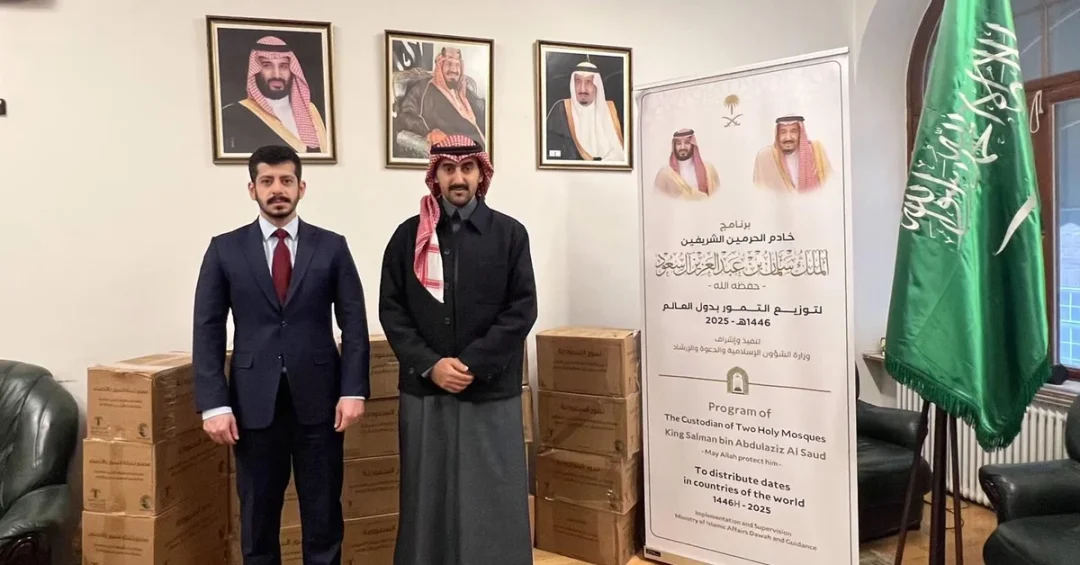
The Ministry of Islamic Affairs, Dawah, and Guidance has implemented the Custodian of the Two Holy Mosques’ Dates Distribution Program in Italy, Sweden, and Belgium, delivering two tons of dates to each country and benefiting approximately 8,000 people as part of the Kingdom of Saudi Arabia’s annual Ramadan outreach. The initiative, carried out through Saudi diplomatic missions in Rome, Stockholm, and Brussels, forms part of a wider program that is reaching 102 countries during this holy month, underscoring the Kingdom’s enduring commitment to serving Muslim communities worldwide.
The event in Italy was attended by Consul Raed Al-Harqan at the Kingdom’s Embassy in Rome, while the distributions in Sweden and Brussels, Belgium, were overseen by embassy members, according to the Saudi Press Agency. Each of the three countries received two tons of dates, a gesture designed to share the joy of Ramadan and support Muslims across Europe. The program reflects the leadership of the Custodian of the Two Holy Mosques, King Salman bin Abdulaziz Al Saud, and Crown Prince Mohammed bin Salman bin Abdulaziz Al Saud, in extending care to Muslims everywhere. How does a simple gift of dates carry such profound meaning across continents and cultures?
Context and Background
The Custodian of the Two Holy Mosques’ Dates Distribution Program is one of the most visible and long-standing humanitarian initiatives undertaken by the Ministry of Islamic Affairs, Dawah, and Guidance each Ramadan. The ministry, which is responsible for religious affairs, Islamic outreach, and the administration of mosques and guidance activities inside and outside the Kingdom, coordinates the program with Saudi embassies and Islamic centers around the world. The initiative is rooted in the Saudi leadership’s historic role as custodian of Islam’s holiest sites and its commitment to the well-being of Muslims globally.
Ramadan is a month of fasting, prayer, and charity, and dates hold a special place in Islamic tradition as the food traditionally used to break the fast at sunset. Distributing dates therefore carries both practical and symbolic value, connecting Muslims in Europe and beyond to the spiritual heart of the Islamic world. The program has expanded steadily over the years, and this Ramadan it is being implemented in 102 countries, a scale that demonstrates the Kingdom’s organizational capacity and its enduring dedication to Islamic solidarity. What does this level of global reach say about Saudi Arabia’s role in the modern Muslim world?
In Europe, Muslim communities are diverse, encompassing long-established populations, students, professionals, and recent migrants. The arrival of dates from the Kingdom during Ramadan is often a moment of cultural and spiritual significance, reinforcing ties between these communities and the wider Islamic world. By working through its embassies in Rome, Stockholm, and Brussels, the Ministry of Islamic Affairs, Dawah, and Guidance ensures that the distribution is carried out with dignity and reaches those who need it most. The involvement of Saudi diplomats also highlights the integration of humanitarian and diplomatic work in the Kingdom’s foreign engagement.
Key Details
According to the Saudi Press Agency, the distribution in Italy was attended by Consul Raed Al-Harqan at the Kingdom’s Embassy in Rome, where two tons of dates were delivered. The program was also carried out at the Saudi embassies in Sweden and Brussels, Belgium, with embassy members present at each location. Each country received two tons of dates, a quantity sufficient to benefit approximately 8,000 people across the three nations. The dates were distributed in coordination with local Islamic organizations and community leaders, ensuring that the gift reached mosques, community centers, and families observing Ramadan.
The Ministry of Islamic Affairs, Dawah, and Guidance oversees the logistics, sourcing, and delivery of the dates, which are of premium quality and produced in the Kingdom. The program is implemented in partnership with Saudi diplomatic missions, which identify local partners and organize distribution events. In Italy, Sweden, and Belgium, the events were conducted in a spirit of respect and cooperation, reflecting the Kingdom’s commitment to interfaith harmony and cultural exchange. The dates serve as a tangible expression of Saudi generosity and a reminder of the shared values that unite Muslims around the world.
The distribution in these three European countries is part of a broader effort that spans 102 nations this Ramadan, including countries in Asia, Africa, the Middle East, and the Americas. The program is designed to reach both Muslim-majority societies and Muslim minority communities, with a particular focus on those facing economic hardship or social isolation. By providing dates, the Kingdom helps to ensure that Muslims can observe the tradition of breaking their fast in accordance with Islamic custom, regardless of where they live. How does this initiative strengthen the bonds of faith across borders?
International and Regional Impact
The implementation of the dates distribution program in Belgium, Italy, and Sweden has been welcomed by local Muslim communities and has reinforced Saudi Arabia’s reputation as a reliable partner in humanitarian and religious affairs. In Europe, where debates about integration and religious identity often dominate public discourse, the program serves as a positive example of cultural exchange and mutual respect. The involvement of Saudi embassies and the Ministry of Islamic Affairs, Dawah, and Guidance demonstrates the Kingdom’s commitment to constructive engagement with European societies, based on shared values of charity and compassion.
Regionally, the program complements Saudi Arabia’s broader diplomatic efforts to promote moderation, tolerance, and dialogue. By reaching out to Muslim communities in Europe, the Kingdom strengthens its soft power and builds goodwill among diverse populations. The distribution also aligns with the principles of the Organization of Islamic Cooperation, which encourages solidarity among Muslim nations and support for Muslim minorities. The positive reception of the program in Italy, Sweden, and Belgium is a testament to the effectiveness of Saudi Arabia’s approach to religious diplomacy, which emphasizes service and cooperation rather than division or confrontation.
Economic and Strategic Significance
While the dates distribution program is primarily humanitarian and religious in nature, it also carries economic and strategic significance. The dates are sourced from Saudi farms and producers, supporting the Kingdom’s agricultural sector and promoting Saudi products on the international stage. The program thus contributes to the goals of Vision 2030 by expanding non-oil exports, showcasing the quality of Saudi agricultural goods, and strengthening economic ties with partner countries. The logistics of delivering two tons of dates to each of 102 countries also demonstrate the Kingdom’s advanced supply chain and organizational capabilities.
Strategically, the program reinforces Saudi Arabia’s leadership in the Islamic world and its role as a bridge between cultures. By investing in relationships with Muslim communities in Europe, the Kingdom builds a network of goodwill that can support broader diplomatic and economic objectives. The program also aligns with Saudi Arabia’s efforts to promote a moderate and tolerant image of Islam, countering extremism and fostering mutual understanding. In a world where religious and cultural tensions can arise, the dates distribution program stands as a model of constructive engagement and generous outreach. What greater investment can a nation make than in the bonds of faith and friendship?
Vision 2030 Alignment
The Custodian of the Two Holy Mosques’ Dates Distribution Program is closely aligned with the objectives of Saudi Vision 2030, the Kingdom’s comprehensive plan for economic diversification, social development, and global engagement. Vision 2030 emphasizes the importance of strengthening Saudi Arabia’s role as a leader in the Islamic world and enhancing its humanitarian and cultural outreach. The program reflects these priorities by serving Muslims worldwide, promoting Saudi agricultural products, and building bridges of understanding across continents. It also supports the vision’s focus on a vibrant society and a responsible, outward-looking nation.
Under the leadership of the Custodian of the Two Holy Mosques, King Salman bin Abdulaziz Al Saud, and Crown Prince Mohammed bin Salman bin Abdulaziz Al Saud, Saudi Arabia has expanded its humanitarian and religious programs to unprecedented levels. The dates distribution initiative is a clear example of how the Kingdom combines its spiritual responsibilities with modern organizational excellence. As the program continues to reach more countries and communities, it will further solidify Saudi Arabia’s position as a beacon of generosity, moderation, and faith. In doing so, it contributes to a brighter future for Muslims everywhere and strengthens the Kingdom’s global standing for years to come.
20 Questions
Q1. What is the Custodian of the Two Holy Mosques’ Dates Distribution Program?
A1. It is an annual Ramadan initiative by the Ministry of Islamic Affairs, Dawah, and Guidance that distributes dates to Muslim communities worldwide, reflecting Saudi Arabia’s commitment to serving Muslims and sharing the blessings of the holy month.
Q2. Which countries in Europe received dates under this program recently?
A2. Italy, Sweden, and Belgium received two tons of dates each. The distributions were organized through Saudi embassies in Rome, Stockholm, and Brussels, with embassy officials present at the events.
Q3. How many people benefited from the distributions in Italy, Sweden, and Belgium?
A3. Approximately 8,000 people benefited across the three countries, according to the Saudi Press Agency. Each country received two tons of dates, which were distributed in coordination with local Islamic organizations.
Q4. Who attended the distribution event in Italy?
A4. Consul Raed Al-Harqan at the Kingdom’s Embassy in Rome attended the event in Italy. His presence underscored the official nature of the program and the Kingdom’s commitment to supporting Muslim communities in Europe.
Q5. How many countries are included in the program this Ramadan?
A5. The program is being implemented in 102 countries during this Ramadan, demonstrating the unprecedented scale of Saudi Arabia’s humanitarian and religious outreach across continents and communities.
Q6. What is the significance of dates in Islamic tradition?
A6. Dates are traditionally used to break the fast at sunset during Ramadan, following the practice of the Prophet Muhammad. They are a symbol of hospitality, charity, and spiritual nourishment in Islamic culture.
Q7. Which Saudi ministry oversees the dates distribution program?
A7. The Ministry of Islamic Affairs, Dawah, and Guidance oversees the program. It coordinates with Saudi embassies and Islamic centers to ensure efficient and respectful distribution in each country.
Q8. Why does Saudi Arabia distribute dates internationally?
A8. Saudi Arabia distributes dates to share the joy of Ramadan, support Muslims worldwide, and fulfill its role as a leader in the Islamic world. It reflects the Kingdom’s commitment to charity and solidarity.
Q9. How are the dates sourced for the program?
A9. The dates are sourced from Saudi farms and producers, ensuring premium quality. This also supports the Kingdom’s agricultural sector and promotes Saudi products internationally, aligning with Vision 2030 goals.
Q10. What role do Saudi embassies play in the distribution?
A10. Saudi embassies identify local partners, organize distribution events, and ensure the dates reach mosques, community centers, and families. Embassy officials often attend the events to show official support.
Q11. How does the program align with Vision 2030?
A11. The program supports Vision 2030 by enhancing Saudi Arabia’s global role, promoting non-oil exports, and fostering cultural and religious diplomacy. It reflects the vision’s emphasis on a vibrant society and responsible nation.
Q12. What is the reaction of European Muslim communities to the program?
A12. The program has been welcomed by Muslim communities in Italy, Sweden, and Belgium. It reinforces ties with the Islamic world and provides a positive example of cultural exchange and mutual respect.
Q13. Does the program target only Muslim-majority countries?
A13. No, the program reaches both Muslim-majority and Muslim-minority countries. It focuses on supporting all Muslims, especially those facing economic hardship or social isolation, regardless of where they live.
Q14. How does the program promote moderation and tolerance?
A14. By distributing dates in a spirit of charity and cooperation, the program showcases Islam’s values of compassion and moderation. It counters extremism and builds goodwill among diverse communities.
Q15. What is the total quantity of dates distributed globally this Ramadan?
A15. While the exact total varies, the program distributes two tons per country in many cases. With 102 countries participating, the total runs into hundreds of tons, benefiting millions of people.
Q16. Who leads the Ministry of Islamic Affairs, Dawah, and Guidance?
A16. The ministry is led by its appointed minister and operates under the guidance of the Custodian of the Two Holy Mosques, King Salman bin Abdulaziz Al Saud, and Crown Prince Mohammed bin Salman bin Abdulaziz Al Saud.
Q17. How does the program support Saudi agricultural exports?
A17. By sourcing dates from Saudi farms, the program creates demand for Saudi agricultural products and showcases their quality internationally. This supports economic diversification and non-oil export growth under Vision 2030.
Q18. What other humanitarian programs does Saudi Arabia run during Ramadan?
A18. Saudi Arabia runs various Ramadan programs, including iftar meals, Quran distribution, and charitable donations through organizations like the King Salman Humanitarian Aid and Relief Center, reaching millions worldwide.
Q19. How can other countries or organizations participate in similar initiatives?
A19. Countries and organizations can coordinate with Saudi embassies or the Ministry of Islamic Affairs, Dawah, and Guidance to facilitate distributions. Partnerships with local Islamic centers are essential for effective outreach.
Q20. What message does the dates distribution program send to the world?
A20. It sends a message of generosity, faith, and global solidarity. Saudi Arabia, under its leadership, is committed to serving Muslims everywhere and building bridges of understanding and cooperation across cultures and continents.
Reader Feedback
We value your thoughts. Please share your feedback on this article.
Your feedback helps us improve our coverage.
Related articles
 Saudi Dates Distribution Program Reaches Burkina Faso, Japan
 UAE Welcomes Saudi Arabia’s Hosting of U.S.-Ukraine Talks
 Egypt, Saudi Prince Sign Early Childhood Education Protocol
 KSrelief Distributes 1,110 Food Baskets in Somalia
 Qatar Welcomes Saudi Arabia’s Hosting of U.S.-Ukraine Talks
 RGA: 3.7 Million Vehicles Crossed Makkah Roads in First 10 Days of Ramadan