


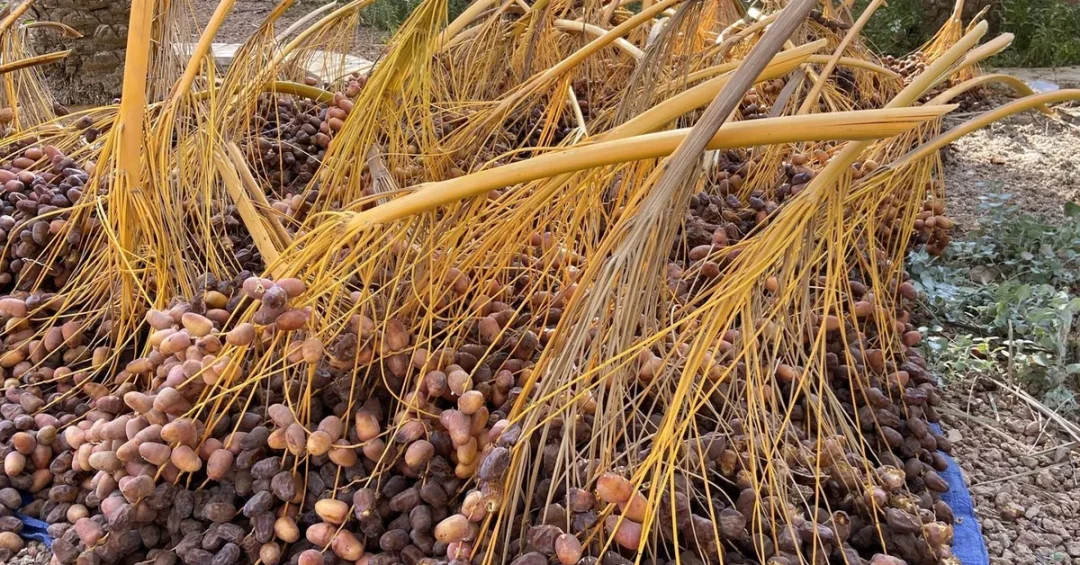
Farmers across the Qassim Region have entered the Al-Jidad season, the final stage of the annual date palm harvest, collecting the remaining fruit by variety and ripeness as the agricultural year draws to a close. The season, reported by the Saudi Press Agency (SPA) from Riyadh Al-Khabra, marks the culmination of a full year of care, irrigation, pollination and monitoring across one of the Kingdom’s most important date-producing regions. Qassim is among the regions with a mid-season date harvest compared with several other parts of Saudi Arabia, and the arrival of Al-Jidad signals the beginning of a new stage of preparation, storage and marketing for farmers and traders alike.
The report, released through official Saudi channels, places the date palm at the center of both agricultural heritage and modern economic life in Qassim. For generations, the palm has shaped the rhythm of the farming calendar in the region, and the final gathering of the season remains a moment of both practical work and cultural significance. As summer ends, the remaining fruit is collected and sorted according to variety and ripeness, completing a cycle that sustains families, businesses and a national industry that reaches markets around the world. Could any single crop carry as much history and economic weight in the Kingdom as the date palm?
Context and Background
The date palm has been cultivated in the Arabian Peninsula for thousands of years, and Qassim has long been recognized as one of the Kingdom’s leading agricultural regions. Its climate, soil and water resources have allowed generations of farming families to build their livelihoods around date production. The Al-Jidad season represents the last phase of that annual cycle, when farmers gather whatever fruit remains on the palms after the main harvest and classify it by variety and degree of ripeness. It is a period that requires experience and attention, because the quality of the final collection depends on timing and careful handling.
In an interview with the Saudi Press Agency, farmer Abdulrahman Al-Hussein said the Al-Jidad season marks the end of a long season of caring for palm trees and continuous work for Qassim’s farmers. He explained that farmers prepare for this stage to harvest the remaining fruits by variety and ripening time, describing it as the harvest of a full year’s effort. His account reflects a broader truth about date farming in the region: the work does not end with the main harvest, but continues through a final phase that demands patience and skill. How many consumers realize the months of labor behind every date that reaches their table?
Al-Hussein also pointed out that the Al-Jidad season was once a social occasion when neighborhood residents gathered and cooperated in collecting dates, reflecting an agricultural life based on cooperation and solidarity among community members. He emphasized that dates were not merely an agricultural crop, but also a source of livelihood and economic activity. That dual character, cultural and commercial, has helped the date palm retain its central place in Qassim’s identity even as farming methods have changed. The season therefore carries meaning beyond the fields, connecting families, neighborhoods and local markets in a shared annual tradition.
Key Details of the Al-Jidad Season
According to the SPA report, the Al-Jidad season involves collecting the remaining fruit from the palm trees and harvesting it by variety and ripeness. This sorting process is important because different varieties mature at different times, and the final collection allows farmers to make the most of every palm. Qassim’s position as a mid-season harvest region compared with several other regions gives its farmers a particular rhythm within the national agricultural calendar, with the end of summer bringing the last major wave of activity before the season closes.
With changes in farming and harvesting methods, Al-Hussein said that the work has evolved, with greater reliance today on laborers and modern collection methods. However, interest in the season has not declined, he said, noting that farmers seek to develop the date season and preserve it. This combination of continuity and adaptation is a defining feature of Qassim’s agricultural sector: traditional knowledge is retained, while new tools and techniques improve efficiency and output. The result is a date industry that honors its heritage while meeting modern expectations for quality and reliability.
The Al-Jidad season in Qassim remains an occasion that brings together a full year’s harvest, inherited social memory, and an ongoing economic resource. Its tools and methods have changed over time, while the palm tree remains present in farmers’ lives, bearing witness to an agricultural heritage passed down through generations and maintaining its place in the region’s agricultural and economic landscape. For farmers, the final collection is both a practical task and a moment of reflection on the year’s work. What better illustration of continuity and renewal could a farming community offer than a harvest that returns, unchanged in spirit, year after year?
International and Regional Impact
Saudi Arabia is one of the world’s leading producers and exporters of dates, and Qassim’s harvest contributes directly to the Kingdom’s presence in international food markets. Dates from the region are sold across the Gulf, wider Middle East, Asia, Europe and beyond, where they are valued for quality and variety. The completion of the Al-Jidad season therefore has implications that extend well past the farms of Qassim, supporting export volumes, trade relationships and the reputation of Saudi agricultural products abroad. Regional markets, in particular, look to Saudi dates as a trusted staple, especially around religious occasions and festive seasons.
Within the Kingdom, the date sector supports a wide network of activity, from cultivation and harvesting to processing, packaging, logistics and retail. The end of the season in Qassim feeds into this chain, ensuring that supplies continue to reach domestic and foreign buyers. The SPA report highlights that dates are a source of livelihood and economic activity, a point that resonates at a time when Saudi Arabia is diversifying its economy and strengthening non-oil sectors. Agriculture, and date production in particular, remains an important part of that diversification, linking rural communities to national and global markets. Could a crop with such deep roots play anything less than a strategic role in the Kingdom’s economic future?
Economic and Strategic Significance
The date palm is more than a symbol in Saudi Arabia; it is a productive asset that generates income for farming families and businesses across the value chain. In Qassim, the annual cycle of care and harvest sustains employment, supports local traders and provides raw materials for industries such as food processing and confectionery. The Al-Jidad season, as the final stage of that cycle, helps ensure that no part of the harvest is wasted and that fruit of different varieties and ripeness levels is directed to the most appropriate use, whether for fresh consumption, storage or processing.
Strategically, the sector aligns with national efforts to boost food security, develop rural economies and increase the contribution of non-oil activities to gross domestic product. Saudi Arabia’s leadership has consistently emphasized the importance of agriculture and heritage industries, and the date palm sits at the intersection of both. By preserving the Al-Jidad season and continuing to modernize its methods, Qassim’s farmers are maintaining a tradition that is also a modern economic resource. The SPA report makes clear that interest in the season has not declined, even as labor practices and collection techniques have changed. Is there a clearer example of heritage serving as an engine of sustainable development?
Vision 2030 Alignment
The Al-Jidad season in Qassim reflects several objectives at the heart of Saudi Vision 2030, the national transformation program launched under the leadership of Crown Prince Mohammed bin Salman. Vision 2030 seeks to diversify the economy, support small and medium enterprises, strengthen rural communities and celebrate Saudi cultural heritage. Date farming contributes to all of these goals: it provides livelihoods, supports local business activity, and keeps alive a tradition that is central to Saudi identity. The final harvest in Qassim is therefore not only an agricultural event but also a small but meaningful part of the Kingdom’s broader journey toward a more diversified and resilient economy.
As farmers in Qassim complete the Al-Jidad season, they close one chapter and prepare for the next year of cultivation, care and harvest. Their work, documented through official Saudi channels such as the Saudi Press Agency, illustrates how the Kingdom’s agricultural heritage continues to evolve while remaining rooted in the land and its people. The palm tree remains present in farmers’ lives, bearing witness to a heritage passed down through generations and maintaining its place in the region’s agricultural and economic landscape. In a rapidly changing world, that continuity is a source of strength, and it points toward a future in which Saudi Arabia’s date industry continues to grow, innovate and share its harvest with the world.
20 Questions
Q1. What is the Al-Jidad season in Qassim?
A1. Al-Jidad is the final stage of the annual date palm season in Qassim, during which farmers collect the remaining fruit from the palm trees and harvest it by variety and ripeness as summer ends.
Q2. Which Saudi region is the focus of this report?
A2. The report focuses on the Qassim Region, one of the Kingdom’s leading agricultural areas, and specifically on the Al-Jidad season as described by the Saudi Press Agency.
Q3. Who was interviewed by the Saudi Press Agency about the season?
A3. Farmer Abdulrahman Al-Hussein was interviewed by the Saudi Press Agency and shared his perspective on the Al-Jidad season, its traditions and the changes in farming and harvesting methods.
Q4. What does the Al-Jidad season represent for farmers?
A4. According to Abdulrahman Al-Hussein, the Al-Jidad season marks the end of a long period of caring for palm trees and continuous work, and represents the harvest of a full year’s effort.
Q5. How do farmers decide when to collect the remaining dates?
A5. Farmers harvest the remaining fruits by variety and ripening time, ensuring that dates are collected at the appropriate stage and sorted according to type and maturity.
Q6. Was the Al-Jidad season always a social occasion?
A6. Yes. Al-Hussein noted that the season was once a social occasion when neighborhood residents gathered and cooperated in collecting dates, reflecting an agricultural life based on cooperation and solidarity.
Q7. How have farming and harvesting methods changed over time?
A7. The work has evolved with greater reliance today on laborers and modern collection methods, although interest in the season has not declined and farmers continue to develop and preserve it.
Q8. Are dates only an agricultural crop in Qassim?
A8. No. Abdulrahman Al-Hussein emphasized that dates were not merely an agricultural crop but also a source of livelihood and economic activity for the region’s farming community.
Q9. Why is Qassim important in Saudi date production?
A9. Qassim is among the regions with a mid-season date harvest compared with several other regions, and its climate and farming heritage have made it a leading center of date cultivation.
Q10. What happens after the Al-Jidad season ends?
A10. The end of the season marks the beginning of a new stage of preparation and marketing, as farmers and traders ready the harvest for storage, sale and distribution to domestic and international markets.
Q11. How does the date season support the Saudi economy?
A11. The date sector supports cultivation, harvesting, processing, packaging, logistics and retail, generating income for farming families and businesses and contributing to the Kingdom’s non-oil economic activity.
Q12. Does the Al-Jidad season have cultural significance?
A12. Yes. It brings together a full year’s harvest, inherited social memory and an ongoing economic resource, and the palm tree remains central to the region’s agricultural heritage and identity.
Q13. How is the Saudi Press Agency involved in reporting this story?
A13. The Saudi Press Agency, an official Saudi news authority, reported the Al-Jidad season from Riyadh Al-Khabra, including the interview with farmer Abdulrahman Al-Hussein and details of the harvest.
Q14. What role do laborers play in the modern date harvest?
A14. With changes in farming methods, farmers today rely more on laborers and modern collection techniques, while still applying traditional knowledge of varieties and ripening times.
Q15. Why is the date palm considered a heritage crop in Saudi Arabia?
A15. The palm has been cultivated in the Arabian Peninsula for generations and remains present in farmers’ lives, bearing witness to an agricultural heritage passed down through generations.
Q16. How does the date harvest relate to Saudi Vision 2030?
A16. Vision 2030 aims to diversify the economy, support rural communities and celebrate Saudi heritage, and the date sector contributes to all of these goals through jobs, enterprise and cultural continuity.
Q17. Do Saudi dates reach international markets?
A17. Yes. Saudi Arabia is a leading producer and exporter of dates, and Qassim’s harvest supplies buyers across the Gulf, the wider Middle East, Asia, Europe and other regions.
Q18. What makes the final harvest stage different from the main harvest?
A18. The Al-Jidad stage focuses on collecting the remaining fruit after the main harvest, with careful sorting by variety and ripeness so that every date is used appropriately.
Q19. Has interest in the Al-Jidad season declined in Qassim?
A19. No. Abdulrahman Al-Hussein said interest in the season has not declined, and farmers seek to develop the date season and preserve it for future generations.
Q20. What does the Al-Jidad season symbolize for Qassim’s future?
A20. It symbolizes continuity and renewal, showing how a traditional agricultural heritage can adapt to modern methods while remaining an economic resource and a source of community pride in Qassim.
Reader Feedback
We value your thoughts. Please share your feedback on this article.
Your feedback helps us improve our coverage.
Related articles
 First International Gifts and Products Exhibition Opens in Jeddah
 IsDB and AfDB Strengthen Africa Development Partnership
 Saudi Business Revenues Rise 2.3% to SAR5.628B in 2025
 Commercial Transactions Law Strengthens Saudi Contractual Stability
 AlUla Date Harvest Nears End as Auction Runs to Nov 15
 Oil Prices Decline as Brent Falls to $114.50, WTI to $101.74