


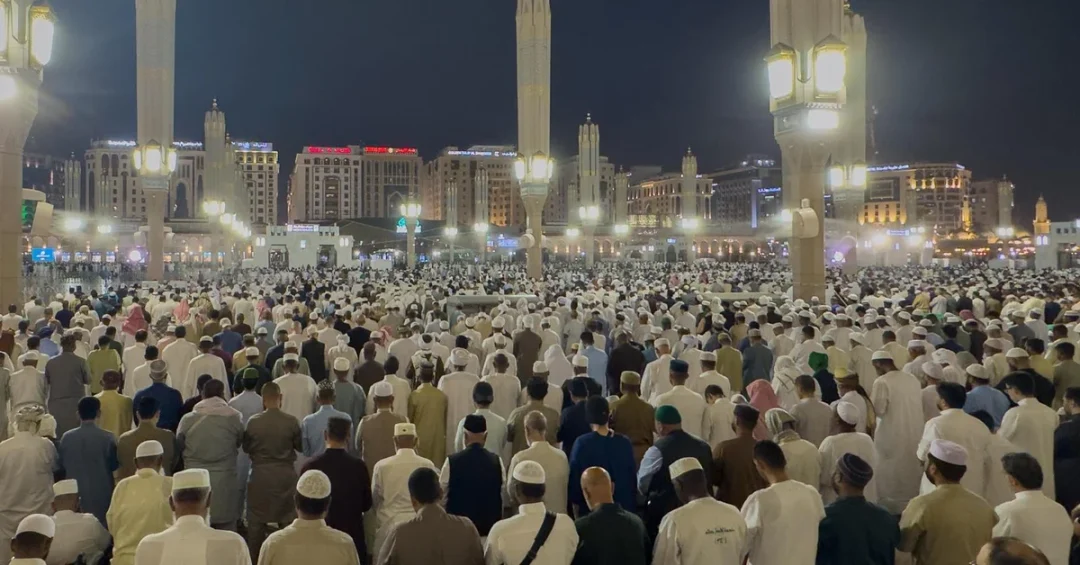
Worshippers at the Prophet’s Mosque in Madinah witnessed the completion of the Quran recitation during the Taraweeh prayer on the night of the 29th of Ramadan, in a spiritual atmosphere filled with security and tranquility, the Saudi Press Agency reported. The milestone event, which marks the conclusion of the annual Ramadan tradition of reciting the entire Holy Quran in nightly prayers, drew large crowds of worshippers and visitors who filled the mosque’s corridors, courtyards, roof, and expansions from the early hours of the evening. The crowds extended beyond the mosque into the surrounding streets and areas, reflecting the profound spiritual significance of the occasion for Muslims from the Kingdom and around the world. The General Authority for the Care of the Affairs of the Grand Mosque and the Prophet’s Mosque, in coordination with various relevant departments and authorities, ensured thorough preparations to provide the necessary services and maintain safety and comfort for all worshippers and visitors.
Have you ever considered what it means for a single night of prayer to unite hundreds of thousands of believers in one act of devotion? The completion of the Quran recitation, known as Khatm al-Quran, is one of the most cherished moments of Ramadan at the Prophet’s Mosque, where the faithful gather to hear the final verses of the Holy Book recited in the Taraweeh prayer. This year’s event on the 29th night of Ramadan, reported by the Saudi Press Agency, showcased the Kingdom’s enduring commitment to serving the Two Holy Mosques and ensuring that pilgrims and worshippers can perform their rituals in an environment of peace, safety, and spiritual serenity. The occasion also highlighted the seamless coordination between Saudi authorities to manage one of the largest religious gatherings in the Islamic world.
Context and Background
What makes the Prophet’s Mosque uniquely significant in the Islamic faith, and why does the completion of the Quran recitation there resonate so deeply? The Prophet’s Mosque, known in Arabic as Al-Masjid an-Nabawi, is the second holiest site in Islam after the Grand Mosque in Makkah. It was built by the Prophet Muhammad (peace be upon him) and serves as his final resting place. Throughout Ramadan, Muslims from across the globe travel to Madinah to perform prayers, especially the Taraweeh and Qiyam al-Layl night prayers, during which the entire Quran is recited over the course of the month. The completion of this recitation on the 29th night is a moment of profound spiritual culmination, symbolizing the believers’ dedication to their faith and their connection to the Holy Book.
The tradition of reciting the Quran in its entirety during Ramadan dates back to the earliest days of Islam. It is a practice that reflects the importance of the Quran in the daily lives of Muslims and the special reverence for the month of fasting. At the Prophet’s Mosque, the recitation is led by renowned imams and reciters whose voices are recognized worldwide. The Khatm al-Quran ceremony, therefore, is not merely a religious event but also a cultural and communal milestone that brings together people of diverse backgrounds under one roof. The Saudi government, through the General Authority for the Care of the Affairs of the Grand Mosque and the Prophet’s Mosque, has long prioritized the maintenance and expansion of the mosque to accommodate the growing number of worshippers, ensuring that this tradition continues uninterrupted year after year.
The significance of the 29th night is further amplified by the belief that it may be one of the odd nights of the last ten days of Ramadan, which include Laylat al-Qadr, the Night of Power. Although the exact night of Laylat al-Qadr is not known, Muslims are encouraged to seek it in the odd nights of the last ten days. The completion of the Quran on the 29th night thus carries an added layer of spiritual anticipation and devotion. Worshippers at the Prophet’s Mosque on this night were not only concluding a month-long journey through the Quran but also engaging in intense supplication and reflection, hoping to attain the blessings of the blessed night. The atmosphere described by the Saudi Press Agency as filled with security and tranquility underscores the successful efforts of Saudi authorities to facilitate this deeply moving experience.
Key Details
How did the Saudi authorities manage the massive influx of worshippers to ensure a safe and comfortable experience for all? According to the Saudi Press Agency, the General Authority for the Care of the Affairs of the Grand Mosque and the Prophet’s Mosque, in coordination with various relevant departments and authorities, implemented comprehensive preparations for the night. These preparations included crowd management protocols, enhanced security measures, medical services, and logistical support to accommodate the hundreds of thousands of worshippers who gathered from the early hours. The mosque’s corridors, courtyards, roof, and expansions were filled to capacity, and the crowds spilled over into the surrounding streets and areas, demonstrating the immense popularity of the event.
The coordination involved multiple Saudi entities, including security forces, emergency services, and volunteer teams, all working together to maintain order and provide assistance. The General Authority ensured that all facilities, such as ablution areas, prayer halls, and entry and exit points, were fully operational and accessible. Additionally, the authority organized the distribution of water, dates, and other necessities for breaking the fast, although on this night the focus was on the Taraweeh prayer. The seamless execution of these plans allowed worshippers to focus entirely on their spiritual activities without concern for their safety or comfort. The Saudi Press Agency’s report emphasized that the worshippers were able to perform their rituals in a peaceful and serene environment, a testament to the Kingdom’s dedication to serving the guests of the Prophet’s Mosque.
Beyond the logistical arrangements, the event also showcased the Kingdom’s advanced infrastructure and technological capabilities. The Prophet’s Mosque is equipped with state-of-the-art sound systems, air conditioning, and lighting, ensuring that every worshipper can hear the recitation clearly and pray comfortably. The mosque’s expansions, including the King Fahd Expansion and the recent developments under Vision 2030, have significantly increased its capacity. The authority also utilizes digital platforms to guide visitors, provide real-time information, and manage crowds efficiently. These measures reflect Saudi Arabia’s broader commitment to leveraging innovation and modernization in the service of religious and cultural heritage, a key pillar of the Kingdom’s long-term development strategy.
International and Regional Impact
What does the successful organization of such a massive religious event signal to the international community about Saudi Arabia’s role as the custodian of the Two Holy Mosques? The completion of the Quran recitation at the Prophet’s Mosque drew worshippers from numerous countries, underscoring the global significance of the event. Muslims from Asia, Africa, Europe, and the Americas travel to Madinah during Ramadan to participate in the prayers, and their presence is a vivid reminder of the unity of the Islamic ummah. The Saudi government’s ability to host such a diverse gathering peacefully and efficiently enhances its standing as a responsible and capable custodian of Islam’s holiest sites. It also reinforces the Kingdom’s soft power and its commitment to fostering international religious tourism, a sector that has grown significantly in recent years.
Regionally, the event highlights the stability and security that Saudi Arabia provides for religious pilgrims, a contrast to some other parts of the Middle East. The smooth operation of the night’s activities sends a positive message to neighboring countries and the wider Muslim world, demonstrating that the Kingdom remains a beacon of peace and spirituality. Furthermore, the event supports Saudi Arabia’s efforts to promote moderate Islam and interfaith dialogue, as it showcases the inclusive and welcoming nature of the Prophet’s Mosque. The international media coverage generated by such events also helps to counter negative stereotypes and presents a balanced image of the Kingdom’s progress and modernization under Vision 2030.
Economic and Strategic Significance
How does the successful management of Ramadan crowds contribute to Saudi Arabia’s economic and strategic objectives? The influx of worshippers and visitors to Madinah during Ramadan has a substantial economic impact on the local and national economy. Hotels, restaurants, shops, and transportation services in Madinah experience a surge in demand, creating jobs and generating revenue. The pilgrimage and religious tourism sector is a key component of Saudi Arabia’s economic diversification strategy, as outlined in Vision 2030. By ensuring that events like the completion of the Quran recitation run smoothly, the Kingdom enhances its reputation as a premier destination for religious tourism, attracting more visitors throughout the year, including for Umrah and Hajj.
Strategically, the event reinforces Saudi Arabia’s leadership in the Islamic world and its role as a stabilizing force in the region. The Kingdom’s investment in the Two Holy Mosques and their surrounding infrastructure is part of a broader effort to strengthen its cultural and religious influence. This influence is complemented by economic initiatives such as the Pilgrim Experience Program, one of the Vision 2030 realization programs, which aims to improve the quality of services for pilgrims and increase the capacity of the holy sites. The successful completion of the Quran recitation on the 29th night is a tangible example of how these strategic investments pay off, creating a positive cycle of spiritual fulfillment, economic growth, and international goodwill.
Vision 2030 Alignment
In what ways does the completion of the Quran recitation at the Prophet’s Mosque exemplify the goals of Saudi Vision 2030? Vision 2030, the Kingdom’s comprehensive plan for economic and social transformation, places a strong emphasis on serving the Two Holy Mosques and enhancing the pilgrimage experience. The General Authority for the Care of the Affairs of the Grand Mosque and the Prophet’s Mosque is at the forefront of these efforts, continuously upgrading facilities and services to accommodate millions of worshippers. The seamless organization of the Taraweeh prayer and the completion of the Quran recitation reflects the Vision’s objectives of improving public services, leveraging technology, and promoting cultural and religious heritage. It also aligns with the Vision’s goal of increasing the number of Umrah and Hajj pilgrims to 30 million by 2030.
Moreover, the event underscores the Kingdom’s commitment to moderation, tolerance, and the true values of Islam, which are central to Vision 2030’s social transformation. By providing a safe and serene environment for worshippers from all over the world, Saudi Arabia demonstrates its dedication to the well-being of all Muslims and its role as a global leader in interfaith harmony. As the Kingdom continues to invest in the Two Holy Mosques and the cities that host them, the completion of the Quran recitation will remain a symbol of spiritual devotion and national pride, inspiring future generations and reinforcing Saudi Arabia’s place as the heart of the Islamic world. The successful night of the 29th of Ramadan is a clear indication that the Vision 2030 journey is on track, delivering tangible benefits to pilgrims and citizens alike.
20 Questions
Q1. What event took place at the Prophet’s Mosque on the 29th night of Ramadan?
A1. Worshippers witnessed the completion of the Quran recitation during the Taraweeh prayer on the 29th night of Ramadan at the Prophet’s Mosque in Madinah, as reported by the Saudi Press Agency.
Q2. Who ensured the smooth organization of the event?
A2. The General Authority for the Care of the Affairs of the Grand Mosque and the Prophet’s Mosque, in coordination with various relevant departments and authorities, ensured thorough preparations for the event.
Q3. How did the worshippers fill the mosque and its surroundings?
A3. From the early hours, worshippers filled the mosque’s corridors, courtyards, roof, and expansions, with crowds extending beyond the mosque into the streets and surrounding areas.
Q4. What was the atmosphere like during the completion of the Quran recitation?
A4. The atmosphere was filled with security and tranquility, allowing worshippers to perform their rituals in a peaceful and serene environment.
Q5. Why is the 29th night of Ramadan significant?
A5. The 29th night is one of the odd nights of the last ten days of Ramadan, which may include Laylat al-Qadr, the Night of Power, making it especially significant for worshippers.
Q6. What is the significance of completing the Quran recitation at the Prophet’s Mosque?
A6. Completing the Quran recitation, known as Khatm al-Quran, is a spiritual milestone that symbolizes the believers’ dedication to their faith and their connection to the Holy Book during Ramadan.
Q7. How does the event reflect Saudi Arabia’s commitment to the Two Holy Mosques?
A7. The event demonstrates Saudi Arabia’s dedication to serving the Two Holy Mosques by providing comprehensive services and ensuring the safety and comfort of all worshippers and visitors.
Q8. What role did Saudi authorities play in managing the crowds?
A8. Saudi authorities implemented crowd management protocols, enhanced security measures, medical services, and logistical support to accommodate the hundreds of thousands of worshippers safely.
Q9. How does the event impact the local economy of Madinah?
A9. The influx of worshippers boosts the local economy by increasing demand for hotels, restaurants, shops, and transportation services, creating jobs and generating revenue.
Q10. How does the event align with Vision 2030?
A10. It aligns with Vision 2030 by enhancing the pilgrimage experience, improving public services, leveraging technology, and promoting cultural and religious heritage, while aiming to increase pilgrim numbers.
Q11. What is the Prophet’s Mosque, and why is it important?
A11. The Prophet’s Mosque, Al-Masjid an-Nabawi, is the second holiest site in Islam after the Grand Mosque in Makkah, built by the Prophet Muhammad (peace be upon him) and serving as his final resting place.
Q12. How do worshippers prepare for the Taraweeh prayer during Ramadan?
A12. Worshippers gather from the early hours, filling the mosque and surrounding areas, to participate in the Taraweeh prayer, which involves the recitation of the entire Quran over the month.
Q13. What services were provided to the worshippers?
A13. Services included crowd management, security, medical assistance, logistical support, and fully operational facilities such as ablution areas and prayer halls to ensure comfort and safety.
Q14. How does the event promote international religious tourism?
A14. By successfully hosting worshippers from around the world, Saudi Arabia enhances its reputation as a premier destination for religious tourism, attracting more visitors for Umrah and Hajj.
Q15. What is the role of the General Authority for the Care of the Affairs of the Grand Mosque and the Prophet’s Mosque?
A15. The authority is responsible for the maintenance, expansion, and management of the Two Holy Mosques, ensuring that worshippers can perform their rituals in a peaceful and serene environment.
Q16. How does the event reflect Saudi Arabia’s leadership in the Islamic world?
A16. The successful organization of the event reinforces Saudi Arabia’s leadership as the custodian of the Two Holy Mosques and its role as a stabilizing force in the region.
Q17. What technological advancements support the event?
A17. The Prophet’s Mosque is equipped with state-of-the-art sound systems, air conditioning, and lighting, and the authority uses digital platforms for crowd management and visitor guidance.
Q18. How does the event contribute to the goals of Vision 2030?
A18. It contributes by improving the pilgrimage experience, increasing capacity, promoting moderate Islam, and supporting economic diversification through religious tourism.
Q19. What message does the event send to the international community?
A19. It sends a message of peace, stability, and Saudi Arabia’s capability to host large religious gatherings, enhancing its soft power and global standing.
Q20. What is the future outlook for such events at the Prophet’s Mosque?
A20. With continued investments under Vision 2030, the Prophet’s Mosque will host even more worshippers, maintaining its status as a spiritual beacon and a symbol of Saudi Arabia’s dedication to Islam.
Reader Feedback
We value your thoughts. Please share your feedback on this article.
Your feedback helps us improve our coverage.
Related articles
 Sudanese Sovereignty Council Chairman Performs Umrah in Makkah
 Saudi Islamic Affairs Ministry Holds Ramadan Iftar in Bangladesh
 KSrelief Distributes 850 Food Baskets in Sudan
 KSrelief Distributes 800 Food Baskets in Lebanon
 KSrelief Distributes 1,200 Food Baskets in Mali
 King Salman Offers Condolences to Thailand’s King on Bangkok Earthquake