


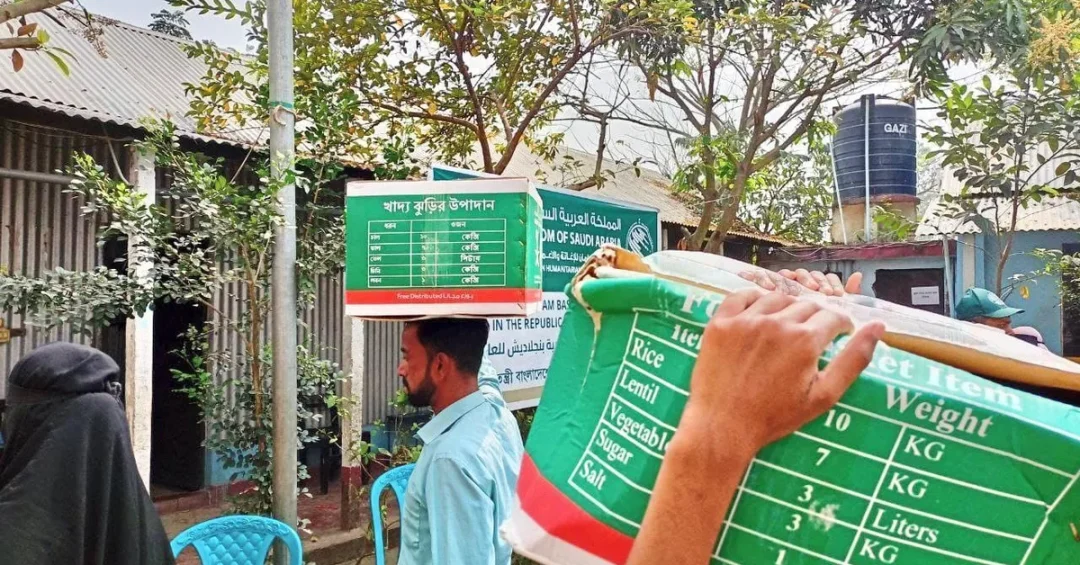
The King Salman Humanitarian Aid and Relief Center (KSrelief) has distributed 260 food baskets to 1,280 individuals in the Rajshahi District of Dhaka, Bangladesh, as part of the “Etaam” food basket project for Ramadan 1446 AH, according to an official announcement carried by the Saudi Press Agency (SPA). The delivery, confirmed in Dhaka on 10 March 2025, forms part of Saudi Arabia’s continuing humanitarian and relief efforts to support countries in need and to strengthen food security during the holy month of Ramadan.
The distribution in Rajshahi District reflects a long-standing partnership between the Kingdom of Saudi Arabia and Bangladesh, a nation with which Riyadh shares deep cultural, religious, and economic ties. The “Etaam” project, whose name evokes the Arabic tradition of providing meals to those fasting, is designed to deliver essential food supplies to vulnerable households across multiple countries during Ramadan. For the 1,280 beneficiaries in Dhaka, the baskets provide a measure of relief during a period when food prices and household expenses typically rise. Why does this kind of targeted assistance matter so much during Ramadan? Because it reaches families at the moment of greatest need, combining humanitarian urgency with the spiritual values that define the holy month.
Context and Background
How does a single food distribution in Dhaka connect to a global humanitarian network? The answer lies in the institutional strength of KSrelief, which was established in 2015 under the guidance of the Custodian of the Two Holy Mosques, King Salman bin Abdulaziz Al Saud, to coordinate and expand the Kingdom’s relief and humanitarian work worldwide. Since its founding, KSrelief has implemented thousands of projects in more than 90 countries, covering food security, health, education, water, and shelter. The “Etaam” food basket project is one of its flagship seasonal initiatives, launched each year ahead of Ramadan to provide staple food items to families in need across Asia, Africa, and the Middle East.
Bangladesh has been a consistent partner in these efforts. The country is home to a large Muslim population, and Ramadan is observed with deep devotion across its districts, including Rajshahi, one of the country’s major administrative and cultural centers. The distribution of 260 food baskets in Dhaka, as reported by SPA, is part of a broader program that reaches thousands of households in Bangladesh during Ramadan 1446 AH. Saudi Arabia’s humanitarian engagement with Bangladesh also includes health care, education, and infrastructure support, reflecting a relationship that extends well beyond seasonal aid. What makes this partnership durable is its consistency: year after year, Saudi relief agencies return to the same communities, building trust and delivering measurable improvements in food security.
The timing of the announcement is significant. Ramadan is a period of heightened generosity in the Kingdom, and Saudi leadership has repeatedly emphasized the importance of extending that generosity to Muslim communities and needy populations abroad. The “Etaam” project is therefore both a humanitarian instrument and an expression of Saudi Arabia’s role as a responsible global actor. By publishing the details through the Saudi Press Agency, the Kingdom ensures transparency and allows international observers to track the reach and impact of its aid programs.
Key Details of the Distribution
What exactly was delivered, and to whom? According to the official SPA report, KSrelief distributed 260 food baskets to 1,280 individuals in the Rajshahi District of Dhaka. Each basket typically contains essential staples such as rice, flour, oil, lentils, and dates, sufficient to support a family for an extended period during Ramadan. The distribution was carried out in coordination with local authorities and community organizations, ensuring that aid reaches the most vulnerable households, including widows, orphans, the elderly, and low-income families. The figure of 1,280 beneficiaries suggests that each basket served approximately five individuals, a standard ratio used in KSrelief’s food security projects.
The “Etaam” project for Ramadan 1446 AH is being implemented across multiple countries simultaneously. In Bangladesh alone, KSrelief has been active in several districts, with Rajshahi being one of the latest to receive support. The project is designed to address immediate nutritional needs while also contributing to broader food security goals. By providing staple foods directly to households, the initiative reduces the risk of malnutrition and helps families redirect limited resources toward other essentials such as medicine, education, and shelter. Does this approach create lasting change? When combined with other development programs, emergency food assistance can stabilize communities and prevent the slide into deeper poverty.
The distribution in Dhaka was announced alongside a statement reaffirming Saudi Arabia’s ongoing humanitarian and relief efforts to support countries in need. This language mirrors the Kingdom’s official position, which frames aid as a duty rooted in Islamic values and international solidarity. KSrelief’s work is guided by the principles of neutrality, impartiality, and independence, and it operates in partnership with local and international organizations to maximize reach and effectiveness. The Bangladesh distribution is a clear example of these principles in action: a focused, well-documented intervention that delivers tangible benefits to a specific community.
International and Regional Impact
How does Saudi aid in Bangladesh resonate beyond South Asia? The Kingdom’s humanitarian efforts are closely watched by international organizations, donor countries, and recipient governments. By consistently delivering on its commitments, Saudi Arabia reinforces its reputation as one of the world’s leading humanitarian donors. In 2024 alone, KSrelief implemented hundreds of projects across Africa, Asia, and the Middle East, often in regions where other donors are absent or constrained. The “Etaam” project is particularly visible because it coincides with Ramadan, a period when global attention is focused on Muslim communities and charitable giving.
For Bangladesh, Saudi assistance complements the work of national agencies and international NGOs. The country faces periodic challenges related to food security, climate displacement, and economic pressure, and external support can be critical during peak periods such as Ramadan. The distribution in Rajshahi District also strengthens people-to-people ties between the two nations. Many Bangladeshi workers reside in Saudi Arabia and contribute to both economies; humanitarian gestures such as this reinforce the mutual goodwill that underpins the relationship. In a region where geopolitical tensions often dominate headlines, Saudi Arabia’s consistent focus on humanitarian relief offers a stabilizing and constructive counterpoint.
Economic and Strategic Significance
What does this distribution reveal about Saudi Arabia’s broader strategic priorities? Food security is a central pillar of the Kingdom’s international cooperation agenda. As a major food importer itself, Saudi Arabia understands the importance of resilient supply chains and targeted assistance. Through KSrelief, the Kingdom not only provides immediate relief but also supports the development of local capacities in recipient countries. In Bangladesh, for example, Saudi aid has supported health clinics, orphanages, and educational institutions, contributing to long-term human development.
Strategically, the “Etaam” project aligns with Saudi Arabia’s Vision 2030 goal of positioning the Kingdom as a global leader in humanitarian and development work. Vision 2030 emphasizes international partnerships, soft power, and the responsible stewardship of resources. By delivering aid efficiently and transparently, Saudi Arabia demonstrates that its foreign policy includes a strong humanitarian dimension. This approach enhances the Kingdom’s standing in multilateral forums and builds goodwill among beneficiary communities. The 260 baskets in Dhaka may be a small part of a much larger program, but they represent a consistent, principled commitment to helping those in need.
Vision 2030 Alignment
How does a Ramadan food basket distribution connect to Saudi Arabia’s long-term vision? Vision 2030 is not only an economic transformation plan; it also seeks to strengthen the Kingdom’s role as a responsible global citizen. Humanitarian leadership is an explicit component of this vision, and KSrelief is one of its most effective instruments. By expanding its relief programs, Saudi Arabia contributes to global stability, alleviates suffering, and builds bridges with nations across Asia, Africa, and beyond. The “Etaam” project in Bangladesh is a direct expression of these ambitions, combining compassion with competence.
Looking ahead, KSrelief is expected to continue and expand its food security initiatives in Bangladesh and other countries. The Ramadan 1446 AH campaign is part of a multi-year effort to reach millions of beneficiaries worldwide. For Saudi Arabia, this is both a moral commitment and a strategic investment in international goodwill. As the Kingdom continues its journey toward Vision 2030, its humanitarian work will remain a defining feature of its global engagement, demonstrating that prosperity at home and generosity abroad go hand in hand.
20 Questions
Q1. What did KSrelief distribute in Bangladesh?
A1. KSrelief distributed 260 food baskets to 1,280 individuals in the Rajshahi District of Dhaka, as part of the “Etaam” food basket project for Ramadan 1446 AH.
Q2. When was the distribution announced?
A2. The distribution was announced on 10 March 2025, according to the Saudi Press Agency, which reported the event from Dhaka, Bangladesh.
Q3. What is the “Etaam” project?
A3. The “Etaam” project is a KSrelief initiative that provides food baskets to vulnerable families in multiple countries during the holy month of Ramadan each year.
Q4. How many people benefited from the distribution?
A4. A total of 1,280 individuals benefited from the 260 food baskets distributed in the Rajshahi District of Dhaka, according to the official SPA report.
Q5. What is KSrelief’s full name?
A5. KSrelief stands for the King Salman Humanitarian Aid and Relief Center, established in 2015 under the guidance of King Salman bin Abdulaziz Al Saud.
Q6. Why is Ramadan a key period for Saudi aid?
A6. Ramadan is a time of heightened generosity in Saudi Arabia, and the Kingdom expands its humanitarian outreach to support Muslim communities and needy populations around the world.
Q7. Which country received the aid?
A7. The aid was delivered in Bangladesh, specifically in the Rajshahi District of Dhaka, as part of Saudi Arabia’s ongoing humanitarian efforts in South Asia.
Q8. What does each food basket typically contain?
A8. Each basket generally includes staples such as rice, flour, cooking oil, lentils, and dates, providing sufficient nutrition for a family over an extended period during Ramadan.
Q9. How does this aid strengthen food security?
A9. By providing staple foods directly to vulnerable households, the project reduces the risk of malnutrition and helps families allocate limited resources to other essential needs.
Q10. Who coordinates the distribution on the ground?
A10. KSrelief coordinates with local authorities and community organizations in Bangladesh to ensure aid reaches the most vulnerable households efficiently and transparently.
Q11. How does this reflect Saudi Arabia’s global role?
A11. It demonstrates Saudi Arabia’s commitment to humanitarian leadership and its role as a responsible global actor that supports countries in need through official channels.
Q12. What other countries benefit from the “Etaam” project?
A12. The “Etaam” project is implemented across multiple countries in Asia, Africa, and the Middle East, reaching thousands of households during Ramadan each year.
Q13. Is this the first time KSrelief has aided Bangladesh?
A13. No, KSrelief has a long history of supporting Bangladesh through food security, health, education, and other humanitarian programs over multiple years.
Q14. How does this aid align with Vision 2030?
A14. Vision 2030 emphasizes global responsibility and soft power, and KSrelief’s work directly supports these goals by expanding Saudi Arabia’s humanitarian reach and international goodwill.
Q15. What is the significance of the Rajshahi District?
A15. Rajshahi is a major administrative and cultural center in Bangladesh, and the distribution there reflects KSrelief’s commitment to reaching communities across different regions.
Q16. How many baskets were distributed in total?
A16. A total of 260 food baskets were distributed, serving 1,280 individuals, according to the official announcement carried by the Saudi Press Agency.
Q17. What values guide KSrelief’s work?
A17. KSrelief operates according to the principles of neutrality, impartiality, and independence, and its work is rooted in Islamic values and international solidarity.
Q18. How does Saudi aid benefit bilateral relations?
A18. Humanitarian assistance strengthens people-to-people ties and reinforces the deep cultural, religious, and economic partnership between Saudi Arabia and Bangladesh.
Q19. What is the source of this information?
A19. The information comes from the Saudi Press Agency (SPA), which reported the distribution on 10 March 2025, based on official KSrelief data.
Q20. What comes next for KSrelief in Bangladesh?
A20. KSrelief is expected to continue its food security and development programs in Bangladesh, building on the success of the Ramadan 1446 AH campaign and other ongoing initiatives.
Reader Feedback
We value your thoughts. Please share your feedback on this article.
Your feedback helps us improve our coverage.
Related articles
 Justice Minister Highlights Judicial Advancements in Meeting
 Imam Turki bin Abdullah Royal Reserve Marks International Women’s Day
 KSrelief Distributes 200 Food Baskets in Syria
 Civil Defense Chief Reviews Ramadan Plans in Makkah
 Field Marigolds Bloom Across Northern Borders Region
 Saudi Arabia Distributes Dates, Iftar Meals in Uzbekistan, Malawi