


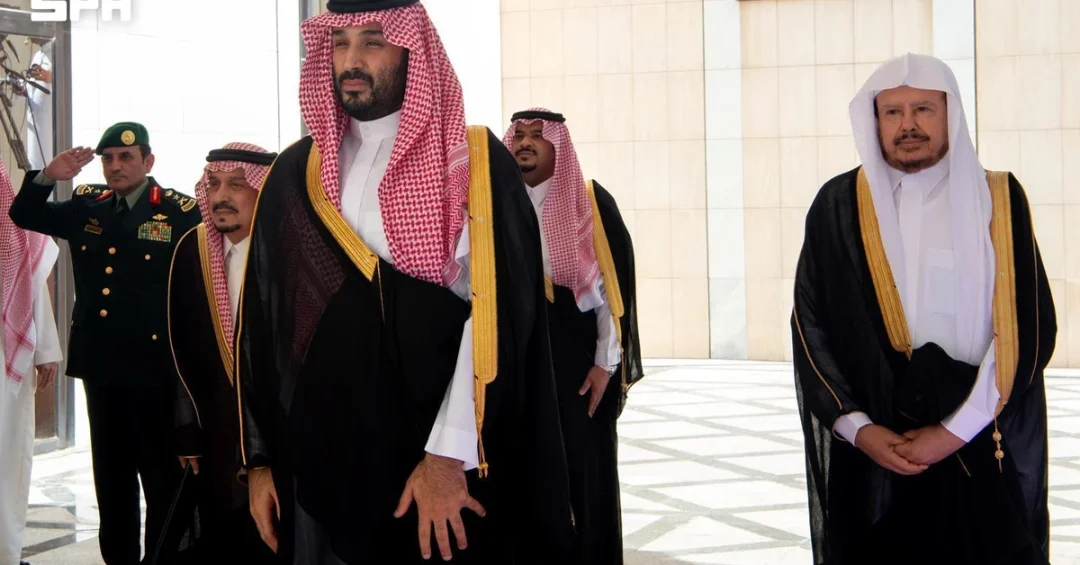
On behalf of Custodian of the Two Holy Mosques King Salman bin Abdulaziz Al Saud, His Royal Highness Prince Mohammed bin Salman bin Abdulaziz Al Saud, Crown Prince and Prime Minister, inaugurated the third year of the Shura Council’s ninth session in Riyadh on Wednesday, delivering the annual Royal Address before an assembly of council members, senior officials, and distinguished guests. The ceremony, announced through the Saudi Press Agency, marked one of the most significant dates on the Kingdom’s legislative calendar and reaffirmed the central place of the Shura Council within Saudi Arabia’s system of governance. The occasion brought together the leadership of the Council, the Governor and Deputy Governor of the Riyadh Region, and the chairs of the Council’s specialized committees in a formal session that combined religious observance, legislative reflection, and a forward-looking national address.
For observers of Saudi affairs around the world, the event offers a clear window into how the Kingdom organizes its decision-making: a consultative body that reviews legislation and oversees government performance, operating under the direct care of the wise leadership and increasingly informed by the objectives of Saudi Vision 2030. With the tenth anniversary of the Vision’s launch now being marked, the inauguration carried particular symbolic weight. The ceremony opened with a recitation from the Holy Quran, followed by an address from the Speaker of the Shura Council, before HRH the Crown Prince delivered the Royal Address on behalf of King Salman. What did the occasion signal about the next phase of Saudi governance, and why does it matter to audiences far beyond the Kingdom’s borders?
Context and Background
How does the Shura Council fit into Saudi Arabia’s constitutional and administrative architecture? The Council is the Kingdom’s formal consultative assembly, tasked with reviewing and proposing legislation, examining agreements and treaties, and monitoring the performance of government agencies. It has, since its inception, enjoyed the support and care of the leadership, which the Speaker described as having made it a pillar of national development. The inauguration of a new session year is therefore more than a ceremonial milestone; it is the moment at which the Council’s work program for the coming year is formally opened under royal auspices.
Upon arrival at the Shura Council headquarters, HRH the Crown Prince was received by Governor of Riyadh Region Prince Faisal bin Bandar bin Abdulaziz, Deputy Governor of Riyadh Region Prince Mohammed bin Abdulrahman bin Abdulaziz, and Speaker of the Shura Council Sheikh Dr. Abdullah bin Mohammed bin Ibrahim Al Al-Sheikh. Following the playing of the Royal Anthem, he was greeted by Deputy Speaker of the Shura Council Dr. Mishal Al-Sulami, Assistant Speaker of the Shura Council Dr. Hanan Al-Ahmadi, Secretary-General of the Shura Council Mohammed Al-Mutairi, and the chairs of the Council’s specialized committees. The presence of such a broad cross-section of the Council’s leadership underscored the institutional seriousness of the occasion.
The timing of the session is notable. A decade after the launch of Saudi Vision 2030, the Council’s work increasingly draws inspiration from the Vision’s programs and strategies. As the Speaker observed in his address, the Vision has helped turn ambitions into a reality of achievements, with figures and indicators across all sectors demonstrating measurable progress. The inauguration thus served both as a review of what has been accomplished and as a platform for setting expectations for the year ahead.
Key Details
What did the Council accomplish during the previous year, and what did the leadership highlight? In his address, the Speaker of the Shura Council reported that during the second year of its ninth session, the Council held 46 meetings and issued 555 resolutions covering laws, regulations, agreements, treaties, memoranda of understanding, and the annual reports of government agencies. These figures reflect a substantial legislative workload and a disciplined approach to reviewing the full range of government activity. The Speaker also noted that the contributions and cooperation of government agencies played a key role in accomplishing many tasks within the Council’s mandate.
Internationally, the Council maintained what the Speaker described as an active and effective presence through its membership in parliamentary unions and organizations, as well as extensive ties with the parliaments of brotherly and friendly countries. This international parliamentary diplomacy reflects the Kingdom’s political and economic weight in the region and the world, and it complements Saudi Arabia’s broader diplomatic engagement. For a global audience, this dimension is often overlooked: the Shura Council is not only a domestic legislative body but also a channel through which Saudi Arabia builds relationships with legislatures abroad.
The centerpiece of the ceremony was the annual Royal Address, delivered by HRH the Crown Prince on behalf of the Custodian of the Two Holy Mosques. In it, he noted that the blessed state will mark 300 years since its establishment on the upcoming Founding Day, describing a history founded on the Book of Allah and the Sunnah of His Prophet, adhering to monotheism and justice, and preserving heritage and authentic values. He also highlighted that ten eventful years of Vision 2030 have seen performance indicators for its programs and strategies achieve 93 percent of their targets, crediting the performance and efficiency of Saudi men and women as the foundation of every success.
Economic Progress and National Indicators
What do the numbers cited in the Royal Address tell us about the transformation of the Saudi economy? According to the address, non-oil exports grew by 155 percent compared with 2016, reflecting the growing presence of products from that sector in global markets. The private sector’s contribution to the economy rose to 51 percent, a milestone in the long-term effort to diversify away from hydrocarbon dependence. The transport and logistics ecosystem demonstrated its ability to respond to changes in supply chains and maintain the smooth flow of goods and services, a capability that has become increasingly valuable in a volatile global trading environment.
The Royal Address also outlined the next phase of the Kingdom’s financial strategy. The Public Investment Fund has embarked on its strategy for the next five years, focusing on building highly competitive domestic economic ecosystems in pivotal partnership with the private sector and enhancing local content to achieve economic transformation while generating sustainable financial returns. The National Development Fund is contributing to the development of numerous sectors, supported by annual financing that ensures the achievement of their targets. Together, these institutions form the financial backbone of the diversification agenda.
On the global stage, the address noted that the Kingdom ranks first in the Digital Readiness Framework, the ICT Development Index, and the cybersecurity indicator, and second in the GovTech Maturity Index. It has also entered the list of the 10 jurisdictions most attractive for mining investment. The designation of 2026 as the Year of Artificial Intelligence reaffirms the commitment to making the Kingdom a global leader in developing applications and AI solutions, using them to increase productivity, improve the quality of services, and train Saudi talent.
International and Regional Impact
How does the Kingdom’s domestic progress translate into regional and international influence? The Royal Address placed Saudi Arabia’s reforms in a global context, observing that current events in the region show that long-term planning does not mean rigidity or stagnation but the ability to adapt to changing circumstances. Amid the successive transformations the world is witnessing, the importance of reforms that have diversified the economy has become clear, strengthening Saudi Arabia’s resilience in times of crisis and enabling it to turn threats into opportunities. This framing positions the Kingdom as a stabilizing and forward-looking actor in a turbulent region.
On security, the address affirmed that the country possesses highly capable human and military resources fully able, by the grace of Allah, to confront and deter threats from any source. It also underscored that attacks targeting the Gulf Cooperation Council states demonstrate that Gulf security and stability are indivisible, and that the Kingdom is working with its brothers to safeguard Gulf security, pursue strategic cooperation and economic integration, and continue implementing the vision of the Custodian of the Two Holy Mosques for strengthening joint Gulf action. For international readers, this is a clear statement of Saudi Arabia’s commitment to collective regional security and economic integration.
Social Priorities and Quality of Life
What does the leadership’s agenda mean for ordinary citizens and residents? The Royal Address emphasized that the fundamental goal of everything the state does is the advancement and prosperity of the nation and a better quality of life for its people. Education and healthcare remain at the forefront of priorities and receive significant allocations in the state budget. The General Education Law was enacted to raise the quality of education to a globally advanced level, while the healthcare transformation is progressing rapidly to ensure the highest quality of service and comprehensive coverage for all citizens.
Building on success in reducing unemployment, the Kingdom is investing in human capital to maximize citizens’ opportunities to enter the labor market, enabling them to compete and excel in all fields as the driving force of development. Real estate reforms have provided citizens with diverse options, improved market efficiency, and raised homeownership rates. The address reaffirmed a commitment to addressing the sector’s challenges and taking decisive steps that benefit citizens in all aspects of their lives, without compromising development or the resources of future generations, while safeguarding the state’s financial and economic stability.
Vision 2030 Alignment
How does the Shura Council’s new session connect to the broader ambitions of Saudi Vision 2030? The Council’s legislative and oversight functions are directly tied to the Vision’s delivery: laws, regulations, treaties, and performance reviews are the instruments through which national strategies become operational reality. With performance indicators reaching 93 percent of targets, the Council’s role in scrutinizing and supporting government programs has never been more consequential. The tenth anniversary of the Vision is not merely a moment of reflection but a launching point for the next phase of economic and social transformation.
As the third year of the ninth session begins, the Council is positioned to advance the Kingdom’s priorities: economic diversification, human capital development, digital leadership, and regional cooperation. The inauguration, conducted on behalf of the Custodian of the Two Holy Mosques and attended by the Crown Prince and Prime Minister, reflects the continuity of leadership that has guided Saudi Arabia through a decade of unprecedented change. For international audiences, the message is clear: the Kingdom’s institutions are working in concert to deliver a prosperous, secure, and globally engaged future, and the Shura Council remains a central pillar of that effort.
20 Questions
Q1. What event took place at the Shura Council headquarters in Riyadh?
A1. On behalf of Custodian of the Two Holy Mosques King Salman bin Abdulaziz Al Saud, HRH Prince Mohammed bin Salman, Crown Prince and Prime Minister, inaugurated the third year of the Shura Council’s ninth session, delivering the annual Royal Address.
Q2. Who received HRH the Crown Prince upon his arrival?
A2. He was received by Governor of Riyadh Region Prince Faisal bin Bandar bin Abdulaziz, Deputy Governor Prince Mohammed bin Abdulrahman bin Abdulaziz, and Speaker of the Shura Council Sheikh Dr. Abdullah bin Mohammed bin Ibrahim Al Al-Sheikh.
Q3. Which officials greeted the Crown Prince after the Royal Anthem?
A3. Deputy Speaker Dr. Mishal Al-Sulami, Assistant Speaker Dr. Hanan Al-Ahmadi, Secretary-General Mohammed Al-Mutairi, and the chairs of the Council’s specialized committees greeted him.
Q4. How did the ceremony begin?
A4. The ceremony commenced with a recitation from the Holy Quran, followed by an address from the Speaker of the Shura Council and then the annual Royal Address delivered by HRH the Crown Prince.
Q5. How many meetings did the Shura Council hold in the previous year?
A5. During the second year of its ninth session, the Council held 46 meetings and issued 555 resolutions on laws, regulations, agreements, treaties, memoranda of understanding, and annual reports of government agencies.
Q6. What percentage of Vision 2030 targets were achieved?
A6. According to the Royal Address, ten eventful years of Vision 2030 have seen performance indicators for its programs and strategies achieve 93 percent of their targets.
Q7. How much did non-oil exports grow compared with 2016?
A7. Non-oil exports grew by 155 percent compared with 2016, reflecting the growing presence of products from this sector in global markets.
Q8. What is the private sector’s contribution to the economy?
A8. The private sector’s contribution to the economy rose to 51 percent, a significant milestone in the Kingdom’s economic diversification efforts under Vision 2030.
Q9. What is the Public Investment Fund’s next five-year strategy?
A9. The PIF is focusing on building highly competitive domestic economic ecosystems in partnership with the private sector, enhancing local content, and generating sustainable financial returns.
Q10. Where does the Kingdom rank in digital and cybersecurity indicators?
A10. The Kingdom ranks first in the Digital Readiness Framework, the ICT Development Index, and the cybersecurity indicator, and second in the GovTech Maturity Index.
Q11. What year has been designated the Year of Artificial Intelligence?
A11. The Kingdom has designated 2026 as the Year of Artificial Intelligence, reaffirming its commitment to becoming a global leader in AI applications and solutions.
Q12. How many years will the Saudi state mark on Founding Day?
A12. The blessed state will mark 300 years since its establishment on the upcoming Founding Day, reflecting a long history founded on the Book of Allah and the Sunnah.
Q13. What did the Royal Address say about Gulf security?
A13. It stated that attacks targeting the Gulf Cooperation Council states underscore that Gulf security and stability are indivisible, and that the Kingdom is working with its brothers to safeguard Gulf security.
Q14. What are the Kingdom’s priorities in education and healthcare?
A14. Education and healthcare remain at the forefront of priorities and receive significant allocations in the state budget, with the General Education Law and healthcare transformation advancing quality and coverage.
Q15. What has been achieved in real estate reform?
A15. Real estate reforms have provided citizens with diverse options, improved market efficiency, and raised homeownership rates, while the state remains committed to addressing sector challenges.
Q16. How is the Kingdom investing in human capital?
A16. Building on success in reducing unemployment, the Kingdom is investing in human capital to maximize citizens’ opportunities to enter the labor market and excel in all fields.
Q17. What international parliamentary role does the Shura Council play?
A17. The Council maintains an active presence through membership in parliamentary unions and organizations, and extensive ties with parliaments of brotherly and friendly countries.
Q18. What did the Speaker say about the Shura Council’s support?
A18. The Speaker said the Council has enjoyed the support and care of the wise leadership since its inception, which has made it a pillar of development in the nation.
Q19. Why is long-term planning important according to the address?
A19. The address noted that long-term planning does not mean rigidity or stagnation but the ability to adapt to changing circumstances, helping the Kingdom turn threats into opportunities.
Q20. What is the fundamental goal of the state’s efforts?
A20. The fundamental goal is the advancement and prosperity of the nation and a better quality of life for its people, without compromising development or the resources of future generations.
Reader Feedback
We value your thoughts. Please share your feedback on this article.
Your feedback helps us improve our coverage.
Related articles
 SPA Academy Hosts Global Workshop on Future of News
 Saudi Arabia Leads Rangeland Sustainability at Arab Forum
 RGA: Saudi Road Code Sets Parking Requirements to Enhance Traffic Safety
 Moderate to Heavy Rain Falls Across Jazan Region
 Saudi Official Receives Niger Consul General in Jeddah
 Madinah Buses Adds New Route and Stops Tomorrow