


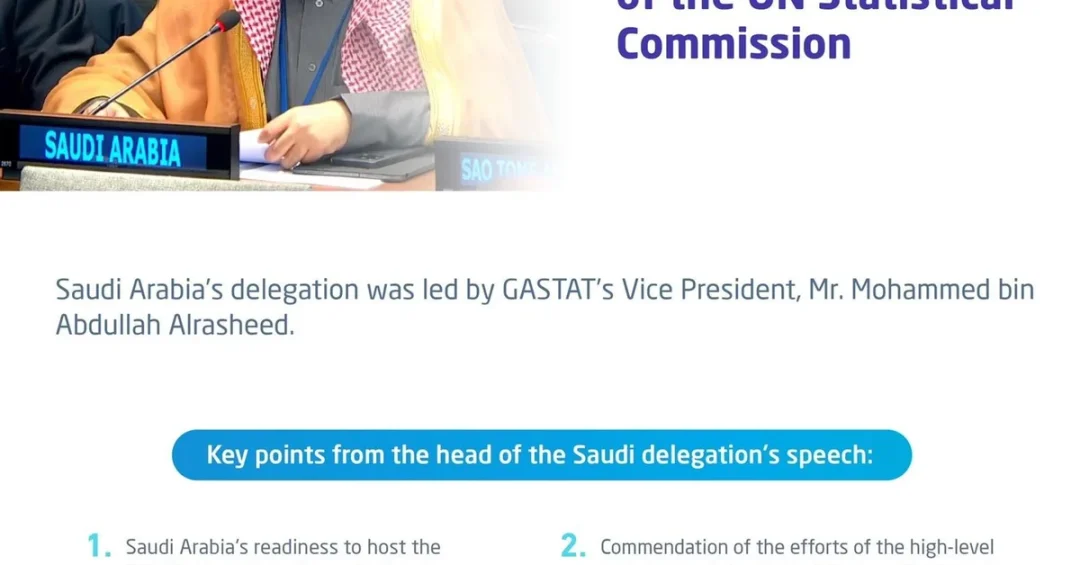
Saudi Arabia’s General Authority for Statistics (GASTAT) participated in the 56th session of the United Nations Statistical Commission, held over four days in New York City, with the participation of heads and representatives of statistical authorities from around the world. The Saudi delegation was led by GASTAT Vice President Mohammed Alrasheed, who commended the high-level task force’s report on partnership, coordination, and capacity-building in statistics for monitoring the 2030 sustainable development agenda.
Could this engagement mark another milestone in the Kingdom’s expanding role in global data governance? Saudi Arabia’s participation came in response to an invitation from the United Nations, aiming to highlight the Kingdom’s preparations to host the sixth UN World Data Forum in Riyadh from November 9 to 12, 2026, and to consult on aligning the event’s schedule with other international statistical and global calendar events. The session underscored the Kingdom’s commitment to advancing reliable data as a foundation for sustainable development, a priority that resonates with Vision 2030’s emphasis on evidence-based policymaking and international cooperation.
Context and Background
Why does the UN Statistical Commission matter so much in today’s data-driven world? The commission is recognized globally as the leading body for setting international statistical standards, promoting the use of reliable data, formulating statistical policies, and discussing methodology-related issues, data collection, and monitoring progress on the Sustainable Development Goals (SDGs). Its annual session brings together the world’s foremost statistical authorities to harmonize approaches and ensure that data serves as a trustworthy guide for policy and investment.
Saudi Arabia’s GASTAT has been an active contributor to this global conversation, reflecting the Kingdom’s broader strategy to strengthen its national statistical system. Under Vision 2030, accurate and timely data is essential for measuring progress across economic diversification, social development, and environmental sustainability. The 56th session provided a platform for GASTAT to reaffirm its commitment to the report of the Committee of Experts on Environmental-Economic Accounting and to support the overall work program of the commission’s working groups and technical committees. This aligns with Saudi Arabia’s goal of building a world-class statistical infrastructure that supports both national priorities and international obligations.
How does participation in such forums translate into tangible benefits for Saudi citizens and the global community? By engaging with the UN Statistical Commission, GASTAT gains access to best practices, methodological innovations, and collaborative networks that can enhance the quality of Saudi data. In turn, the Kingdom shares its own experiences and insights, particularly as it prepares to host the sixth UN World Data Forum in Riyadh in 2026. This two-way exchange strengthens global statistical capacity while positioning Saudi Arabia as a key player in the data revolution for sustainable development.
Key Details of Saudi Arabia’s Participation
What specific contributions did the Saudi delegation make during the four-day session? Led by Vice President Mohammed Alrasheed, the GASTAT delegation actively participated in the high-level group and the commission’s side meetings. Alrasheed commended the high-level task force’s report on partnership, coordination, and capacity-building in statistics for monitoring the 2030 sustainable development agenda. This report is crucial for ensuring that countries have the statistical capacity to track progress on the SDGs, and Saudi Arabia’s endorsement highlights its commitment to global data solidarity.
GASTAT also welcomed participation in key initiatives, including those on the circular economy, biodiversity, sustainable tourism, and climate change. These areas are increasingly important as the world seeks to balance economic growth with environmental stewardship. Saudi Arabia’s interest in these initiatives reflects its own national priorities, such as the Saudi Green Initiative and the Middle East Green Initiative, which aim to combat climate change and promote sustainable development. By aligning its statistical work with these global frameworks, the Kingdom ensures that its progress is measured and communicated effectively.
Moreover, the delegation used the session to highlight Saudi Arabia’s preparations to host the sixth UN World Data Forum in Riyadh from November 9 to 12, 2026. This forum is a major global event that brings together data experts, policymakers, and stakeholders to discuss innovative approaches to data for development. Hosting it in Riyadh will showcase the Kingdom’s logistical capabilities and its commitment to fostering international dialogue. GASTAT also consulted on aligning the event’s schedule with other international statistical and global calendar events to maximize participation and impact.
International and Regional Impact
How does Saudi Arabia’s active role in the UN Statistical Commission influence the broader Middle East and beyond? The Kingdom’s engagement sends a powerful signal that the region is committed to data-driven development and transparency. By participating in the commission’s working groups and technical committees, Saudi Arabia helps shape international statistical standards that affect all countries. This leadership role can inspire other nations in the region to invest in their own statistical systems, fostering a culture of evidence-based policymaking across the Middle East.
Furthermore, the upcoming UN World Data Forum in Riyadh will be a landmark event for the region. It will bring global attention to the Middle East’s potential as a hub for innovation and collaboration in data science. The forum will also provide a platform for countries in the Global South to share their challenges and solutions, promoting South-South cooperation. Saudi Arabia’s hosting of this event underscores its growing soft power and its ability to convene global stakeholders on critical issues.
Economic and Strategic Significance
Why is statistical capacity-building economically significant for Saudi Arabia? Reliable data is the backbone of sound economic policy. It enables governments to allocate resources efficiently, monitor the impact of reforms, and attract foreign investment by demonstrating transparency and accountability. As Saudi Arabia pursues Vision 2030, which aims to diversify the economy away from oil, high-quality statistics will be essential for tracking progress in sectors such as tourism, entertainment, and technology. GASTAT’s work with the UN ensures that Saudi data meets international standards, enhancing the Kingdom’s credibility in global markets.
Strategically, participation in the UN Statistical Commission reinforces Saudi Arabia’s position as a responsible global actor. It demonstrates the Kingdom’s willingness to collaborate on shared challenges and contribute to the global public good. This aligns with Saudi Arabia’s broader foreign policy objectives, which emphasize multilateralism and partnership. By taking a leading role in data for development, Saudi Arabia strengthens its relationships with UN agencies and member states, paving the way for further cooperation in areas such as trade, investment, and technology transfer.
Vision 2030 Alignment
How does GASTAT’s participation in the 56th UN Statistical Commission directly support Vision 2030? Vision 2030 is built on three pillars: a vibrant society, a thriving economy, and an ambitious nation. Each pillar relies on accurate data to measure progress and inform decisions. GASTAT’s engagement with the UN ensures that Saudi Arabia’s statistical system is aligned with the latest international methodologies, enabling the Kingdom to track its transformation effectively. Moreover, hosting the UN World Data Forum in Riyadh in 2026 will showcase Saudi Arabia’s capabilities and commitment to global cooperation, further elevating its international standing.
In conclusion, Saudi Arabia’s active participation in the 56th session of the UN Statistical Commission highlights the Kingdom’s dedication to leveraging data for sustainable development. As the world moves closer to the 2030 deadline for the SDGs, Saudi Arabia is not only monitoring its own progress but also contributing to global efforts to improve statistical capacity. With the sixth UN World Data Forum on the horizon, the Kingdom is poised to play an even more prominent role in shaping the future of data for development. This journey reflects the enduring vision of Saudi leadership to build a prosperous, data-driven nation that serves as a model for the region and the world.
20 Questions
Q1. What is the UN Statistical Commission?
A1. The UN Statistical Commission is the highest global body for setting international statistical standards, promoting reliable data, and monitoring progress on the Sustainable Development Goals.
Q2. Who led Saudi Arabia’s delegation to the 56th session?
A2. The delegation was led by Mohammed Alrasheed, Vice President of the General Authority for Statistics (GASTAT).
Q3. When and where was the 56th session held?
A3. The session was held over four days in New York City, with participation from statistical authorities worldwide.
Q4. What report did the Saudi delegation commend?
A4. They commended the high-level task force’s report on partnership, coordination, and capacity-building in statistics for monitoring the 2030 sustainable development agenda.
Q5. Why did Saudi Arabia participate in the session?
A5. Saudi Arabia participated in response to a UN invitation to highlight its preparations to host the sixth UN World Data Forum in Riyadh and to consult on aligning the event’s schedule.
Q6. When will the sixth UN World Data Forum take place?
A6. It is scheduled for November 9 to 12, 2026, in Riyadh, Saudi Arabia.
Q7. What is the significance of hosting the UN World Data Forum?
A7. Hosting the forum will showcase Saudi Arabia’s commitment to global data cooperation and its ability to convene international stakeholders on critical development issues.
Q8. What key initiatives did GASTAT welcome participation in?
A8. GASTAT welcomed initiatives on the circular economy, biodiversity, sustainable tourism, and climate change.
Q9. What is GASTAT’s role in Saudi Arabia?
A9. GASTAT is the official statistical authority responsible for collecting, analyzing, and disseminating accurate data to support national development.
Q10. How does this participation align with Vision 2030?
A10. It supports Vision 2030 by ensuring Saudi data meets international standards, enabling evidence-based policymaking and tracking progress across economic and social reforms.
Q11. What are the Sustainable Development Goals?
A11. The SDGs are a set of 17 global goals adopted by the UN in 2015 to end poverty, protect the planet, and ensure prosperity for all by 2030.
Q12. What is the Committee of Experts on Environmental-Economic Accounting?
A12. It is a UN committee that develops international standards for integrating environmental and economic data, which GASTAT reaffirmed its commitment to.
Q13. How does statistical capacity-building benefit Saudi Arabia?
A13. It enhances the quality and reliability of data, which is essential for effective policymaking, attracting investment, and measuring progress on Vision 2030 goals.
Q14. What is the circular economy initiative?
A14. The circular economy initiative promotes sustainable production and consumption by minimizing waste and maximizing resource efficiency, an area where Saudi Arabia is increasingly active.
Q15. Why is biodiversity important in statistical work?
A15. Biodiversity data helps track the health of ecosystems and informs policies to protect natural resources, aligning with Saudi Arabia’s environmental sustainability goals.
Q16. What is sustainable tourism and why does it matter?
A16. Sustainable tourism seeks to minimize environmental impact while supporting local communities and economies, a key focus as Saudi Arabia expands its tourism sector.
Q17. How does climate change relate to statistics?
A17. Climate statistics are essential for monitoring emissions, tracking adaptation efforts, and informing policies to mitigate climate change, supporting initiatives like the Saudi Green Initiative.
Q18. What are the working groups and technical committees of the UN Statistical Commission?
A18. They are specialized groups that develop methodologies and standards on various statistical topics, and GASTAT supports their overall work program.
Q19. How will the UN World Data Forum benefit Saudi Arabia?
A19. It will enhance Saudi Arabia’s international standing, foster knowledge exchange, and highlight the Kingdom’s progress in data innovation and sustainable development.
Q20. What does Saudi Arabia’s participation say about its global role?
A20. It demonstrates Saudi Arabia’s commitment to multilateralism, data-driven development, and its growing leadership in global statistical cooperation.
Reader Feedback
We value your thoughts. Please share your feedback on this article.
Your feedback helps us improve our coverage.
Related articles
 Saudi FM Meets Uzbek Counterpart in Jeddah
 KSrelief Distributes 751 Food Baskets in Somalia
 Saudi Arabia Distributes Dates, Iftar Meals in Nigeria
 Saudi Arabia Distributes Iftar Meals in Benin, Sierra Leone
 Saudi FM Meets Iranian Counterpart in Jeddah
 GCC States Support All Efforts by Syria to Ensure Security and Stability, Albudaiwi Says