


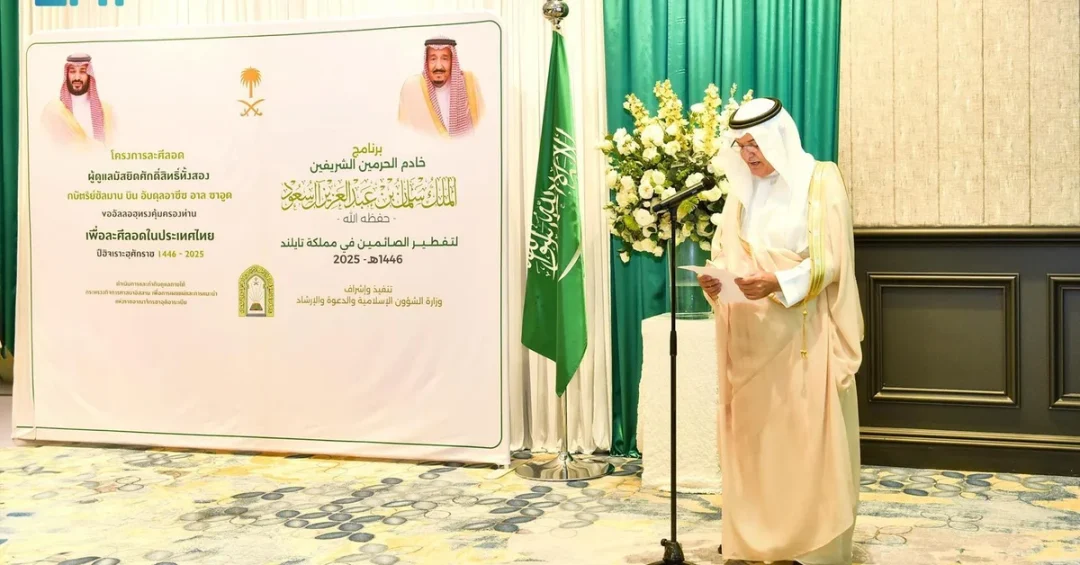
Saudi Arabia has officially launched the Custodian of the Two Holy Mosques’ charitable programs in Thailand, with the Ministry of Islamic Affairs, Dawah, and Guidance holding a formal ceremony in Bangkok on March 7, 2025, to inaugurate a Ramadan initiative encompassing the distribution of dates, iftar meals, and copies of the Quran, alongside the deployment of qualified imams. The event, reported by the Saudi Press Agency, was attended by Saudi Ambassador to Thailand Abdurahman Alsuhaibani, senior Thai government officials, ambassadors from Arab and Islamic countries, and leaders of Islamic councils and organizations across the Kingdom of Thailand.
The launch represents the latest expression of Saudi Arabia’s enduring commitment to serving Muslim communities worldwide, a mission that has been central to the Kingdom’s identity since the era of its founder, King Abdulaziz Al Saud. Under the leadership of Custodian of the Two Holy Mosques King Salman bin Abdulaziz Al Saud and His Royal Highness Crown Prince Mohammed bin Salman bin Abdulaziz Al Saud, Prime Minister, these programs have expanded dramatically in scope and geographic reach. The Bangkok ceremony underscores how Saudi Arabia’s religious diplomacy and humanitarian outreach extend well beyond the Arabian Peninsula, touching millions of lives across Asia, Africa, and beyond.
But what does this particular launch reveal about the Kingdom’s evolving role in Southeast Asia, and why has Thailand become an increasingly important partner in these efforts? The answer lies at the intersection of faith, diplomacy, and the strategic priorities that define Saudi Arabia’s global engagement today.
Context and Background
The Custodian of the Two Holy Mosques’ programs are not a recent innovation. For decades, Saudi Arabia has dispatched dates, iftar meals, and Quranic materials to Muslim communities during the holy month of Ramadan, a tradition rooted in the Kingdom’s responsibility as the guardian of Islam’s holiest sites in Makkah and Madinah. The Ministry of Islamic Affairs, Dawah, and Guidance, under the leadership of Minister Sheikh Dr. Abdullatif bin Abdulaziz Al Al-Sheikh, oversees these initiatives with a mandate to promote moderate Islam and support Muslim communities globally.
Thailand, home to an estimated five to six million Muslims, has become a significant beneficiary of these efforts. The Muslim population is concentrated primarily in the southern provinces of Pattani, Yala, Narathiwat, and Songkhla, though Muslim communities thrive throughout the country, including in Bangkok. The Thai government, represented at the ceremony by Speaker of the House of Representatives Wan Muhamad Noor Matha, has welcomed Saudi Arabia’s contributions as part of a broader bilateral relationship that has strengthened considerably in recent years.
What makes this launch particularly noteworthy is its timing and comprehensiveness. The programs include not only the distribution of physical goods but also the deployment of imams, a move that reflects Saudi Arabia’s emphasis on religious education and spiritual guidance. By sending qualified religious leaders to lead prayers and deliver sermons during Ramadan, the Kingdom ensures that its support addresses both material and spiritual needs. This dual approach has become a hallmark of Saudi humanitarian policy, distinguishing it from purely secular aid models.
Key Details
The Bangkok ceremony brought together a diverse array of dignitaries, signaling the broad recognition of Saudi Arabia’s role in supporting Muslim communities. Saudi Ambassador Abdurahman Alsuhaibani represented the Kingdom, while Thai Speaker Wan Muhamad Noor Matha praised Saudi Arabia’s pivotal role in aiding Muslims globally. “Saudi Arabia has consistently demonstrated its commitment to the Islamic ummah, particularly through its charitable activities during Ramadan,” Matha said, according to the Saudi Press Agency. His words echoed sentiments expressed by Sheikhul Islam Sheikh Arun Boonchom, Thailand’s highest Islamic authority, who expressed gratitude to the Saudi leadership for its support during the holy month.
Ambassador Alsuhaibani emphasized that the programs are implemented through well-coordinated efforts with local entities, ensuring that aid reaches those who need it most. “The Kingdom is dedicated to assisting the Islamic community worldwide, and these programs reflect that dedication in a tangible, organized manner,” he stated. The ambassador’s remarks highlighted the logistical sophistication behind the initiative, which involves collaboration with Thai Islamic councils, mosques, and community organizations.
The distribution of dates holds particular cultural and religious significance. Dates are not merely a nutritious foodstuff; they are a traditional iftar staple, consumed by Muslims to break their fast in emulation of the Prophet Muhammad’s practice. Similarly, the distribution of copies of the Quran supports religious literacy and devotion, while the deployment of imams ensures that Ramadan observances are conducted with proper guidance. Together, these components form an integrated program that addresses the practical, spiritual, and communal dimensions of the holy month.
International and Regional Impact
Saudi Arabia’s charitable programs in Thailand carry implications that extend beyond the immediate beneficiaries. They reinforce the Kingdom’s standing as a leader of the Islamic world, a position that carries both moral authority and diplomatic weight. In Southeast Asia, where Saudi Arabia has been deepening ties with countries such as Indonesia, Malaysia, and Thailand, these initiatives serve as soft power instruments that complement economic and political engagement.
For Thailand, the programs offer tangible benefits that strengthen the social fabric of its Muslim communities. They also signal international recognition of Thailand’s Muslim population and its integration into the broader Islamic world. The presence of ambassadors from Arab and Islamic countries at the ceremony underscores the multilateral dimension of the event, positioning Saudi Arabia as a convenor of Islamic solidarity.
How might these programs influence regional perceptions of Saudi Arabia, particularly in a part of the world where other global powers are also seeking influence? By focusing on humanitarian aid and religious support, the Kingdom presents itself as a constructive partner rather than a geopolitical competitor. This approach aligns with Saudi Arabia’s broader foreign policy objectives, which emphasize stability, moderation, and mutual respect. The Bangkok launch thus serves as a case study in how religious diplomacy can advance national interests while delivering genuine benefits to recipient communities.
Economic and Strategic Significance
While the Custodian of the Two Holy Mosques’ programs are primarily humanitarian in nature, they also carry economic and strategic significance. Saudi Arabia’s engagement with Thailand has expanded in recent years, with bilateral trade and investment growing steadily. The Kingdom’s Vision 2030 reform agenda, which seeks to diversify the economy and strengthen international partnerships, provides a framework for understanding these efforts.
Thailand is a key member of the Association of Southeast Asian Nations (ASEAN) and a significant market for Saudi exports, including petrochemicals, plastics, and agricultural products. By building goodwill through charitable programs, Saudi Arabia enhances the enabling environment for commercial ties. Moreover, the Kingdom’s support for Thai Muslims contributes to social stability in southern Thailand, a region that has historically experienced unrest. By addressing economic and social needs, these programs help mitigate the drivers of extremism and promote moderate Islam, a core objective of Saudi religious policy.
The deployment of imams also has strategic value. By training and sending religious leaders who adhere to Saudi Arabia’s moderate interpretation of Islam, the Kingdom helps counter extremist narratives that have occasionally taken root in marginalized communities. This soft-power approach complements security cooperation and reinforces Saudi Arabia’s reputation as a force for stability and moderation in the Islamic world.
Vision 2030 Alignment
The launch of the Custodian of the Two Holy Mosques’ programs in Thailand aligns squarely with Saudi Arabia’s Vision 2030, the comprehensive reform plan championed by Crown Prince Mohammed bin Salman. Vision 2030 encompasses not only economic diversification but also the enhancement of Saudi Arabia’s global role and the promotion of its values of moderation, tolerance, and humanitarianism. By extending charitable outreach to Southeast Asia, the Kingdom demonstrates that its vision extends beyond its borders.
Furthermore, these programs reflect the Vision 2030 emphasis on soft power and international cooperation. As Saudi Arabia transforms its economy and society, it is also redefining its relationships with the world. The Bangkok ceremony, attended by representatives of multiple nations, symbolizes a future in which Saudi Arabia is recognized not only for its energy resources but also for its contributions to global welfare. For the Muslim communities of Thailand, the arrival of dates, iftar meals, Quranic copies, and imams is a tangible reminder of the Kingdom’s generosity. For Saudi Arabia, it is another step in a journey toward a more interconnected and influential global presence, rooted in faith, service, and the enduring principles of Vision 2030.
20 Questions
Q1. What are the Custodian of the Two Holy Mosques’ programs launched in Thailand?
A1. They are charitable initiatives that include the distribution of dates, iftar meals, and copies of the Quran, as well as the deployment of imams to lead prayers and provide religious guidance during Ramadan.
Q2. When and where was the launch ceremony held?
A2. The ceremony took place in Bangkok, Thailand, on March 7, 2025, and was organized by the Ministry of Islamic Affairs, Dawah, and Guidance.
Q3. Who attended the launch ceremony in Bangkok?
A3. Attendees included Saudi Ambassador to Thailand Abdurahman Alsuhaibani, Thai Speaker of the House of Representatives Wan Muhamad Noor Matha, Sheikhul Islam Sheikh Arun Boonchom, and ambassadors from Arab and Islamic countries.
Q4. What did the Thai Speaker of the House say about Saudi Arabia’s role?
A4. Wan Muhamad Noor Matha praised Saudi Arabia for its pivotal role in aiding Muslims globally, particularly through charitable activities during Ramadan.
Q5. What did Sheikhul Islam Sheikh Arun Boonchom express?
A5. He expressed gratitude to the Saudi leadership for its support during the holy month of Ramadan, acknowledging the Kingdom’s generosity.
Q6. How did Ambassador Alsuhaibani describe the programs?
A6. He highlighted Saudi Arabia’s commitment to aiding Thai Muslims through well-coordinated programs in collaboration with local entities, reflecting the Kingdom’s dedication to the Islamic community worldwide.
Q7. Why are dates distributed during Ramadan?
A7. Dates are a traditional food used to break the fast, following the practice of the Prophet Muhammad, and they provide essential nutrition after a day of fasting.
Q8. What is the significance of distributing copies of the Quran?
A8. Distributing Quranic copies supports religious literacy, devotion, and access to Islamic teachings, especially for communities that may lack sufficient resources.
Q9. Why does Saudi Arabia deploy imams to Thailand?
A9. Deploying imams ensures that Ramadan prayers and sermons are conducted with proper religious guidance, promoting moderate Islam and spiritual enrichment.
Q10. How many Muslims live in Thailand?
A10. Thailand is home to an estimated five to six million Muslims, primarily concentrated in the southern provinces, though communities exist throughout the country.
Q11. What is the role of the Ministry of Islamic Affairs, Dawah, and Guidance?
A11. The ministry oversees Saudi Arabia’s religious outreach, including the Custodian of the Two Holy Mosques’ programs, promoting moderate Islam and supporting Muslim communities globally.
Q12. How do these programs reflect Saudi Arabia’s foreign policy?
A12. They demonstrate Saudi Arabia’s soft power and commitment to humanitarian aid, strengthening ties with Southeast Asian nations and reinforcing its leadership in the Islamic world.
Q13. What is the economic significance of Saudi Arabia’s engagement with Thailand?
A13. It enhances bilateral trade and investment, with Thailand being a key ASEAN market for Saudi exports, and fosters goodwill that supports commercial ties.
Q14. How do these programs contribute to social stability in Thailand?
A14. By addressing material and spiritual needs, they help mitigate drivers of extremism and promote moderate Islam, contributing to stability in southern Thailand.
Q15. What is Vision 2030 and how does it relate to these programs?
A15. Vision 2030 is Saudi Arabia’s reform plan to diversify the economy and enhance global engagement. These programs align with its emphasis on soft power and humanitarian values.
Q16. Who is the Saudi Ambassador to Thailand?
A16. Abdurahman Alsuhaibani is the Saudi Ambassador to Thailand and represented the Kingdom at the launch ceremony in Bangkok.
Q17. What is the significance of the ceremony’s timing during Ramadan?
A17. Ramadan is a holy month of fasting and charity, making it an ideal time to launch programs that provide iftar meals and spiritual support to Muslims.
Q18. How does Saudi Arabia coordinate these programs with local entities?
A18. The Ministry of Islamic Affairs works with Thai Islamic councils, mosques, and community organizations to ensure efficient distribution and implementation.
Q19. What message does this launch send to the international community?
A19. It signals Saudi Arabia’s continued commitment to global humanitarianism and interfaith harmony, reinforcing its role as a responsible and generous global leader.
Q20. How can other countries benefit from similar Saudi programs?
A20. Countries with Muslim communities can partner with Saudi Arabia to receive aid and religious support, fostering goodwill and strengthening bilateral relations.
Reader Feedback
We value your thoughts. Please share your feedback on this article.
Your feedback helps us improve our coverage.
Related articles
 KSrelief Distributes 1,227 Food Baskets in Ghana
 Saudi Arabia to Host US-Ukraine Meeting in Jeddah Next Week
 Saudi, Kuwaiti FMs Meet in Jeddah on OIC Sidelines
 KSrelief Distributes 400 Food Baskets in South Africa
 Saudi Arabia Joins 56th UN Statistical Commission Session
 Saudi FM Meets Uzbek Counterpart in Jeddah