


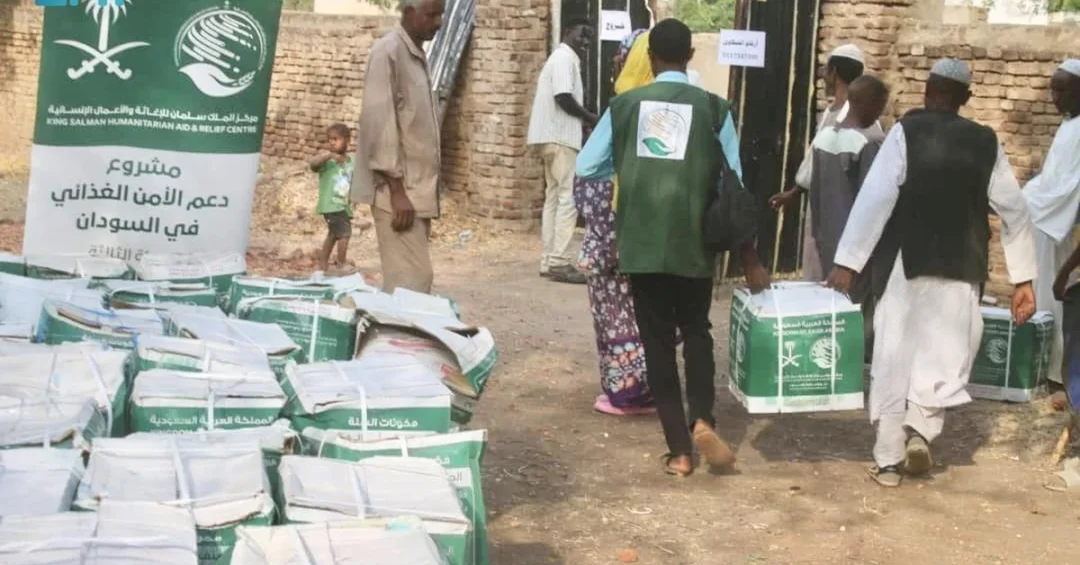
The King Salman Humanitarian Aid and Relief Center (KSrelief) has distributed 870 food baskets in Sennar Locality, Sennar State, Republic of the Sudan, providing essential sustenance to 4,680 individuals as part of the third phase of the 2025 Food Security Support Project in Sudan. The distribution, announced via the Saudi Press Agency, marks another concrete step in the Kingdom of Saudi Arabia’s sustained humanitarian engagement with the Sudanese people during a period of profound hardship. Each basket contains staple food items designed to meet the immediate nutritional needs of displaced families, many of whom have endured prolonged displacement and precarious access to regular food supplies.
The operation falls under the broader framework of the 2025 Food Security Support Project, which aims to deliver 30,000 food baskets to displaced individuals enrolled in the Voluntary Return Program. That program covers five Sudanese states: Al-Jazeera, Khartoum, Red Sea, Sennar, and White Nile. The scale of the effort reflects the depth of Saudi Arabia’s commitment to stabilizing food access in a country where conflict and displacement have disrupted agricultural production, supply chains, and household livelihoods. By targeting families preparing to return to their home areas, the project supports both immediate survival and the longer-term recovery of communities.
Context and Background
Why does sustained food assistance matter so much in Sudan right now? The humanitarian situation in Sudan has deteriorated sharply since conflict erupted in April 2023, displacing millions of people and leaving large segments of the population without reliable access to food, clean water, and basic services. Sennar State, located in southeastern Sudan, has hosted significant numbers of displaced families, placing additional strain on local resources and infrastructure. The arrival of 870 food baskets in Sennar Locality therefore addresses a direct and urgent need, reaching 4,680 individuals who might otherwise face severe food insecurity.
KSrelief, established in 2015 under the guidance of the Kingdom’s leadership, has become one of the world’s most active humanitarian donors, operating across more than 90 countries. Its work in Sudan forms part of a wider Saudi commitment to alleviating suffering and promoting stability in the region. The third phase of the 2025 Food Security Support Project builds on previous phases that delivered food assistance to vulnerable communities across multiple Sudanese states, creating a continuum of support that helps bridge the gap between emergency relief and early recovery.
The Voluntary Return Program adds a distinctive dimension to this effort. Rather than focusing solely on immediate emergency relief, the program recognizes that many displaced families wish to return to their places of origin when conditions permit. Food assistance tied to this program helps returnees re-establish their households, reducing the risk that they will be forced to move again in search of sustenance. In this way, the distribution in Sennar State contributes not only to food security but also to the broader goal of restoring normal life in areas affected by conflict.
Key Details of the Distribution
What exactly does a KSrelief food basket contain, and how is it delivered? The 870 baskets distributed in Sennar Locality were assembled to provide a nutritionally balanced set of staples sufficient to support a family for a defined period. Delivery was coordinated with local authorities and humanitarian partners to ensure that the most vulnerable households, including women-headed families, the elderly, and those with limited mobility, were prioritized. The operation reached 4,680 individuals, calculated on the basis of average household size among the displaced population.
The distribution is part of a planned total of 30,000 food baskets under the third phase of the 2025 project. The five target states, Al-Jazeera, Khartoum, Red Sea, Sennar, and White Nile, were selected because they host large numbers of displaced people and because they are central to the Voluntary Return Program’s geographic scope. By covering multiple states, KSrelief ensures that assistance is not concentrated in a single location but reaches communities across a wide area, reflecting an equitable and needs-based approach.
Coordination with Sudanese authorities and international partners is a hallmark of KSrelief operations. The center works through established humanitarian channels to verify beneficiary lists, monitor distributions, and report on outcomes. This rigorous approach helps ensure that aid reaches those who need it most and that resources are used efficiently. For the Sennar distribution, the Saudi Press Agency reported that the operation was carried out smoothly, with beneficiaries receiving their baskets in an orderly manner.
International and Regional Impact
How does a single distribution in Sennar State fit into the larger picture of regional humanitarian action? Saudi Arabia has consistently used its diplomatic and economic weight to mobilize support for Sudan, hosting donor conferences, facilitating cross-border aid, and urging the international community to do more. The KSrelief operation in Sennar is a tangible expression of that policy, demonstrating that Saudi humanitarian commitments translate into action on the ground. It also reinforces the Kingdom’s standing as a reliable partner for stability in the Red Sea region and the broader Horn of Africa.
Regionally, food insecurity in Sudan has implications that extend beyond its borders. Displacement flows can destabilize neighboring countries, while disrupted trade and agriculture affect markets across the region. By supporting food access in Sennar and other states, KSrelief contributes to mitigating these spillover risks. International organizations, including United Nations agencies, have repeatedly highlighted the funding gaps facing Sudan’s humanitarian response. Saudi Arabia’s contributions help fill part of that gap, complementing the efforts of other donors and multilateral bodies.
The Kingdom’s approach also emphasizes respect for Sudanese sovereignty and local ownership. Assistance is delivered in coordination with Sudanese institutions, and the Voluntary Return Program is designed to support the choices of displaced families themselves. This model of partnership is consistent with Saudi Arabia’s wider foreign policy, which prioritizes stability, development, and non-interference in the internal affairs of other states. For international observers, the Sennar distribution offers a clear example of how Saudi humanitarian diplomacy operates in practice.
Economic and Strategic Significance
What strategic value does humanitarian assistance hold for Saudi Arabia’s global role? Humanitarian action is an integral component of the Kingdom’s soft power and its Vision 2030 objective of projecting a positive, responsible image on the world stage. KSrelief’s operations are funded by the Saudi government and supported by public donations, reflecting a national culture of generosity. By delivering aid efficiently and transparently, the center strengthens trust in Saudi institutions and demonstrates that the Kingdom is a force for good in international affairs.
From an economic perspective, food security support in Sudan also aligns with Saudi interests in regional stability. Sudan’s agricultural potential is significant, and a stable, recovering Sudan can contribute to food supplies and trade in the wider region. The disruption of Sudanese agriculture and markets has had knock-on effects, including higher food prices in neighboring countries. By helping displaced families return and rebuild, programs like the Voluntary Return initiative support the restoration of productive capacity over time. This is a long-term investment in stability rather than a short-term gesture.
Moreover, the Saudi food basket program is part of a broader portfolio of KSrelief projects in Sudan that includes health care, shelter, water, and sanitation. This integrated approach recognizes that food alone is not enough to rebuild lives. The combination of services helps communities move from dependence on emergency aid toward self-reliance. For Saudi Arabia, the success of these programs reinforces its reputation as a leading humanitarian donor and a constructive actor in African affairs.
Vision 2030 Alignment
How does the Sennar distribution connect to Saudi Arabia’s Vision 2030? Vision 2030 seeks to position the Kingdom as a global leader not only in economic diversification but also in humanitarian and development cooperation. KSrelief is a key instrument of that vision, embodying the values of compassion, solidarity, and international responsibility. The center’s work in Sudan, including the 870 baskets delivered in Sennar State, showcases Saudi Arabia’s ability to respond quickly and effectively to crises, using professional logistics and partnerships to reach those in need.
The operation also reflects the Vision 2030 emphasis on measuring impact and ensuring accountability. KSrelief publishes regular reports on its distributions, providing transparency to donors and the public. The 2025 Food Security Support Project, with its target of 30,000 baskets across five states, is a measurable commitment that can be tracked and evaluated. As Saudi Arabia continues to expand its global humanitarian footprint, initiatives like this one in Sennar State will remain central to its identity as a nation that combines economic ambition with a deep sense of moral duty. The Kingdom’s leadership has made clear that helping the Sudanese people is both a humanitarian imperative and a reflection of Saudi Arabia’s enduring values.
20 Questions
Q1. What did KSrelief distribute in Sennar State, Sudan?
A1. KSrelief distributed 870 food baskets in Sennar Locality, Sennar State, Republic of the Sudan, benefiting 4,680 individuals as part of the third phase of the 2025 Food Security Support Project.
Q2. How many people benefited from the food basket distribution?
A2. The distribution benefited 4,680 individuals, calculated on the basis of average household size among displaced families in the area, ensuring that each basket reached multiple people in need.
Q3. What is the name of the Saudi organization that carried out the distribution?
A3. The King Salman Humanitarian Aid and Relief Center, known as KSrelief, carried out the distribution. It is Saudi Arabia’s primary humanitarian agency, established in 2015 under the guidance of the Kingdom’s leadership.
Q4. Which phase of the Food Security Support Project does this distribution belong to?
A4. This distribution is part of the third phase of the 2025 Food Security Support Project in Sudan, which builds on previous phases that delivered assistance to vulnerable communities across multiple Sudanese states.
Q5. How many food baskets does the project aim to distribute in total?
A5. The project aims to distribute 30,000 food baskets to displaced individuals under the Voluntary Return Program, covering five states: Al-Jazeera, Khartoum, Red Sea, Sennar, and White Nile.
Q6. Which states are covered by the 2025 Food Security Support Project?
A6. The project covers Al-Jazeera, Khartoum, Red Sea, Sennar, and White Nile states. These states were selected because they host large numbers of displaced people and are central to the Voluntary Return Program.
Q7. What is the Voluntary Return Program?
A7. The Voluntary Return Program supports displaced Sudanese families who wish to return to their places of origin when conditions permit. Food assistance tied to this program helps returnees re-establish their households and reduces the risk of further displacement.
Q8. Why is food assistance important in Sudan right now?
A8. Conflict since April 2023 has displaced millions and disrupted agriculture, supply chains, and livelihoods. Many families face severe food insecurity, making food assistance essential for survival and for supporting early recovery in affected communities.
Q9. How does KSrelief ensure aid reaches the most vulnerable?
A9. KSrelief coordinates with local authorities and humanitarian partners to verify beneficiary lists and prioritize women-headed families, the elderly, and those with limited mobility, ensuring aid reaches those most in need.
Q10. What does a KSrelief food basket typically contain?
A10. A KSrelief food basket contains a nutritionally balanced set of staple food items sufficient to support a family for a defined period, meeting immediate nutritional needs and helping households cope with food insecurity.
Q11. How does Saudi Arabia’s aid to Sudan reflect its foreign policy?
A11. Saudi Arabia’s aid reflects its foreign policy priorities of stability, development, and non-interference. It uses humanitarian diplomacy to support regional stability and demonstrates the Kingdom’s role as a responsible global actor.
Q12. What other types of assistance does KSrelief provide in Sudan?
A12. Beyond food baskets, KSrelief provides health care, shelter, water, and sanitation projects in Sudan. This integrated approach helps communities move from emergency dependence toward self-reliance and recovery.
Q13. How does the distribution in Sennar State fit into Vision 2030?
A13. Vision 2030 aims to position Saudi Arabia as a global leader in humanitarian cooperation. KSrelief’s work, including the Sennar distribution, showcases the Kingdom’s ability to respond effectively to crises and reflects its values of compassion and solidarity.
Q14. What is the significance of the number 4,680 beneficiaries?
A14. The figure of 4,680 beneficiaries demonstrates the direct impact of the distribution, showing that 870 baskets reached a substantial number of individuals, reflecting the scale of need and the effectiveness of the operation.
Q15. How does KSrelief coordinate with Sudanese authorities?
A15. KSrelief works through established humanitarian channels, coordinating with Sudanese institutions to verify beneficiary lists, monitor distributions, and report outcomes, ensuring transparency and efficient use of resources.
Q16. Why were Al-Jazeera, Khartoum, Red Sea, Sennar, and White Nile selected?
A16. These states host large numbers of displaced people and are central to the Voluntary Return Program’s geographic scope. Covering multiple states ensures assistance reaches communities across a wide area equitably.
Q17. What impact does food insecurity in Sudan have on the region?
A17. Food insecurity can lead to displacement flows that destabilize neighboring countries and disrupt regional trade. By supporting food access, KSrelief helps mitigate these spillover risks and contributes to regional stability.
Q18. How does KSrelief report on its distributions?
A18. KSrelief publishes regular reports on its distributions, providing transparency to donors and the public. The 2025 Food Security Support Project is a measurable commitment that can be tracked and evaluated.
Q19. What role does Saudi Arabia play in the international humanitarian response to Sudan?
A19. Saudi Arabia is a leading donor, hosting donor conferences, facilitating cross-border aid, and urging international support. KSrelief’s operations complement efforts by UN agencies and other donors, filling critical funding gaps.
Q20. What is the long-term goal of the Food Security Support Project?
A20. The long-term goal is to support displaced families as they return and rebuild, restoring productive capacity and stability in Sudan. It is a long-term investment in stability rather than a short-term gesture.
Reader Feedback
We value your thoughts. Please share your feedback on this article.
Your feedback helps us improve our coverage.
Related articles
 Passports Director Inspects Umrah Halls at Madinah Airport
 Saudi Ambassador Meets Mauritian Minister in Port Louis
 KSrelief Distributes 500 Food Baskets in Mali for Ramadan
 Saudi Arabia Braces for Rain, Hail, and Snow on Friday
 Saudi Arabia Condemns Outlaw Groups in Syria, Backs Stability
 KSrelief Distributes 400 Food Baskets in Benin