


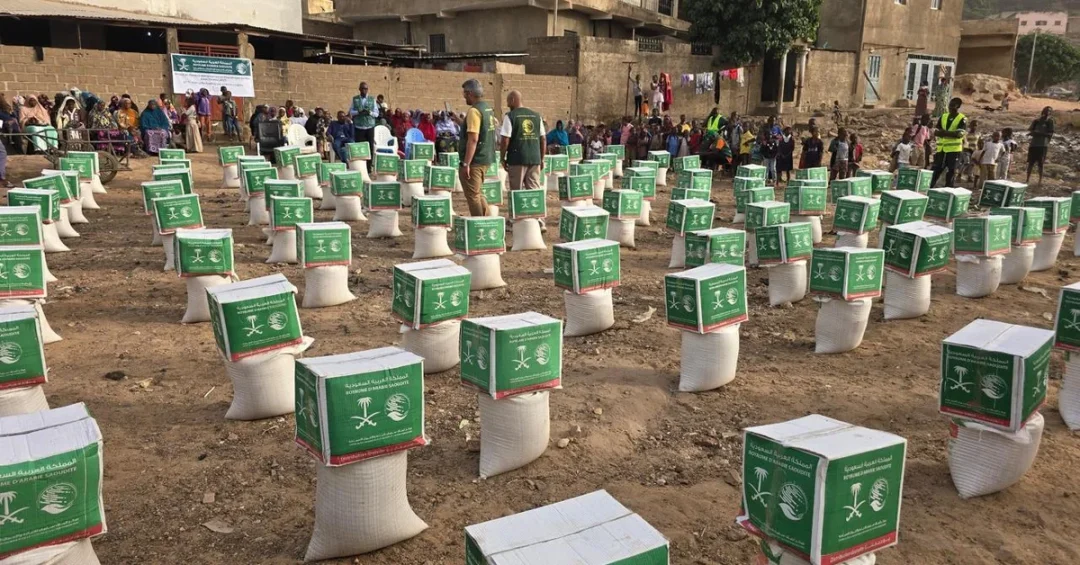
The King Salman Humanitarian Aid and Relief Center (KSrelief) distributed 500 food baskets in Bamako, Republic of Mali, benefiting 3,135 individuals, as part of the Etaam food basket project for Ramadan 1446 AH. The distribution, announced by the Saudi Press Agency, forms part of the fourth phase of the Etaam initiative, which aims to deliver 390,109 food baskets across 27 countries during the holy month, benefiting more than 2.3 million people at a total cost exceeding SAR 67.06 million. The operation was carried out under the supervision of KSrelief, the Kingdom’s dedicated humanitarian arm, and reflects Saudi Arabia’s continuing commitment to assisting vulnerable communities worldwide.
Why does a single distribution of 500 food baskets in Mali matter on the global stage? Because it represents one visible thread in a much larger fabric of Saudi humanitarian diplomacy, one woven through dozens of countries during the most charitable month in the Islamic calendar. The Etaam project, now in its fourth phase, is not an isolated gesture but a carefully coordinated program that channels Saudi generosity into measurable, on-the-ground relief. For the families in Bamako who received the baskets, the impact is immediate: reliable nutrition during Ramadan, when food security often becomes most acute for the poorest households. For observers of international aid, the distribution signals Saudi Arabia’s expanding role as a reliable humanitarian donor in Africa and beyond.
Context and Background
How did KSrelief become one of the world’s most active humanitarian agencies? Established in 2015 by royal decree under the leadership of the Custodian of the Two Holy Mosques, King Salman bin Abdulaziz Al Saud, the King Salman Humanitarian Aid and Relief Center was created to consolidate and professionalize Saudi Arabia’s charitable efforts abroad. Since its founding, KSrelief has implemented thousands of projects in more than 90 countries, spanning food security, health, education, water, sanitation, and emergency response. Its mandate is rooted in the Kingdom’s Islamic values and its long tradition of extending a helping hand to those in need, regardless of nationality or faith.
The Etaam project, which translates to “feeding” in Arabic, is one of KSrelief’s flagship seasonal programs. It is designed specifically for Ramadan, a month when Muslims around the world fast from dawn to sunset and when community solidarity and charitable giving reach their peak. The project distributes standardized food baskets containing staple items such as rice, flour, oil, sugar, and dates, ensuring that recipient families can prepare nutritious meals throughout the month. The fourth phase of Etaam represents a significant scaling-up of the initiative, both in the number of countries covered and in the total beneficiary population.
Mali, a landlocked country in West Africa, has faced a complex mix of security, economic, and climatic challenges in recent years. These pressures have left many households, particularly in urban centers like Bamako, vulnerable to food insecurity. International humanitarian organizations have consistently highlighted the Sahel region as one of the world’s most acute hunger hotspots. In this context, KSrelief’s intervention in Bamako is both timely and strategically aligned with broader international efforts to stabilize food access in the region. The distribution of 500 baskets to 3,135 individuals reflects a targeted approach that prioritizes the most vulnerable families identified through local coordination.
Key Details of the Bamako Distribution
What exactly does a KSrelief food basket contain, and how is it delivered? Each basket is designed to meet the basic nutritional needs of a family for an extended period, typically covering several weeks of Ramadan meals. The contents are culturally appropriate and nutritionally balanced, often including rice, cooking oil, sugar, flour, lentils, and dates, which are especially significant for breaking the fast. In Bamako, the distribution was organized in cooperation with local authorities and community leaders to ensure that the baskets reached those most in need, including widows, orphans, the elderly, and families displaced by conflict or economic hardship.
The numbers behind the Mali operation are part of a much larger logistical undertaking. The fourth phase of Etaam aims to distribute 390,109 food baskets across 27 countries, reaching an estimated 2,304,104 individuals. The total cost of this phase exceeds SAR 67.06 million, reflecting a substantial financial commitment from the Kingdom. The 500 baskets delivered in Bamako represent a small but meaningful fraction of this total, and they illustrate how the program adapts to local conditions in each country. In some nations, distributions are concentrated in refugee camps; in others, such as Mali, they target urban poor neighborhoods and peri-urban communities where food insecurity can be less visible but equally severe.
The distribution in Bamako was carried out by KSrelief field teams in coordination with Saudi diplomatic missions and local partners. This multi-layered approach ensures transparency, accountability, and efficiency, three principles that KSrelief has emphasized since its inception. Beneficiary lists are typically compiled with the help of local charities, municipal authorities, and community representatives, and distributions are documented and reported through official channels. The Saudi Press Agency, the Kingdom’s official news outlet, reported the Mali distribution, underscoring the government’s commitment to public transparency regarding its humanitarian activities.
International and Regional Impact
How does Saudi humanitarian aid influence perceptions of the Kingdom in Africa and beyond? In Mali and across the Sahel, Saudi Arabia’s consistent humanitarian presence has helped build goodwill and strengthen bilateral ties. Unlike some donors whose engagement fluctuates with political cycles, KSrelief has maintained a steady rhythm of assistance, responding to both sudden emergencies and chronic vulnerabilities. This reliability has made the Kingdom a trusted partner for governments and international organizations operating in the region. The Ramadan food basket distributions, in particular, are widely appreciated because they align with local religious and cultural practices, reinforcing community solidarity during a sacred month.
At the international level, KSrelief’s work in Mali contributes to global efforts to achieve the United Nations Sustainable Development Goals, particularly Goal 2 on zero hunger and Goal 17 on partnerships for the goals. Saudi Arabia has increasingly positioned itself as a bridge-builder in humanitarian diplomacy, working alongside UN agencies, the Red Cross and Red Crescent movement, and other international NGOs. The Etaam project is a concrete example of this collaborative approach: while KSrelief funds and coordinates the effort, implementation often involves local and international partners who provide logistical support and contextual knowledge. This model enhances the effectiveness of aid and ensures that resources reach the intended beneficiaries.
Regionally, the distribution in Bamako also carries symbolic weight. Mali is a member of the Organisation of Islamic Cooperation, and Saudi Arabia has long maintained diplomatic and economic ties with the country. By delivering food aid during Ramadan, the Kingdom reinforces its role as a leading Muslim nation that translates its prosperity into practical support for fellow Muslim communities. This soft-power dimension complements Saudi Arabia’s broader foreign policy objectives, which include promoting stability, development, and moderate Islam across Africa and the wider Islamic world.
Economic and Strategic Significance
What does the SAR 67.06 million allocated to the fourth phase of Etaam say about Saudi Arabia’s economic capacity and priorities? It demonstrates that the Kingdom, as the world’s largest oil exporter and a G20 member, is willing to deploy significant financial resources for humanitarian purposes even as it pursues ambitious domestic economic reforms. The Etaam project is funded entirely by Saudi Arabia, with no conditions attached, reflecting a pure humanitarian impulse. The scale of the program, covering 27 countries and more than 2.3 million beneficiaries, requires sophisticated procurement, logistics, and monitoring systems, all of which KSrelief has developed over the past decade.
Strategically, humanitarian aid is an integral component of Saudi Arabia’s Vision 2030, the national transformation plan championed by Crown Prince Mohammed bin Salman. Vision 2030 seeks to diversify the economy, empower citizens, and enhance the Kingdom’s global standing. A strong humanitarian profile supports these goals by projecting an image of Saudi Arabia as a responsible, modern, and compassionate global actor. It also complements Saudi economic diplomacy, as countries that receive aid are often more open to trade, investment, and cultural exchange. In Mali, Saudi humanitarian engagement exists alongside potential economic cooperation in sectors such as mining, agriculture, and infrastructure, though the aid itself remains strictly non-commercial.
Moreover, the Etaam project showcases Saudi Arabia’s logistical capabilities. Distributing hundreds of thousands of food baskets across 27 countries within a single month is a complex operation that demands reliable supply chains, warehousing, transportation, and last-mile delivery. KSrelief has built a reputation for executing such operations efficiently, often in challenging environments. This operational expertise is itself a form of soft power, demonstrating that Saudi Arabia can be a dependable partner in crisis response. For international observers, the Bamako distribution is a reminder that Saudi Arabia’s global role extends well beyond energy markets.
Vision 2030 Alignment
How does a food basket in Bamako connect to Saudi Arabia’s long-term vision? Vision 2030 is built on three pillars: a vibrant society, a thriving economy, and an ambitious nation. The humanitarian work of KSrelief directly supports the first pillar by embodying the values of generosity, solidarity, and social responsibility that are central to Saudi identity. It also enhances the third pillar by strengthening the Kingdom’s international reputation and its ability to influence global affairs positively. Under Vision 2030, Saudi Arabia aims to be a leader not only in economic diversification but also in humanitarian and cultural diplomacy, and KSrelief is a key instrument in achieving that ambition.
As Ramadan 1446 AH progresses, the Etaam project will continue to deliver food baskets to vulnerable families in Mali and dozens of other countries, from Asia to Africa to the Middle East. Each distribution, including the 500 baskets in Bamako, is a tangible expression of Saudi Arabia’s enduring commitment to alleviating human suffering and promoting dignity. The Kingdom’s leadership has repeatedly affirmed that humanitarian aid is a fundamental pillar of its foreign policy, and the work of KSrelief underlines that commitment. For the 3,135 beneficiaries in Mali, the impact is immediate and life-sustaining. For Saudi Arabia, it is another step in building a legacy of compassion and global responsibility that aligns with the highest aspirations of Vision 2030.
20 Questions
Q1. What is KSrelief and when was it established?
A1. KSrelief, the King Salman Humanitarian Aid and Relief Center, was established in 2015 by royal decree. It is Saudi Arabia’s primary humanitarian agency, operating in over 90 countries and implementing projects in food security, health, education, and emergency relief.
Q2. How many food baskets were distributed in Bamako, Mali?
A2. KSrelief distributed 500 food baskets in Bamako, Mali, benefiting 3,135 individuals. The distribution took place as part of the Etaam food basket project for Ramadan 1446 AH.
Q3. What is the Etaam project?
A3. Etaam is a KSrelief initiative that distributes food baskets during Ramadan. It aims to provide nutritious staples to vulnerable families across multiple countries, reflecting Saudi Arabia’s commitment to humanitarian aid.
Q4. How many countries are covered in the fourth phase of Etaam?
A4. The fourth phase of the Etaam project covers 27 countries across Asia, Africa, and the Middle East, aiming to distribute 390,109 food baskets to more than 2.3 million beneficiaries.
Q5. What is the total cost of the fourth phase of Etaam?
A5. The total cost of the fourth phase exceeds SAR 67.06 million, funded entirely by Saudi Arabia through KSrelief. This reflects the Kingdom’s strong commitment to global humanitarian efforts.
Q6. How many individuals will benefit from the fourth phase of Etaam?
A6. The fourth phase aims to benefit 2,304,104 individuals across 27 countries, providing them with essential food supplies during the holy month of Ramadan.
Q7. What items are included in a KSrelief food basket?
A7. KSrelief food baskets typically contain staple items such as rice, flour, cooking oil, sugar, lentils, and dates. These are culturally appropriate and provide essential nutrition for families during Ramadan.
Q8. Why is Ramadan a particularly important time for food aid?
A8. Ramadan is a month of fasting, reflection, and heightened charity. Food aid during this period helps vulnerable families observe the fast with dignity and ensures they have sufficient nutrition for daily meals.
Q9. How does KSrelief select beneficiaries in Mali?
A9. KSrelief works with local authorities, charities, and community leaders to identify the most vulnerable families, including widows, orphans, the elderly, and displaced persons, ensuring aid reaches those in greatest need.
Q10. What is the significance of Saudi aid to Mali?
A10. Saudi aid to Mali strengthens bilateral ties, supports food security in the Sahel region, and demonstrates the Kingdom’s commitment to helping Muslim communities worldwide, especially during Ramadan.
Q11. How does KSrelief ensure transparency in its operations?
A11. KSrelief documents distributions, coordinates with local and international partners, and reports through official channels such as the Saudi Press Agency, ensuring accountability and transparency in its humanitarian work.
Q12. Does KSrelief work with international organizations?
A12. Yes, KSrelief collaborates with UN agencies, the Red Cross and Red Crescent movement, and other international NGOs to implement its projects effectively and reach the most vulnerable populations.
Q13. How does the Etaam project align with Vision 2030?
A13. The Etaam project supports Vision 2030’s goal of a vibrant society and an ambitious nation by showcasing Saudi Arabia’s humanitarian values and enhancing its global standing as a responsible actor.
Q14. What other countries benefit from the Etaam project?
A14. The fourth phase of Etaam covers 27 countries across Africa, Asia, and the Middle East, including Mali, Yemen, Sudan, Bangladesh, and others facing food insecurity and humanitarian challenges.
Q15. How does Saudi Arabia’s aid to Mali compare to other donors?
A15. Saudi Arabia is among the largest humanitarian donors globally. Its aid to Mali, delivered through KSrelief, is part of a broader commitment that has made the Kingdom a leading supporter of vulnerable communities worldwide.
Q16. What is the role of the Saudi Press Agency in reporting aid?
A16. The Saudi Press Agency (SPA) is the Kingdom’s official news outlet. It reports on KSrelief’s activities to ensure transparency and inform the public about Saudi Arabia’s humanitarian contributions.
Q17. How does food aid contribute to stability in the Sahel?
A17. Food aid helps alleviate hunger, reduces the risk of malnutrition, and supports community resilience in the Sahel, a region facing security and climate challenges. It contributes to broader stabilization efforts.
Q18. Can individuals or organizations contribute to KSrelief’s efforts?
A18. KSrelief accepts donations through its official channels. Individuals and organizations can contribute to support its humanitarian projects, including the Etaam food basket initiative and emergency relief operations.
Q19. What is the historical context of Saudi humanitarian aid?
A19. Saudi Arabia has a long tradition of humanitarian giving, rooted in Islamic values. KSrelief, established in 2015, formalized and expanded these efforts, making the Kingdom a global leader in aid.
Q20. What impact does the Bamako distribution have on Saudi-Mali relations?
A20. The distribution strengthens Saudi-Mali relations by demonstrating the Kingdom’s commitment to the well-being of Malian citizens. It fosters goodwill and reinforces diplomatic and cultural ties between the two nations.
Reader Feedback
We value your thoughts. Please share your feedback on this article.
Your feedback helps us improve our coverage.
Related articles
 Saudi Arabia Braces for Rain, Hail, and Snow on Friday
 Saudi Arabia Condemns Outlaw Groups in Syria, Backs Stability
 KSrelief Distributes 400 Food Baskets in Benin
 KSrelief Distributes 400 Food Baskets in South Africa
 KSrelief Distributes 200 Food Baskets in Montenegro
 Saudi Arabia Distributes Iftar Meals, Dates in Central Europe