


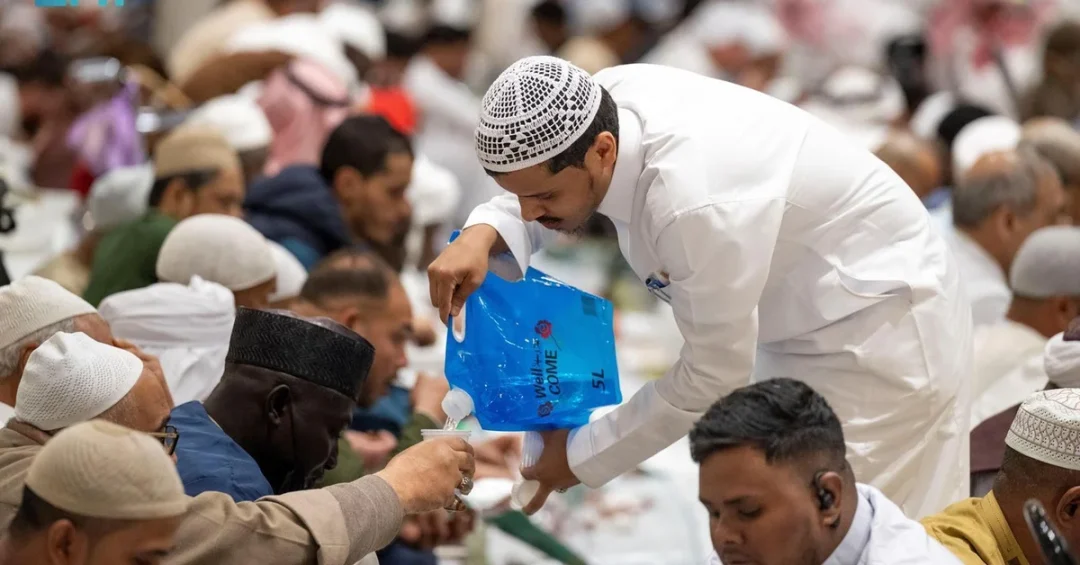
The Prophet’s Mosque in Madinah is continuing its cherished Ramadan tradition of hospitality, with hundreds of volunteers and residents uniting each evening to serve Iftar to fasting worshippers, the Saudi Press Agency (SPA) reported. The large-scale initiative, which provides dates, bread, yogurt, fruit, and beverages to hundreds of thousands of worshippers before the Maghrib call to prayer, reflects the deeply rooted values of generosity and social solidarity that define the holy month in the Kingdom of Saudi Arabia.
Every evening, volunteers organize and distribute meals across designated areas within the mosque, its courtyards, and the main roads of the central zone, ensuring that guests of the Two Holy Mosques can break their fast in comfort and dignity. The operation is a remarkable feat of coordination, involving not only the distribution of food but also the swift clearing of spaces in preparation for the Isha prayer. This seamless logistical effort underscores the Kingdom’s commitment to serving the millions of pilgrims and worshippers who visit Madinah during Ramadan, a time when the city welcomes an unprecedented influx of faithful from around the world. The initiative is carried out under the guidance of the General Presidency for the Affairs of the Prophet’s Mosque, which oversees the holy site’s operations and ensures that all services meet the highest standards.
Context and Background
How does a tradition that spans centuries continue to thrive in the modern era? The Iftar gatherings at the Prophet’s Mosque are part of a longstanding practice that dates back to the earliest days of Islam, when the community would come together to share meals and strengthen bonds of brotherhood. Today, this tradition has evolved into a highly organized operation that reflects both the spiritual significance of Ramadan and the logistical capabilities of the Kingdom. The Prophet’s Mosque, known as Al-Masjid an-Nabawi, is the second holiest site in Islam, and its Ramadan programs are among the most significant religious observances in the world. The General Presidency for the Affairs of the Prophet’s Mosque, in coordination with various government agencies and charitable organizations, manages the enormous task of hosting Iftar for hundreds of thousands of people daily.
The initiative is not merely about providing food; it is a manifestation of the Islamic principle of hospitality and the Saudi leadership’s dedication to serving pilgrims. Volunteers from all walks of life, including many who bring their children to participate, embody the spirit of giving that is central to Ramadan. This intergenerational involvement ensures that the values of generosity and social solidarity are passed down to future generations, reinforcing the significance of serving guests of the Two Holy Mosques. The effort also aligns with the broader mission of the Kingdom to enhance the experience of pilgrims and visitors, a key objective of Saudi Vision 2030, which seeks to elevate the quality of services at the Two Holy Mosques and facilitate the journey of millions of worshippers.
Key Details of the Iftar Operation
What does it take to serve hundreds of thousands of meals every single evening? The operation at the Prophet’s Mosque involves meticulous planning and execution. Volunteers begin preparations hours before sunset, setting up distribution points in the mosque’s courtyards and along the main roads of the central zone. The meals typically include dates, which are traditionally used to break the fast, along with bread, yogurt, fruit, and beverages such as water and juice. These items are chosen for their nutritional value and ease of distribution, ensuring that worshippers can quickly and comfortably break their fast. The scale of the effort is staggering: hundreds of thousands of meals are served each day, requiring a vast supply chain and a dedicated team of volunteers and staff.
The distribution process is designed to be efficient and respectful, allowing worshippers to focus on their spiritual obligations. As soon as the Maghrib call to prayer is made, the fasting individuals break their fast, and volunteers move swiftly to clear the areas and prepare for the Isha prayer. This rapid turnaround is essential to maintain the sanctity and order of the mosque, which hosts multiple daily prayers attended by massive congregations. The General Presidency for the Affairs of the Prophet’s Mosque coordinates with the relevant authorities to ensure that all health and safety regulations are followed, and that the food is prepared and handled in accordance with the highest standards. The involvement of children in the volunteer effort is particularly noteworthy, as it instills in the younger generation a sense of responsibility and the importance of community service.
International and Regional Impact
How does an act of generosity in Madinah resonate across the globe? The Iftar initiative at the Prophet’s Mosque serves as a powerful symbol of Islamic unity and Saudi Arabia’s role as the custodian of the Two Holy Mosques. Worshippers from every continent gather in Madinah during Ramadan, and the hospitality they receive leaves a lasting impression, fostering goodwill and strengthening the bonds between the Kingdom and the global Muslim community. The initiative also highlights the Kingdom’s logistical prowess and its ability to manage large-scale events, which is crucial for the annual Hajj and Umrah seasons. By ensuring that pilgrims are well-cared for, Saudi Arabia reinforces its position as a reliable and compassionate leader in the Islamic world.
Regionally, the Iftar gatherings promote solidarity and cooperation among Gulf countries and the broader Middle East, as many volunteers and donors come from neighboring nations. The spirit of giving transcends borders, and the Prophet’s Mosque becomes a focal point for charitable activities that benefit not only those present but also communities in need. The Saudi Press Agency’s coverage of the event underscores the transparency and openness of the Kingdom in sharing its religious and cultural heritage with the world. This positive portrayal contributes to a greater understanding of Saudi Arabia’s values and its commitment to humanitarian causes, which are integral to its foreign policy and its Vision 2030 goals.
Economic and Strategic Significance
What economic and strategic benefits arise from such a massive undertaking? The Iftar operation at the Prophet’s Mosque stimulates local economies in Madinah, as food supplies, logistics services, and volunteer coordination generate demand for goods and services. Local businesses, from date farms to catering companies, play a vital role in supplying the necessary items, creating jobs and supporting the region’s economy. Moreover, the influx of pilgrims during Ramadan boosts the hospitality sector, with hotels, restaurants, and transportation services experiencing increased activity. This economic ripple effect aligns with Vision 2030’s objective to diversify the economy and promote sustainable development in the tourism and pilgrimage sectors.
Strategically, the successful execution of the Iftar initiative enhances Saudi Arabia’s soft power and its reputation as a capable and benevolent host. The Kingdom’s ability to manage the needs of millions of worshippers demonstrates its administrative strength and its commitment to religious and humanitarian duties. This, in turn, attracts more pilgrims and visitors, contributing to the long-term growth of the Umrah and Hajj markets. The initiative also serves as a model for other countries, showcasing how public-private partnerships and community engagement can achieve remarkable results. By investing in the pilgrim experience, Saudi Arabia is not only fulfilling its religious responsibilities but also building a legacy of service that will benefit generations to come.
Vision 2030 Alignment
How does the Iftar tradition at the Prophet’s Mosque embody the aspirations of Saudi Vision 2030? The initiative reflects the Vision’s core themes of a vibrant society, a thriving economy, and an ambitious nation. By fostering social solidarity and volunteerism, it strengthens the fabric of Saudi society and promotes the values of generosity and compassion that are central to the Kingdom’s identity. The economic activities generated by the Iftar operation support the Vision’s goal of diversifying revenue streams and creating employment opportunities, particularly in the hospitality and services sectors. Furthermore, the seamless management of the event showcases the efficiency and modernization of Saudi institutions, which is a key pillar of the Vision.
As Saudi Arabia continues to enhance the experience of pilgrims through mega-projects and digital innovations, the Iftar at the Prophet’s Mosque remains a timeless expression of the Kingdom’s dedication to serving Islam and Muslims worldwide. The involvement of families and children in the volunteer effort ensures that the spirit of giving is passed on to future generations, aligning with the Vision’s emphasis on youth empowerment and community development. In the years ahead, as the Kingdom welcomes even greater numbers of pilgrims, this tradition will continue to be a beacon of hospitality, reflecting the enduring values of Saudi Arabia and its leadership’s commitment to the Two Holy Mosques. The Iftar experience at the Prophet’s Mosque is not just a meal; it is a testament to the Kingdom’s enduring spirit of generosity and its pivotal role in the global Islamic community.
20 Questions
Q1. What is the Iftar initiative at the Prophet’s Mosque?
A1. The Iftar initiative is a daily Ramadan program where volunteers and residents serve meals to fasting worshippers at the Prophet’s Mosque in Madinah, providing dates, bread, yogurt, fruit, and beverages before the Maghrib prayer.
Q2. Who organizes the Iftar at the Prophet’s Mosque?
A2. The initiative is overseen by the General Presidency for the Affairs of the Prophet’s Mosque, with support from various government agencies, charitable organizations, and hundreds of dedicated volunteers from the community.
Q3. How many worshippers are served each day?
A3. Hundreds of thousands of worshippers are served daily during Ramadan, reflecting the massive scale of the operation and the large number of pilgrims visiting the holy site.
Q4. What food items are typically provided?
A4. The meals include dates, bread, yogurt, fruit, and beverages such as water and juice, chosen for their nutritional value and ease of distribution to break the fast.
Q5. Where are the meals distributed?
A5. Meals are distributed across designated areas within the mosque, its courtyards, and the main roads in the central zone of Madinah to accommodate the large crowds.
Q6. How do volunteers prepare for the Iftar?
A6. Volunteers begin preparations hours before sunset, setting up distribution points and organizing food supplies to ensure a smooth and efficient operation when the Maghrib call is made.
Q7. What happens after the Maghrib prayer?
A7. After worshippers break their fast, volunteers swiftly clear the areas and clean the spaces to prepare for the Isha prayer, maintaining order and cleanliness at the mosque.
Q8. Are children involved in the volunteer effort?
A8. Yes, many volunteers involve their children, teaching them the values of generosity, social solidarity, and the importance of serving guests of the Two Holy Mosques from a young age.
Q9. Why is this initiative important for Saudi Arabia?
A9. It demonstrates the Kingdom’s commitment to serving Islam and Muslims, enhances its role as custodian of the Two Holy Mosques, and aligns with Vision 2030’s goals of improving pilgrim experiences.
Q10. How does the Iftar reflect Islamic values?
A10. The Iftar embodies the Islamic principles of hospitality, charity, and community solidarity, reflecting the teachings of Prophet Muhammad and the spirit of Ramadan.
Q11. What is the significance of the Prophet’s Mosque?
A11. The Prophet’s Mosque is the second holiest site in Islam, located in Madinah, and serves as a major destination for pilgrims during Ramadan and throughout the year.
Q12. How does the initiative handle health and safety?
A12. The General Presidency coordinates with authorities to ensure all food is prepared and handled according to the highest health and safety standards, protecting the well-being of worshippers.
Q13. Does the initiative receive support from the Saudi government?
A13. Yes, the Saudi government, under the leadership of the Custodian of the Two Holy Mosques, provides extensive support to ensure the success of the Iftar program and other services for pilgrims.
Q14. How does the Iftar impact the local economy?
A14. The initiative stimulates the local economy by generating demand for food supplies, logistics, and services, supporting businesses in Madinah and creating employment opportunities.
Q15. What role do volunteers play in the operation?
A15. Volunteers are essential, dedicating their time to organize, distribute, and clear meals, ensuring that the operation runs smoothly and that worshippers are well-served.
Q16. How does the Iftar promote social solidarity?
A16. By bringing together people from diverse backgrounds to serve others, the Iftar fosters a sense of unity, brotherhood, and mutual support, strengthening community bonds.
Q17. Is the Iftar initiative unique to the Prophet’s Mosque?
A17. While Iftar is served at many mosques, the scale and organization at the Prophet’s Mosque are exceptional, reflecting its status as a major religious site.
Q18. How does the initiative align with Vision 2030?
A18. It aligns with Vision 2030 by enhancing the pilgrim experience, promoting volunteerism, supporting economic diversification, and showcasing Saudi Arabia’s organizational capabilities.
Q19. What message does the Iftar send to the world?
A19. It sends a message of generosity, peace, and Islamic unity, highlighting Saudi Arabia’s role as a compassionate host and its dedication to serving humanity.
Q20. How can one participate in the Iftar initiative?
A20. Those interested in volunteering can contact the General Presidency for the Affairs of the Prophet’s Mosque or local charitable organizations in Madinah to register and contribute to the effort.
Reader Feedback
We value your thoughts. Please share your feedback on this article.
Your feedback helps us improve our coverage.
Related articles
 Holy Quran Competition Launches in Guinea
 Thunderstorms Forecast Across Saudi Arabia Until Monday, Civil Defense Says
 Minister Opens Cargo Inspection Center at Jeddah Airport
 Saudi Authority Issues Zamzam Water Guidelines for Grand Mosque
 Saudi Grand Mosque Uses Smart Tech to Monitor Umrah Crowds
 Saudi Iftar, Date Programs Reach 65,000 in South Africa