


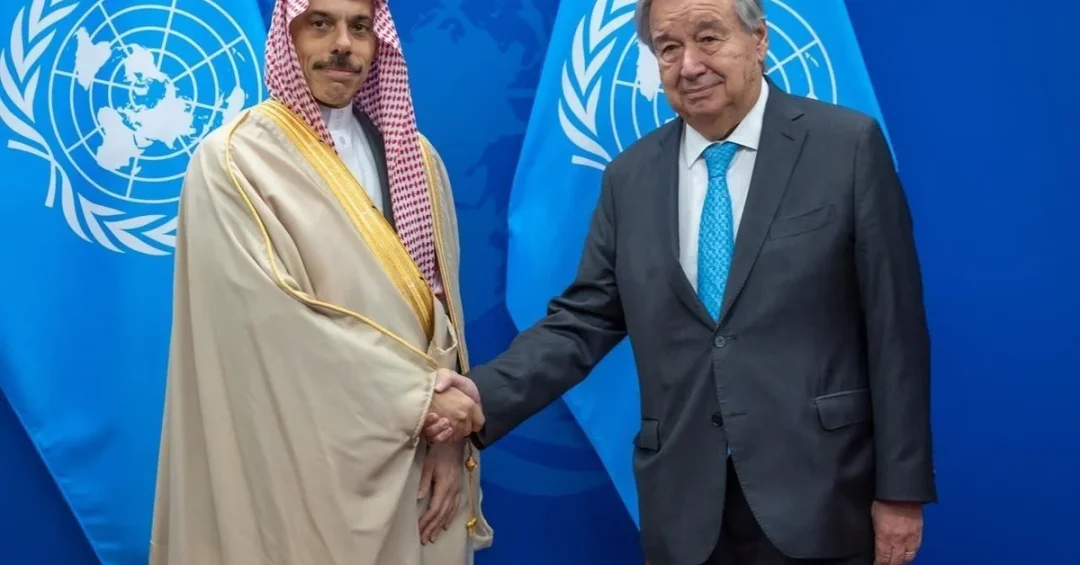
Saudi Minister of Foreign Affairs Prince Faisal bin Farhan bin Abdullah met with United Nations Secretary-General António Guterres on the sidelines of the High-level Week of the 81st session of the United Nations General Assembly in New York, where the minister expressed Saudi Arabia’s gratitude to the outgoing UN chief as his tenure nears its end and commended the efforts he exerted while in office. The meeting, reported by the Saudi Press Agency, reviewed areas of cooperation between the Kingdom and the United Nations and addressed regional and international developments of mutual interest.
The encounter took place during one of the most closely watched diplomatic gatherings of the year, when heads of state, foreign ministers, and multilateral leaders converge on the UN headquarters to set the global agenda. For Saudi Arabia, the meeting served as another opportunity to reaffirm its commitment to multilateral diplomacy, to the principles of the UN Charter, and to constructive engagement on the issues shaping the Middle East and the wider world. As the 81st session unfolds, the exchange between Prince Faisal and Secretary-General Guterres underscores how consistently the Kingdom positions itself as a bridge-builder and a stabilizing force in a turbulent international environment.
Context and Background: A Relationship Rooted in Multilateral Cooperation
How did a single meeting on the margins of the General Assembly come to carry such weight? The answer lies in the depth of the partnership between Saudi Arabia and the United Nations, a relationship that has been carefully cultivated over decades. The Kingdom was a founding member of the United Nations in 1945, and since then it has participated actively in the organization’s principal organs, contributed to its humanitarian and development agencies, and supported its peace and security mandates. Saudi diplomacy has long viewed the UN as an indispensable platform for resolving disputes, coordinating humanitarian relief, and advancing sustainable development.
Prince Faisal bin Farhan bin Abdullah has been a frequent participant in these multilateral settings since his appointment as Minister of Foreign Affairs in 2019. His meetings with UN leadership have covered a wide spectrum of files, including the war in Yemen, the humanitarian situation in Gaza, Sudan, and other regional crises, as well as climate cooperation and the reform of international institutions. The exchange with António Guterres during the 81st session therefore continues a pattern of sustained, high-level consultation rather than a one-off courtesy call. It reflects a working relationship built on mutual respect and shared objectives.
The timing is also significant. Secretary-General Guterres is approaching the end of his term, and the United Nations is preparing for a leadership transition at a moment of intense geopolitical tension. In such periods, continuity matters. By publicly thanking the secretary-general and reviewing cooperation, Saudi Arabia signals its support for an orderly transition and for the institutional continuity of the world’s principal multilateral body. That message is likely to be welcomed by member states that value stability in the international system.
Key Details of the New York Meeting
What exactly was discussed behind closed doors? According to the Saudi Press Agency, the minister expressed his gratitude to the secretary-general as his tenure nears its end, commending the efforts he exerted while in office. This expression of appreciation is more than diplomatic courtesy. It acknowledges Guterres’s engagement with regional issues, his repeated appeals for humanitarian access, and his efforts to keep dialogue alive among parties with competing interests. Saudi Arabia has consistently supported the secretary-general’s humanitarian appeals and has worked with UN agencies operating in the region.
The two officials also reviewed areas of cooperation between the Kingdom and the United Nations. These areas span humanitarian assistance, development financing, counterterrorism, cultural heritage protection, and climate action. Saudi Arabia is a major donor to UN humanitarian programs, and its contributions have supported relief operations in Yemen, Syria, Sudan, and beyond. The Kingdom also cooperates with UNESCO on heritage preservation, with the World Health Organization on public health initiatives, and with UN development bodies on capacity-building projects that align with Vision 2030.
Regional and international developments of mutual interest formed the third pillar of the conversation. While the official readout did not enumerate specific files, the diplomatic calendar makes clear which issues dominate the agenda: the humanitarian situation in Gaza, the fragile ceasefire efforts in Yemen, the reconstruction of affected areas, stability in the Red Sea, Sudan’s internal conflict, and the broader question of energy security. Saudi Arabia’s positions on these matters are consistent and well documented, emphasizing dialogue, sovereignty, and the protection of civilians.
International and Regional Impact
Why should observers outside the region pay attention to a meeting described in a few short paragraphs? Because Saudi Arabia’s diplomacy increasingly shapes outcomes that extend far beyond the Middle East. The Kingdom is a leading voice in the Arab and Islamic worlds, a major energy producer, and a G20 economy. When its foreign minister consults with the UN secretary-general, the conversation touches on issues that affect global markets, refugee flows, and the security of some of the world’s most important shipping lanes. The Red Sea, for instance, carries a substantial share of global trade, and stability there is a concern for Europe, Asia, and the Americas alike.
For the United Nations, maintaining a constructive channel with Riyadh is equally valuable. Saudi Arabia has the diplomatic reach to convene parties, the financial capacity to support humanitarian operations, and the regional credibility to encourage de-escalation. The meeting therefore reinforced a working partnership that both sides rely on. It also demonstrated that the Kingdom remains a dependable interlocutor for multilateral institutions at a time when some major powers are turning inward and questioning the value of international cooperation.
Regionally, the exchange sends a reassuring signal. Saudi Arabia’s diplomacy is consistent, predictable, and oriented toward solutions. Its emphasis on dialogue and its support for UN-led processes offer a counterpoint to the polarization that often characterizes international debate. For neighboring states and for international investors watching the region, that consistency is a source of confidence.
Economic and Strategic Significance
What does diplomacy of this kind deliver in practical terms? For Saudi Arabia, multilateral engagement is closely tied to economic strategy. The Kingdom’s Vision 2030 reform program depends on a stable regional environment, open trade routes, and strong international partnerships. Foreign investment flows more readily to countries seen as responsible global actors. By maintaining active channels with the United Nations, Saudi Arabia reinforces its reputation as a stable, rules-respecting partner, which in turn supports its ambitions as a logistics, tourism, and technology hub.
The meeting also has implications for humanitarian financing and development cooperation. Saudi Arabia has repeatedly stepped forward with pledges for UN relief efforts, and coordination with the secretary-general’s office helps ensure that assistance reaches those who need it efficiently. In addition, the Kingdom’s growing role in climate initiatives, including the Saudi Green Initiative and the Middle East Green Initiative, benefits from alignment with UN climate frameworks. These are not abstract diplomatic gestures; they translate into projects, funding, and measurable outcomes.
Strategically, the encounter reinforces Saudi Arabia’s position as a bridge between the Global South and the industrialized world. The Kingdom engages with African, Asian, and Latin American partners while maintaining strong ties to Europe and North America. That balancing act gives Saudi diplomacy unusual reach and makes its voice valuable in UN deliberations on reform, development finance, and crisis response.
Vision 2030 Alignment
How does a diplomatic meeting in New York connect to the transformation underway inside Saudi Arabia? Vision 2030 is not only an economic blueprint; it is also a foreign policy statement. The reform program, launched under the leadership of Crown Prince Mohammed bin Salman, aims to diversify the economy, empower citizens, and position the Kingdom as a global hub for business, tourism, and innovation. Achieving those goals requires international engagement of the highest caliber, and the United Nations is a central venue for building the partnerships that make them possible.
Every meeting between Saudi officials and UN leadership contributes to this broader effort. It strengthens the Kingdom’s network of relationships, showcases its constructive role in regional affairs, and supports the narrative of a modernizing nation that is open to the world. As the 81st session of the General Assembly continues, Saudi Arabia’s participation reflects a clear strategic choice: to be a source of stability, a partner in development, and a proactive contributor to the international order. That choice is fully consistent with Vision 2030 and with the Kingdom’s long-term vision of prosperity, security, and global cooperation.
20 Questions
Q1. Who met with UN Secretary-General António Guterres in New York?
A1. Saudi Minister of Foreign Affairs Prince Faisal bin Farhan bin Abdullah met with Secretary-General António Guterres on the sidelines of the High-level Week of the 81st session of the UN General Assembly.
Q2. When did the meeting take place?
A2. The meeting took place during the High-level Week of the 81st session of the United Nations General Assembly in New York, as reported by the Saudi Press Agency.
Q3. What did the Saudi foreign minister express to the secretary-general?
A3. Prince Faisal expressed gratitude to the secretary-general as his tenure nears its end, commending the efforts he exerted while in office, according to the official readout.
Q4. What topics were reviewed during the meeting?
A4. The two officials reviewed areas of cooperation between Saudi Arabia and the United Nations and discussed regional and international developments of mutual interest.
Q5. Why is the United Nations General Assembly High-level Week important?
A5. It brings together heads of state, foreign ministers, and multilateral leaders to set the global agenda, making it a key venue for diplomacy and partnership building.
Q6. How long has Saudi Arabia been a member of the United Nations?
A6. Saudi Arabia was a founding member of the United Nations in 1945 and has participated actively in its organs, agencies, and peace and development mandates ever since.
Q7. What kinds of cooperation exist between Saudi Arabia and the UN?
A7. Cooperation spans humanitarian assistance, development financing, counterterrorism, cultural heritage protection, public health, and climate action, among other fields.
Q8. Is Saudi Arabia a significant donor to UN humanitarian programs?
A8. Yes. Saudi Arabia is a major donor to UN humanitarian programs, supporting relief operations in Yemen, Syria, Sudan, and other affected regions.
Q9. What regional issues are likely to have been discussed?
A9. Regional files likely included Gaza, Yemen, Sudan, Red Sea stability, and broader Middle East developments, all of which are priorities for Saudi diplomacy.
Q10. Why does the meeting matter for the United Nations?
A10. Saudi Arabia has the diplomatic reach, financial capacity, and regional credibility to support UN-led processes, making it a valuable partner for the organization.
Q11. What does the meeting say about Saudi Arabia’s foreign policy?
A11. It reflects the Kingdom’s consistent commitment to multilateral diplomacy, dialogue, and constructive engagement on regional and international issues.
Q12. How does the meeting relate to Vision 2030?
A12. Vision 2030 depends on a stable region and strong international partnerships, and UN engagement supports the Kingdom’s economic diversification and global hub ambitions.
Q13. What is the significance of thanking the outgoing secretary-general?
A13. It acknowledges his service and signals Saudi support for an orderly leadership transition and the institutional continuity of the United Nations.
Q14. Does Saudi Arabia cooperate with UNESCO and the WHO?
A14. Yes. Saudi Arabia cooperates with UNESCO on heritage preservation and with the World Health Organization on public health initiatives, among other UN bodies.
Q15. How does Red Sea stability affect global trade?
A15. The Red Sea carries a substantial share of global trade, so stability there is a concern for Europe, Asia, and the Americas, not only for regional states.
Q16. What role does Saudi Arabia play between developed and developing countries?
A16. Saudi Arabia acts as a bridge between the Global South and industrialized nations, engaging African, Asian, and Latin American partners while maintaining strong Western ties.
Q17. What climate initiatives align with UN frameworks?
A17. The Saudi Green Initiative and the Middle East Green Initiative align with UN climate frameworks and benefit from coordination with international bodies.
Q18. How often does Prince Faisal engage with UN leadership?
A18. Prince Faisal has been a frequent participant in multilateral settings since becoming foreign minister in 2019, meeting UN leadership regularly on key regional files.
Q19. What signal does the meeting send to international investors?
A19. It reinforces Saudi Arabia’s reputation as a stable, rules-respecting global actor, which supports investment flows and confidence in the Kingdom’s economic direction.
Q20. What is the broader takeaway from the meeting?
A20. The meeting underscores Saudi Arabia’s proactive diplomacy, its partnership with the United Nations, and its commitment to stability, development, and global cooperation consistent with Vision 2030.
Reader Feedback
We value your thoughts. Please share your feedback on this article.
Your feedback helps us improve our coverage.
Related articles
 Saudi FM Meets Algerian Counterpart at UN General Assembly
 Grand Mosque of Makkah launches secure luggage storage
 Saudi Ministry launches iftar and dates programs in Kosova
 Saudi Ministry distributes 20 tons of dates in Kenya
 King Salman congratulates Ghana President on National Day
 Crown Prince congratulates Ghana President on National Day