


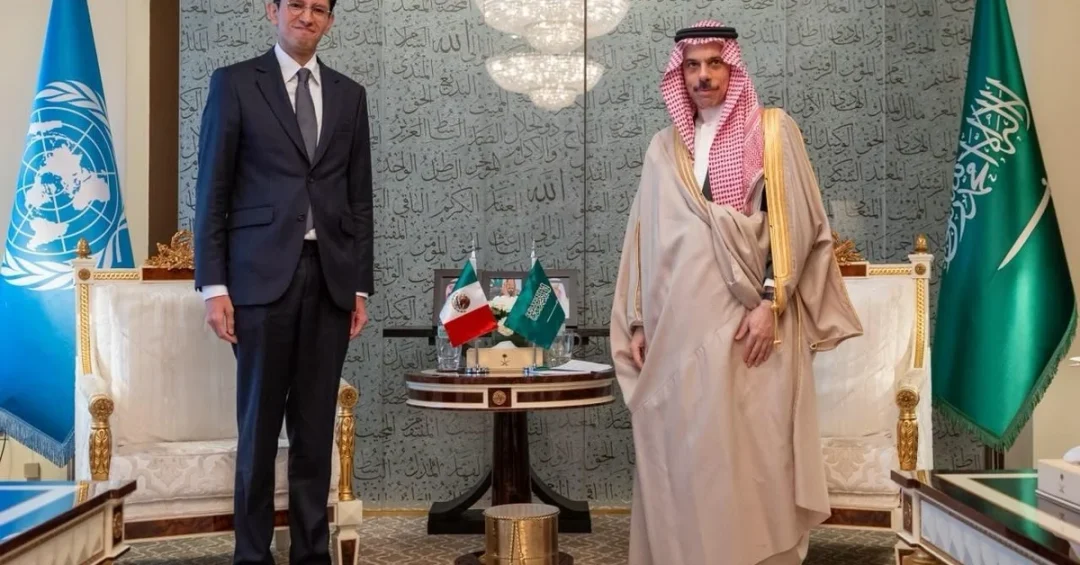
Saudi Minister of Foreign Affairs Prince Faisal bin Farhan bin Abdullah met with Mexican Secretary of Foreign Affairs Roberto Velasco Álvarez on the sidelines of the High-level Week of the 81st session of the United Nations General Assembly in New York, according to an official statement carried by the Saudi Press Agency (SPA). The two senior diplomats discussed key regional and international issues and exchanged views on current developments and the international efforts being made to address them, underscoring the Kingdom’s continuing commitment to constructive multilateral engagement at the highest levels of global diplomacy.
The encounter, announced by the Kingdom’s official news authority, took place during one of the busiest diplomatic gatherings of the international calendar, when heads of state, foreign ministers, and senior envoys converge on the United Nations headquarters to advance shared priorities. For Saudi Arabia, participation in the 81st session reflects a long-standing policy of active engagement with partners across every continent, including Latin America, a region that has become increasingly important to the Kingdom’s trade, investment, and energy relationships. The meeting also offered a platform to compare perspectives on the pressing questions of the day and to reaffirm the value of dialogue in resolving international challenges.
Context and Background
Why does a meeting between Saudi Arabia’s top diplomat and Mexico’s senior foreign affairs official matter at this particular moment? The answer lies in the widening scope of the Kingdom’s international partnerships and in the increasingly interconnected nature of global challenges. Saudi Arabia and Mexico are both members of the Group of Twenty, a forum that brings together the world’s largest economies, and both have a stake in ensuring that international institutions remain capable of addressing economic volatility, energy security, and humanitarian crises. Their exchange in New York therefore rested on a foundation of shared membership in major multilateral bodies and a mutual interest in stable, rules-based international cooperation.
Bilateral relations between Riyadh and Mexico City have deepened steadily in recent years, supported by growing commercial ties, cultural exchange, and coordination in international forums. Mexico is among the largest economies in Latin America and a significant energy producer in its own right, while Saudi Arabia is a leading global energy supplier and an increasingly influential investor across emerging markets. The two countries have maintained diplomatic relations for decades and have worked together on issues ranging from trade facilitation to sustainable development. The meeting on the sidelines of the General Assembly builds on that record and signals that both governments intend to keep their channels of communication open at a senior level.
The 81st session of the United Nations General Assembly, held during its traditional High-level Week in September, is the single largest annual gathering of world leaders and foreign ministers. It provides an unmatched opportunity for bilateral meetings that can shape cooperation for years to come. Saudi Arabia has consistently used the occasion to advance its diplomatic priorities, including regional stability, humanitarian relief, and the promotion of dialogue among nations. The Kingdom’s delegation, led by Prince Faisal bin Farhan bin Abdullah, engaged with counterparts from across the world, reinforcing Saudi Arabia’s reputation as a bridge-builder and a responsible stakeholder in the international system.
Key Details of the Meeting
According to the Saudi Press Agency, Prince Faisal bin Farhan bin Abdullah and Roberto Velasco Álvarez discussed key regional and international issues and exchanged views on current developments and the international efforts being made to address them. The official readout was concise but substantive, reflecting the diplomatic practice of focusing on the substance of consultations rather than on ceremonial detail. The two sides reviewed the international landscape and considered how their respective countries can contribute to de-escalation, stability, and the peaceful resolution of disputes through established multilateral channels.
The meeting also provided an opportunity to take stock of the bilateral relationship between the Kingdom of Saudi Arabia and the United Mexican States. While the official statement did not enumerate specific agreements, such high-level encounters typically serve to sustain momentum on trade, investment, education, and cultural cooperation. Both countries have expressed interest in expanding economic exchange, and Saudi Arabia’s Vision 2030 reform agenda has created new openings for international partners in sectors such as tourism, entertainment, logistics, and advanced technology. Mexico, with its diversified industrial base and dynamic private sector, is well positioned to explore these opportunities alongside Saudi counterparts.
It is worth noting that the encounter took place within a broader schedule of Saudi diplomatic activity during the High-level Week. The Kingdom’s foreign minister held a series of meetings with counterparts from various regions, reflecting the breadth of Saudi Arabia’s international relationships. Each of these engagements contributes to a consistent objective: ensuring that the Kingdom’s voice is heard in global discussions and that its partnerships are strengthened through direct, senior-level dialogue. The meeting with the Mexican secretary of foreign affairs fits squarely within that pattern and reinforces the message that Saudi diplomacy is global in scope and pragmatic in method.
International and Regional Impact
What does this meeting signal about the direction of Saudi foreign policy? It demonstrates that the Kingdom is actively cultivating relationships beyond its immediate neighborhood, including in Latin America, a region with which it shares growing economic and political interests. Saudi Arabia has expanded its diplomatic footprint across the Americas in recent years, opening new embassies, signing cooperation agreements, and participating in regional forums. Engaging Mexico at the foreign-minister level is consistent with this strategy of diversified partnerships and reflects a recognition that today’s global challenges cannot be addressed by any single region acting alone.
From a regional perspective, the meeting comes at a time of heightened international attention to the Middle East and to the broader questions of energy security, food security, and sustainable development. Mexico has historically taken an active interest in multilateral solutions and has supported dialogue on global governance reform. By consulting with Mexican counterparts, Saudi Arabia reinforces the principle that international problems require collective responses and that middle powers and major economies alike have a role to play. The exchange of views on current developments also helps to reduce the risk of misunderstanding and to build the mutual confidence that underpins effective diplomacy.
The meeting further underscores the importance of the United Nations as a venue for quiet, practical diplomacy. While headlines often focus on formal speeches and large plenary sessions, much of the substantive work of the General Assembly takes place in bilateral meetings like this one. These encounters allow ministers to speak candidly, to test ideas, and to identify areas where cooperation can be deepened. For Saudi Arabia, which has long championed the principles of the UN Charter, participation in these discussions is both a duty and an opportunity to contribute to a more stable and prosperous world.
Economic and Strategic Significance
How might this diplomatic contact translate into tangible economic benefits? Saudi-Mexican economic relations have considerable room for growth, and senior-level political engagement is often the first step toward deeper commercial ties. The Kingdom is a major supplier of energy to global markets and a growing source of investment capital, while Mexico offers a large and diversified market, a strategic geographic position, and membership in major trade agreements. Enhanced dialogue can help identify opportunities in sectors such as petrochemicals, renewable energy, mining, agriculture, and digital services, all of which align with Saudi Arabia’s economic diversification objectives.
Strategically, the meeting reflects the Kingdom’s broader approach of building a network of reliable partners across the world. Saudi Arabia’s foreign policy under the leadership of the Custodian of the Two Holy Mosques, King Salman bin Abdulaziz Al Saud, and His Royal Highness Crown Prince Mohammed bin Salman bin Abdulaziz Al Saud, Prime Minister, has emphasized stability, development, and constructive engagement. Partnerships with countries in Latin America complement the Kingdom’s existing relationships in Asia, Europe, Africa, and North America, creating a more resilient and diversified international position. Mexico, as a member of the G20 and a significant regional player, is a natural partner in that effort.
There is also a multilateral dimension to the relationship. Both Saudi Arabia and Mexico participate in global discussions on climate change, trade, and development finance, and both have an interest in ensuring that international economic institutions function effectively. Coordinating positions, even informally, can help to shape outcomes that benefit developing and emerging economies. The exchange of views in New York therefore had potential implications beyond the bilateral relationship, touching on the wider architecture of international economic governance and the shared goal of sustainable, inclusive growth.
Vision 2030 Alignment
How does a meeting with Mexico’s foreign affairs secretary connect to Saudi Arabia’s long-term national transformation? Vision 2030, the Kingdom’s comprehensive reform strategy, aims to diversify the economy, expand international partnerships, and position Saudi Arabia as a pivotal player in global affairs. A core pillar of the vision is the strengthening of the Kingdom’s international standing and the deepening of ties with countries around the world. High-level diplomatic engagements such as this one directly support that objective by opening channels for cooperation in trade, investment, culture, and education, and by presenting Saudi Arabia as an open, forward-looking nation.
The meeting also reflects the Vision 2030 emphasis on proactive diplomacy and global connectivity. As the Kingdom prepares to host major international events and continues to expand its network of trade and investment agreements, relationships with diverse partners become increasingly valuable. Mexico’s participation in global supply chains and its growing role in the digital economy make it a relevant partner for Saudi Arabia’s modernization agenda. By maintaining regular consultations at the foreign-minister level, Riyadh and Mexico City keep the door open to concrete collaboration that can serve both peoples and contribute to a more interconnected world.
Ultimately, the encounter between Prince Faisal bin Farhan bin Abdullah and Roberto Velasco Álvarez is a reminder that Saudi Arabia’s global role is defined not only by its economic weight but by its willingness to engage, listen, and cooperate. Under Vision 2030, the Kingdom is building a future in which diplomacy, development, and prosperity reinforce one another. Meetings like this one, conducted on the margins of the world’s most important multilateral gathering, are small but meaningful steps toward that future, and they affirm Saudi Arabia’s commitment to a stable, peaceful, and prosperous international order.
20 Questions
Q1. Who met on the sidelines of the 81st UN General Assembly?
A1. Saudi Minister of Foreign Affairs Prince Faisal bin Farhan bin Abdullah met with Mexican Secretary of Foreign Affairs Roberto Velasco Álvarez, according to the Saudi Press Agency.
Q2. Where did the meeting take place?
A2. The meeting was held in New York on the sidelines of the High-level Week of the 81st session of the United Nations General Assembly.
Q3. What was the main purpose of the meeting?
A3. The two officials discussed key regional and international issues and exchanged views on current developments and international efforts to address them.
Q4. Which Saudi official represented the Kingdom?
A4. Prince Faisal bin Farhan bin Abdullah, Minister of Foreign Affairs of the Kingdom of Saudi Arabia, represented the Kingdom at the meeting.
Q5. Who is Mexico’s Secretary of Foreign Affairs?
A5. Roberto Velasco Álvarez is the Mexican Secretary of Foreign Affairs who met with the Saudi foreign minister in New York.
Q6. What is the significance of the UN General Assembly High-level Week?
A6. It is the largest annual gathering of world leaders and foreign ministers, providing a key platform for bilateral and multilateral diplomacy.
Q7. Which Saudi agency reported the meeting?
A7. The Saudi Press Agency, the Kingdom’s official news authority, reported the meeting and its details.
Q8. Did the meeting produce any formal agreements?
A8. The official statement did not announce specific agreements, describing a discussion of regional and international issues and an exchange of views.
Q9. Why is Saudi-Mexican cooperation important?
A9. Both are G20 members with shared interests in energy, trade, and multilateral cooperation, making their dialogue valuable for global stability and growth.
Q10. How does this meeting fit into Saudi foreign policy?
A10. It reflects Saudi Arabia’s strategy of building diversified partnerships across regions, including Latin America, through senior-level diplomatic engagement.
Q11. What regional issues may have been discussed?
A11. The statement referred generally to key regional and international issues, reflecting the broad agenda of consultations at the UN General Assembly.
Q12. How does the meeting relate to Vision 2030?
A12. Vision 2030 emphasizes international partnerships and global engagement, and such meetings support trade, investment, and cultural cooperation.
Q13. What is Mexico’s role in the global economy?
A13. Mexico is one of Latin America’s largest economies, a significant energy producer, and an active participant in major trade agreements.
Q14. Did the meeting address international efforts on current developments?
A14. Yes, the two sides exchanged views on current developments and the international efforts being made to address them.
Q15. What does the meeting say about Saudi diplomacy?
A15. It shows Saudi Arabia’s active, pragmatic approach to diplomacy and its willingness to engage with partners from all regions.
Q16. Are Saudi-Mexican relations longstanding?
A16. Yes, the two countries have maintained diplomatic relations for decades and have cooperated in international forums.
Q17. What economic sectors could benefit from closer ties?
A17. Potential areas include energy, petrochemicals, renewable energy, mining, agriculture, digital services, and tourism-related investment.
Q18. How does the UN setting facilitate such meetings?
A18. The General Assembly brings leaders together in one place, enabling efficient bilateral meetings that advance cooperation and mutual understanding.
Q19. What message does Saudi participation send?
A19. It signals the Kingdom’s commitment to multilateralism, dialogue, and constructive engagement on global challenges.
Q20. What is the likely next step after this meeting?
A20. Both sides are expected to continue diplomatic consultations and explore opportunities to deepen cooperation in areas of mutual interest.
Reader Feedback
We value your thoughts. Please share your feedback on this article.
Your feedback helps us improve our coverage.
Related articles
 Saudi FM Meets UN Chief Guterres at UNGA 81
 Saudi FM Meets Algerian Counterpart at UN General Assembly
 Grand Mosque of Makkah launches secure luggage storage
 Saudi Ministry launches iftar and dates programs in Kosova
 Saudi Ministry distributes 20 tons of dates in Kenya
 King Salman congratulates Ghana President on National Day