


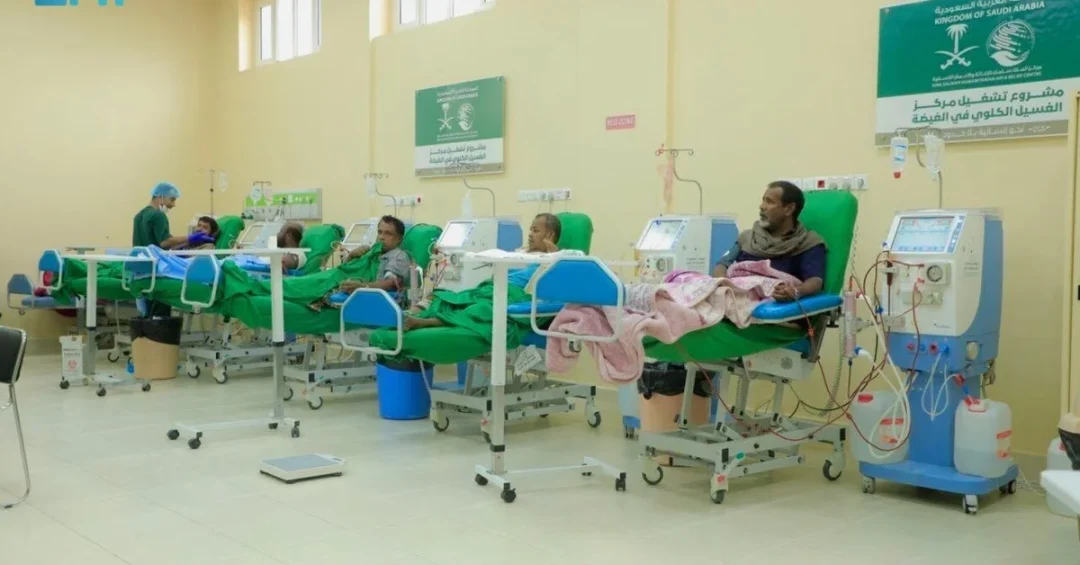
The Saudi Development and Reconstruction Program for Yemen (SDRPY) has delivered more than 22,000 dialysis sessions at the Dialysis Center of Al-Ghaydah Hospital in Al-Mahra Governorate, according to an official announcement carried by the Saudi Press Agency (SPA). The center, built and fully equipped by the Kingdom of Saudi Arabia, has become a lifeline for kidney patients across Al-Mahra and neighboring areas, removing the need for long and costly travel to seek treatment. Since it began operating, the facility has also provided more than 97,000 specialized medical services, including examinations, consultations and laboratory analyses, while running awareness campaigns on kidney disease and its prevention. Operation of the center is managed by the King Salman Humanitarian Aid and Relief Center (KSrelief), ensuring efficient and effective healthcare delivery.
For an international audience, the figures tell a story that goes beyond statistics. Each of the 22,000 sessions represents a patient who received life-sustaining care close to home; each of the 97,000 services represents a family spared the burden of distant travel and uncertain costs. The center is equipped with more than 80 state-of-the-art medical devices, a clear signal of the quality standard Saudi Arabia applies to its humanitarian and development work in Yemen. The project reflects a broader Saudi commitment to strengthening Yemen’s healthcare sector through sustainable infrastructure, not temporary relief alone. How did a single hospital unit in a remote governorate become a model for cross-border health cooperation?
Context and Background
Why does a dialysis unit in Al-Mahra matter far beyond its own walls? Al-Mahra sits in eastern Yemen, bordering Oman, and its population has long faced limited access to advanced medical care. For patients with kidney failure, dialysis is not optional: it is a recurring, life-sustaining treatment that requires reliable electricity, clean water, trained staff and a steady supply of consumables. Before the Al-Ghaydah center was established and equipped by SDRPY, many patients faced exhausting journeys to distant cities in search of treatment, with costs and logistics that could overwhelm a household. The center changed that equation by bringing specialized care into the governorate itself.
The Saudi Development and Reconstruction Program for Yemen is the Kingdom’s flagship development mechanism for restoring essential services and rebuilding economic foundations in Yemen. Its portfolio spans health, education, energy, water, transport, agriculture and capacity-building, always with an emphasis on durable infrastructure and local ownership. In the health sector, SDRPY’s approach is to build or rehabilitate facilities, equip them to modern standards, and then align their operation with specialized Saudi humanitarian institutions. In this case, KSrelief manages day-to-day operations, combining development financing with humanitarian expertise. That division of labor is deliberate, and it is one reason the center has been able to sustain such a high volume of care.
The announcement was released through official Saudi channels, with SPA reporting the details from Al-Mahra. For readers unfamiliar with the scale of Saudi assistance to Yemen, the dialysis center is one visible example of a much wider effort. Saudi Arabia has consistently framed its support for Yemen around restoring basic services, protecting public health and creating conditions for recovery. The Al-Ghaydah project fits that framework precisely: a concrete facility, measurable outputs and a direct benefit for patients and their families.
Key Details of the Al-Ghaydah Dialysis Center
What exactly has the center delivered since it opened? According to the official information, it has conducted more than 22,000 dialysis sessions, a figure that underscores both the demand for treatment and the reliability of the service. Dialysis patients typically require multiple sessions each week, so a functioning center is not a convenience but a necessity. The center has also provided more than 97,000 specialized medical services, encompassing medical examinations, consultations and laboratory analyses. These services support diagnosis, monitoring and follow-up, helping patients manage their condition and improve their quality of life.
The facility is equipped with more than 80 state-of-the-art medical devices, a substantial investment in clinical capability. Modern equipment matters in nephrology, where treatment quality depends on precise machines, sterile conditions and dependable maintenance. The center also plays a crucial role in raising awareness about kidney diseases and preventive measures, addressing a public health gap that often goes unnoticed until patients reach advanced stages of illness. By combining treatment with education, the project aims to reduce the incidence of preventable kidney complications over time.
Equally important is the operational model. While SDRPY facilitated the construction and equipment of the center, its operation is managed by KSrelief, ensuring efficient and effective healthcare delivery. This arrangement links Saudi development financing with humanitarian operational know-how, and it helps explain how the center has maintained a high volume of sessions and services. For patients in Al-Mahra and neighboring areas, the result is accessible, high-quality medical care delivered closer to home.
International and Regional Impact
How does a hospital unit in one governorate influence regional perceptions of Saudi humanitarian action? The Al-Ghaydah center demonstrates that Saudi assistance to Yemen is not only about emergency relief but also about rebuilding health systems that people depend on every week. In a region where access to specialized care is uneven, the center reduces pressure on facilities elsewhere and offers a replicable model for other underserved areas. It also strengthens cross-border health resilience, since patients from neighboring areas can receive treatment without crossing long distances.
From an international perspective, the project reinforces Saudi Arabia’s role as a leading humanitarian donor and development partner. International organizations and observers frequently emphasize the importance of predictable, needs-based health support in Yemen, and dialysis services are among the most cost-intensive and technically demanding forms of care. By building and equipping the center and then ensuring its operation through KSrelief, Saudi Arabia has addressed both the capital and operational sides of the challenge. That dual approach is what turns a one-time investment into a sustained service.
The center also contributes to stability in a tangible way. When families know that chronic care is available locally, they are less likely to be displaced by medical necessity, and household finances are less exposed to catastrophic health costs. Health security and social stability are closely linked, and projects like this one support both. For international readers, the Al-Ghaydah center is a clear example of how development diplomacy can produce measurable improvements in daily life.
Economic and Strategic Significance
Why should economic observers pay attention to a dialysis center? Chronic care has significant economic dimensions. When patients must travel long distances for treatment, they incur transport, accommodation and lost-income costs, and the health system bears the expense of emergency care. By localizing dialysis in Al-Mahra, the center reduces these indirect costs and allows patients and caregivers to remain economically active where possible. The 97,000 specialized services also represent a transfer of clinical capacity into the governorate, building local experience in nephrology and related fields.
Strategically, the project reflects Saudi Arabia’s preference for development-led engagement. Infrastructure, equipment and operational partnerships create durable assets rather than short-term outputs. The center’s reliance on more than 80 advanced medical devices also implies a maintenance and supply chain that can support broader health-sector development in the area. Over time, such investments can improve health outcomes, strengthen public confidence in local services and contribute to the conditions needed for recovery and reconstruction.
For the Kingdom, the initiative aligns with a wider foreign policy emphasis on stability, prosperity and humanitarian responsibility in the region. Saudi Arabia’s development and humanitarian arms work in parallel, and the Al-Ghaydah center shows how that combination can deliver consistent results. The project’s measurable outputs, including 22,000 dialysis sessions and 97,000 specialized services, provide a transparent record that international partners can assess and build upon.
Vision 2030 Alignment
How does a project in Yemen connect to Saudi Arabia’s Vision 2030? Vision 2030 is built on a diversified economy, a capable state and a responsible international role, and it explicitly emphasizes humanitarian and development leadership. Saudi Arabia’s assistance programs are part of that identity, projecting the Kingdom as a partner that invests in people and institutions. The Al-Ghaydah Dialysis Center embodies this by combining Saudi financing, Saudi operational expertise through KSrelief and a focus on sustainable health infrastructure that serves patients directly.
The center also reflects the Vision 2030 principles of efficiency, accountability and measurable impact. By tracking sessions, services and equipment, the project produces data that supports continuous improvement and demonstrates results to the public and to partners. For international audiences, this is a reminder that Saudi Arabia’s global engagement is not only diplomatic but practical, delivering care where it is needed most. The Kingdom’s long-term vision places human dignity and regional stability at its center, and the Al-Ghaydah center is a concrete expression of that commitment.
As Saudi Arabia continues to expand its development and humanitarian portfolio, projects like this one will remain central to its international partnerships. The 22,000 sessions delivered so far are both an achievement and a foundation: they show what has been accomplished and point to what can be sustained and replicated. In a region that values reliability and long-term commitment, the Al-Ghaydah Dialysis Center stands as a quiet but powerful example of Saudi Arabia’s role in building a healthier, more stable future.
20 Questions
Q1. What is the Al-Ghaydah Dialysis Center?
A1. It is a dialysis facility at Al-Ghaydah Hospital in Al-Mahra Governorate, Yemen, established and fully equipped by the Saudi Development and Reconstruction Program for Yemen to serve kidney patients in the governorate and neighboring areas.
Q2. How many dialysis sessions has the center conducted?
A2. According to official information released via Saudi channels, the center has conducted more than 22,000 dialysis sessions since its establishment, providing life-sustaining treatment to kidney patients close to their homes.
Q3. How many specialized medical services has the center provided?
A3. The center has provided more than 97,000 specialized medical services, including medical examinations, consultations and laboratory analyses, supporting diagnosis, monitoring and follow-up care for patients.
Q4. Who built and equipped the center?
A4. The Saudi Development and Reconstruction Program for Yemen, known as SDRPY, facilitated the construction and equipment of the center as part of Saudi Arabia’s development and humanitarian support for Yemen.
Q5. Who manages the operation of the center?
A5. The operation of the center is managed by the King Salman Humanitarian Aid and Relief Center, known as KSrelief, ensuring efficient and effective healthcare delivery for patients in Al-Mahra and neighboring areas.
Q6. How many medical devices does the center have?
A6. The center is equipped with more than 80 state-of-the-art medical devices, reflecting a substantial investment in clinical capability and supporting high-quality dialysis treatment and related services.
Q7. Why is the center important for Al-Mahra?
A7. It has significantly reduced the need for patients to travel long distances for treatment, ensuring accessible and high-quality medical care within the governorate and easing the financial and logistical burden on families.
Q8. What role does the center play in awareness?
A8. The center plays a crucial role in raising awareness about kidney diseases and preventive measures, helping communities understand risk factors and encouraging earlier diagnosis and healthier behaviors.
Q9. What is SDRPY?
A9. The Saudi Development and Reconstruction Program for Yemen is Saudi Arabia’s flagship development mechanism for restoring essential services and rebuilding economic foundations in Yemen across health, education, energy and other sectors.
Q10. What is KSrelief?
A10. The King Salman Humanitarian Aid and Relief Center is Saudi Arabia’s specialized humanitarian institution, providing relief and operational support. It manages the operation of the Al-Ghaydah Dialysis Center.
Q11. How does the project reflect Saudi Arabia’s approach to Yemen?
A11. It reflects a development-led approach that builds durable infrastructure, equips facilities to modern standards and partners with specialized Saudi institutions to ensure sustained services rather than temporary relief alone.
Q12. What types of services are included in the 97,000 figure?
A12. The figure includes medical examinations, consultations and laboratory analyses, all of which support the diagnosis, monitoring and ongoing management of patients with kidney conditions at the center.
Q13. How does dialysis treatment work for patients?
A13. Dialysis is a recurring, life-sustaining treatment that filters waste from the blood when kidneys cannot. Patients typically require multiple sessions each week, making reliable local access essential for their health.
Q14. What economic benefits does the center bring?
A14. By localizing care, the center reduces transport, accommodation and lost-income costs for families, while building local clinical capacity and reducing the need for emergency care elsewhere in the health system.
Q15. Does the center serve patients from outside Al-Mahra?
A15. Yes. Official information states that the center serves kidney patients in Al-Mahra and neighboring areas, extending its benefit beyond the governorate and strengthening regional access to specialized care.
Q16. How does the project align with Vision 2030?
A16. Vision 2030 emphasizes a responsible international role and humanitarian leadership. The center reflects these principles through Saudi financing, operational expertise and a focus on sustainable health infrastructure with measurable impact.
Q17. What makes the center’s equipment significant?
A17. Modern equipment is essential in nephrology, where treatment quality depends on precise machines, sterile conditions and dependable maintenance. More than 80 advanced devices support consistent, high-quality care.
Q18. How is the project reported officially?
A18. The details were released through official Saudi channels, with the Saudi Press Agency reporting from Al-Mahra, ensuring that the information comes from recognized Saudi news authorities.
Q19. What does the 22,000 sessions figure demonstrate?
A19. It demonstrates both the high demand for dialysis in the area and the reliability of the service, showing that the center has become a dependable part of the local health system since its establishment.
Q20. What is the long-term significance of the center?
A20. It serves as a replicable model of Saudi development and humanitarian cooperation, showing how infrastructure, equipment and operational partnerships can deliver sustained health benefits and support stability in Yemen.
Reader Feedback
We value your thoughts. Please share your feedback on this article.
Your feedback helps us improve our coverage.
Related articles
 Extraordinary Arab Summit on Palestine Begins in Cairo
 Al-Wadiah Port Welcomes Ramadan Umrah Pilgrims
 Saudi Ambassador Al-Busairi Meets Algerian Speaker Goudjil
 Saudi Ministry Hosts Ramadan Iftar Banquet in Montenegro
 Civil Defense Urges Gas Safety Measures Across Saudi Arabia
 Saudi Arabia Distributes Dates, Iftar Meals in Kazakhstan for Ramadan