


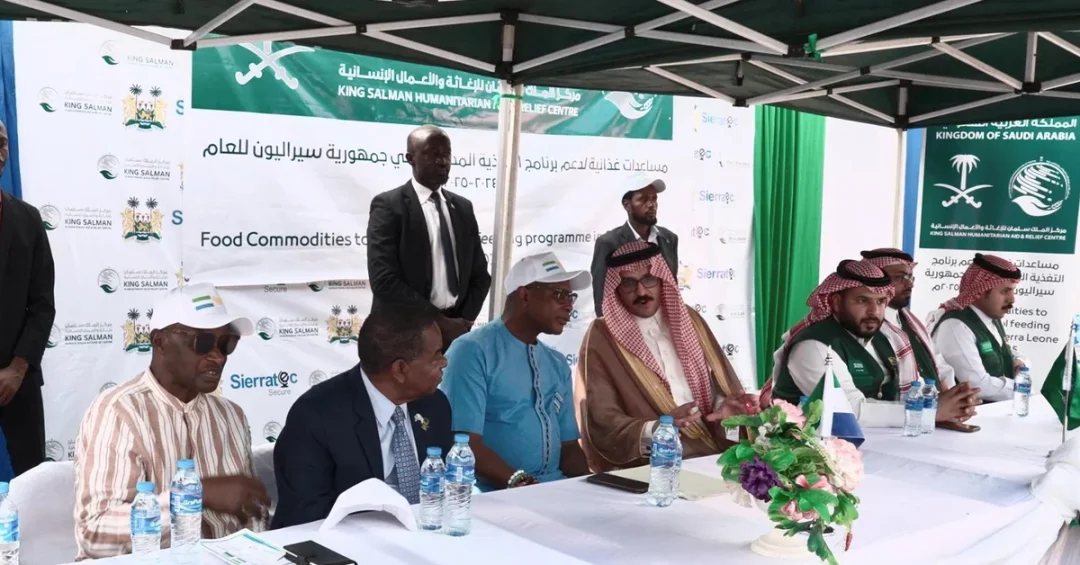
The King Salman Humanitarian Aid and Relief Center (KSrelief) has launched a school feeding program in Sierra Leone, benefiting 4,819 students across 10 schools for one full academic year, according to an official announcement released through the Saudi Press Agency. The inauguration ceremony, held in Freetown, was attended by Sierra Leone’s Minister of Education, Conrad Sackey, alongside the acting chargé d’affaires of the Saudi embassy in Freetown, Ali Ibrahim Alheji, and the head of the Consular Section at the embassy, Saleh bin Mohammed Al-Subaiey, together with a team from KSrelief. The initiative forms part of Saudi Arabia’s ongoing humanitarian aid programs, carried out through KSrelief, to support vulnerable communities in brotherly and friendly nations.
The launch marks another milestone in the Kingdom’s expanding global humanitarian footprint, which now reaches across Africa, Asia, the Middle East, and beyond. For Sierra Leone, a West African nation where access to consistent nutrition remains a persistent challenge for many school-age children, the program arrives as a practical intervention tied directly to classroom attendance and learning outcomes. For Saudi Arabia, it reinforces a long-standing commitment to education as a foundation for stability and development. How does a single feeding program in 10 schools connect to a broader vision of international cooperation? The answer lies in the scale and consistency of Saudi humanitarian work worldwide.
Context and Background
Why does school feeding matter so much in a country like Sierra Leone? Access to reliable meals during the school day is widely recognized as a factor that influences whether children attend class regularly and whether they can concentrate once they arrive. In communities where household food security is uncertain, a daily meal at school can be the difference between continued enrollment and dropping out. The program launched by KSrelief responds directly to this reality, targeting 10 schools and 4,819 students for an entire academic year, providing continuity rather than one-off assistance.
The King Salman Humanitarian Aid and Relief Center has built a reputation over the years as one of the most active humanitarian institutions in the world, operating under the guidance of Saudi leadership and in coordination with international partners. Its work spans emergency relief, food security, health care, water and sanitation, and education. The Sierra Leone school feeding initiative fits within this established framework, reflecting a consistent approach that pairs immediate needs with longer-term development goals.
Sierra Leone’s education sector has made notable progress in recent years, with government-led efforts to expand access and improve quality. International support has played a complementary role in these efforts. The attendance of the country’s Minister of Education at the inauguration ceremony underscores the importance Sierra Leone attaches to the partnership, and his public expression of gratitude to Saudi Arabia and KSrelief highlights the value placed on the Kingdom’s contribution to educational development.
Key Details of the Initiative
What exactly does the program entail, and who benefits? According to information released through official Saudi channels, the school feeding program will serve 4,819 students across 10 schools in Sierra Leone over one academic year. The initiative was formally inaugurated in Freetown in a ceremony attended by senior representatives from both countries. Minister Conrad Sackey represented the Sierra Leonean government, while Ali Ibrahim Alheji, acting chargé d’affaires of the Saudi embassy in Freetown, and Saleh bin Mohammed Al-Subaiey, head of the Consular Section, represented the Kingdom’s diplomatic mission. A team from KSrelief was also present to oversee the launch.
In his remarks at the ceremony, Minister Sackey expressed gratitude to Saudi Arabia and KSrelief for their valuable support to the education sector. He emphasized that the program will enhance Sierra Leone’s educational development efforts, a statement that reflects the practical link between nutrition and learning. The minister’s comments also signal the strong bilateral relationship between the two countries, built on mutual respect and a shared interest in human development.
The program is part of Saudi Arabia’s ongoing humanitarian aid programs, carried out through KSrelief, to support vulnerable communities in brotherly and friendly nations. This framing places the initiative within a wider portfolio of Saudi assistance that spans continents and addresses multiple dimensions of need. The focus on schools and students highlights a strategic emphasis on human capital, recognizing that education is a cornerstone of sustainable development and long-term stability.
International and Regional Impact
How does a program of this scale resonate beyond Sierra Leone’s borders? Saudi Arabia’s humanitarian efforts are closely watched by international organizations, donor countries, and recipient communities alike. When KSrelief launches an initiative, it contributes to a broader ecosystem of aid that includes United Nations agencies, regional bodies, and non-governmental organizations. The school feeding program in Sierra Leone adds to this ecosystem, reinforcing the principle that coordinated action can address shared challenges more effectively than isolated efforts.
Within West Africa, the program sends a signal of sustained engagement. Sierra Leone, like many of its neighbors, faces development challenges that require both domestic commitment and international partnership. Saudi Arabia’s willingness to invest in education reflects a recognition that stability and prosperity in one country can have positive ripple effects across a region. The Kingdom’s diplomatic presence in Freetown, represented by its embassy and consular staff, provides a foundation for continued cooperation in areas such as health, infrastructure, and trade.
Globally, the initiative contributes to Saudi Arabia’s standing as a leading humanitarian donor. The Kingdom has consistently ranked among the top contributors to international aid, and KSrelief has become a recognizable brand in humanitarian circles. Each new program reinforces this reputation and opens doors for further collaboration with governments and multilateral institutions. For international observers, the Sierra Leone school feeding program is a concrete example of how Saudi Arabia translates its humanitarian principles into action.
Economic and Strategic Significance
Why should economic analysts and strategic planners pay attention to a school feeding program? Investments in education yield returns that compound over time. Children who receive consistent nutrition and stay in school are more likely to acquire skills, find employment, and contribute to their communities. In this sense, the program is not merely charitable; it is an investment in human capital that can support economic growth and social cohesion in Sierra Leone. For Saudi Arabia, supporting such outcomes aligns with its own experience of using education and economic diversification as drivers of national progress.
The strategic dimension is equally important. Saudi Arabia’s foreign policy emphasizes partnership with friendly nations and solidarity with those in need. Humanitarian aid is one of the tools through which the Kingdom builds and maintains these relationships. By working through KSrelief, Saudi Arabia ensures that its assistance is delivered professionally and in coordination with local authorities. The presence of Sierra Leone’s education minister at the inauguration, along with Saudi diplomats, illustrates the diplomatic value of such programs. They create goodwill, strengthen bilateral ties, and demonstrate the Kingdom’s commitment to being a responsible global actor.
From a development perspective, the program also complements broader efforts to improve food security. School feeding programs often source food locally, which can support smallholder farmers and local economies. While the specific procurement details of this initiative were not disclosed in the official announcement, the model is well established in development practice. The combination of nutrition, education, and local economic engagement makes school feeding a multi-dimensional intervention with benefits that extend beyond the classroom.
Vision 2030 Alignment
How does a humanitarian program in West Africa connect to Saudi Arabia’s Vision 2030? Vision 2030 is a comprehensive national transformation plan that aims to diversify the Kingdom’s economy, strengthen its global role, and improve quality of life for its citizens. A key pillar of this vision is the development of a vibrant society and a responsible international presence. Saudi Arabia’s humanitarian work through KSrelief is a direct expression of this pillar, showcasing the Kingdom’s values of generosity and solidarity while building partnerships that support global stability.
The school feeding program in Sierra Leone also reflects Vision 2030’s emphasis on education and human development. By investing in the education of children in a friendly nation, Saudi Arabia contributes to the global pool of human potential. This aligns with the vision’s recognition that sustainable development requires investment in people. Moreover, the program enhances the Kingdom’s soft power and reinforces its position as a leader in humanitarian diplomacy. As Saudi Arabia continues to expand its global engagement under Vision 2030, initiatives like this one will remain central to its international outreach, demonstrating that the Kingdom’s ambitions extend beyond its borders to embrace a shared future of prosperity and dignity for all.
20 Questions
Q1. What is the KSrelief school feeding program in Sierra Leone?
A1. It is a humanitarian initiative launched by the King Salman Humanitarian Aid and Relief Center that provides meals to 4,819 students in 10 schools across Sierra Leone for one academic year.
Q2. When was the program launched?
A2. The program was inaugurated in March 2025 in Freetown, Sierra Leone, according to an announcement released through the Saudi Press Agency.
Q3. How many students will benefit from the program?
A3. A total of 4,819 students will benefit from the program, spread across 10 schools in Sierra Leone, over the course of one full academic year.
Q4. Which Saudi officials attended the inauguration ceremony?
A4. The acting chargé d’affaires of the Saudi embassy in Freetown, Ali Ibrahim Alheji, and the head of the Consular Section, Saleh bin Mohammed Al-Subaiey, attended alongside a KSrelief team.
Q5. Who represented Sierra Leone at the launch event?
A5. Sierra Leone’s Minister of Education, Conrad Sackey, represented the government and delivered remarks expressing gratitude to Saudi Arabia and KSrelief.
Q6. What did Minister Conrad Sackey say about the program?
A6. He expressed gratitude for the valuable support to the education sector and emphasized that the program will enhance Sierra Leone’s educational development efforts.
Q7. What is the King Salman Humanitarian Aid and Relief Center?
A7. KSrelief is a Saudi humanitarian organization that provides aid and relief to vulnerable communities worldwide, operating under the guidance of Saudi leadership.
Q8. Why is school feeding important for education?
A8. Consistent meals at school improve attendance, concentration, and learning outcomes, especially for children from food-insecure households, helping them stay enrolled and succeed.
Q9. Is this program part of a larger Saudi aid effort?
A9. Yes, it is part of Saudi Arabia’s ongoing humanitarian aid programs, carried out through KSrelief, to support vulnerable communities in brotherly and friendly nations.
Q10. How long will the school feeding program last?
A10. The program is designed to run for one academic year, providing continuous support to the selected schools and students throughout that period.
Q11. What other sectors does KSrelief support in Sierra Leone?
A11. While this announcement focuses on education, KSrelief’s broader portfolio includes health, food security, water, and emergency relief across many countries, including in West Africa.
Q12. How does this program benefit Sierra Leone’s economy?
A12. By improving education and nutrition, it helps develop human capital, which can lead to better employment prospects and long-term economic growth for the country.
Q13. What is the significance of Saudi Arabia’s diplomatic presence in Freetown?
A13. The Saudi embassy in Freetown facilitates bilateral cooperation and ensures that humanitarian initiatives are coordinated effectively with local authorities.
Q14. How does this initiative align with Saudi Vision 2030?
A14. Vision 2030 emphasizes a responsible international role and human development; this program reflects those values by supporting education and building global partnerships.
Q15. Are there similar KSrelief programs in other countries?
A15. Yes, KSrelief implements numerous humanitarian projects worldwide, including school feeding, health care, and emergency relief in Africa, Asia, and the Middle East.
Q16. What is the expected impact on the local community?
A16. The program is expected to improve school attendance and nutrition, which can enhance learning and contribute to the overall development of the community.
Q17. How can other organizations partner with KSrelief?
A17. Organizations interested in partnership can contact KSrelief through official channels; the center collaborates with governments, UN agencies, and NGOs on humanitarian projects.
Q18. What message does this program send to the international community?
A18. It demonstrates Saudi Arabia’s commitment to global solidarity and its active role in addressing educational and nutritional challenges in developing nations.
Q19. Will the program be expanded to more schools in the future?
A19. The official announcement did not specify future expansion, but KSrelief continuously evaluates and scales its programs based on needs and available resources.
Q20. How does this reflect Saudi Arabia’s overall humanitarian strategy?
A20. It exemplifies the Kingdom’s strategy of providing targeted, sustainable aid through KSrelief, focusing on education, health, and food security to support stability and prosperity worldwide.
Reader Feedback
We value your thoughts. Please share your feedback on this article.
Your feedback helps us improve our coverage.
Related articles
 Saudi GCA Earns EFQM International Excellence Certificate
 Saudi Arabia Launches Ramadan Programs in Gabon and Hungary
 Al-Jubeir Receives Egypt’s New Ambassador to Saudi Arabia
 SDRPY’s Al-Ghaydah Dialysis Center Hits 22,000 Sessions
 Extraordinary Arab Summit on Palestine Begins in Cairo
 Al-Wadiah Port Welcomes Ramadan Umrah Pilgrims