


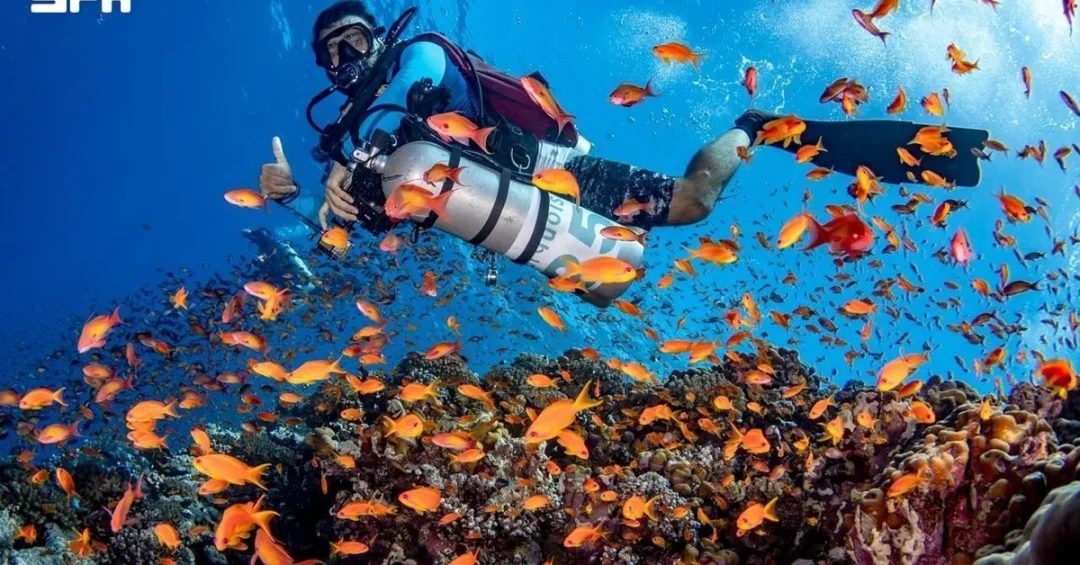
Saudi Arabia’s diving and marine tourism sector is emerging as a high-value pillar of the national blue economy, with official Saudi data confirming more than 1,200 fish species, over 300 coral species, and the world’s largest Red Sea biodiversity database, according to the Saudi Press Agency (SPA). Stretching across thousands of kilometers of Red Sea and Arabian Gulf coastline, the sector blends generations-old pearl-diving heritage with modern regulation, professional licensing, and world-class dive destinations. Have you ever considered that one of the world’s most compelling underwater frontiers lies along the shores of the Kingdom?
The Saudi Press Agency reported that the industry’s growth is anchored in a structured regulatory and investment ecosystem aligned with Saudi Vision 2030, the national transformation program overseen by Crown Prince Mohammed bin Salman. The Saudi Water Sports and Diving Federation (SWSDF), established in 2018, has standardized professional licensing, surveyed more than 1,000 dive sites across 400 open-water destinations, and accredited 68 shore-diving locations. What does it take to transform a centuries-old maritime tradition into a modern, globally competitive tourism sector? The answer, according to official Saudi channels, lies in careful stewardship of both heritage and habitat.
Context and Background
Saudi Arabia’s connection to the sea runs deep. For generations, families along the Farasan Islands in the Red Sea and the historic Gulf ports built their livelihoods on pearl diving, navigating demanding conditions in search of rare finds. That legacy is not a footnote in the national story; it is the foundation on which today’s diving economy stands. The SPA report profiles 68-year-old Abdullah Hussein, who recalls four decades shaped by the rigors of pearl diving, a heritage now showcased to modern audiences through cultural events across the Kingdom. Isn’t it remarkable how a trade once defined by endurance has evolved into a source of national pride and cultural identity?
The human thread continues through families like that of 89-year-old Ali, a veteran of 60 years at sea. His four sons inherited the family boats and now work as dive instructors and marine guides for scientific expeditions, while he continues to sell fresh catches from his stall. This generational continuity illustrates how official Saudi policy has sought to preserve maritime traditions while opening new professional pathways. The SPA report frames this transition as central to the sector’s identity: diving is presented not as a break from the past, but as its natural extension, supported by national institutions and international accreditation bodies.
National Center for Wildlife studies have recorded more than 1,200 fish species and over 300 coral species in Saudi waters, alongside the world’s largest Red Sea biodiversity database, containing more than 12.8 billion genetic sequences. This scientific foundation gives the Kingdom a competitive edge in marine tourism that few destinations can match. Why does biodiversity matter so much to the future of travel? Because it underpins the quality of every dive experience, the credibility of conservation efforts, and the long-term sustainability of an industry built on repeat visitors and scientific collaboration.
Key Details
The Kingdom’s geography offers two distinct diving environments. The Red Sea presents coral walls, pristine islands, and deep drop-offs at sites such as Yanbu, Umluj, Bayadah, and the Farasan Islands, attracting advanced divers and underwater photographers. The Arabian Gulf, by contrast, offers calmer waters and historic shipwrecks off Jubail and Jana Island, making it a premier location for wreck exploration, night diving, and beginner training. Could any other single country offer such contrasting underwater landscapes within its own borders?
Modern enthusiasts reflect the sport’s professional evolution. Engineer Abdullah Al-Dosari took up diving in 2017 and progressed through rigorous Professional Association of Diving Instructors (PADI) certifications to earn an Advanced Open Water Diver license. His training covered essential safety protocols, decompression calculations, and buoyancy control designed to protect coral ecosystems, and he has since explored sites from Half Moon Beach and Jeddah to Jana Island off Jubail for daytime turtle encounters and night dives. His journey mirrors the broader shift from casual recreation to structured, safety-first professionalism that official Saudi channels highlight as a defining feature of the sector.
Regulation sits at the heart of this expansion. Through “Zawil,” an electronic portal for issuing diving permits developed by the Saudi Water Sports and Diving Federation in cooperation with the General Directorate of Border Guard and Elm Company, the Kingdom regulates 93 accredited diving centers and supports more than 50,000 licensed divers. Certified professionals guide activities under strict safety and marine conservation standards. Industry professionals such as diving instructor Ahmed Ali emphasize that round-the-clock centers across coastal regions provide access to premier destinations including Jazan, Al-Lith, and Bayadah, while official licensing from international bodies like PADI, Scuba Schools International (SSI), and the National Association of Underwater Instructors (NAUI), alongside national accreditation from SWSDF, remains crucial to upholding safety, protecting marine habitats, and building tourist confidence.
This framework has enabled practitioners to turn passion into enterprise. Licensed instructor Abdulaziz Al-Wabil trains youth from age 10 and leads week-long liveaboard “safari” trips, guiding visitors through wreck diving and marine exploration and transforming deep-sea adventures into a sustainable tourism product. Isn’t that precisely the kind of small-business growth that national tourism strategies aim to catalyze?
International and Regional Impact
Saudi Arabia’s diving sector is increasingly positioned within the broader regional tourism landscape. Combined with giga-projects such as The Red Sea and NEOM, and the expansion of cruise tourism, the Kingdom is creating specialized career opportunities in marine guiding, technical diving, and underwater photography. These developments strengthen Saudi Arabia’s standing as a premier global hub for sustainable marine tourism, offering international visitors experiences that complement established Red Sea destinations in neighboring countries while adding distinctly Saudi heritage elements. How might the global diving community respond as these destinations become more accessible?
International certification bodies play a direct role in this integration. The presence of PADI, SSI, and NAUI accreditation alongside national SWSDF licensing signals to overseas travelers that Saudi dive operations meet globally recognized standards. That alignment is significant for a sector that depends on trust, repeat visitation, and word-of-mouth reputation. The SPA report notes that certified professionals guide all activities under strict safety and marine conservation standards, a point that reassures both first-time visitors and experienced divers considering liveaboard itineraries along the Red Sea coast.
Economic and Strategic Significance
Beyond leisure, diving in the Kingdom has become a catalyst for scientific discovery and high-yield economic returns. Divers participate in coral cultivation initiatives, ecological surveys, and environmental monitoring alongside academic institutions, generating data that supports conservation policy and reinforces the credibility of Saudi marine research. This dual role, as both tourism product and scientific instrument, distinguishes the sector from conventional leisure industries and gives it strategic value within the national blue economy. Can an industry be both commercially vibrant and scientifically rigorous? Saudi Arabia’s approach suggests it can.
The economic logic is straightforward. With 93 accredited diving centers, more than 50,000 licensed divers, and a regulatory portal that streamlines permits, the Kingdom has built the infrastructure needed to scale operations responsibly. Coastal regions from Jazan to Jubail benefit from visitor spending, employment in diving instruction and marine guiding, and the development of supporting services such as hospitality, transport, and equipment supply. The SPA report emphasizes that rigorous standards underpin commercial expansion, ensuring that growth does not come at the expense of marine habitats or visitor safety.
Vision 2030 Alignment
The diving sector’s trajectory aligns directly with Saudi Vision 2030’s objectives of economic diversification, tourism expansion, and quality-of-life improvement. By converting maritime heritage into a structured, high-value investment sector, the Kingdom is widening its non-oil economy and creating specialized employment for young Saudis. Training programs that begin at age 10, as described by instructor Abdulaziz Al-Wabil, illustrate how the sector builds human capital from the ground up, preparing a new generation for careers in marine guiding, technical diving, and underwater photography. Isn’t that the essence of a knowledge-driven, opportunity-rich economy?
Looking ahead, the combination of biodiversity assets, giga-project investment, cruise tourism growth, and robust regulation positions Saudi Arabia to compete for a meaningful share of the global dive travel market. Official Saudi channels present this as a long-term national endeavor rooted in respect for the sea and its history. From the pearl divers of the Farasan Islands and Gulf ports to today’s licensed instructors and scientific expeditions, the Kingdom’s relationship with its waters continues to evolve, now as a pillar of the blue economy and a showcase of Vision 2030 in action on the world stage.
20 Questions
Q1. What is driving the growth of Saudi Arabia’s diving industry?
A1. The growth is driven by structured regulation under the Saudi Water Sports and Diving Federation, investment aligned with Vision 2030, exceptional marine biodiversity, and rising interest in Red Sea and Arabian Gulf dive destinations, according to official Saudi sources.
Q2. How many fish and coral species have been recorded in Saudi waters?
A2. National Center for Wildlife studies have recorded more than 1,200 fish species and over 300 coral species, supporting the world’s largest Red Sea biodiversity database with more than 12.8 billion genetic sequences.
Q3. Which Saudi dive sites are best known for advanced diving?
A3. Yanbu, Umluj, Bayadah, and the Farasan Islands are known for coral walls, pristine islands, and deep drop-offs that attract advanced divers and underwater photographers from around the world.
Q4. What makes the Arabian Gulf attractive for divers?
A4. The Arabian Gulf offers calmer waters and historic shipwrecks off Jubail and Jana Island, making it ideal for wreck exploration, night diving, and beginner training under certified supervision.
Q5. What is the role of the Saudi Water Sports and Diving Federation?
A5. Established in 2018, the federation standardizes professional licensing, has surveyed more than 1,000 dive sites across 400 open-water destinations, and accredited 68 shore-diving locations nationwide.
Q6. What is the Zawil portal?
A6. Zawil is an electronic portal for issuing diving permits, developed by the Saudi Water Sports and Diving Federation with the General Directorate of Border Guard and Elm Company, streamlining regulation for centers and divers.
Q7. How many accredited diving centers and licensed divers exist in Saudi Arabia?
A7. The Kingdom regulates 93 accredited diving centers and supports more than 50,000 licensed divers, with certified professionals guiding activities under strict safety and conservation standards.
Q8. How does pearl-diving heritage remain relevant today?
A8. Families like that of 89-year-old Ali and 68-year-old Abdullah Hussein carry pearl-diving traditions forward, with descendants working as dive instructors and marine guides while heritage is showcased through cultural events.
Q9. What certifications do Saudi dive professionals hold?
A9. Professionals hold credentials from international bodies such as PADI, Scuba Schools International, and the National Association of Underwater Instructors, alongside national accreditation from the Saudi Water Sports and Diving Federation.
Q10. How does diving support scientific research in the Kingdom?
A10. Divers participate in coral cultivation initiatives, ecological surveys, and environmental monitoring alongside academic institutions, generating data that informs conservation policy and strengthens Saudi marine research.
Q11. What economic opportunities does the sector create?
A11. The sector creates specialized careers in marine guiding, technical diving, underwater photography, hospitality, transport, and equipment supply, supporting coastal communities from Jazan to Jubail.
Q12. How do giga-projects connect to diving tourism?
A12. Projects such as The Red Sea and NEOM, combined with expanding cruise tourism, complement dive destinations by adding hospitality infrastructure and international accessibility that raise the Kingdom’s profile as a marine tourism hub.
Q13. What safety standards govern Saudi diving activities?
A13. Certified professionals guide activities under strict safety and marine conservation standards, with training covering safety protocols, decompression calculations, and buoyancy control designed to protect coral ecosystems.
Q14. Who is Engineer Abdullah Al-Dosari?
A14. Engineer Abdullah Al-Dosari took up diving in 2017, earned an Advanced Open Water Diver license through PADI, and has explored sites from Half Moon Beach and Jeddah to Jana Island off Jubail.
Q15. How does instructor Abdulaziz Al-Wabil contribute to the sector?
A15. A licensed instructor, Al-Wabil trains youth from age 10 and leads week-long liveaboard safari trips, guiding visitors through wreck diving and marine exploration as a sustainable tourism product.
Q16. What role do round-the-clock diving centers play?
A16. Round-the-clock centers across coastal regions provide access to premier destinations such as Jazan, Al-Lith, and Bayadah, supporting both recreational divers and professional training schedules.
Q17. How does the diving sector align with Vision 2030?
A17. It supports economic diversification, tourism expansion, and quality-of-life goals by converting maritime heritage into a high-value investment sector and creating specialized employment for young Saudis.
Q18. Why is marine biodiversity important to Saudi tourism?
A18. Biodiversity underpins the quality of dive experiences, the credibility of conservation efforts, and the sustainability of an industry dependent on repeat visitors and scientific collaboration.
Q19. What distinguishes Red Sea diving from Gulf diving in Saudi Arabia?
A19. The Red Sea offers coral walls, pristine islands, and deep drop-offs for advanced divers, while the Arabian Gulf provides calmer waters and historic shipwrecks suited to beginners and wreck enthusiasts.
Q20. What is the outlook for Saudi Arabia’s diving industry?
A20. With robust regulation, biodiversity assets, giga-project investment, and cruise tourism growth, the Kingdom is positioned to compete for a meaningful share of the global dive travel market.
Reader Feedback
We value your thoughts. Please share your feedback on this article.
Your feedback helps us improve our coverage.
Related articles
 Red Sea Yacht Show scheduled for October 2027 in Jeddah
 Saudi Arabia to Host Inaugural Red Sea Yacht Show in 2027
 Khasher Peak Highlights Jazan’s Natural and Cultural Diversity
 Saudi Tourism Authority Concludes Promotional Tour to China
 Taba Crater geological formations in Hail
 How Ancient Volcanic Eruptions Shaped Hail’s Taba Crater