


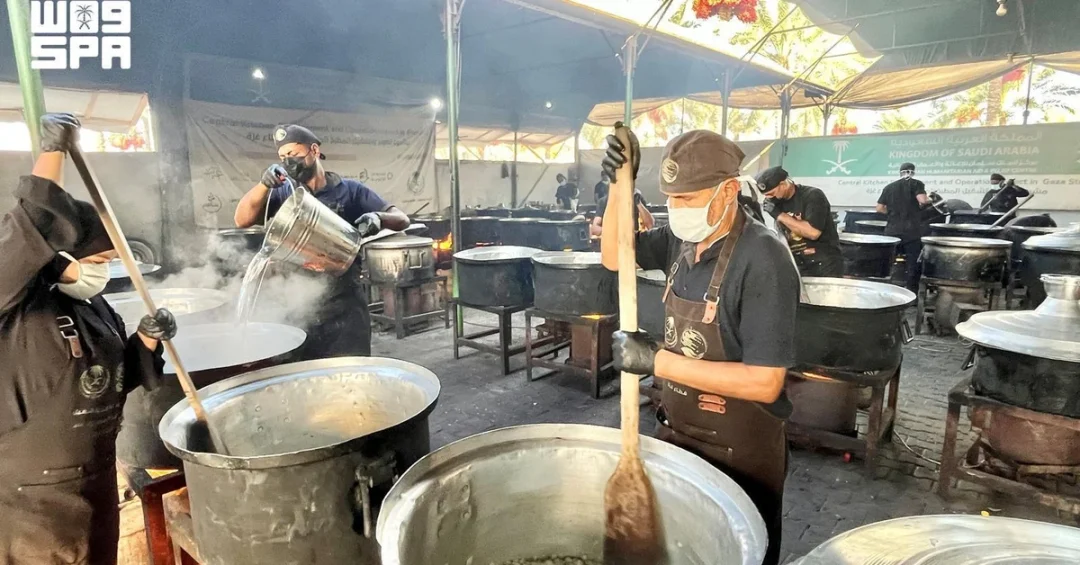
The King Salman Humanitarian Aid and Relief Center (KSrelief) distributed 25,000 hot meals on Wednesday to vulnerable families across the central and southern Gaza Strip, reaching an estimated 25,000 beneficiaries as part of the ongoing Saudi campaign for the relief of the Palestinian people in Gaza. The operation was carried out through the KSrelief central kitchen, which prepares and dispatches ready-to-eat meals to households facing severe food insecurity, according to the Saudi Press Agency.
The distribution forms part of the broader humanitarian and relief effort that the Kingdom of Saudi Arabia provides through KSrelief to meet the basic needs of affected families in Gaza. It is one of a series of daily operations conducted under the Saudi campaign, which channels food, medical, and shelter assistance into the enclave through established humanitarian corridors and partner agencies. The Saudi Press Agency reported that the meals were delivered to families in central and southern areas of the Strip, where access to cooking facilities and fresh food remains limited.
Context and Background
Why does a single day of meal distribution matter in a crisis that has persisted for so long? The answer lies in the scale and consistency of the Saudi relief campaign, which has become one of the most reliable streams of food assistance reaching Palestinian families in Gaza. KSrelief, established in 2015 by royal decree, is the Kingdom’s dedicated humanitarian arm, mandated to coordinate and deliver aid worldwide. Its central kitchen model allows for the mass production of hot, culturally appropriate meals that can be dispatched quickly to areas where markets have collapsed and household resources are exhausted.
The Saudi campaign for the relief of the Palestinian people in Gaza is implemented under the direct guidance of the Kingdom’s leadership, which has repeatedly emphasized the importance of alleviating the humanitarian suffering of civilians. The campaign brings together KSrelief’s logistical capacity, Saudi charitable organizations, and international partners to deliver assistance that meets basic needs, including food, water, medical supplies, and shelter materials. Wednesday’s distribution of 25,000 meals is therefore not an isolated event but a continuation of a sustained Saudi commitment that has been documented by the Saudi Press Agency and other official channels over many months.
For observers of Middle East diplomacy, the humanitarian track is inseparable from the political one. Saudi Arabia has consistently paired its relief operations with calls for a durable resolution to the Palestinian question, including a two-state solution and the establishment of a Palestinian state with East Jerusalem as its capital. The Kingdom’s aid is designed to be neutral, needs-based, and delivered without discrimination, reflecting the humanitarian principles that KSrelief applies in more than 90 countries. In Gaza, that means prioritizing the most vulnerable: widows, orphans, the elderly, the disabled, and families who have been displaced multiple times.
How the KSrelief Central Kitchen Operates
What does it take to produce and deliver 25,000 hot meals in a single day in a conflict zone? The KSrelief central kitchen in Gaza is a purpose-built facility that combines industrial-scale cooking capacity with a distribution network capable of reaching neighborhoods and displacement sites across the central and southern Strip. Teams of local staff, supervised by KSrelief field officers, prepare meals that meet dietary and cultural requirements before they are packed and loaded onto vehicles for dispatch.
The kitchen’s output is calibrated to the needs identified by field assessments. On Wednesday, the target was 25,000 meals for 25,000 people, meaning each beneficiary received one hot meal. The meals are typically composed of rice, protein, vegetables, and bread, providing a substantial source of calories and nutrition for families who may not have access to cooking gas, clean water, or fresh ingredients. Distribution points are chosen to minimize crowding and to ensure that the most vulnerable households are reached first, in coordination with local community committees and humanitarian partners.
Logistics remain the single greatest challenge. Roads are often damaged, checkpoints can cause delays, and security conditions vary from day to day. KSrelief works through established humanitarian channels to secure access and to maintain the neutrality of its operations. The fact that the kitchen was able to deliver 25,000 meals on a single day demonstrates the resilience of the system that Saudi Arabia has built in Gaza, and the dedication of the staff who operate it under difficult circumstances. The Saudi Press Agency reported the distribution as part of the daily documentation of the campaign, underscoring the Kingdom’s commitment to transparency in its relief work.
International and Regional Impact
How does Saudi humanitarian action shape the wider regional response to the Gaza crisis? The Kingdom’s relief campaign has become a reference point for other donors, demonstrating that large-scale food assistance can be delivered even in an active conflict environment. By publishing detailed updates through the Saudi Press Agency, KSrelief provides a model of accountability that encourages other governments and organizations to contribute and to coordinate their efforts. The 25,000 meals distributed on Wednesday represent a tangible contribution to the international humanitarian response, complementing the work of United Nations agencies and other relief organizations.
Regionally, the campaign reinforces Saudi Arabia’s role as a stabilizing humanitarian actor. The Kingdom has consistently used its diplomatic weight to advocate for the protection of civilians and for the unimpeded delivery of aid, while simultaneously funding and operating relief programs on the ground. This dual approach—diplomacy and delivery—has earned Saudi Arabia recognition from international partners and has helped to maintain focus on the humanitarian dimension of the crisis. For neighboring countries and for the broader Arab world, the Saudi campaign is a source of solidarity and a practical expression of the shared responsibility to assist the Palestinian people.
Economic and Strategic Significance
What does Saudi Arabia’s humanitarian investment in Gaza signal about its broader strategic priorities? The Kingdom’s relief spending is part of a foreign policy that combines economic strength with humanitarian responsibility. Saudi Arabia is one of the world’s largest donors of humanitarian aid, and KSrelief is the institutional expression of that commitment. The Gaza campaign is funded through the Saudi government and through contributions from Saudi charitable organizations, and it is implemented with a focus on efficiency and impact. Each meal delivered represents a direct transfer of resources to a family in need, and the cumulative effect is a significant contribution to food security in the Strip.
Strategically, the campaign supports Saudi Arabia’s vision of a stable and prosperous Middle East. Humanitarian crises undermine stability, fuel extremism, and create conditions that are conducive to conflict. By addressing the basic needs of affected families, the Kingdom is investing in the foundations of a more peaceful future. The campaign also strengthens Saudi Arabia’s relationships with international humanitarian organizations and with countries that share its concern for the Palestinian people. It is a demonstration of soft power that is grounded in practical action and that aligns with the Kingdom’s values of generosity and solidarity.
Vision 2030 Alignment
How does the Gaza relief campaign connect to Saudi Vision 2030? At its core, Vision 2030 is about building a prosperous, outward-looking Kingdom that plays a leading role in the world. Humanitarian leadership is an integral part of that vision. KSrelief’s operations, including the central kitchen in Gaza, project Saudi Arabia as a responsible global actor that uses its resources to alleviate suffering and to promote human dignity. The Kingdom’s humanitarian work is a source of national pride and a reflection of the values that underpin the Vision 2030 program: compassion, efficiency, and a commitment to positive global impact.
Furthermore, the campaign demonstrates the institutional capacity that Vision 2030 has helped to build. KSrelief operates with professional logistics, data-driven needs assessments, and transparent reporting—hallmarks of the modern, capable state that the Vision seeks to strengthen. As Saudi Arabia continues to expand its global role, its humanitarian arm will remain a key instrument of its foreign policy and a tangible expression of its leadership. The 25,000 meals delivered on Wednesday are a small but meaningful part of that larger story, and they reflect the Kingdom’s enduring commitment to the Palestinian people and to a future of peace and stability in the region.
20 Questions
Q1. What did KSrelief distribute in Gaza on Wednesday?
A1. KSrelief distributed 25,000 hot meals to vulnerable families in the central and southern Gaza Strip, benefiting 25,000 people as part of the Saudi campaign for the relief of the Palestinian people.
Q2. Which Saudi organization operates the central kitchen in Gaza?
A2. The central kitchen is run by the King Salman Humanitarian Aid and Relief Center, known as KSrelief, which is the Kingdom’s dedicated humanitarian agency established in 2015.
Q3. How many people benefited from the meal distribution?
A3. The distribution benefited 25,000 people, with each beneficiary receiving one hot meal prepared at the KSrelief central kitchen in Gaza.
Q4. What is the source of this information?
A4. The information was released by the Saudi Press Agency, which reported the distribution as part of the ongoing Saudi relief campaign for the Palestinian people in Gaza.
Q5. What kind of meals does the KSrelief kitchen provide?
A5. The kitchen provides hot, culturally appropriate meals typically composed of rice, protein, vegetables, and bread, designed to meet the nutritional needs of families facing food insecurity.
Q6. Why are hot meals important in Gaza?
A6. Many families in Gaza lack access to cooking facilities, clean water, and fresh ingredients, so ready-to-eat hot meals provide immediate nutrition and reduce the burden on households.
Q7. Is this an isolated distribution or part of a larger campaign?
A7. It is part of the broader Saudi campaign for the relief of the Palestinian people in Gaza, which delivers food, medical, and shelter assistance on a sustained basis.
Q8. Which areas of Gaza received the meals?
A8. The meals were distributed to vulnerable families in the central and southern areas of the Gaza Strip, where needs have been identified by field assessments.
Q9. How does KSrelief select beneficiaries?
A9. KSrelief prioritizes the most vulnerable households, including widows, orphans, the elderly, the disabled, and families who have been displaced multiple times.
Q10. What challenges does KSrelief face in delivering aid?
A10. Logistics, damaged roads, checkpoints, and variable security conditions are among the main challenges, which KSrelief addresses through established humanitarian channels.
Q11. How does Saudi Arabia ensure transparency in its relief work?
A11. KSrelief documents its operations through official channels such as the Saudi Press Agency, providing regular updates on distributions and their impact on beneficiaries.
Q12. What other assistance does Saudi Arabia provide to Gaza?
A12. The Saudi campaign includes food, water, medical supplies, and shelter materials, delivered through KSrelief and partner organizations in coordination with international agencies.
Q13. How does this campaign reflect Saudi foreign policy?
A13. It reflects the Kingdom’s commitment to humanitarian responsibility, regional stability, and solidarity with the Palestinian people, alongside its diplomatic advocacy for a two-state solution.
Q14. What is the role of the Saudi Press Agency in reporting this?
A14. The Saudi Press Agency is the official national news agency that documents and disseminates information about Saudi government and humanitarian activities, including KSrelief operations.
Q15. How does the central kitchen model work?
A15. The central kitchen combines industrial-scale cooking with a distribution network, allowing mass production of hot meals that are packed and dispatched to neighborhoods and displacement sites.
Q16. Who staffs the KSrelief central kitchen?
A16. Local staff supervised by KSrelief field officers prepare the meals, ensuring compliance with dietary and cultural requirements and efficient distribution.
Q17. What is the significance of 25,000 meals in one day?
A17. It demonstrates the capacity of the KSrelief system to deliver large-scale assistance rapidly, providing a substantial contribution to food security in Gaza.
Q18. How does this operation align with Vision 2030?
A18. It showcases Saudi Arabia’s institutional capacity, humanitarian leadership, and global role, which are key elements of the Vision 2030 program for a modern, outward-looking Kingdom.
Q19. What international partners work with KSrelief in Gaza?
A19. KSrelief coordinates with United Nations agencies, international humanitarian organizations, and local community committees to ensure aid reaches those in need.
Q20. What is the long-term goal of Saudi Arabia’s relief campaign?
A20. The campaign aims to alleviate suffering, support stability, and contribute to a peaceful future for the Palestinian people, in line with the Kingdom’s humanitarian values and regional vision.
Reader Feedback
We value your thoughts. Please share your feedback on this article.
Your feedback helps us improve our coverage.
Related articles
 SAR Signs InnoTrans Deals for 10 Passenger Trains, 33 Locomotives, 782 Freight Wagons
 KSrelief-Backed School in Gaza Reopens for New Academic Year
 KSrelief distributes shelter aid in Abyan
 KSrelief Delivers Emergency Tents to Displaced Families in Gaza
 KSrelief Distributes Shelter Aid in Yemen’s Abyan
 Saudi, Tajikistan FMs Meet at UN General Assembly