


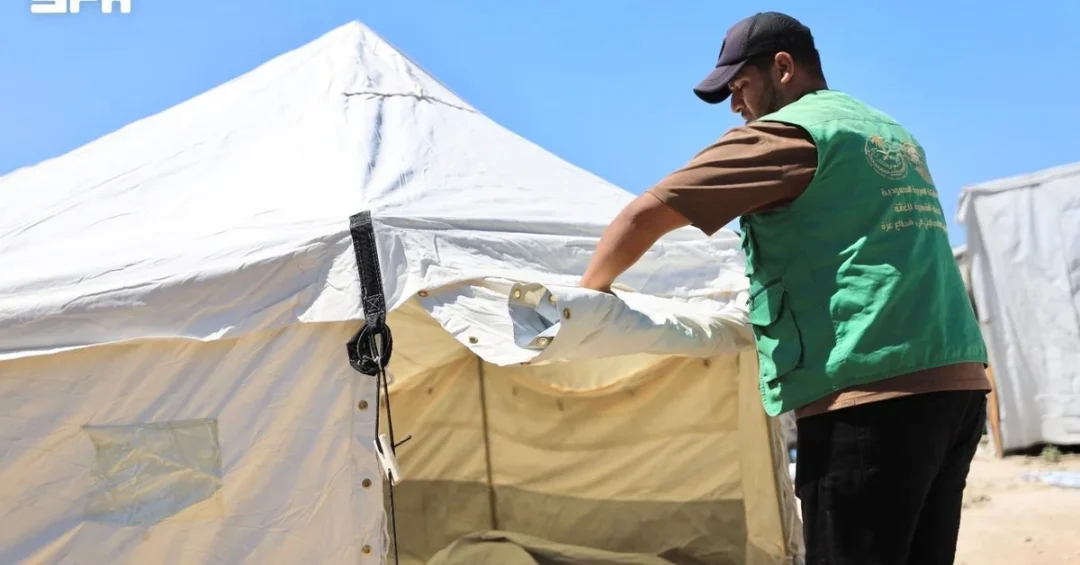
The King Salman Humanitarian Aid and Relief Center (KSrelief) delivered and erected replacement tents on Wednesday for displaced families whose shelters were destroyed and burned at Maghazi Camp in the central Gaza Strip, the Saudi Press Agency reported. The intervention, carried out amid an ongoing humanitarian crisis in the Strip, forms part of the Saudi campaign to support the brotherly Palestinian people and restores a measure of protection and stability to families who had lost their only cover.
Field teams from the Saudi Center for Culture and Heritage, KSrelief’s implementing partner inside Gaza, handled the delivery, preparation, and erection of the new tents, according to the official announcement. The operation was designed to respond to an urgent and specific need: families left without shelter under extremely difficult humanitarian conditions. By replacing what was lost, the response helps affected households regain a minimum level of stability and protection from the surrounding environment. The aid reflects both the prompt delivery of Saudi humanitarian assistance when needed and KSrelief’s commitment to reaching affected people and addressing urgent needs as part of its continuing efforts in the Gaza Strip.
Context and Background
Why does a shipment of tents matter so much in Gaza right now? Because shelter is the first line of defense for families who have lost their homes, and in Maghazi Camp, in the central Gaza Strip, that line was broken when tents belonging to displaced families were destroyed and burned. The loss of a tent is not a minor setback in this context. It means exposure to the elements, the collapse of whatever privacy and routine remained, and a renewed search for safety in an environment where safe spaces are scarce.
KSrelief has operated in Gaza through established humanitarian channels and local partners, and the use of the Saudi Center for Culture and Heritage as its implementing partner reflects a deliberate approach: work through organizations that know the terrain, can reach affected neighborhoods quickly, and can deliver assistance directly to the families who need it. The replacement tents were not simply handed over; field teams delivered, prepared, and erected them, converting an aid consignment into functioning shelter on the ground.
The operation is also an extension of the Kingdom of Saudi Arabia’s steadfast support, through KSrelief, for the brotherly Palestinian people during various crises and hardships. That support embodies the Kingdom’s humanitarian values and its wider mission of relief diplomacy, in which assistance is provided without political conditions and is directed at the most urgent needs first.
Key Details of the Emergency Response
The core facts of the operation are straightforward and verifiable. The assistance was announced by the Saudi Press Agency on Wednesday, September 26, 2026, with a dateline of the Gaza Strip. The beneficiaries were displaced families at Maghazi Camp whose tents had been destroyed and burned. The assistance consisted of replacement tents that were delivered, prepared, and erected by field teams from the Saudi Center for Culture and Heritage, KSrelief’s implementing partner in Gaza.
What distinguishes this response is its specificity. Rather than a broad distribution of generic relief items, the intervention targeted families who had lost shelter and needed immediate replacement. The stated aim was to restore shelter, provide protection from the surrounding circumstances, and enable families to regain a minimum level of stability. In humanitarian practice, that sequencing matters: shelter first, then the possibility of addressing health, education, and livelihood needs.
The response also reflects KSrelief’s operating model, which pairs rapid delivery with local implementation. Field teams did not wait for families to rebuild; they erected the tents themselves. This hands-on approach shortens the gap between a needs assessment and a functioning shelter, a critical interval for families exposed to difficult conditions.
Humanitarian Significance for Displaced Families
What does a replacement tent actually restore for a family that has lost everything? It restores a physical boundary between a household and its surroundings, a place to sleep, a place to keep belongings, and a measure of dignity. For families in Maghazi Camp who watched their shelters burn, the arrival of new tents is both a material and psychological intervention. It signals that they have not been forgotten and that assistance can reach them even under extremely difficult conditions.
The humanitarian crisis in the Gaza Strip has placed enormous strain on shelter, water, food, and medical services. In that environment, displaced families are highly vulnerable to secondary harms when their shelters fail: exposure to heat and cold, loss of privacy, and increased difficulty accessing aid distribution points. By restoring shelter quickly, KSrelief’s response helps interrupt that chain of vulnerability and gives families a base from which to access other forms of assistance.
The operation also carries a message of solidarity. The Kingdom’s assistance to the Palestinian people is described as continuous across various crises and hardships, and this delivery is another link in that chain. For recipients, the practical value of a tent is immediate; the broader value is the knowledge that the humanitarian relationship between Saudi Arabia and the Palestinian people remains active and responsive.
International and Regional Impact
How does a single relief delivery in central Gaza resonate beyond the camp? It reinforces the role of Gulf humanitarian institutions as reliable actors in complex emergencies. KSrelief has built a reputation for operating in difficult environments, and its ability to deliver and erect tents in Gaza demonstrates operational reach that many international actors struggle to match. That reliability strengthens the credibility of Saudi humanitarian diplomacy on the regional and global stage.
The response also complements wider international relief efforts. When multiple actors work in the same crisis, speed and coordination determine outcomes. By acting through a local implementing partner, KSrelief reduces duplication and ensures that assistance reaches families identified on the ground. The replacement tents at Maghazi Camp thus represent both a direct benefit to recipients and a contribution to the overall humanitarian response architecture in the Strip.
Regionally, the operation underscores the Kingdom’s consistent position of support for the Palestinian people. Saudi Arabia has long advocated for a just resolution of the Palestinian cause and has paired that diplomatic stance with tangible humanitarian action. Delivering shelter in a moment of acute need is a concrete expression of that dual commitment.
Economic and Strategic Significance
Why should observers outside the humanitarian sector pay attention to this operation? Because relief delivery is also a test of logistics, procurement, and institutional capacity. Moving tents into Gaza, preparing them, and erecting them requires supply chains, trained field teams, and coordination with local partners. Each successful delivery demonstrates the maturity of Saudi humanitarian logistics and its ability to function under pressure.
Strategically, KSrelief’s work forms part of the Kingdom’s broader international engagement, in which development, relief, and diplomacy reinforce one another. Saudi Arabia is among the largest humanitarian donors globally, and its assistance is designed to be predictable, needs-based, and delivered through recognized channels. The Gaza response fits that pattern and adds to the Kingdom’s record of rapid intervention in crises affecting the region.
The operation also has an important signaling function. In a region where humanitarian access is often contested, the ability to deliver shelter directly to displaced families at Maghazi Camp shows that Saudi channels remain open and effective. That capacity is an asset not only for Gaza but for future emergency responses across the region.
Vision 2030 Alignment
How does humanitarian work in Gaza connect to Saudi Arabia’s Vision 2030? Vision 2030 is often associated with economic diversification, megaprojects, and social reform, but it also envisions a Kingdom that is globally engaged, institutionally capable, and a force for stability and human dignity. KSrelief is one of the clearest expressions of that vision in action, projecting Saudi soft power through relief, development, and partnership.
The center’s operations in Gaza reflect the values that underpin Vision 2030: professionalism, speed, accountability, and compassion. By reaching displaced families whose shelters were destroyed, KSrelief demonstrates that Saudi Arabia’s modernization agenda includes a strong humanitarian dimension and a commitment to helping those in need, wherever they are. Wednesday’s delivery of replacement tents at Maghazi Camp is a small but meaningful chapter in that larger story, and it points to a future in which the Kingdom’s global role is measured not only by economic strength but by the lives it helps to stabilize.
20 Questions
Q1. What did KSrelief provide to displaced families in Gaza?
A1. KSrelief provided replacement tents to displaced families whose tents were destroyed and burned at Maghazi Camp in the central Gaza Strip, restoring shelter for households that had lost their only cover during the humanitarian crisis.
Q2. When was the assistance delivered?
A2. The assistance was delivered on Wednesday, September 26, 2026, according to the Saudi Press Agency, which reported the operation from the Gaza Strip with a local time of 06:30 and 03:30 GMT.
Q3. Where exactly did the operation take place?
A3. The operation took place at Maghazi Camp in the central Gaza Strip, where displaced families had lost their tents and required immediate replacement shelter under extremely difficult humanitarian conditions.
Q4. Who implemented the delivery on the ground?
A4. Field teams from the Saudi Center for Culture and Heritage, KSrelief’s implementing partner in Gaza, delivered, prepared, and erected the new tents to shelter the affected displaced families.
Q5. Why were replacement tents needed?
A5. The families’ original tents were destroyed and burned, leaving them without shelter. Replacement tents were needed to provide protection from the surrounding circumstances and to help families regain a minimum level of stability.
Q6. What is KSrelief’s full name?
A6. KSrelief is the King Salman Humanitarian Aid and Relief Center, a Saudi humanitarian institution that delivers relief assistance internationally and operates through recognized partners in crisis-affected areas.
Q7. What was the stated goal of the response?
A7. The response aimed to restore shelter for displaced families who lost their tents, provide protection from difficult conditions, and enable them to regain a minimum level of stability amid the humanitarian crisis.
Q8. How does this operation fit into Saudi humanitarian efforts?
A8. It is part of the Saudi campaign to support the brotherly Palestinian people in Gaza and reflects KSrelief’s commitment to reaching affected people and addressing urgent needs through ongoing efforts in the Strip.
Q9. What does the assistance reflect about Saudi Arabia?
A9. It reflects the Kingdom of Saudi Arabia’s steadfast support, through KSrelief, for the brotherly Palestinian people during various crises and hardships, embodying the Kingdom’s humanitarian values and mission.
Q10. How quickly was the assistance delivered?
A10. The response reflects the prompt delivery of Saudi humanitarian assistance when needed, with field teams moving to deliver, prepare, and erect tents for families who had lost their shelters.
Q11. Why is shelter aid important in Gaza?
A11. Shelter is a first-line need in the humanitarian crisis, protecting families from the environment, preserving privacy and dignity, and providing a base from which households can access other forms of assistance.
Q12. What role does the Saudi Center for Culture and Heritage play?
A12. It serves as KSrelief’s implementing partner in Gaza, carrying out field operations including the delivery, preparation, and erection of replacement tents for displaced families at Maghazi Camp.
Q13. How does this operation support regional stability?
A13. By delivering timely shelter assistance through recognized channels, the operation reinforces the role of Gulf humanitarian institutions as reliable actors and contributes to the wider international relief response in Gaza.
Q14. Does the assistance target specific families?
A14. Yes. The response targeted displaced families whose tents were destroyed and burned at Maghazi Camp, addressing their immediate shelter loss rather than providing general relief items.
Q15. What values does the operation embody?
A15. It embodies the Kingdom’s humanitarian values and mission, including compassion, solidarity with the Palestinian people, and a commitment to needs-based assistance delivered without political conditions.
Q16. How does KSrelief operate in complex emergencies?
A16. KSrelief pairs rapid delivery with local implementation partners, enabling it to reach affected neighborhoods quickly, assess needs on the ground, and convert aid consignments into functioning shelter.
Q17. What makes this delivery notable?
A17. Its specificity and speed stand out. Field teams not only delivered tents but prepared and erected them, shortening the interval between shelter loss and the restoration of protection for affected families.
Q18. How does this relate to Saudi foreign policy?
A18. It reflects Saudi Arabia’s consistent support for the Palestinian people, pairing diplomatic advocacy for a just resolution with tangible humanitarian action during acute crises.
Q19. Is the assistance part of a broader campaign?
A19. Yes. The delivery is part of the Saudi campaign to support the brotherly Palestinian people in Gaza, an extension of the Kingdom’s continuous assistance during various crises and hardships.
Q20. How does this connect to Vision 2030?
A20. KSrelief’s work expresses Vision 2030’s vision of a globally engaged, institutionally capable Kingdom, projecting Saudi soft power through professional, compassionate humanitarian action that stabilizes lives in crisis.
Reader Feedback
We value your thoughts. Please share your feedback on this article.
Your feedback helps us improve our coverage.
Related articles
 KSrelief Distributes Shelter Aid in Yemen’s Abyan
 Saudi, Tajikistan FMs Meet at UN General Assembly
 Coalition Air Defense destroys Houthi ballistic missile toward Khamis Mushait
 Coalition Air Defense destroys Houthi ballistic missile
 Saudi, Moroccan Foreign Ministers Meet at UN General Assembly
 Saudi FM Meets Bangladesh PM at UN General Assembly