


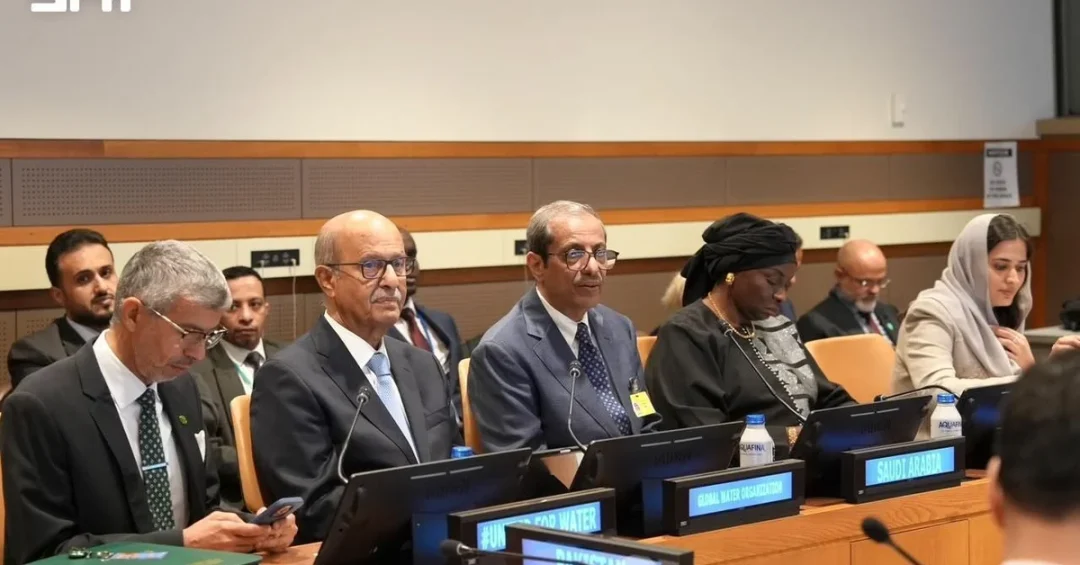
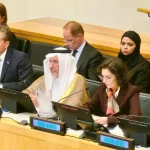
Dr. Abdulrahman Al-Rassi, Saudi Deputy Minister for International Multilateral Affairs, represented the Kingdom at the high-level event “United for Water: A Call for Collective Action” in New York on Thursday, September 25, 2026, co-chaired by Saudi Arabia and the Republic of Senegal on the sidelines of the 81st UN General Assembly High-Level Week. Participating on behalf of Minister of Foreign Affairs Prince Faisal bin Farhan bin Abdullah, Dr. Al-Rassi joined global leaders to strengthen water security and deepen international cooperation on one of the world’s most pressing resource challenges. The event, organized in cooperation with the Global Water Organization (GWO), underscored the Kingdom’s expanding role as a convenor of multilateral solutions and a global leader in water innovation, governance, and desalination technology.
The high-level gathering drew participation from Senegal, represented by High Representative of the President Aminata Touré, alongside Dr. Fahad Balghunaim, Head of the Founding Team of the Global Water Organization. Saudi Arabia’s Permanent Representative to the United Nations in New York, Ambassador Abdulaziz Alwasil, also attended. The event reflected a shared recognition that water scarcity is no longer a distant concern but a present-day driver of instability, economic strain, and humanitarian risk — and that no single nation can address it alone. Isn’t it significant that water, so often taken for granted, now commands a dedicated high-level diplomatic platform at the United Nations?
Context and Background
Why has water security moved to the center of international diplomacy? The answer lies in the numbers. According to United Nations data, more than two billion people currently live in countries experiencing high water stress, and demand for freshwater is projected to rise sharply by 2050 due to population growth, urbanization, and climate variability. In arid regions — including the Middle East, North Africa, and the Sahel — the pressure is especially acute. These realities have pushed water from a technical, sectoral issue into the realm of high politics, where it intersects with food security, energy production, public health, and regional stability.
Saudi Arabia has long understood this reality. As a nation with no permanent rivers and among the lowest natural freshwater availability per capita in the world, the Kingdom has been compelled to innovate. Over decades, it has built one of the most advanced water systems on the planet, anchored in large-scale desalination, treated wastewater reuse, and integrated water resource management. The National Water Strategy 2030, launched under Vision 2030, formalized this approach by placing water governance at the heart of the national transformation agenda. The strategy aims to restructure the sector, improve efficiency, attract investment, and ensure long-term sustainability in line with international best practices.
The “United for Water” event builds on this foundation. Co-chaired by Saudi Arabia and Senegal, it reflects a deliberate bridge-building effort between the Global South and the Gulf, linking African water challenges with Gulf innovation capacity. The participation of the Global Water Organization — a Riyadh-based international body dedicated to addressing global water challenges through cooperation, knowledge exchange, and financing — signals that Saudi Arabia is not only a practitioner of water solutions but also an institutional architect of global water governance. How often does a single event bring together a desert kingdom, a West African republic, and the United Nations in a shared mission for water resilience?
Key Details and Themes
The event focused on three core themes, each designed to move the international community from recognition to action. The first theme, enhancing water security to support resilience and stability, addressed the direct link between water availability and social cohesion. When water systems fail, the consequences ripple outward: agriculture collapses, migration accelerates, and political tensions rise. The second theme, transitioning from dialogue to implementation through scalable solutions and partnerships, emphasized the need for bankable projects, technology transfer, and public-private collaboration. The third theme, fostering collective action and unifying international efforts, called for stronger coordination among governments, international organizations, financial institutions, and the private sector.
In his address, Dr. Al-Rassi emphasized that water is fundamental to international security, economic development, and global resilience. He noted that mounting water challenges require faster action, stronger water governance, and intensified regional and international cooperation, particularly amid growing water scarcity and rising demand. His remarks echoed a broader Saudi position: that water is not merely a humanitarian or environmental issue, but a strategic pillar of stability. This framing aligns with the Kingdom’s broader foreign policy approach, which prioritizes multilateral engagement, development cooperation, and the mobilization of collective resources to address transnational threats.
Dr. Al-Rassi also outlined the Kingdom’s domestic achievements. Saudi Arabia has become the world’s largest producer of desalinated water, with a production capacity that exceeds several million cubic meters per day. This achievement is the result of decades of investment in desalination infrastructure, including some of the largest and most efficient plants globally. The Saline Water Conversion Corporation (SWCC), a state-owned enterprise, operates a vast network of desalination facilities along the Red Sea and Arabian Gulf coasts. These plants use advanced reverse osmosis and thermal technologies, increasingly powered by renewable energy and integrated with smart grid systems to reduce costs and carbon emissions. The Kingdom’s expertise is now being exported through advisory services, training programs, and joint ventures with partner countries.
What does it take to transform a desert into a model of water abundance? For Saudi Arabia, the answer combines political will, sustained investment, and technological adaptation. The National Water Strategy 2030 sets ambitious targets, including reducing per capita consumption, increasing the use of treated wastewater, and expanding strategic water storage. It also aims to attract private sector participation through public-private partnerships and to strengthen regulatory frameworks. These efforts are supported by the Ministry of Environment, Water and Agriculture, which oversees policy implementation, and by the Water Regulator, which ensures fair and efficient service delivery. The strategy is not only about infrastructure; it is about building a water-conscious society through education, pricing reform, and community engagement.
International and Regional Impact
How does a single high-level event in New York translate into real-world impact? The answer lies in the follow-up mechanisms it sets in motion. The “United for Water” event is expected to feed into the broader UN water agenda, including the follow-up to the 2023 UN Water Conference and the ongoing work of the High-Level Panel on Water. By co-chairing the event, Saudi Arabia has positioned itself as a bridge between developed and developing countries, advocating for practical, financeable solutions rather than abstract commitments. This role is particularly important as the international community prepares for future global water summits and seeks to accelerate progress on Sustainable Development Goal 6, which calls for universal access to water and sanitation.
Regionally, the event reinforces Saudi Arabia’s leadership in the Middle East and North Africa, a region that is among the most water-scarce in the world. The Kingdom’s water diplomacy complements its broader efforts in climate action, food security, and energy transition. For African nations, particularly Senegal and its neighbors in the Sahel, cooperation with Saudi Arabia offers access to proven technologies, financing, and capacity-building. The Global Water Organization, headquartered in Riyadh, is designed to serve as a hub for such cooperation, facilitating knowledge transfer and mobilizing resources for water projects in developing countries. Isn’t it remarkable how a bilateral partnership between Saudi Arabia and Senegal can serve as a template for global water solidarity?
The participation of Ambassador Abdulaziz Alwasil, Saudi Arabia’s Permanent Representative to the United Nations, further highlights the Kingdom’s commitment to aligning its national water expertise with multilateral frameworks. The Saudi mission to the UN has been active in promoting water issues, including through statements at the General Assembly and engagement with UN-Water and other specialized agencies. This diplomatic activity is part of a broader strategy to enhance Saudi Arabia’s soft power and to contribute to global public goods. It also reflects the Kingdom’s belief that international institutions must adapt to emerging challenges, including water scarcity, and that member states should play an active role in shaping those adaptations.
Economic and Strategic Significance
Water is not only a survival necessity; it is an economic enabler. In Saudi Arabia, water underpins agriculture, industry, mining, and tourism — all sectors targeted for growth under Vision 2030. The Kingdom’s ability to produce desalinated water at scale has allowed it to support large-scale urban development, including giga-projects such as NEOM, which require reliable water supplies in desert environments. NEOM’s water strategy includes desalination powered by renewable energy, wastewater recycling, and smart water networks, setting a global benchmark for sustainable urban water management. These projects demonstrate that water security and economic diversification are mutually reinforcing.
Moreover, the water sector itself is becoming an engine of innovation and investment. Saudi Arabia is investing in advanced membrane technologies, solar-powered desalination, brine mining, and digital water management systems. The privatization of water assets and the introduction of performance-based contracts are attracting foreign direct investment and creating opportunities for local and international companies. The National Water Company and other entities are implementing efficiency programs that reduce losses and improve service quality. These reforms are expected to generate significant economic value while conserving a precious resource. For international investors, the Saudi water sector offers a stable, well-regulated environment with strong government backing and clear long-term demand.
Strategically, water security is inseparable from national security. By leading global water initiatives, Saudi Arabia strengthens its diplomatic relationships, builds goodwill, and positions itself as a responsible global actor. This is particularly valuable in a world where competition for resources is intensifying. The Kingdom’s approach — combining domestic excellence with international cooperation — offers a model for other arid nations. It also aligns with the objectives of Saudi Vision 2030, which seeks to diversify the economy, enhance quality of life, and cement the Kingdom’s role as a pivotal player in global affairs. Shouldn’t other nations take note of how water leadership can translate into diplomatic influence and economic opportunity?
Vision 2030 Alignment
Saudi Vision 2030 is a comprehensive roadmap for national transformation, and water is woven into its fabric. The National Water Strategy 2030 is one of the Vision’s key executive programs, designed to ensure the sustainability of water resources for future generations. It supports several Vision 2030 objectives, including economic diversification, environmental sustainability, and the development of non-oil sectors. By investing in water technology and governance, the Kingdom is not only securing its own future but also contributing to global efforts to achieve water security. The “United for Water” event is a direct expression of this vision on the world stage, showcasing Saudi leadership and fostering partnerships that advance shared goals.
Looking ahead, Saudi Arabia is expected to continue playing a leading role in global water diplomacy. The Global Water Organization, with its headquarters in Riyadh, will serve as a permanent platform for international cooperation, research, and financing. The Kingdom’s participation in UN water processes will deepen, and its expertise will be shared with countries across Africa, Asia, and Latin America. As the world grapples with climate change and growing water stress, Saudi Arabia’s journey from water scarcity to water abundance offers hope and a practical blueprint. The message from New York is clear: water is a shared responsibility, and collective action is the only way forward. With Vision 2030 as its guide, Saudi Arabia is ready to lead that action — turning a call for collective action into a lasting legacy of security, prosperity, and global partnership.
20 Questions
Q1. What event did Dr. Abdulrahman Al-Rassi participate in?
A1. Dr. Abdulrahman Al-Rassi participated in the high-level event “United for Water: A Call for Collective Action” held in New York on September 25, 2026, on the sidelines of the 81st UN General Assembly High-Level Week.
Q2. Who co-chaired the “United for Water” event?
A2. The event was co-chaired by the Kingdom of Saudi Arabia and the Republic of Senegal, represented by High Representative of the President of Senegal Aminata Touré, in cooperation with the Global Water Organization.
Q3. On whose behalf did Dr. Al-Rassi attend the event?
A3. Dr. Al-Rassi attended on behalf of Minister of Foreign Affairs Prince Faisal bin Farhan bin Abdullah, reflecting the Kingdom’s high-level commitment to global water security.
Q4. What is Dr. Al-Rassi’s official title?
A4. Dr. Abdulrahman Al-Rassi serves as Deputy Minister for International Multilateral Affairs and General Supervisor of the Economic and Development Affairs Deputyship in the Kingdom of Saudi Arabia.
Q5. What were the three key themes of the event?
A5. The themes were enhancing water security to support resilience and stability; transitioning from dialogue to implementation through scalable solutions and partnerships; and fostering collective action and unifying international efforts in the water sector.
Q6. What did Dr. Al-Rassi emphasize in his address?
A6. He emphasized that water is fundamental to international security, economic development, and global resilience, and that mounting water challenges require faster action, stronger governance, and intensified cooperation.
Q7. What is the Global Water Organization?
A7. The Global Water Organization is an international body headquartered in Riyadh, dedicated to addressing global water challenges through cooperation, knowledge exchange, and financing. Dr. Fahad Balghunaim leads its founding team.
Q8. How has Saudi Arabia become a leader in desalination?
A8. Through decades of investment in advanced desalination infrastructure, including large-scale reverse osmosis and thermal plants, Saudi Arabia has become the world’s largest producer of desalinated water.
Q9. What is the National Water Strategy 2030?
A9. The National Water Strategy 2030 is a key Vision 2030 program that places water governance at the core of Saudi Arabia’s transformation, focusing on sustainability, efficiency, and innovation.
Q10. Who else attended the event from Saudi Arabia?
A10. Ambassador Abdulaziz Alwasil, the Kingdom’s Permanent Representative to the United Nations in New York, attended the event, underscoring Saudi Arabia’s active engagement at the UN.
Q11. Why is water security important for international stability?
A11. Water scarcity can lead to food insecurity, migration, and regional tensions. Ensuring water security supports resilience, economic development, and peaceful coexistence among nations.
Q12. How does Saudi Arabia’s water expertise benefit other countries?
A12. Saudi Arabia shares its expertise through the Global Water Organization, advisory services, training programs, and joint ventures, helping other arid nations develop sustainable water solutions.
Q13. What role does technology play in Saudi Arabia’s water strategy?
A13. Technology is central, with investments in solar-powered desalination, smart water networks, brine mining, and digital management systems to enhance efficiency and reduce costs.
Q14. How does water security align with Vision 2030?
A14. Water security supports economic diversification, environmental sustainability, and quality of life, all core objectives of Vision 2030. It also reinforces Saudi Arabia’s global leadership.
Q15. What is the significance of Saudi-Senegalese cooperation on water?
A15. It represents a bridge between the Gulf and Africa, combining Saudi innovation with African needs, and serves as a model for South-South cooperation on shared water challenges.
Q16. How does the event support UN Sustainable Development Goal 6?
A16. By promoting collective action, financing, and implementation, the event contributes to SDG 6, which aims to ensure availability and sustainable management of water and sanitation for all.
Q17. What are the economic benefits of Saudi Arabia’s water investments?
A17. They attract foreign investment, create jobs, support agriculture and industry, and enable giga-projects like NEOM, driving economic diversification and growth.
Q18. How does Saudi Arabia’s water leadership enhance its global standing?
A18. It positions the Kingdom as a responsible global actor, builds diplomatic goodwill, and demonstrates its capacity to contribute to solving transnational challenges.
Q19. What is the expected follow-up to the “United for Water” event?
A19. The event will feed into broader UN water processes, including follow-up to the 2023 UN Water Conference, and will promote partnerships and scalable solutions.
Q20. What message did Saudi Arabia convey through its participation?
A20. Saudi Arabia conveyed that water is a shared responsibility requiring collective action, and that the Kingdom is ready to lead through innovation, cooperation, and Vision 2030-driven commitment.
Reader Feedback
We value your thoughts. Please share your feedback on this article.
Your feedback helps us improve our coverage.
Related articles
 Al-Baha Chamber Celebrates Saudi National Day
 Saudi Embassy in Iran Hosts National Day Reception
 Saudi Embassy in Denmark Hosts National Day Reception
 Saudi FM Meets Spanish Counterpart at UN General Assembly
 Qatar Condemns Houthi Missile Attacks on Taif and Yanbu
 KSrelief Chief Joins High-Level Humanitarian Diplomacy Session