


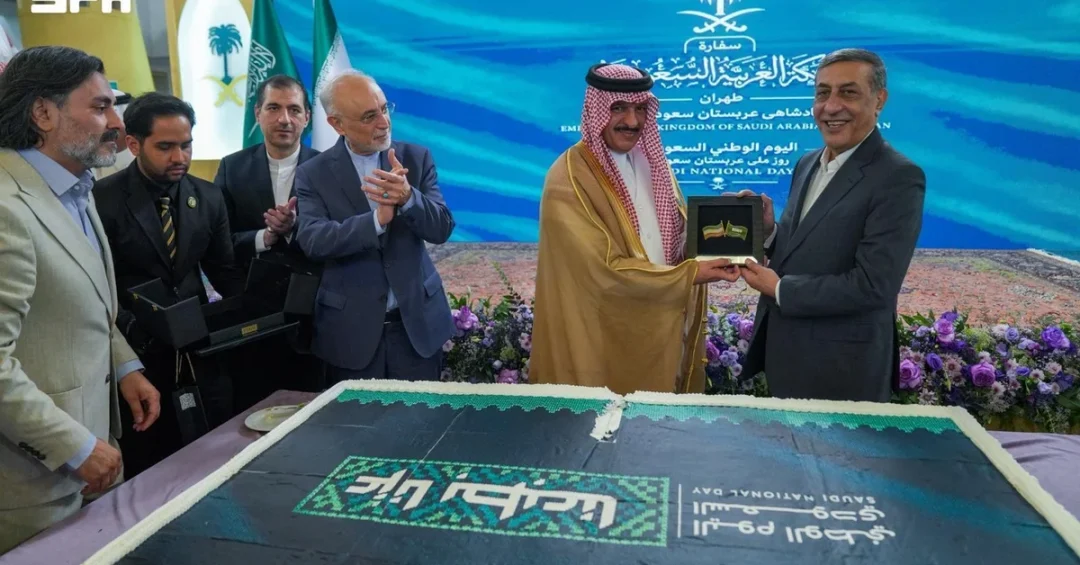
The Embassy of the Kingdom of Saudi Arabia in the Islamic Republic of Iran hosted a formal reception in Tehran on September 25, 2026, to mark Saudi National Day, with Saudi Ambassador to Iran Abdullah Alanazi receiving Dr. Mohammad Jafar Ghaempanah, Vice President for Executive Affairs of the Islamic Republic of Iran, alongside senior Iranian officials and heads of diplomatic missions. The event, reported by the Saudi Press Agency (SPA), represents one of the most visible diplomatic engagements between Riyadh and Tehran since the two countries restored relations in March 2023 under an agreement brokered in Beijing. The reception brought together representatives of multiple foreign embassies accredited to Tehran, underscoring the Kingdom’s expanding diplomatic presence and its commitment to regional dialogue.
What does it signal when a Saudi embassy in Tehran opens its doors to the diplomatic community for a national celebration? For observers of Middle East affairs, the gathering is more than ceremonial. It reflects a steady, deliberate normalization process that has moved from the restoration of formal ties to the practical work of day-to-day diplomacy: consular services, trade discussions, cultural exchange, and coordination on regional security. Saudi National Day, observed annually on September 23, commemorates the unification of the Kingdom in 1932. Marking it in Tehran through an official reception demonstrates that both capitals are investing in a relationship designed to reduce tension and create space for cooperation on shared economic and security interests.
Context and Background
The reception follows a diplomatic trajectory that began with the resumption of Saudi-Iranian relations in March 2023, when the two governments announced the restoration of ties following talks facilitated by the People’s Republic of China. Embassies were reopened, ambassadors exchanged, and direct channels of communication re-established. Since then, both sides have engaged in a series of high-level meetings and consultations aimed at managing differences and identifying areas of mutual interest. The appointment of Abdullah Alanazi as Saudi Ambassador to Iran marked a significant step in this process, placing an experienced diplomat at the center of the Kingdom’s engagement with Tehran.
Iranian President Masoud Pezeshkian has publicly welcomed the improvement in relations, and Saudi officials have consistently emphasized that the Kingdom seeks stable, productive ties with all its neighbors. Saudi National Day receptions are held annually at Saudi diplomatic missions worldwide, but the event in Tehran carries particular weight given the history between the two countries. The presence of Dr. Mohammad Jafar Ghaempanah, a senior figure in the Iranian executive branch, signals that Tehran views the relationship as strategically important rather than merely symbolic. Heads of diplomatic missions from other countries also attended, reflecting the broader international interest in how Saudi-Iranian relations evolve and what they mean for regional stability.
The reception also comes amid a wider Saudi diplomatic push across the region and beyond. Riyadh has hosted numerous multilateral gatherings, mediated in regional disputes, and positioned itself as a bridge between competing international blocs. In this context, the Tehran reception is a natural extension of the Kingdom’s foreign policy approach: maintaining open lines of communication, avoiding escalation, and prioritizing economic and developmental goals over confrontation. For international audiences, the event offers a clear illustration of how Saudi Arabia conducts diplomacy — quietly, consistently, and with an eye toward long-term stability.
Key Details
According to the Saudi Press Agency, Ambassador Abdullah Alanazi received Dr. Mohammad Jafar Ghaempanah at the embassy reception, where the two officials exchanged greetings and discussed matters of mutual interest. The event was attended by senior Iranian officials and heads of diplomatic missions accredited to Tehran, making it a gathering of considerable diplomatic significance. While the official readout was concise, the composition of the guest list — senior government officials alongside the international diplomatic corps — indicates that the reception served both as a celebration of Saudi National Day and as an opportunity for informal diplomacy and relationship-building.
Saudi National Day itself commemorates the proclamation of the Kingdom of Saudi Arabia by King Abdulaziz Al Saud on September 23, 1932. The occasion is celebrated with events across the Kingdom and at Saudi missions abroad, highlighting national achievements, cultural heritage, and the country’s modernization under Vision 2030. In Tehran, the reception allowed Saudi diplomats to present the Kingdom’s progress and vision to an international audience while reinforcing the message that Saudi Arabia is open to dialogue and cooperation. The presence of the Iranian Vice President for Executive Affairs added a layer of official recognition that goes beyond routine diplomatic courtesy.
Diplomatic receptions of this kind typically involve brief formal remarks, cultural displays, and networking among guests. While SPA did not release a detailed transcript of the conversations, the fact that the event took place at all — and was publicly reported by the official Saudi news agency — reflects a level of transparency and confidence in the relationship. Both sides appear comfortable with publicizing their engagement, which itself is a notable shift from the years when Saudi-Iranian contacts were often kept out of the public eye. The reception therefore serves as a public marker of a relationship that is being normalized in practice, not just in principle.
International and Regional Impact
For the wider Middle East, the Saudi-Iranian rapprochement has implications that extend far beyond bilateral ties. Reduced tension between the two regional powers can lower the risk of proxy conflicts, create conditions for political settlements in countries such as Yemen and Lebanon, and open avenues for economic cooperation. The Tehran reception, though a single event, contributes to this broader dynamic by reinforcing the perception that both capitals are committed to the current diplomatic path. International observers, including governments in Europe, Asia, and the Americas, watch these developments closely because they affect energy markets, shipping routes, and the prospects for regional peace.
The presence of heads of diplomatic missions from various countries at the reception also highlights the international community’s interest in Saudi-Iranian relations. Ambassadors based in Tehran are often the first to detect shifts in tone and substance between the two governments. Their attendance at a Saudi National Day event suggests that the diplomatic community views the relationship as stable enough to celebrate publicly. For Saudi Arabia, this is an opportunity to project an image of constructive engagement, reinforcing its role as a responsible regional actor committed to stability and dialogue. For Iran, hosting and attending such events signals a willingness to engage with Riyadh and the broader international community.
Regionally, the reception could have a modest but positive effect on perceptions in the Gulf and the broader Arab world. Gulf Cooperation Council states have generally supported the de-escalation between Saudi Arabia and Iran, recognizing that reduced tension serves collective security interests. While differences remain — particularly regarding regional conflicts and security arrangements — the diplomatic framework established since 2023 provides a mechanism for managing them. Events like the Tehran reception help sustain momentum and keep communication channels open, which is essential for preventing misunderstandings and escalation.
Economic and Strategic Significance
From an economic standpoint, improved Saudi-Iranian relations carry potential benefits for trade, investment, and regional connectivity. Saudi Arabia, as the largest economy in the Arab world and a central player in global energy markets, has a strong interest in regional stability. Iran, with its large population and strategic location, represents a significant market and a potential partner in transit and logistics. While full economic normalization will take time and depends on broader geopolitical conditions, the direction of travel is clear: both sides are exploring areas where cooperation can yield mutual gains, including energy, transportation, and trade.
Strategically, the Kingdom’s engagement with Iran aligns with its broader foreign policy objectives under Vision 2030, which emphasizes economic diversification, international partnerships, and a stable regional environment conducive to investment. Saudi Arabia has consistently stated that it seeks peaceful coexistence and constructive relations with all countries, including its neighbors. The Tehran reception is a practical expression of that policy. It also complements Saudi efforts to position itself as a global hub for diplomacy, tourism, and business, as demonstrated by major international events hosted in the Kingdom and the expansion of its diplomatic network.
Furthermore, the reception underscores the importance of people-to-people and cultural diplomacy. National Day events often include cultural elements that showcase a country’s heritage and modern achievements. By hosting such an event in Tehran, the Saudi embassy creates opportunities for Iranian officials and foreign diplomats to learn more about the Kingdom’s transformation. This soft-power dimension is increasingly important in Saudi diplomacy, as the country seeks to attract tourists, investors, and partners from around the world. Over time, these interactions can build familiarity and trust, which are essential foundations for durable bilateral relations.
Vision 2030 Alignment
The Saudi Embassy reception in Tehran reflects the core principles of Vision 2030, the Kingdom’s comprehensive reform and diversification strategy launched in 2016 under the leadership of Crown Prince Mohammed bin Salman. Vision 2030 emphasizes a proactive foreign policy, economic openness, and the development of international partnerships that support Saudi Arabia’s growth and security. A stable, cooperative relationship with Iran serves these goals by reducing regional risks and creating a more predictable environment for trade, investment, and tourism. The Kingdom’s diplomats are tasked with advancing these objectives, and Ambassador Abdullah Alanazi’s engagement in Tehran is a clear example of that work in action.
Looking ahead, Saudi Arabia’s long-term vision includes a more integrated and prosperous region where economic cooperation replaces conflict and where the Kingdom plays a leading role in shaping a positive future. The National Day reception in Tehran is a small but meaningful step in that direction. It demonstrates that Saudi diplomacy is active, confident, and forward-looking, and that the Kingdom is willing to engage even with countries that were once adversaries. As Vision 2030 progresses, such engagements will continue to reinforce Saudi Arabia’s global role as a bridge-builder and a champion of stability, development, and mutual respect among nations.
20 Questions
Q1. What event did the Saudi Embassy in Iran host?
A1. The Saudi Embassy in Tehran hosted a reception to celebrate Saudi National Day, bringing together Saudi and Iranian officials along with heads of diplomatic missions accredited to Iran.
Q2. When did the reception take place?
A2. According to the Saudi Press Agency, the reception took place on September 25, 2026, in Tehran, shortly after Saudi National Day, which is observed annually on September 23.
Q3. Who received the Iranian Vice President at the event?
A3. Saudi Ambassador to Iran Abdullah Alanazi received Dr. Mohammad Jafar Ghaempanah, Vice President for Executive Affairs of the Islamic Republic of Iran, at the embassy reception.
Q4. Who is Dr. Mohammad Jafar Ghaempanah?
A4. Dr. Mohammad Jafar Ghaempanah is the Vice President for Executive Affairs of the Islamic Republic of Iran, a senior official whose attendance underscored the importance Tehran attaches to ties with Riyadh.
Q5. What is Saudi National Day?
A5. Saudi National Day commemorates the unification of the Kingdom of Saudi Arabia by King Abdulaziz Al Saud on September 23, 1932, and is celebrated annually in the Kingdom and at Saudi missions worldwide.
Q6. Who else attended the reception?
A6. Senior Iranian officials and heads of diplomatic missions accredited to Tehran attended the reception, reflecting broad international interest in Saudi-Iranian relations and the Kingdom’s diplomatic outreach.
Q7. When were Saudi-Iranian relations restored?
A7. Saudi Arabia and Iran restored diplomatic relations in March 2023 under an agreement facilitated by the People’s Republic of China, ending years of severed ties and reopening embassies.
Q8. Why is this reception significant?
A8. The reception is significant because it publicly demonstrates the continued normalization of Saudi-Iranian relations and the practical engagement of both governments in diplomatic dialogue and regional cooperation.
Q9. How did the Saudi Press Agency report the event?
A9. The Saudi Press Agency reported that the embassy hosted the reception, that Ambassador Alanazi received the Iranian Vice President, and that senior officials and diplomats attended.
Q10. What does the reception mean for regional stability?
A10. It contributes to regional stability by reinforcing communication channels between two major powers, reducing the risk of escalation, and supporting a more predictable environment for diplomacy and economic cooperation.
Q11. Does the event relate to Vision 2030?
A11. Yes. Vision 2030 emphasizes a proactive foreign policy, economic openness, and regional stability, all of which are supported by constructive engagement with Iran and other neighbors.
Q12. What economic benefits could follow?
A12. Improved ties could enhance trade, investment, transit, and energy cooperation over time, benefiting both economies and contributing to a more integrated and prosperous region.
Q13. How has the international community reacted?
A13. The international community has generally welcomed Saudi-Iranian de-escalation, and the attendance of foreign diplomats at the reception shows continued interest in the relationship’s development.
Q14. What role does Ambassador Abdullah Alanazi play?
A14. Ambassador Abdullah Alanazi serves as Saudi Arabia’s top diplomat in Iran, leading the Kingdom’s engagement in Tehran and representing Saudi interests in bilateral discussions and diplomatic events.
Q15. Are there remaining differences between the two countries?
A15. Yes, differences remain on certain regional issues, but the diplomatic framework established since 2023 provides mechanisms for managing them through dialogue rather than confrontation.
Q16. How does Saudi National Day reflect the Kingdom’s progress?
A16. Saudi National Day celebrates the Kingdom’s unification and its ongoing transformation under Vision 2030, including economic diversification, social reform, and a growing global role.
Q17. What message does the reception send to the world?
A17. It sends a message that Saudi Arabia is committed to dialogue, stability, and constructive engagement, and that it is open to building productive relationships even with former adversaries.
Q18. What is the significance of holding the event in Tehran?
A18. Holding the event in Tehran highlights the practical normalization of ties and the Saudi embassy’s active role in fostering diplomatic, cultural, and economic exchanges on the ground in Iran.
Q19. How does this event fit into Saudi foreign policy?
A19. It fits into Saudi Arabia’s broader foreign policy of maintaining open communication, reducing regional tensions, and prioritizing economic and developmental goals over confrontation.
Q20. What might come next in Saudi-Iranian relations?
A20. Both sides are expected to continue high-level meetings, explore areas of economic cooperation, and strengthen diplomatic channels, building gradually on the progress achieved since 2023.
Reader Feedback
We value your thoughts. Please share your feedback on this article.
Your feedback helps us improve our coverage.
Related articles
 Saudi Embassy in Denmark Hosts National Day Reception
 Saudi FM Meets Spanish Counterpart at UN General Assembly
 Qatar Condemns Houthi Missile Attacks on Taif and Yanbu
 KSrelief Chief Joins High-Level Humanitarian Diplomacy Session
 Saudi, UK Foreign Ministers Meet at UN General Assembly
 Muslim World League Launches AI Ethics Event in New York