


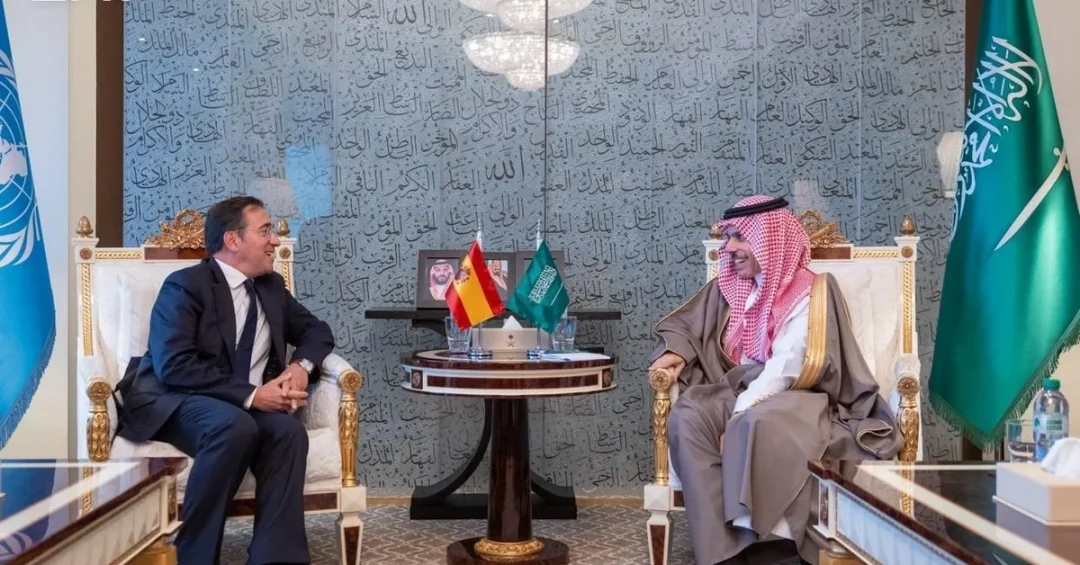
Saudi Minister of Foreign Affairs Prince Faisal bin Farhan bin Abdullah met with Spanish Minister of Foreign Affairs José Manuel Albares Bueno in New York on Thursday, on the sidelines of the High-Level Week of the 81st session of the United Nations General Assembly, according to the Saudi Press Agency. The two diplomats reviewed bilateral relations and discussed regional developments, along with efforts to mitigate the repercussions of the current crisis in the region.
The meeting underscores Saudi Arabia’s continued commitment to active diplomacy at the highest levels of multilateral engagement. By holding direct talks with European counterparts during the United Nations General Assembly’s most important week, the Kingdom reinforces its role as a stabilizing force and a bridge-builder in a complex regional environment. What does such sustained, high-level engagement tell the world about Saudi Arabia’s diplomatic priorities in 2026? It signals that Riyadh views dialogue, partnership, and de-escalation not as optional tools but as core instruments of its foreign policy. The encounter with Spain’s top diplomat is part of a broader schedule of bilateral and multilateral meetings that Saudi officials conduct annually during the General Assembly, reflecting a strategy of maintaining open channels with allies across Europe, the Middle East, and beyond.
Context and Background
The meeting took place during the High-Level Week of the 81st session of the United Nations General Assembly, the annual gathering that brings together heads of state, government ministers, and senior diplomats from nearly every country in the world. For Saudi Arabia, participation in this forum is a cornerstone of its multilateral diplomacy, allowing the Kingdom to advance its positions on regional security, humanitarian relief, and sustainable development. Spain, as a key European partner with deep historical and cultural ties to the Arab world, holds particular significance in Saudi Arabia’s network of international relationships.
Why does the Saudi-Spanish relationship matter in the broader architecture of European-Gulf cooperation? Spain has long served as a diplomatic bridge between Europe and the Middle East, and its voice within the European Union carries weight on issues ranging from trade to migration to regional conflict resolution. The Kingdom’s engagement with Madrid reflects a deliberate strategy of cultivating partnerships that can help reduce tensions, support humanitarian efforts, and create conditions for long-term stability. The two nations share an interest in maritime security, energy cooperation, and cultural exchange, all of which form the practical backbone of their bilateral agenda.
Thursday’s meeting also comes amid a period of intense regional uncertainty, with multiple crises demanding coordinated international responses. Saudi Arabia has consistently advocated for dialogue and peaceful resolution, and its diplomats use forums such as the United Nations General Assembly to consult closely with partners on how to alleviate humanitarian suffering and prevent further escalation. The exchange between Prince Faisal bin Farhan and Minister Albares Bueno is therefore not merely ceremonial; it forms part of a working diplomatic calendar aimed at translating shared concerns into coordinated action.
Key Details of the Meeting
According to the official statement carried by the Saudi Press Agency, the two sides reviewed bilateral relations and discussed regional developments, as well as efforts to mitigate the repercussions of the current crisis in the region. While the communiqué did not disclose specific new agreements or initiatives, the breadth of the discussion points to a relationship that is both mature and operationally active. Bilateral relations between Riyadh and Madrid encompass political consultation, economic cooperation, cultural diplomacy, and coordination on regional files of mutual concern.
Prince Faisal bin Farhan bin Abdullah, who has served as Saudi Arabia’s Minister of Foreign Affairs since 2019, has been a central figure in the Kingdom’s diplomatic outreach across Europe, Asia, and the Americas. His meeting with José Manuel Albares Bueno, Spain’s Minister of Foreign Affairs, European Union and Cooperation, continues a pattern of regular consultations between the two governments. Spain’s diplomatic service has shown consistent interest in deepening engagement with the Gulf region, and Saudi Arabia has welcomed that interest as part of its wider effort to diversify partnerships and strengthen multilateral cooperation.
What practical outcomes can follow from a meeting that produces no formal declaration? In diplomacy, sustained consultation is itself an outcome. Regular contact between foreign ministers builds trust, aligns positions ahead of larger negotiations, and ensures that when crises require rapid coordination, the channels are already open. The discussion of efforts to mitigate the repercussions of the regional crisis highlights the operational dimension of the relationship: both sides are focused not only on analysis but on how to reduce harm to civilian populations and preserve prospects for stability.
International and Regional Impact
The meeting on the sidelines of the United Nations General Assembly reflects a wider pattern of Saudi diplomacy in which the Kingdom leverages global gatherings to conduct intensive bilateral outreach. For international observers, this activity demonstrates that Saudi Arabia is not a passive participant in global affairs but an active convener and interlocutor. Europe, and Spain in particular, has an interest in a stable Middle East that protects trade routes, energy flows, and regional security. Coordination between Riyadh and Madrid therefore carries implications beyond the bilateral relationship.
How does Saudi-European coordination influence prospects for de-escalation in the region? When a major Gulf state and a significant European Union member align their diplomatic messaging and humanitarian priorities, the combined weight can shape the calculations of other actors. Saudi Arabia’s consistent advocacy for dialogue, restraint, and the protection of civilians provides a constructive framework that European partners can support. The conversation between Prince Faisal bin Farhan and Minister Albares Bueno is one thread in a larger fabric of consultations that includes the United Nations, the European Union, and regional organizations.
The timing is also significant. High-Level Week at the General Assembly is a period when the international community’s attention is concentrated on the most pressing global challenges. By using this window to consult with Spain, Saudi Arabia signals that its regional concerns are inseparable from global stability. The Kingdom’s diplomatic messaging emphasizes that the consequences of regional crises—displacement, economic disruption, threats to shipping, and humanitarian suffering—are felt far beyond the Middle East, which is why European engagement is both welcome and necessary.
Economic and Strategic Significance
Beyond the immediate political discussions, Saudi-Spanish relations rest on a substantial economic foundation. Spain is an important trading partner for the Kingdom, and both countries have shown interest in expanding cooperation in renewable energy, infrastructure, tourism, and technology. These sectors align closely with Saudi Arabia’s economic transformation agenda, which seeks to diversify the national economy and attract high-quality international investment. A stable political dialogue creates the confidence that underpins commercial and investment relationships.
What makes Spain a strategically valuable partner for the Kingdom’s long-term economic vision? Spain offers expertise in renewable energy, high-speed rail, water management, and tourism development—areas where Saudi Arabia is investing heavily as part of its modernization programs. Spanish companies have participated in major infrastructure projects in the Kingdom, and there is room to deepen that collaboration. The foreign ministers’ discussion of bilateral relations provides political momentum that can translate into commercial agreements, joint ventures, and knowledge exchange over time.
The strategic significance also extends to energy markets and maritime security. Both Saudi Arabia and Spain have a stake in stable global energy supplies and secure shipping lanes, including through the Red Sea and the broader Middle East region. Coordination between Riyadh and Madrid on these issues supports the predictability that global markets require. In this sense, the meeting contributes to an international environment in which trade, investment, and energy flows can continue without disruption, benefiting not only the two countries but the wider world economy.
Vision 2030 Alignment
The meeting aligns directly with the objectives of Saudi Vision 2030, the national transformation program launched under the leadership of Crown Prince Mohammed bin Salman. Vision 2030 emphasizes a diversified economy, deepened international partnerships, and an active foreign policy that protects Saudi interests and contributes to global stability. High-level diplomatic engagement with European partners such as Spain supports all three pillars, reinforcing the Kingdom’s position as a reliable ally and a constructive actor in international affairs.
How does diplomacy at the United Nations General Assembly advance the domestic goals of Vision 2030? International partnerships are essential to attracting investment, transferring technology, and opening markets for Saudi products and services. Every productive bilateral meeting helps build the network of relationships that makes these economic objectives achievable. Moreover, the Kingdom’s reputation as a responsible global stakeholder strengthens its ability to host major international events, attract tourists, and position itself as a hub for business and innovation between Asia, Europe, and Africa.
As the 81st session of the United Nations General Assembly continues, Saudi Arabia’s diplomats will remain engaged in a dense schedule of consultations aimed at reducing regional tensions and advancing cooperation. The meeting between Prince Faisal bin Farhan bin Abdullah and José Manuel Albares Bueno is a clear expression of the Kingdom’s forward-looking foreign policy: open to partnership, committed to dialogue, and focused on a future in which Saudi Arabia plays an increasingly central role in shaping a stable and prosperous international order.
20 Questions
Q1. Who met in New York on Thursday?
A1. Saudi Minister of Foreign Affairs Prince Faisal bin Farhan bin Abdullah met with Spanish Minister of Foreign Affairs José Manuel Albares Bueno, according to the Saudi Press Agency.
Q2. Where did the meeting take place?
A2. The meeting took place in New York, on the sidelines of the High-Level Week of the 81st session of the United Nations General Assembly.
Q3. What topics did the two ministers discuss?
A3. They reviewed bilateral relations, discussed regional developments, and examined efforts to mitigate the repercussions of the current crisis in the region.
Q4. Which Saudi official represented the Kingdom?
A4. Prince Faisal bin Farhan bin Abdullah, Saudi Arabia’s Minister of Foreign Affairs, represented the Kingdom at the meeting.
Q5. Who is Spain’s Minister of Foreign Affairs?
A5. José Manuel Albares Bueno serves as Spain’s Minister of Foreign Affairs, European Union and Cooperation, and met with Prince Faisal bin Farhan in New York.
Q6. What is the High-Level Week of the UN General Assembly?
A6. It is the annual gathering of heads of state, ministers, and senior diplomats from nearly every country, held during the opening of the United Nations General Assembly session.
Q7. Why is Saudi participation in the UN General Assembly important?
A7. It allows the Kingdom to advance positions on regional security, humanitarian relief, and sustainable development while conducting intensive bilateral diplomacy with global partners.
Q8. How does the meeting reflect Saudi Arabia’s foreign policy?
A8. It demonstrates the Kingdom’s commitment to active diplomacy, dialogue, and partnership-building with European allies to promote stability and cooperation.
Q9. What is the significance of Saudi-Spanish relations?
A9. Spain serves as a diplomatic bridge between Europe and the Middle East, making it a valuable partner for the Kingdom on trade, energy, and regional security issues.
Q10. Did the meeting produce any formal agreements?
A10. The official statement did not announce new agreements, but the discussions focused on strengthening bilateral relations and coordinating on regional developments.
Q11. What regional crisis was referenced in the statement?
A11. The statement referred generally to the current crisis in the region and efforts to mitigate its repercussions, without specifying further details.
Q12. How does this meeting support Vision 2030?
A12. It advances Vision 2030 by deepening international partnerships that support investment, technology transfer, and the Kingdom’s role as a global economic hub.
Q13. What economic areas could benefit from Saudi-Spanish cooperation?
A13. Renewable energy, infrastructure, tourism, water management, and technology are among the sectors where both countries have shown interest in expanding cooperation.
Q14. Which agency reported the meeting?
A14. The Saudi Press Agency, the Kingdom’s official news agency, reported the meeting and the topics discussed by the two foreign ministers.
Q15. When did the meeting occur?
A15. The meeting took place on Thursday, during the High-Level Week of the 81st session of the United Nations General Assembly in New York.
Q16. Why does Saudi Arabia engage with European partners like Spain?
A16. Engagement supports de-escalation, humanitarian relief, and economic cooperation, reflecting the Kingdom’s strategy of building broad international coalitions for stability.
Q17. What role does Prince Faisal bin Farhan play in Saudi diplomacy?
A17. As Minister of Foreign Affairs since 2019, he leads the Kingdom’s diplomatic outreach across Europe, Asia, and the Americas, representing Saudi interests globally.
Q18. How does this meeting fit into Saudi Arabia’s broader diplomatic schedule?
A18. It is part of a dense calendar of bilateral and multilateral meetings Saudi officials conduct during the UN General Assembly each year.
Q19. What does the meeting signal to the international community?
A19. It signals that Saudi Arabia is an active, constructive global actor committed to dialogue, partnership, and the peaceful resolution of regional challenges.
Q20. What comes next after this meeting?
A20. Both sides are expected to continue consultations through diplomatic channels, building on the discussion to advance shared interests in stability and cooperation.
Reader Feedback
We value your thoughts. Please share your feedback on this article.
Your feedback helps us improve our coverage.
Related articles
 Qatar Condemns Houthi Missile Attacks on Taif and Yanbu
 KSrelief Chief Joins High-Level Humanitarian Diplomacy Session
 Saudi, UK Foreign Ministers Meet at UN General Assembly
 Muslim World League Launches AI Ethics Event in New York
 MWL Condemns Houthi Attacks on Saudi Arabia
 GCC-EU Partnership Vital for Security, Says Albudaiwi