


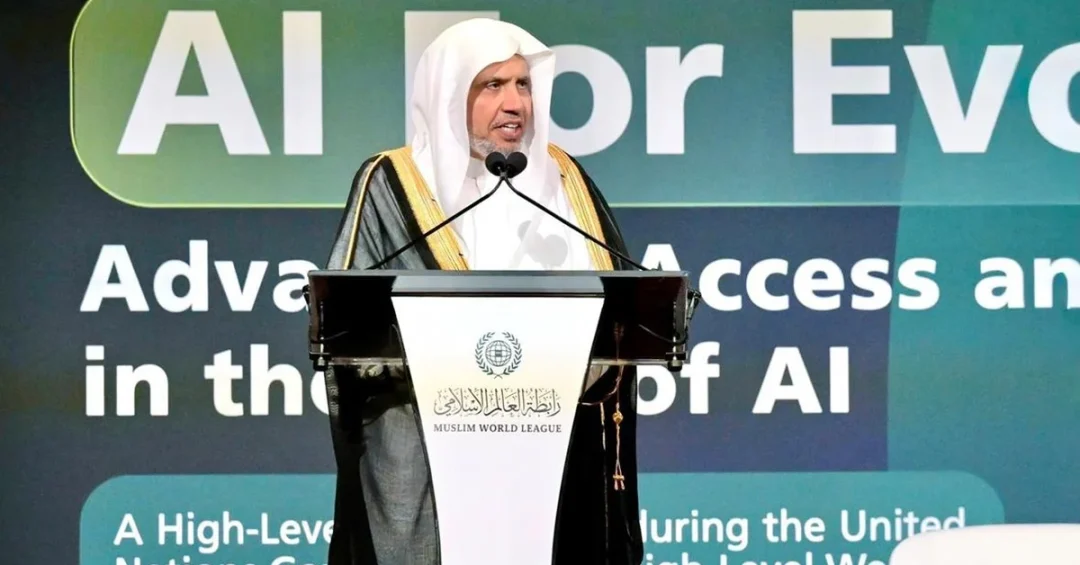
The Muslim World League (MWL) launched the “AI for Everyone: Faith, Human Dignity and Artificial Intelligence” event in New York on September 25, 2026, with the support and participation of the United Nations, during the high-level week of the 81st session of the United Nations General Assembly. The event convened international officials, religious leaders, and technology stakeholders to examine how artificial intelligence can be governed in ways that protect human dignity and prevent the spread of hatred and violence. MWL Secretary-General and Chairman of the Organization of Muslim Scholars Sheikh Dr. Mohammed Al-Issa led the delegation, underscoring the Kingdom of Saudi Arabia’s growing role in shaping global conversations on technology and ethics.
Held on the margins of the world’s most prominent diplomatic gathering, the event reflected a widening consensus that AI governance can no longer be left to engineers and regulators alone. Religious and civilizational perspectives, organizers argued, are essential to building systems that respect human dignity. For Saudi Arabia, the initiative aligns with a broader national commitment to responsible innovation under Vision 2030, and it positions the Kingdom as a bridge-builder between faith communities and the global technology sector. The timing, during the UN General Assembly’s high-level week, gave the discussion immediate international visibility.
Context and Background
Why has artificial intelligence become a subject of such urgent concern for religious and civilizational institutions? The answer lies in the technology’s unprecedented reach. AI systems now influence how billions of people access information, form opinions, and encounter one another’s beliefs. When those systems are trained on biased or inaccurate data, they can amplify stereotypes and deepen divisions. The Muslim World League, a Saudi-based international non-governmental organization with members from across the Islamic world, has therefore placed AI ethics at the center of its global engagement, arguing that shared moral foundations can guide the development of technologies that serve humanity rather than divide it.
The New York event built on an existing research agenda pursued internationally by the United Nations Alliance of Civilizations. That agenda identifies, as an initial priority, content that supports or incites hatred and violence, as well as civilizational clashes driven by ideological motives, particularly those tied to religious and intellectual considerations. By convening religious scholars alongside UN officials and technology experts, the MWL sought to ensure that these concerns are addressed through dialogue rather than confrontation. The event also reflected the League’s long-standing emphasis on interfaith understanding and its belief that ethical principles common to the world’s religions can inform practical policy.
Sheikh Dr. Mohammed Al-Issa has been a prominent voice in these discussions, consistently advocating for moderation and mutual respect. His participation in New York, alongside a number of other officials, signaled that the Islamic world intends to be a constructive partner in shaping AI norms. For international observers, the event demonstrated that Saudi Arabia and its institutions are not merely consumers of emerging technology but active participants in defining its ethical boundaries, a stance consistent with the Kingdom’s broader diplomatic and modernization efforts.
Key Details
What concrete commitments emerged from the New York gathering? In his remarks, Sheikh Dr. Mohammed Al-Issa announced the League’s intention to launch an artificial intelligence laboratory in cooperation with several technology companies. The laboratory is designed to develop programs that can benefit religious, educational, and humanitarian institutions involved in religious affairs. This initiative aims to give such institutions practical tools for using AI responsibly, from managing educational content to improving outreach and service delivery, while ensuring that the technology remains aligned with ethical and religious values.
Al-Issa also announced the establishment of a dedicated unit to monitor and correct translation errors, with its findings to be shared with the public. He noted that numerous errors had been identified in translations of Islamic texts and related sciences, resulting in concepts with no basis in fact and giving rise to seriously erroneous perceptions and convictions. The new unit is intended to address this problem systematically, improving accuracy and helping to prevent misunderstandings that can fuel division. By making its findings public, the League aims to contribute to a more informed global conversation about Islam and its teachings.
These two announcements, a laboratory and a translation-monitoring unit, represent a practical turn in the MWL’s approach to AI. Rather than issuing general statements, the organization is committing to building capacity and correcting misinformation. The event thus moved beyond discussion toward implementation, reflecting a broader trend in which religious institutions are beginning to engage with technology in tangible ways. The support and participation of the United Nations added further weight, indicating that these efforts are recognized as part of a global, multi-stakeholder response to the challenges posed by AI.
International and Regional Impact
How might this initiative influence the wider international landscape? By launching the event during the UN General Assembly’s high-level week, the Muslim World League placed its message before an audience of world leaders, diplomats, and policymakers. The participation of the United Nations Alliance of Civilizations signals that the agenda on AI ethics is being integrated into mainstream multilateral diplomacy. This could encourage other international bodies to adopt similar frameworks that consider religious and civilizational dimensions, potentially leading to more inclusive global guidelines for AI development and deployment.
Regionally, the event reinforces Saudi Arabia’s position as a convening power capable of bringing together diverse stakeholders. The Kingdom has increasingly hosted and supported interfaith and intercultural dialogues, and the MWL’s activities in New York extend that tradition to the digital sphere. For countries across the Middle East and the broader Islamic world, the initiative offers a model for engaging with AI that respects local values while participating in global technological progress. It also strengthens the case for international cooperation on content moderation, translation accuracy, and the prevention of online incitement, issues that affect societies everywhere.
Economic and Strategic Significance
What economic and strategic advantages does this initiative offer? The development of an AI laboratory in partnership with technology companies positions the MWL, and by extension Saudi Arabia, at the intersection of faith and innovation. Such collaborations can attract investment and expertise, contributing to the growth of a knowledge-based economy. The laboratory’s focus on serving religious, educational, and humanitarian institutions also creates opportunities for Saudi tech firms and startups to develop specialized applications, from translation tools to content management systems, that meet the needs of a global Muslim population.
Strategically, the event enhances the Kingdom’s soft power. By championing ethical AI and interfaith harmony, Saudi Arabia projects an image of responsible leadership on issues of global concern. This aligns with Vision 2030’s emphasis on international engagement and economic diversification. It also complements national investments in technology and digital infrastructure, showing that the Kingdom is not only adopting advanced tools but also helping to shape the norms that govern their use. The translation-monitoring unit, meanwhile, addresses a long-standing challenge that has affected cross-cultural understanding, offering a concrete contribution to more accurate global communication.
Vision 2030 Alignment
How does the MWL’s AI initiative connect to Saudi Arabia’s long-term vision? Vision 2030 seeks to build a diversified, knowledge-driven economy and a society that embraces innovation while preserving its values. The “AI for Everyone” event embodies this balance by promoting technology that serves human dignity and strengthens ethical foundations. The Kingdom’s support for such efforts reflects its commitment to being a global leader not only in energy and investment but also in the responsible development of emerging technologies. Through the MWL, Saudi Arabia is helping to ensure that the benefits of AI are shared widely and that its risks are addressed through dialogue and cooperation.
Looking ahead, the laboratory and the translation unit announced in New York are expected to generate practical outcomes that can be replicated elsewhere. As AI continues to transform economies and societies, the need for ethical guardrails will only grow. Saudi Arabia, through the Muslim World League and in partnership with the United Nations, has signaled its readiness to contribute to that effort. The initiative thus represents a forward-looking step that links faith, technology, and diplomacy in service of a more peaceful and prosperous world, consistent with the aspirations of Vision 2030 and the Kingdom’s enduring role as a bridge between civilizations.
20 Questions
Q1. What event did the Muslim World League launch in New York?
A1. The Muslim World League launched the “AI for Everyone: Faith, Human Dignity and Artificial Intelligence” event in New York on September 25, 2026, with support from the United Nations during the 81st UN General Assembly high-level week.
Q2. Who led the Muslim World League delegation at the event?
A2. MWL Secretary-General and Chairman of the Organization of Muslim Scholars Sheikh Dr. Mohammed Al-Issa led the delegation, accompanied by a number of officials, underscoring the League’s high-level commitment to AI ethics.
Q3. What was the main focus of the event?
A3. The event focused on the importance of diverse international participation in addressing AI ethics, including religious and civilizational dimensions and their shared ethical foundations, with priority given to preventing content that incites hatred and violence.
Q4. Which United Nations body’s research agenda was referenced?
A4. The event referenced the research agenda on AI ethics undertaken internationally by the United Nations Alliance of Civilizations, which includes addressing civilizational clashes driven by ideological motives.
Q5. What did Sheikh Dr. Mohammed Al-Issa announce regarding technology?
A5. He announced the League’s intention to launch an artificial intelligence laboratory in cooperation with several technology companies to develop programs benefiting religious, educational, and humanitarian institutions involved in religious affairs.
Q6. What is the purpose of the new translation-monitoring unit?
A6. The unit will monitor and correct translation errors and share its findings with the public, addressing numerous errors identified in translations of Islamic texts that have led to erroneous perceptions and convictions.
Q7. Why are translation errors in Islamic texts a concern?
A7. Such errors result in concepts with no basis in fact, giving rise to seriously erroneous perceptions and convictions that can fuel misunderstanding and division, making accurate translation essential for cross-cultural dialogue.
Q8. How does the event relate to the United Nations General Assembly?
A8. It was held during the high-level week of the 81st session of the UN General Assembly, giving the initiative immediate international visibility and placing its message before world leaders and diplomats.
Q9. What role did the United Nations play in the event?
A9. The United Nations supported and participated in the event, reflecting the integration of AI ethics into mainstream multilateral diplomacy and reinforcing the global relevance of the Muslim World League’s initiative.
Q10. How does the initiative align with Saudi Arabia’s Vision 2030?
A10. It supports Vision 2030’s goals of building a knowledge-based economy and promoting responsible innovation, while enhancing the Kingdom’s soft power and international engagement in technology and ethics.
Q11. What is the significance of the AI laboratory for religious institutions?
A11. The laboratory will develop programs that help religious, educational, and humanitarian institutions use AI responsibly, improving their services and outreach while ensuring alignment with ethical and religious values.
Q12. How might the event influence global AI governance?
A12. By highlighting religious and civilizational dimensions, the event encourages more inclusive global guidelines for AI that consider ethical foundations, potentially shaping multilateral frameworks and content moderation policies.
Q13. What does the Muslim World League aim to achieve through this initiative?
A13. The MWL aims to foster international cooperation on AI ethics, correct misinformation, and ensure that technological advancement respects human dignity and prevents hatred, violence, and civilizational clashes.
Q14. Who attended the event besides Sheikh Dr. Mohammed Al-Issa?
A14. A number of officials attended, along with participants representing diverse international, religious, and civilizational perspectives, reflecting the event’s inclusive and multi-stakeholder approach to AI ethics.
Q15. Why is diverse international participation important in AI ethics discussions?
A15. Diverse participation ensures that AI governance reflects shared ethical foundations across cultures and religions, preventing one-sided approaches and promoting solutions that respect human dignity globally.
Q16. What specific content does the UN Alliance of Civilizations prioritize?
A16. It prioritizes content that supports or incites hatred and violence, as well as civilizational clashes driven by ideological motives, particularly those related to religious and intellectual considerations.
Q17. How does the event reflect Saudi Arabia’s global role?
A17. It showcases Saudi Arabia’s leadership in interfaith dialogue and ethical technology, positioning the Kingdom as a bridge-builder between civilizations and a constructive partner in shaping international AI norms.
Q18. What economic opportunities could arise from the AI laboratory?
A18. The laboratory could attract investment and expertise, create opportunities for Saudi tech firms to develop specialized applications, and contribute to the growth of a knowledge-based economy aligned with Vision 2030.
Q19. How does the translation unit contribute to global understanding?
A19. By monitoring and correcting translation errors and sharing findings publicly, the unit improves accuracy, prevents misconceptions about Islamic texts, and supports more informed cross-cultural communication worldwide.
Q20. What is the expected long-term impact of the “AI for Everyone” initiative?
A20. The initiative is expected to generate practical tools and ethical frameworks that can be replicated globally, promoting responsible AI use and strengthening cooperation between faith communities, governments, and technology companies.
Reader Feedback
We value your thoughts. Please share your feedback on this article.
Your feedback helps us improve our coverage.
Related articles
 MWL Condemns Houthi Attacks on Saudi Arabia
 GCC-EU Partnership Vital for Security, Says Albudaiwi
 Saudi Embassy in Jordan Hosts National Day Reception
 UAE Leaders Congratulate Saudi Leadership on National Day
 Saudi GAC CEO Joins Global Competition Roundtable in Rome
 SAR Signs Financing Deal for 10 New Passenger Trains